Restaurant Gary Danko menu, graded
A prix-fixe that quietly runs the whole playbook
Some menus need a behavioral overhaul. This one is closer to a finished proof: a room that opened in 1999 and engineers the choice without anyone noticing.
Menu-craft grade
Tiered courses that engineer the middle, round whole-dollar prices with no cents, a caviar anchor, curated build-your-own freedom and a tableside cheese cart that doubles as reassurance. It already runs the playbook.
Graded on how well the menu uses behavioral economics, not the food.
Menu and prices verified September 2026
A 3-minute audio read of the analysis
- Type
- Independent
- Where
- San Francisco, Fisherman's Wharf
- Cuisine
- Contemporary American / French
- Footprint
- 1 location
- Since
- 1999
- Ownership
- Chef-owned, James Beard winner
The mechanics, drawn
The same menu, mapped onto an axis, so the behavioral move is something you can see, not just read.
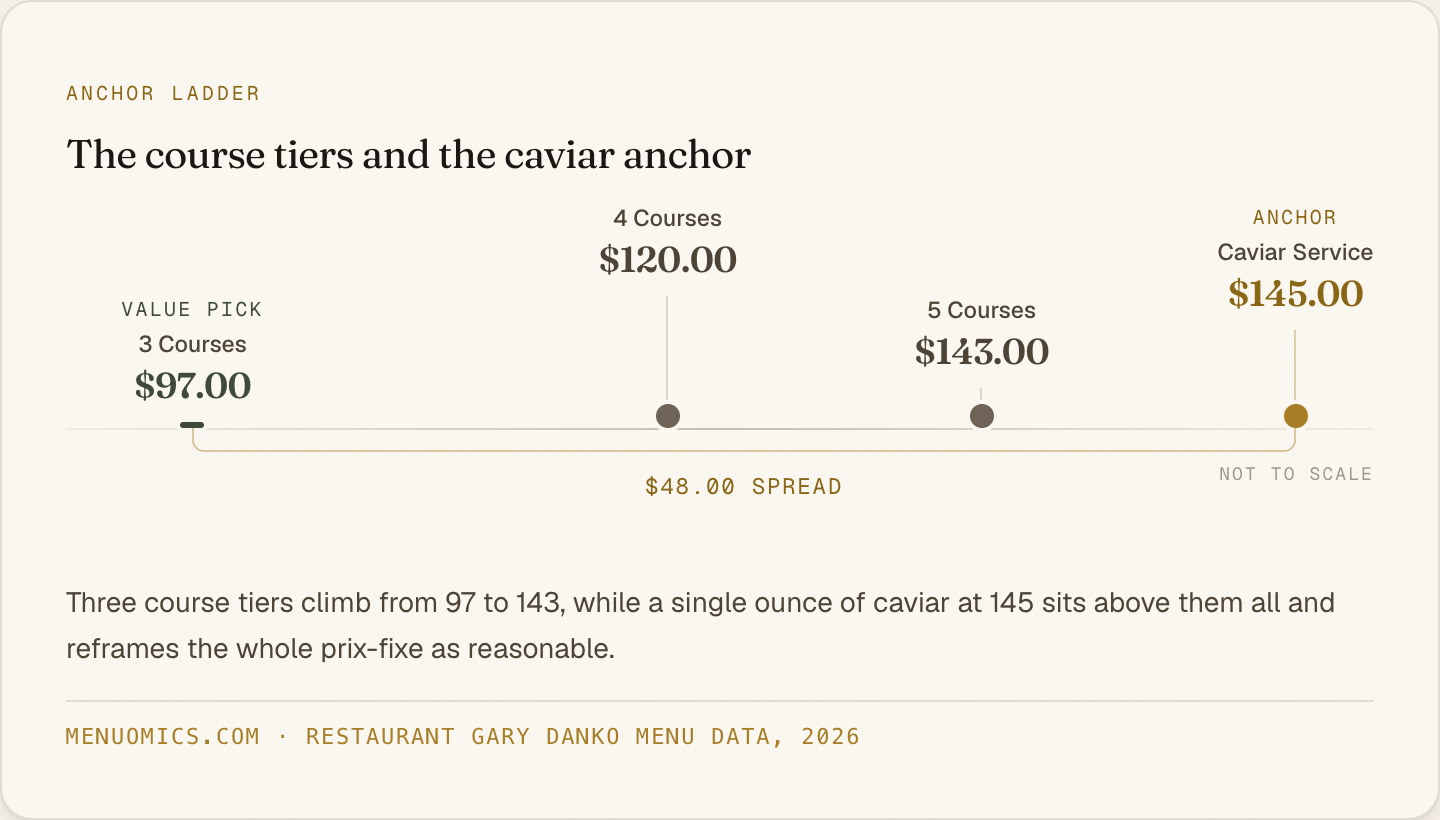
The course tiers and the caviar anchor
Three course tiers climb from 97 to 143, while a single ounce of caviar at 145 sits above them all and reframes the whole prix-fixe as reasonable.
Download this chart (PNG) · free to reuse with credit, see reuse terms.
The setup
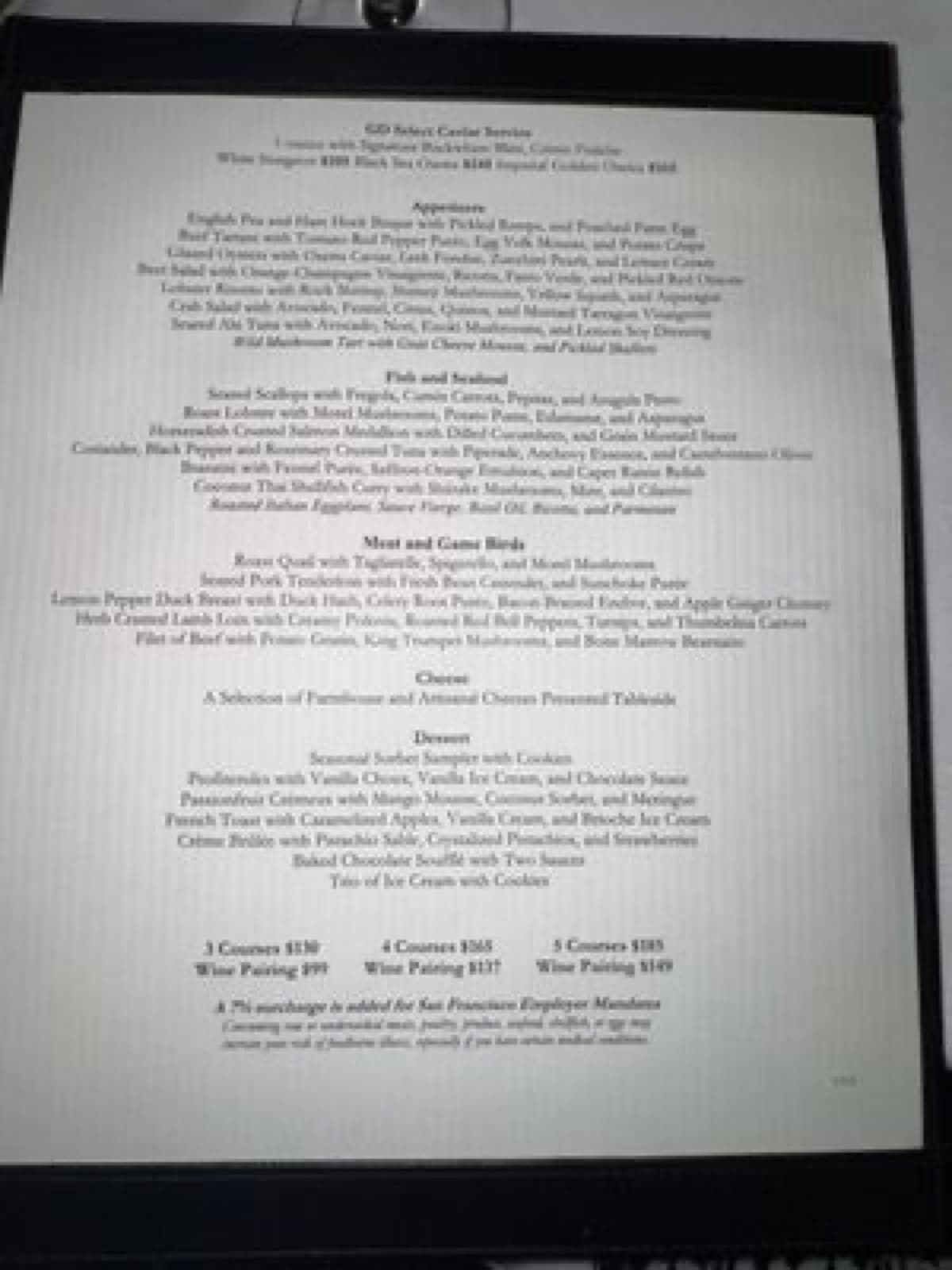
Gary Danko's menu is deceptively plain: pick 3, 4 or 5 courses ($97 / $120 / $143) from a single list of appetizers, fish and seafood, meat and game birds, cheese and dessert. The chef's-choice tasting is simply the 5-course price; there is no separate tasting tier. No photos, no exclamation points. It reads like restraint. It is actually a stack of behavioral levers, executed so smoothly they look like good taste.
If most of our breakdowns are 'here is what to change,' this one is closer to 'here is why it works,' and the two or three places even a master could push a little further.
What they get right
The behavioral economics already at work.
The 4-course is the engineered middle
Three tiers create a Goldilocks structure. Extremeness aversion pushes diners off the cheapest (3) and the priciest (5) toward the middle, and adding the 5-course option mathematically raises the 4-course's share. With the chef's tasting priced at the same 5-course $143, the top is capped, not extended.
a top tier shifted the middle's share ~20 points, Simonson & Tversky, 1992
Round whole-dollar prices, no cents
'$97,' not '$96.95.' The menu prints the dollar sign, but the prices are round whole numbers with no cents, and round numbers read as 'premium' where 9-endings read as 'discount.' Pricing dishes by course count, rather than per item, also mutes how many individual charges a diner is tallying. Exactly right for this room.
round-vs-charm pricing signals premium vs discount, Schindler & Naipaul on round-vs-charm pricing
Choose-your-own-courses is the format Sutherland loves
Rory Sutherland's favorite menu gives you a curated structure you're still free to deviate from. Danko's build-it-yourself prix-fixe does exactly that: it maximizes what he calls 'the feeling of having made a good decision.'
Sutherland on the Chapito set-menu; 'people maximise the feeling of having made a good decision'
The caviar service anchors the page
A Tsar Nicoulai Osetra Caviar Service at $105 / $125 / $145, sitting at the top of the menu, is a high anchor. Once a diner has seen a single ounce of caviar priced near the cost of a whole 5-course dinner, $97 to $143 for the full prix-fixe reads as reasonable by contrast. The anchor does its work whether or not anyone orders it.
an early high number reframes everything below it, anchoring; Tversky & Kahneman 1974
The cheese cart is a costly signal
Rolling 15 to 20 cheeses to the table nightly is theater you can see and choose from: it removes uncertainty and turns service into ceremony. Sutherland: the ritual is part of the flavor. The dessert course ends the meal on a high (the peak-end rule).
What we’d test
The rewrite, with the expected lift and the honest caveat.
Point at the middle
The tiering already favors the 4-course; a light wording touch, noting it as the most-chosen, or simply listing it first in the price line, would amplify on the page the compromise effect Danko already gets for free.
Expect More diners self-select the margin-friendly tier
Caveat Menu wording and ordering only; this room sells understatement, so keep the cue subtle.
A sentence of story on the signatures
The menu is a pure ingredient list. For one or two signatures, a short line of provenance or method in the dish copy can lift perceived value, the cleanest, best-evidenced naming effect there is.
Expect Higher perceived value on the hero dishes
Caveat Menu copy only; fine-dining diners prize restraint, so test one or two dishes, don't narrate the whole card.
Move the caviar anchor to the very top
If the caviar service is not already the first thing the eye lands on, leading the page with it sets the highest reference point before any course price is read, making the $97 to $143 tiers feel modest by comparison.
Expect Course prices read as more reasonable against the caviar anchor
Caveat Menu layout and ordering only; no change to dishes, prices or service.
What diners actually say
Synthesized from public reviews, the reality check that grounds every recommendation.
They praise
- Impeccable, personable service
- The cheese-cart ritual
- Consistency over decades
- Build-your-own flexibility
They criticize
- Feels 'dated' to some
- Cheese cart less lavish than it was
- Value questioned at the price
The verdict
Gary Danko is what the output of a behavioral-economics menu audit looks like when it is done right: tiered courses that engineer the middle, round whole-dollar prices with no cents, a caviar service that anchors the page, curated freedom and ritual that doubles as reassurance. The remaining gains are amplification and story: point harder at the middle tier, give a signature dish a line of provenance, and make sure the caviar anchor leads the page.
Common questions
- How much does dinner at Gary Danko cost?
- Gary Danko is a prix-fixe priced at $97 for 3 courses, $120 for 4, or $143 for 5, with no separate tasting tier. You build the meal from any section, and the chef's tasting is simply the 5-course price, so the top is capped at $143, not extended.
- Which Gary Danko course option is the best value?
- The 4-course at $120 is the engineered middle, and it earns the menu an A grade. Three tiers create a Goldilocks structure: extremeness aversion pushes diners off the cheapest 3-course and priciest 5-course toward the reasonable middle.
- Why does Gary Danko have caviar on the menu?
- The Tsar Nicoulai Osetra Caviar Service runs $105, $125 or $145 and sits at the top as a high anchor. Once a single ounce of caviar reads near the cost of a whole 5-course dinner, the $97 to $143 prix-fixe feels reasonable by contrast, whether anyone orders it or not.
- Why are Gary Danko's prices round whole dollars?
- Prices print as round whole dollars with no cents, '$97' rather than '$96.95,' because round numbers read as premium where 9-endings read as discount. Pricing by course count, not per dish, also mutes how many individual charges a diner is tallying.
Sources (7)
- Restaurant Gary Danko, official menu (PDF)
- Restaurant Gary Danko, menus
- SFist, Gary Danko loses its Michelin star (2024)
- Gary Danko, MICHELIN Guide (recommended, no star)
- Compromise / extremeness aversion, Simonson & Tversky, 1992
- Cornell, removing the “$” lifted spend ≈8%/person (Yang, Kimes & Sessarego, 2009)
- Rory Sutherland, “The presentation of choice” (the Chapito set menu)
Head to head
More breakdowns
A 1984 steakhouse at 2100 Van Ness Avenue that dry-ages its beef behind a streetside glass window, so the single best argument for the price is visible before you even sit down.
Read the Harris' Restaurant breakdown → Saint Frank CoffeeB+
An SF specialty roaster that prices a latte at a fine-coffee premium and justifies it with a story: named farms, tasting notes, and a 'relationship coffee' ethos that turns a cup into a cause.
Read the Saint Frank Coffee breakdown → Yank SingA-
A 1958 dim sum institution where you pick from a rolling cart by sight, plate by plate, and the bill quietly adds up.
Read the Yank Sing breakdown →A Michelin-starred Fillmore room where small plates roam by on dim-sum carts at $3 to $14 each, so you say yes one plate at a time and the check climbs on its own.
Read the State Bird Provisions breakdown → Zuni CafeA-
A 75.00 chicken that takes about 75 minutes, and the menu says so. A practical warning that also happens to reduce uncertainty, printed in the margin.
Read the Zuni Cafe breakdown → Pearl 6101B+
A neighborhood Outer Richmond Cal-Mediterranean restaurant from the Pizzetta 211 team, whose menu prints prices as bare round numbers with no dollar signs and no cents.
Read the Pearl 6101 breakdown →Your menu next
Get this for your own menu, free.
Send your menu and we’ll send back the same breakdown, what you get right, what we’d test, and why.
Zuni Cafe
A 75.00 chicken that takes about 75 minutes, and the menu says so. A practical warning that also happens to reduce uncertainty, printed in the margin.
Read it →