State Bird Provisions menu, graded
Sell one small plate at a time, hide the total, and the check writes itself.
State Bird Provisions runs the rare independent ticket-multiplier: a live cart, per-plate prices, no running total, and a short printed menu holding the anchors.
Menu-craft grade
A roving cart turns the menu into a live impulse machine: you say yes to one $3 to $14 plate at a time, with no running total in view, so the check accumulates naturally while a short printed list anchors the larger Commandables and the namesake quail.
Graded on how well the menu uses behavioral economics, not the food.
Menu and prices verified September 2026
A 3-minute audio read of the analysis
- Type
- Independent
- Where
- San Francisco, California
- Cuisine
- New American small plates
- Footprint
- 1 location
- Since
- 2011
- Ownership
- Chef-owners Stuart Brioza and Nicole Krasinski
The mechanics, drawn
The same menu, mapped onto an axis, so the behavioral move is something you can see, not just read.
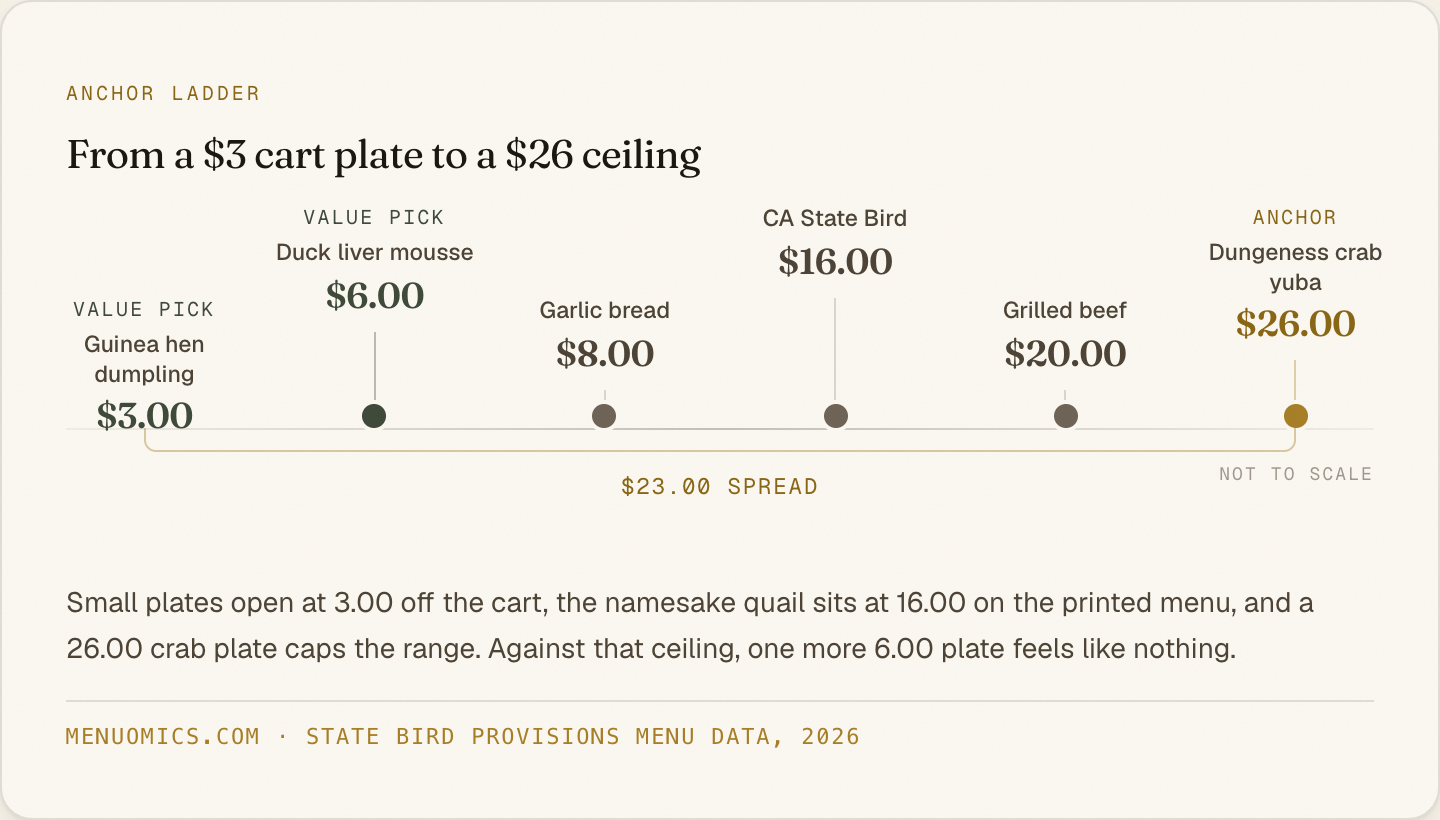
From a $3 cart plate to a $26 ceiling
Small plates open at 3.00 off the cart, the namesake quail sits at 16.00 on the printed menu, and a 26.00 crab plate caps the range. Against that ceiling, one more 6.00 plate feels like nothing.
Download this chart (PNG) · free to reuse with credit, see reuse terms.
The full ticket
What it actually rings up to.
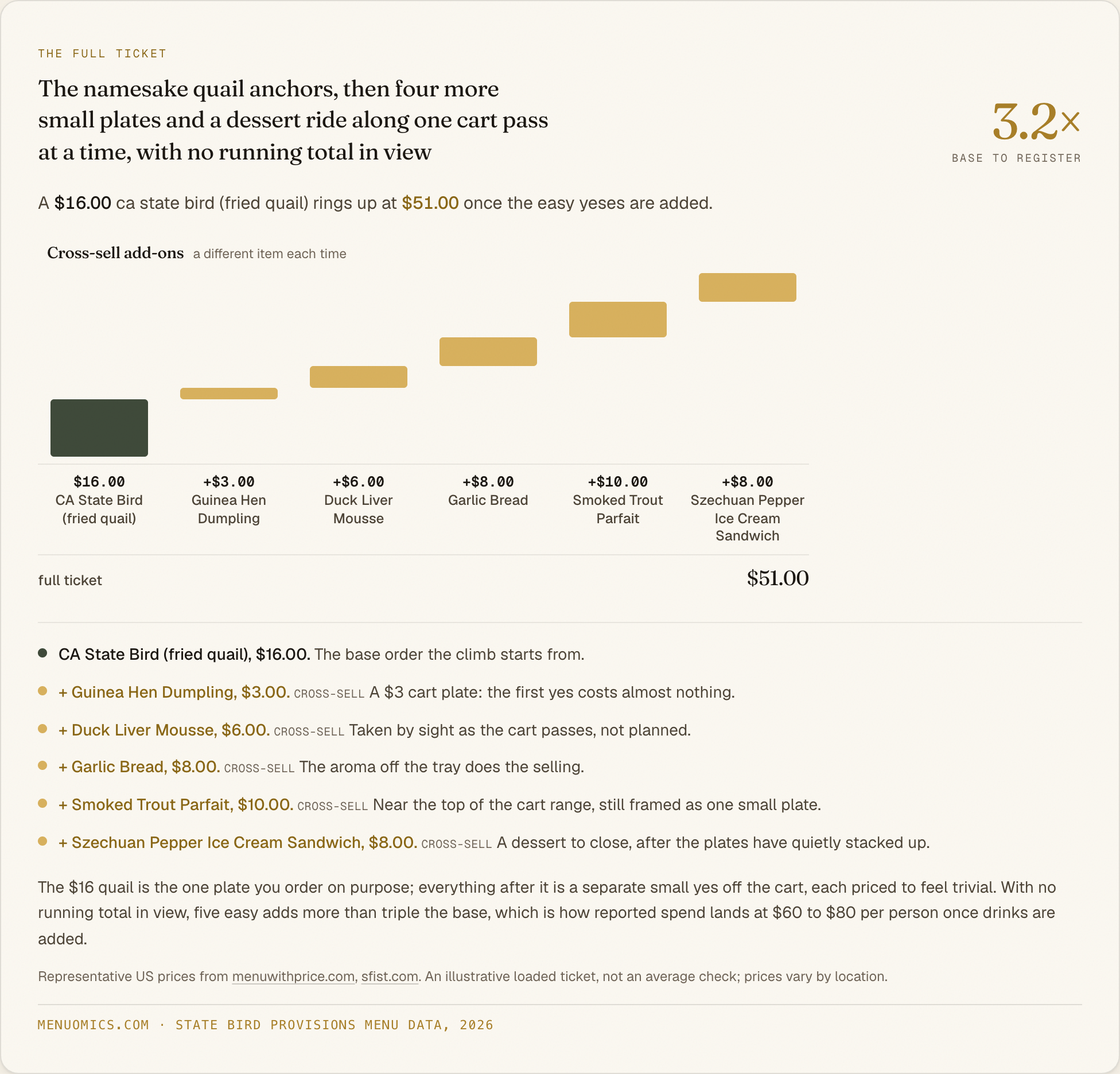
The headline price is only the start. The real number is the journey from a base order to the check at the register, one easy yes at a time.
The namesake quail anchors, then four more small plates and a dessert ride along one cart pass at a time, with no running total in view
A $16.00 ca state bird (fried quail) rings up at $51.00 once the easy yeses are added.
- CA State Bird (fried quail), $16.00. The base order the climb starts from.
- + Guinea Hen Dumpling, $3.00. cross-sell A $3 cart plate: the first yes costs almost nothing.
- + Duck Liver Mousse, $6.00. cross-sell Taken by sight as the cart passes, not planned.
- + Garlic Bread, $8.00. cross-sell The aroma off the tray does the selling.
- + Smoked Trout Parfait, $10.00. cross-sell Near the top of the cart range, still framed as one small plate.
- + Szechuan Pepper Ice Cream Sandwich, $8.00. cross-sell A dessert to close, after the plates have quietly stacked up.
The $16 quail is the one plate you order on purpose; everything after it is a separate small yes off the cart, each priced to feel trivial. With no running total in view, five easy adds more than triple the base, which is how reported spend lands at $60 to $80 per person once drinks are added.
Representative US prices from menuwithprice.com, sfist.com. An illustrative loaded ticket, not an average check; prices vary by location.
Download this chart (PNG) · free to reuse with credit, see reuse terms.
The setup
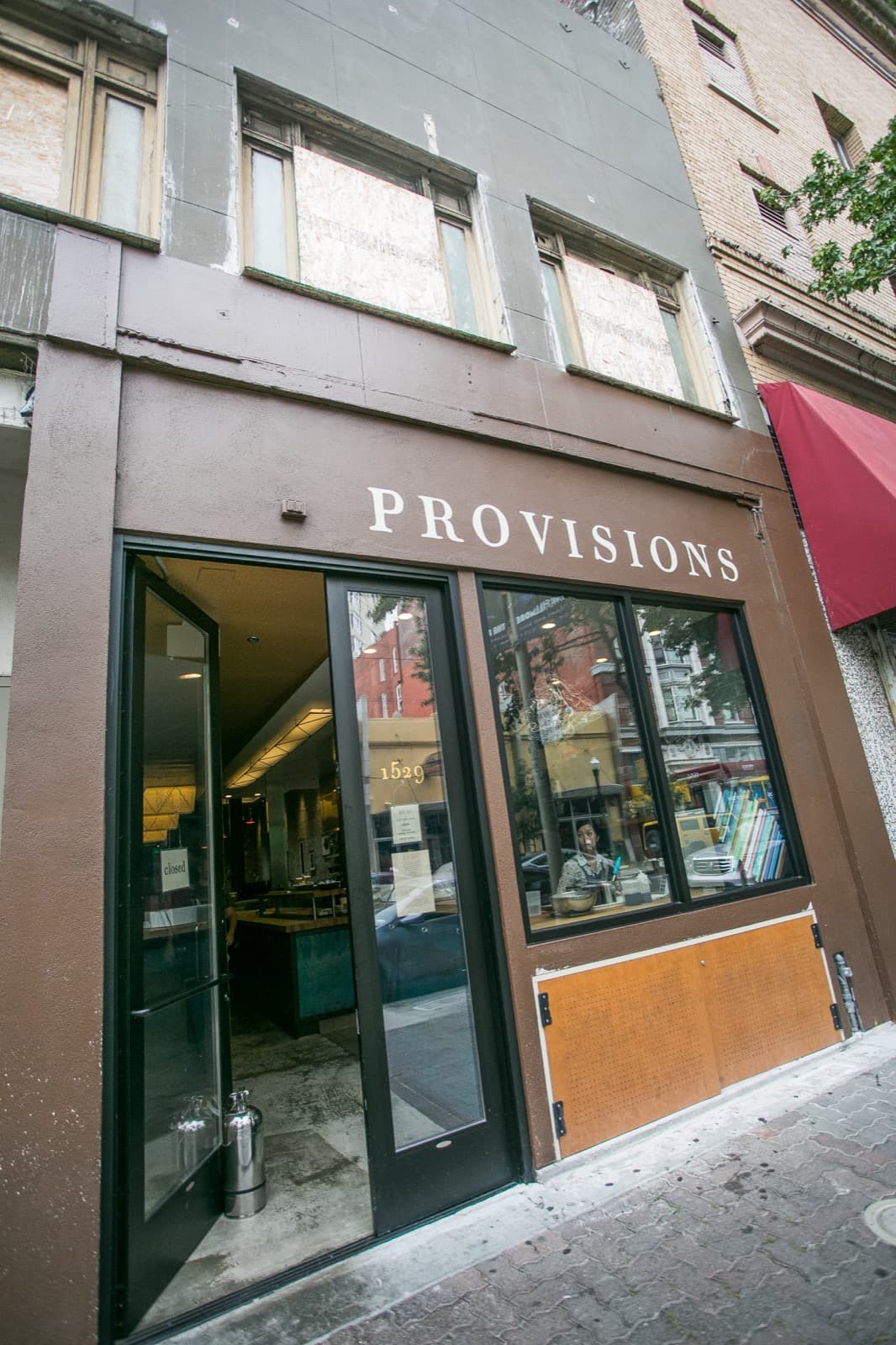
State Bird Provisions opened in 2011 on Fillmore Street in San Francisco from chef-owners Stuart Brioza and Nicole Krasinski. It was named Bon Appetit's best new restaurant in the country, won the James Beard Best New Restaurant award in 2013, and has held a Michelin star every year since 2014. The format is its signature: servers roam the dining room with dim-sum-style carts and trays of small plates, describe each dish as they reach you, and add what you accept to the tab. A short printed menu handles the rest, split into Pancakes and Toast, the Commandables entrees, and desserts. The namesake dish, the CA State Bird, is a fried California quail, the state bird, carried over from the chefs' time at Rubicon.
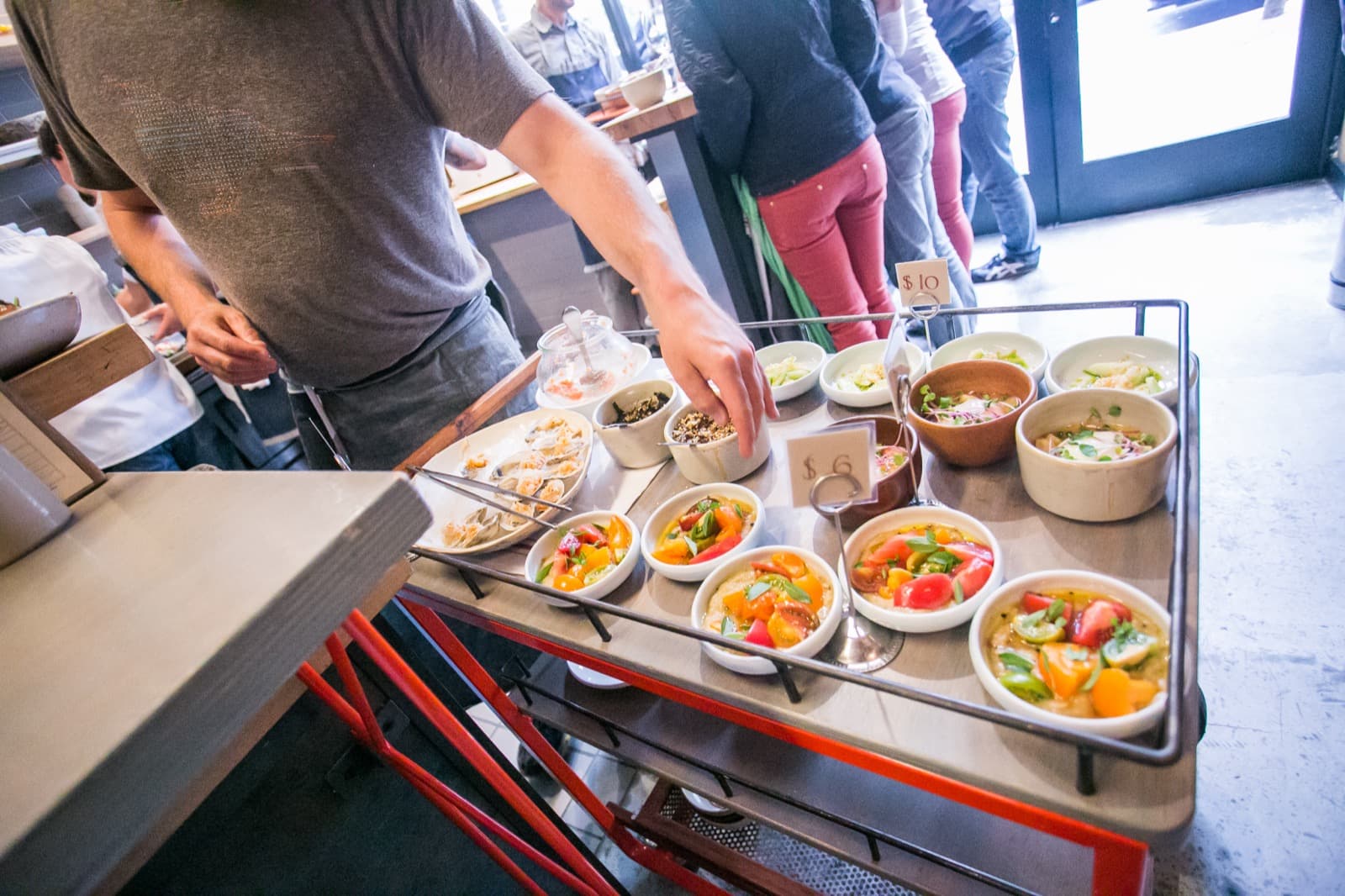
The behavioral interest is that the cart makes ordering a stream of tiny, separate yes-or-no decisions rather than one menu-scanning choice. Each cart shows its own price, plates run roughly $3 to $14, and there is no running total in front of you, so the cost only resolves when the check arrives. A low-looking entry point and a genuinely high final ticket sit on either side of that gap. (State Bird Provisions does not frame these as behavioral tactics; this is our reading of the observed design.)
What they get right
The behavioral economics already at work.
One plate at a time, priced separately
The cart splits the meal into many small per-plate charges, each $3 to $14, decided one by one. Breaking a total into small parts makes each part feel minor and lowers the perceived cost of the whole, which is exactly what the stream of single-plate yeses does here.
Morwitz, Greenleaf and Johnson, 1998 (partitioned pricing)
No running total while you eat
There is no visible running total during the meal; the cost only resolves at the check. Decoupling the pleasure of each plate from the pain of paying, which is deferred to the end, is what lets the count climb without a moment of reckoning at the table.
Thaler, 1999; Prelec and Loewenstein, 1998 (mental accounting)
You order what you see going by
Choice is driven by the plate in front of you and the ones landing at nearby tables, not by scanning a list. Seeing a dish arrive works like the strongest form of a most-popular cue, and the appetite-and-appearance decision is far easier to say yes to than reading a price off a menu.
most-popular cues lifted item sales 13 to 20%, Cai, Chen and Fang, AER 2009 (social proof)
The reservation is the first scarcity signal
A table here is one of the most coveted in the city, released 30 days out at midnight and backed by a walk-in line. Scarcity raises perceived value before any food is chosen, so diners arrive primed to treat the meal as worth a premium.
Worchel, Lee and Adewole, 1975 (scarcity raises perceived value)
A short printed list holds the anchors
The printed Commandables run up to a Dungeness crab plate near $26 and a grilled beef at $20. Those high reference points sit alongside the cart, so a $6 provision reads as the cheap, easy layer by comparison, whether or not the placement is deliberate.
State Bird Provisions printed menu (Commandables)
What we’d test
The rewrite, with the expected lift and the honest caveat.
Print a running subtotal on request
Offer diners a mid-meal subtotal, on a small card or the reservation app, showing plates taken so far. Test whether making the accumulating total visible changes the count and mix of plates versus the current no-total cart.
Expect Fewer impulse plates per table and less end-of-meal sticker shock, since the deferred cost re-enters the decision.
Caveat This touches only how the total is shown, not the cart service, the plates, or how anything is cooked.
Add a quiet cue to the namesake quail on the printed menu
The CA State Bird is already the plate most tables order on purpose. A light printed cue on its line, noting it as the signature or most-ordered, would put on the page the social proof the cart earns for the provisions by sight.
Expect A higher share of tables order the quail knowingly, reinforcing the intended center of the meal.
Caveat Menu wording only; this room trades on restraint, so keep the cue subtle and true.
Group the dessert cart's flavors as a named set
The pastry ice cream sandwiches rotate through many flavors. Listing them as a clearly named, sectioned set on the printed menu, rather than as a passing cart choice, would let descriptive naming lift the dessert attach after the savory plates.
Expect A higher dessert attach rate, consistent with descriptive labels and clear sectioning raising chosen items.
Caveat Menu naming and layout only; no change to which desserts are made or how the cart circulates.
What diners actually say
Synthesized from public reviews, the reality check that grounds every recommendation.
They praise
- The fried CA State Bird quail, crisp and rightly the signature
- The cart itself is genuinely fun: you see the food before you commit
- Inventive, constantly changing small plates that reward curiosity
- Nicole Krasinski's ice cream sandwich desserts
- Deserving of its Michelin star while staying casual and lively
They criticize
- Easy to hit $60 to $80 or more per person without noticing
- The lack of a running total surprises some diners at the check
- Reservations are notoriously hard to land
- The room is loud and tightly packed at prime times
- Small plates can feel small for the accumulated cost
The verdict
State Bird Provisions is the rare independent where a genuine ticket-multiplier story applies, and it earns the grade honestly. Moving the choice onto a roving cart, pricing each plate separately, and keeping any total out of view lets appetite and sight, not arithmetic, drive the order, so the check climbs plate by plate with no pressure at all. A short printed list of Commandables and the namesake quail anchors the higher end and paces the meal. The honest catch is that the same missing running total is exactly what leaves some diners startled at the bill.
Common questions
- Why is State Bird Provisions so expensive?
- Diners commonly spend $60 to $80 or more per person (2026), because the cart moves small plates past your table at $3 to $14 each and you accept them one at a time. There is no running total in view, so each single yes feels trivial while the plate count and the check climb together.
- How does ordering work at State Bird Provisions?
- Servers roam the room with dim-sum-style carts and trays of small plates, each cart showing a price, and you take what you want as it passes. A short printed menu covers pancakes, the Commandables entrees, and desserts, so sight sells the small plates and the printed list carries the larger ones.
- What is the signature dish at State Bird Provisions?
- The CA State Bird, a fried California quail with lemon-onion compote and parmesan, is the namesake Commandable, around $16 (2026). It is one of the few plates you order off the printed menu rather than take from the cart, which is why it reads as the intentional center of the meal.
- Is it hard to get a reservation at State Bird Provisions?
- Yes. A table here is one of the most coveted in San Francisco, with bookings released 30 days out at midnight on OpenTable and a walk-in line that forms before doors open (2026). Scarcity raises perceived value before a single plate is ordered, which is where the meal's premium starts.
Sources (10)
- State Bird Provisions official site
- State Bird Provisions, MICHELIN Guide (one star)
- SFist, "The Dim Sum Carts Are Rolling Again at State Bird Provisions" (2022)
- The Infatuation, State Bird Provisions review
- Chef Denise, State Bird Provisions menu pro tips (prices, ordering)
- Menu With Price, State Bird Provisions (sampled prices)
- Partitioned pricing, Morwitz, Greenleaf & Johnson, 1998
- Mental accounting & decoupling, Thaler (1999); Prelec & Loewenstein (1998)
- “Most popular” tags +13-20%, Cai, Chen & Fang, AER 2009
- Scarcity raises perceived value, Worchel, Lee & Adewole, 1975
Head to head
More breakdowns
 Restaurant Gary DankoA
Tiered courses, round whole-dollar prices, a caviar anchor, build-your-own freedom and a tableside cheese cart. Danko is already doing what we'd recommend.
Read the Restaurant Gary Danko breakdown →A 1984 steakhouse at 2100 Van Ness Avenue that dry-ages its beef behind a streetside glass window, so the single best argument for the price is visible before you even sit down.
Read the Harris' Restaurant breakdown → Saint Frank CoffeeB+
An SF specialty roaster that prices a latte at a fine-coffee premium and justifies it with a story: named farms, tasting notes, and a 'relationship coffee' ethos that turns a cup into a cause.
Read the Saint Frank Coffee breakdown → Yank SingA-
A 1958 dim sum institution where you pick from a rolling cart by sight, plate by plate, and the bill quietly adds up.
Read the Yank Sing breakdown → Zuni CafeA-
A 75.00 chicken that takes about 75 minutes, and the menu says so. A practical warning that also happens to reduce uncertainty, printed in the margin.
Read the Zuni Cafe breakdown → Pearl 6101B+
A neighborhood Outer Richmond Cal-Mediterranean restaurant from the Pizzetta 211 team, whose menu prints prices as bare round numbers with no dollar signs and no cents.
Read the Pearl 6101 breakdown →Your menu next
Get this for your own menu, free.
Send your menu and we’ll send back the same breakdown, what you get right, what we’d test, and why.
The Anchovy Bar
A small seafood and wine bar on O'Farrell Street from the State Bird Provisions team, where oysters are sold by the piece, the anchovies are the point, and the wine list does the quiet work.
Read it →