4505 Burgers & BBQ menu, graded
Naming as social proof: a self-applied superlative and a high family-platter anchor reframe weighed-by-the-pound barbecue as the confident everyday choice.
How a self-applied superlative and a big family-platter anchor reframe by-the-pound barbecue, the most price-salient format in food, as the easy everyday order.
Menu-craft grade
Confident no-dollar-sign pricing, a self-bestowed 'Best Damn' superlative that does the work of social proof, and a 149.95 Boss Platter anchor that frames the everyday plates; held back by selling barbecue by the half-pound, the most price-salient format there is, and a footnoted surcharge that lands after the menu math.
Graded on how well the menu uses behavioral economics, not the food.
Menu and prices verified September 2026
A 3-minute audio read of the analysis
- Type
- Independent
- Where
- 705 Divisadero St, NoPa, San Francisco
- Cuisine
- Whole-animal barbecue and grass-fed burgers
- Footprint
- Divisadero flagship
- Since
- 2014
- Ownership
- Ryan and Cesalee Farr (4505 Meats)
The mechanics, drawn
The same menu, mapped onto an axis, so the behavioral move is something you can see, not just read.
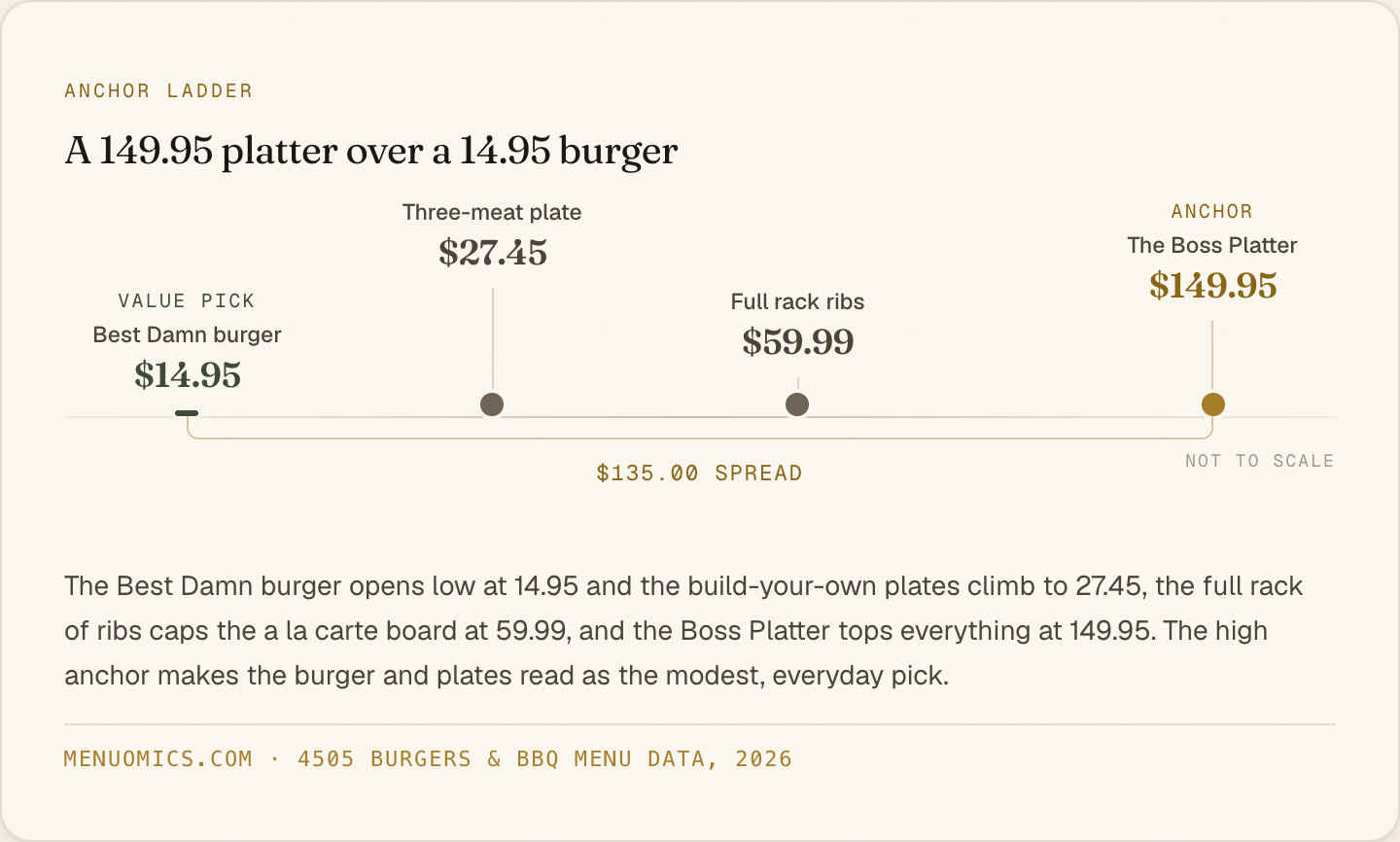
A 149.95 platter over a 14.95 burger
The Best Damn burger opens low at 14.95 and the build-your-own plates climb to 27.45, the full rack of ribs caps the a la carte board at 59.99, and the Boss Platter tops everything at 149.95. The high anchor makes the burger and plates read as the modest, everyday pick.
Download this chart (PNG) · free to reuse with credit, see reuse terms.
The setup
4505 grew out of butcher Ryan Farr's whole-animal meat company, 4505 Meats, which he started in 2009 selling chicharrones at the San Francisco farmers market before opening a Mission butcher shop in 2012. In 2014 Farr and his wife Cesalee took over the former Da Pitt BBQ space at 705 Divisadero, kept one of the area's last historic wood-fired barbecue pits, and opened 4505 Burgers & BBQ. The kitchen's stated ethos is plain: 'Fresh, never frozen meats, smoked that day,' scratch-made sides and house-made sausages, and a promise to 'sell out daily so your meal is always fresh, never leftover.'
The behavioral interest is in two menu choices that pull in opposite directions. The flagship burger is named the 'Best Damn Grass-Fed Burger,' a superlative the restaurant awards itself, which functions as a social-proof claim printed right on the page. At the same time, the barbecue is priced the hardest way to price food: by the half-pound, where the diner is doing dollars-per-weight arithmetic in real time. The menu uses a high family-platter anchor and a no-dollar-sign format to soften that, and the result is a board where confidence and price-salience are visibly negotiating.
What they get right
The behavioral economics already at work.
The 'Best Damn' name is social proof the menu awards itself
Printing 'Best Damn' on the burger and the fried chicken sandwich is a superlative claim made on the page, at the point of choice. It functions like a 'most popular' tag, a confidence cue that steers an undecided first-timer, with the honest caveat that it is self-bestowed rather than a third-party verdict. The effect is the same direction as a printed popularity claim: it raises the odds the named item gets picked.
popularity-style tags lift selection of the tagged item, strongest on first-time customers, Cai, Chen & Fang, AER 2009 (here the claim is self-applied, not third-party)
A 149.95 platter anchors the whole board
The Boss Platter at 149.95 sits at the top of the price range. Once a diner has seen a three-figure number, the 14.95 burger and the 17-to-27 build-your-own plates read as comparatively modest. The anchor does its reframing whether or not anyone orders it, which is exactly the point of a high reference price.
an early high number reframes everything below it, anchoring; Tversky & Kahneman 1974
No dollar sign, charm endings that fit the room
Prices print without a currency symbol and lean on .95 and .99 endings. Dropping the dollar sign mutes the pain-of-paying cue, and the charm endings are the correct positioning choice for a counter-service pit: they read as value and casual, where round whole dollars would read as fine dining and fight the picnic-table room.
removing the dollar sign lifted spend ~8% per person in a Cornell field study, Cornell, Yang & Kimes 2009 (single-venue, test the magnitude)
The plate hides the upgrades as small +increments
The Smoked Meat Plate shows one headline price (17.45 / 22.45 / 27.45) and then sells the premium meats as separate small add-ons: 'beef brisket +3.99,' 'add a 1/3# of spare ribs +6.99.' Splitting the upgrade off the base keeps the entry price low and turns each enhancement into its own small yes rather than a bigger sticker.
Morwitz, Greenleaf & Johnson, 1998 (partitioned pricing)
Sourcing-and-method copy does the describing
The menu leans on provenance and technique rather than bare nouns: 'grass-fed beef patty,' 'gruyere cheese and secret sauce on a griddled sesame and scallion bun,' fries 'fried in tallow,' 'house-smoked, handcrafted sausages,' 'family recipes,' 'Slow Moving Farms.' Sensory and sourced labels are associated with higher appeal and willingness to pay than plain ingredient lists.
descriptive labels lifted sales of named items ~27% in the classic study, Wansink, Painter & van Ittersum, 2001 (it lifts which item is picked, not what people will pay)
What we’d test
The rewrite, with the expected lift and the honest caveat.
Lead the BBQ board with a per-plate price, keep the per-pound as the secondary line
Selling brisket and ribs 'per 1/2 pound' is the most price-salient format on the menu: the diner is forced into dollars-per-weight arithmetic before they have pictured the food. Present the build-your-own plate (one number, sides included) as the primary, top-of-section line and keep the per-half-pound figure as a smaller 'or by the pound' note beneath. This is a layout and pricing-presentation change to how the same prices are ordered on the page, not a change to portions, the smoker, or what is charged.
Expect Fewer diners doing weight math at the point of choice, and a higher share routed to the plate where the price reads as a meal rather than a scale reading.
Caveat Tests sectioning and the order of existing price lines only; it does not change portion size, the meats, or the price per pound.
State the 'sell-out' as a printed scarcity line on the ribs
The menu already says 'come early, we sell out daily' in the general copy and calls the spare ribs 'Limited, coveted.' Move that into a single explicit line on the ribs themselves, for example 'Limited daily, when they're gone they're gone,' so the scarcity is stated at the item rather than buried in the section header. A stated, closing window reads as more urgent than an open-ended one. The wording carries the scarcity; the sell-out already happens.
Expect Sharper urgency on the highest-ticket a la carte item while it lasts, with the claim staying truthful because the kitchen genuinely sells out.
Caveat A menu-copy change only; it states an existing condition and does not change how much is smoked or when it runs out.
Surface the surcharge before the total, not after the menu
The 'Tax and 4505 Employee Experience Surcharge Not Included in Menu Items' is footnoted at the bottom, so a diner does the menu math at 14.95 and meets a higher number at the register. Partitioned pricing reverses and breeds resentment the moment an add-on feels hidden (the drip-pricing backlash). Print the surcharge percentage plainly beside the prices it applies to, so the all-in figure is legible at the point of choice.
Expect Fewer register-time surprises and complaints that the listed price was not the real price, preserving the value read the charm endings work to build.
Caveat A pricing-presentation and disclosure change only; it does not add, remove, or alter the surcharge itself, only where and how clearly it is shown.
What diners actually say
Synthesized from public reviews, the reality check that grounds every recommendation.
They praise
- Repeatedly called one of the few places in San Francisco for genuine, Texas- or Carolina-grade barbecue, by reviewers from the South
- Fresh, never-frozen, smoked-that-day meats from a real whole-animal butcher, with the kitchen selling out rather than holding leftovers
- The Best Damn Grass-Fed Burger is a consistent draw and a credible counterweight to the BBQ
- Casual outdoor picnic-table atmosphere around a historic wood-fired pit
They criticize
- Widely flagged as expensive for the portion, with the by-the-half-pound pricing making the cost feel high
- Some longtime regulars say the food has slipped over the years
- The added surcharge and tax on top of the listed prices catches diners off guard at the register
The verdict
4505's menu is a confident piece of casual-pit design fighting one self-inflicted handicap. The confidence is real: a self-applied 'Best Damn' superlative that works like printed social proof, a 149.95 Boss Platter that anchors the page so the 14.95 burger reads as easy, no dollar signs, and charm endings that correctly position a counter-service smokehouse. The handicap is selling the barbecue by the half-pound, the single most price-salient way to price food, which is exactly the format the reviews translate into 'expensive for what it is,' compounded by a surcharge that only appears after the menu math. The menu-design upside is all presentation: lead the BBQ board with a per-plate price and demote the per-pound figure, state the daily sell-out as a scarcity line on the ribs, and show the surcharge up front so the value the rest of the menu builds survives the trip to the register.
Common questions
- Is 4505 Burgers & BBQ expensive?
- The Best Damn Grass-Fed Burger starts at 14.95 (19.95 for a double), but barbecue is sold by the half-pound, with brisket at 24.95 per half-pound, which earns the menu a B+. Pricing by the half-pound is the most price-salient format in food, so reviews often translate it into 'expensive for the portion.'
- What is the most expensive item at 4505 Burgers & BBQ?
- The Boss Platter tops the board at 149.95 with all the meats and sides and feeds 6, while the a la carte ceiling is the Full Rack of pork spare ribs at 59.99. The three-figure Boss Platter anchors the page so the 14.95 burger and 17-to-27 plates read as the modest, everyday order.
- Why is the 4505 burger called the 'Best Damn'?
- The flagship is named the Best Damn Grass-Fed Burger, a superlative the restaurant awards itself and prints right where a diner reads it before deciding. It works like a 'most popular' tag, a confidence cue that steers undecided first-timers, with the honest caveat that the claim is self-bestowed.
- How much is a barbecue plate at 4505?
- The build-your-own Smoked Meat Plate runs 17.45, 22.45, or 27.45 for one, two, or three meats, with brisket a +3.99 upcharge. Showing one headline plate price and selling the premium meats as small separate increments keeps the entry price low and turns each upgrade into its own small yes.
- Does 4505 Burgers & BBQ add a surcharge?
- Yes, a footnoted 'Tax and 4505 Employee Experience Surcharge Not Included in Menu Items' lands after the listed prices, so the math you do at 14.95 meets a higher number at the register. Hidden add-ons breed resentment, which is why diners report the listed price was not the real price.
Sources (9)
- 4505 Burgers & BBQ, official menu PDF (dated 9.11.25, as sampled 2026)
- 4505 Burgers & BBQ, About (history, founder Ryan Farr, whole-animal ethos)
- 4505 Burgers & BBQ, San Francisco location (705 Divisadero, hours)
- SF Weekly / SFoodie: 4505 Burgers & BBQ opens on Divisadero (2014, former Da Pitt, wood-fired pit)
- 4505 Burgers & BBQ, Yelp listing (rating and review count, June 2026)
- Cornell, drop the dollar sign (Yang, Kimes & Sessarego, 2009)
- Descriptive labels +27% sales (Wansink, Painter & van Ittersum, 2001)
- Partitioned pricing (Morwitz, Greenleaf & Johnson, 1998)
- 'Most popular' tags +13-20% (Cai, Chen & Fang, AER 2009)
More breakdowns
 Zuni CafeA-
A 75.00 chicken that takes about 75 minutes, and the menu says so. A practical warning that also happens to reduce uncertainty, printed in the margin.
Read the Zuni Cafe breakdown →A 1988 supper club hidden down a Gold Street alley, where live jazz, $18 martinis and tableside theater are the product and the food only has to clear the bar the room has raised.
Read the Bix breakdown →An elegant, romantic neighborhood bistro in Lower Pacific Heights serving modern French cooking with a Californian accent, from chef JP Carmona and the B Patisserie team.
Read the Routier breakdown →The James Beard 'America's Classic' that builds its whole reputation on what it leaves out: no rice, six meats, one price, off-menu dorado.
Read the La Taqueria breakdown →A Tenderloin Creole institution where one cheap, famous beignet gets bundled into a four-way Flight that quietly triples the check.
Read the Brenda's French Soul Food breakdown → NopaA
NopaAA 2006 Divisadero gathering place whose daily wood-fired menu prints prices as plain numbers, no dollar signs, no cents, anchored by a 49 brisket.
Read the Nopa breakdown →Your menu next
Get this for your own menu, free.
Send your menu and we’ll send back the same breakdown, what you get right, what we’d test, and why.
CAVA
CAVA's menu is a build-your-own Mediterranean line that includes three scratch dips and unlimited toppings free, then concentrates the upsell on one flat premium-protein step and resells the dips as paid sides.
Read it →