
Nopa menu, graded
Strip the prices to bare numbers and the room stops counting dollars.
Nopa's menu does its pricing work by subtraction: no dollar signs, no decimals, one dated page, and a high anchor that makes the rest read like a deal.
Menu-craft grade
A clean, leader-dotted single page with bare numeric prices, a clear three-section spine, and a high brisket anchor that quietly resets the read on the burger and beans.
Graded on how well the menu uses behavioral economics, not the food.
Menu and prices verified September 2026
A 3-minute audio read of the analysis
- Type
- Independent
- Where
- San Francisco, North of the Panhandle
- Cuisine
- California wood-fired
- Footprint
- 1 location
- Since
- 2006
- Ownership
- Chef Laurence Jossel (sole owner)
The mechanics, drawn
The same menu, mapped onto an axis, so the behavioral move is something you can see, not just read.
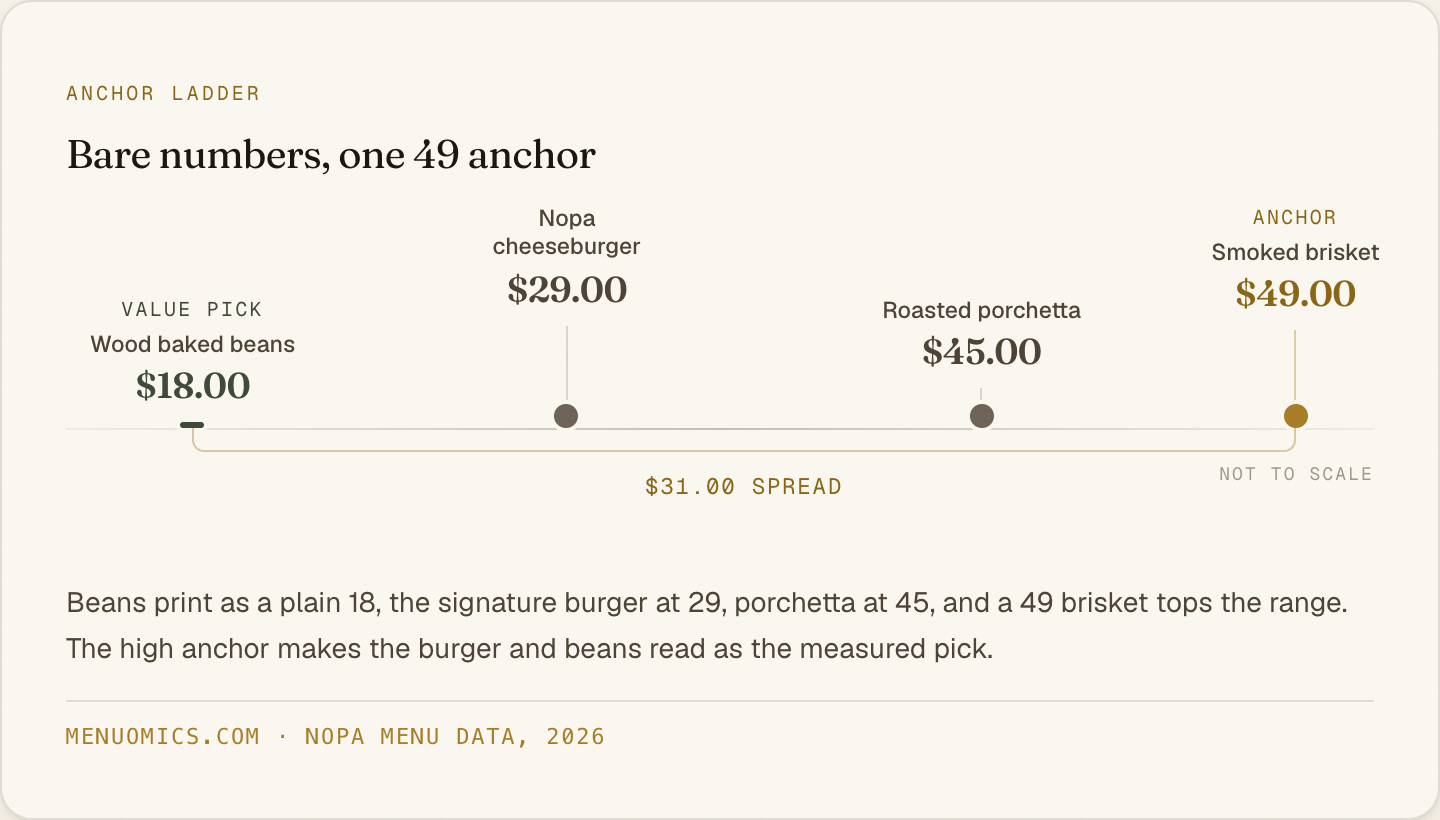
Bare numbers, one 49 anchor
Beans print as a plain 18, the signature burger at 29, porchetta at 45, and a 49 brisket tops the range. The high anchor makes the burger and beans read as the measured pick.
The burger sold as a base plus +4s
The cheeseburger holds at 29 with each topping printed as a small plus four. Attention lands on the increment, not the built-up total.
Download this chart (PNG) · free to reuse with credit, see reuse terms.
The setup
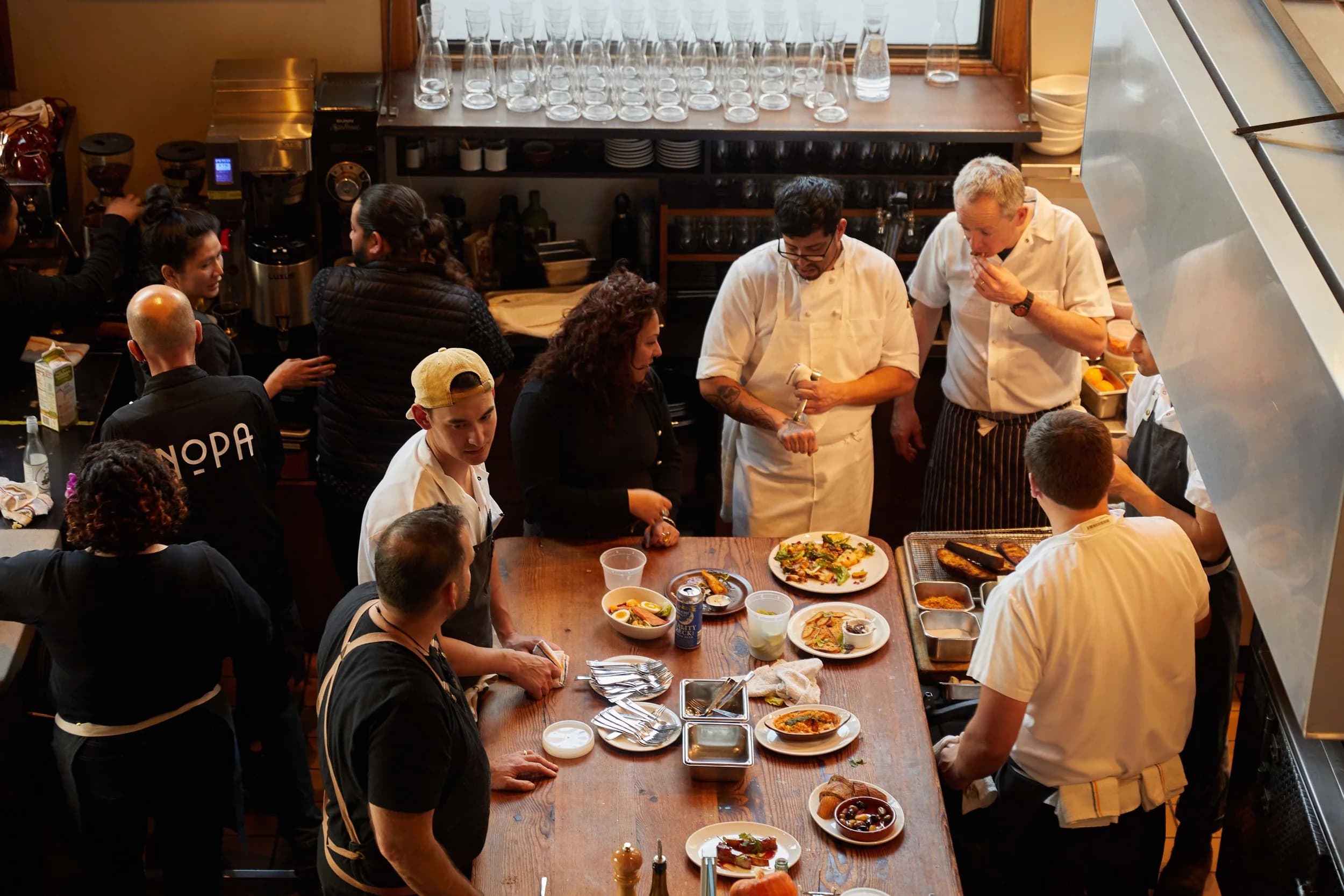
Nopa opened in 2006 in a converted laundromat on the corner of Hayes and Divisadero, the restaurant credited with naming the North of the Panhandle neighborhood. In its own words it specializes in organic wood-fired cuisine, serving straightforward food from seasonal, local ingredients, and bills itself as a San Francisco gathering place. Chef Laurence Jossel is now the sole owner; the kitchen is built around an open wood-burning oven and grill, and the menu is reprinted daily with the date at the top.
The behavioral interest is in the presentation, not the produce. Prices are set as bold whole numbers with leader dots and no currency symbol or cents, the page is divided into just three labeled sections, and a 49 brisket sits at the top of the dollar range. Together these are textbook price-de-emphasis and anchoring moves, and the menu lets us read how much of Nopa's check-building is layout rather than cooking.
What they get right
The behavioral economics already at work.
Bare numbers, no dollar signs, no cents
Every price is a bold whole number with no currency symbol or decimals: "18", "29", "49". In a controlled study, diners shown numeral-only prices spent significantly more than those shown a dollar sign, the sign acting as a pain-of-paying cue. Nopa strips that cue, though the dotted leader lines are the one element working the other way, running the eye straight to the number.
Numeral-only prices outspent dollar-sign prices in a Cornell field study, Cornell, Yang and Kimes 2009 (drop the dollar sign)
A 49 brisket anchors the page
The Cherrywood Smoked Brisket at 49 is the single highest price and sits in the large-plates column where the eye lands. A high first reference point makes the items beneath it, the 29 burger, the 33 fried chicken, read as comparatively reasonable. The effect is a reframing of the mid-priced plates, whether or not it is deliberately placed.
Nopa daily dinner menu
Burger add-ons are sold as +4, not 33
The cheeseburger is listed at 29 with "add house smoked bacon +4" and "add Brokaw avocado +4" printed beneath it. Splitting a price into a base plus small increments tends to lower perceived total cost versus showing the bundled all-in figure, because attention anchors on the small +4 rather than the combined 37.
Morwitz, Greenleaf and Johnson, 1998 (partitioned pricing)
Names that are mostly sourcing, not adjectives
Items are described through farms and provenance: "Iacopi Farm gigantes," "grass fed Stemple Creek beef ground daily," "Star Route lettuces." Descriptive and origin-rich menu language has been shown to raise both sales and diners' rated enjoyment of the same dish, and Nopa leans on supplier names rather than empty flourishes to do it.
Descriptive menu labels lifted sales of named items by about 27% in a Cornell study, Wansink, Painter and van Ittersum, 2001 (descriptive labels)
Three sections, one dated page
The menu is split into just Small Plates, Large Plates and Sides on a single sheet reprinted daily with the date at top. A short, clearly sectioned list keeps the decision tractable: fewer options, organized into legible buckets, reduce the choice overload that can stall or shrink an order.
Iyengar and Lepper, 2000 (choice overload)
What we’d test
The rewrite, with the expected lift and the honest caveat.
Move the brisket to the top of Large Plates
If the 49 brisket is printed as the first line of the large-plates column instead of mid-column, the high anchor is encountered before the mid-priced plates rather than after, which should strengthen the framing that makes the 29 burger and 33 chicken read as moderate.
Expect Higher attach rate on the 29 to 35 large plates relative to the brisket.
Caveat This tests item ordering and anchor placement on the page only, not the food, the cooking, or what the kitchen charges.
Print the cheeseburger add-ons as a combined price
Replace "add bacon +4 / add avocado +4" with a single "loaded" line at the bundled total (for example a 37 build) and compare against the current base-plus-increments format. Partitioning theory predicts the +4 framing produces more add-on uptake than the all-in number.
Expect More add-on selections under the +4 framing than under the bundled total.
Caveat This tests how the same upcharge is worded and laid out, not portion size, ingredients, or kitchen execution.
Drop the dotted leaders
The dotted leader runs the eye from the dish straight to the price, working against the no-dollar-sign, no-cents de-emphasis the rest of the menu earns. Test setting the price inline at the end of the description with no leader, so the diner reads the dish before the number.
Expect Less price-led scanning; the page reads as dishes, not a price column.
Caveat A price-typography and layout change only, not the prices themselves or anything the kitchen does.
What diners actually say
Synthesized from public reviews, the reality check that grounds every recommendation.
They praise
- The pork chop and wood-grilled mains are described as among the best in the city
- Atmospheric two-story room built around a blazing wood oven
- Farmers-market-driven menu that changes with the season
- A reliable special-occasion and late-night gathering place since 2006
They criticize
- The burger is called inconsistent and no longer the reason to come, with its price questioned
- The room is loud and reservations are hard to get
- Quality varies dish to dish, the rotating flatbread especially
The verdict
Nopa's menu is a quiet masterclass in pricing presentation: a single dated page, bare numbers with no dollar signs or cents, three clean sections, and a 49 brisket that anchors a check most diners never see itemized in dollars. The cooking changes nightly, but the layout does steady, repeatable work, de-emphasizing cost and reframing the mid-priced plates. The design upside is that almost all of this travels: any independent could drop the dollar sign, set a real anchor, and section the page, and capture the same effect without touching a recipe.
Common questions
- Why does Nopa's menu have no dollar signs?
- Nopa prints every price as a bold whole number with no currency symbol or cents, like 18 for the beans and 29 for the cheeseburger. In a Cornell field study diners shown numeral-only prices spent significantly more than those shown a dollar sign, because the symbol acts as a pain-of-paying cue that Nopa strips away.
- How much is the Nopa cheeseburger?
- The Nopa Cheeseburger is 29, with house smoked bacon and Brokaw avocado each listed as a separate "+4" add-on rather than a bundled 37. Splitting the price into a base plus small increments anchors attention on the +4 instead of the combined total, which tends to lower the perceived cost.
- What is the most expensive dish at Nopa?
- The Cherrywood Smoked Brisket at 49 is the single highest price on the page and sits in the large-plates column where the eye lands. As the anchor it makes the 29 burger and 18 beans read as comparatively reasonable, whether or not the placement is deliberate.
- Is Nopa worth it?
- Nopa's daily wood-fired menu runs from an 18 small plate to a 49 brisket on a single dated page split into just three sections. The cooking changes nightly, but the layout does steady work de-emphasizing cost and reframing the mid-priced plates, so most diners never see the check itemized in dollars.
Sources (6)
- Nopa daily menu (official)
- The Infatuation: Nopa review
- SFist: the partnership behind Nopa (history and ownership)
- Cornell, removing the “$” lifted spend ≈8%/person (Yang, Kimes & Sessarego, 2009)
- Partitioned pricing, Morwitz, Greenleaf & Johnson, 1998
- Descriptive labels +27% sales, Wansink, Painter & van Ittersum, 2001
More breakdowns
 Zuni CafeA-
A 75.00 chicken that takes about 75 minutes, and the menu says so. A practical warning that also happens to reduce uncertainty, printed in the margin.
Read the Zuni Cafe breakdown →A 1988 supper club hidden down a Gold Street alley, where live jazz, $18 martinis and tableside theater are the product and the food only has to clear the bar the room has raised.
Read the Bix breakdown →An elegant, romantic neighborhood bistro in Lower Pacific Heights serving modern French cooking with a Californian accent, from chef JP Carmona and the B Patisserie team.
Read the Routier breakdown →The James Beard 'America's Classic' that builds its whole reputation on what it leaves out: no rice, six meats, one price, off-menu dorado.
Read the La Taqueria breakdown →A Tenderloin Creole institution where one cheap, famous beignet gets bundled into a four-way Flight that quietly triples the check.
Read the Brenda's French Soul Food breakdown → Marufuku RamenA-
A four-bowl Hakata tonkotsu menu that lets you tune firmness, spice, and richness without ever asking you to design the bowl. Constrained customization, done well.
Read the Marufuku Ramen breakdown →Your menu next
Get this for your own menu, free.
Send your menu and we’ll send back the same breakdown, what you get right, what we’d test, and why.
McDonald's
The Extra Value Meal is one of the most-copied ideas in food: fold the whole order into a single number that hurts less than three. Then McValue and the app pile value on top, and the McRib drops in as an event.
Read it →