La Taqueria menu, graded
Confidence through subtraction: a short, flat-priced menu that refuses the default reads as conviction, not lack.
A menu that wins by refusing things. The riceless, one-price, six-word burrito board is a masterclass in productive subtraction.
Menu-craft grade
A one-screen menu of single-word meats at one flat price turns ruthless subtraction into the whole pitch.
Graded on how well the menu uses behavioral economics, not the food.
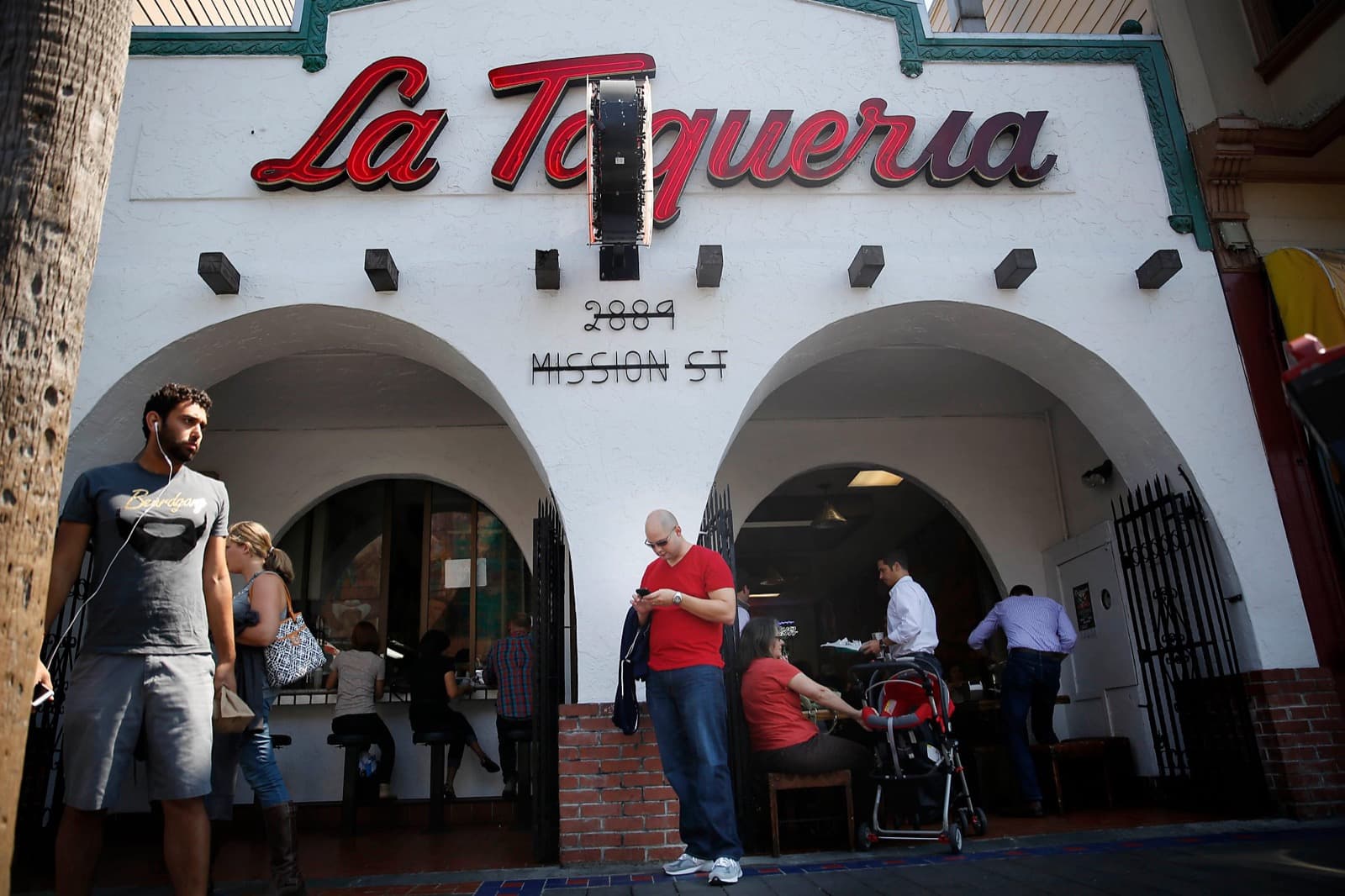
Menu and prices verified September 2026
A 3-minute audio read of the analysis
- Type
- Independent
- Where
- Mission District, San Francisco
- Cuisine
- Mexican / Mission-style burritos
- Footprint
- 1 location
- Since
- 1973
- Ownership
- Miguel Jara (founder-owned)
The mechanics, drawn
The same menu, mapped onto an axis, so the behavioral move is something you can see, not just read.
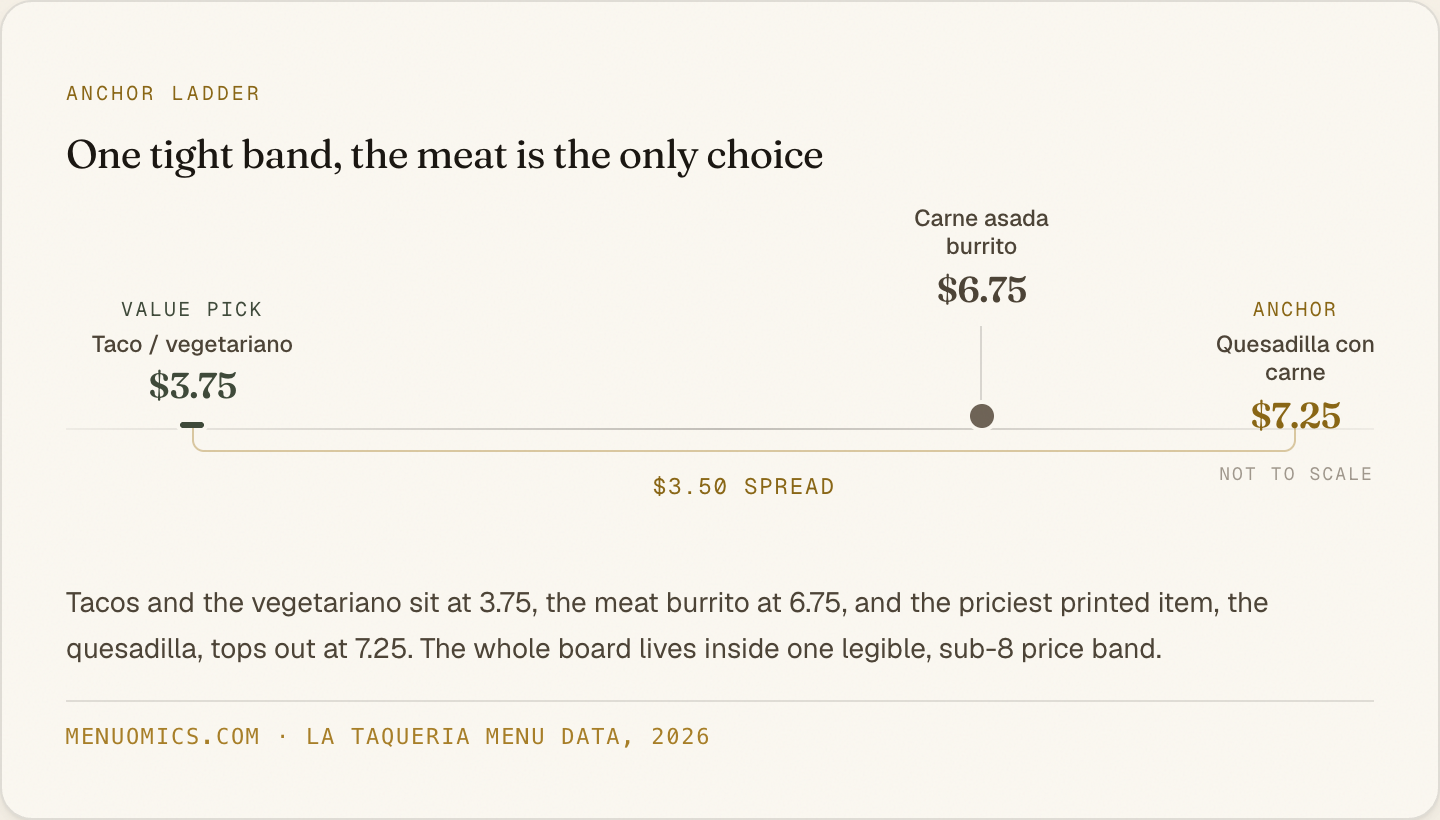
One tight band, the meat is the only choice
Tacos and the vegetariano sit at 3.75, the meat burrito at 6.75, and the priciest printed item, the quesadilla, tops out at 7.25. The whole board lives inside one legible, sub-8 price band.
Build your own super, one yes at a time
There is no super line on the board. The base burrito stays 6.75 and each upgrade is a small, separate add, so the headline price never moves.
Download this chart (PNG) · free to reuse with credit, see reuse terms.
The setup
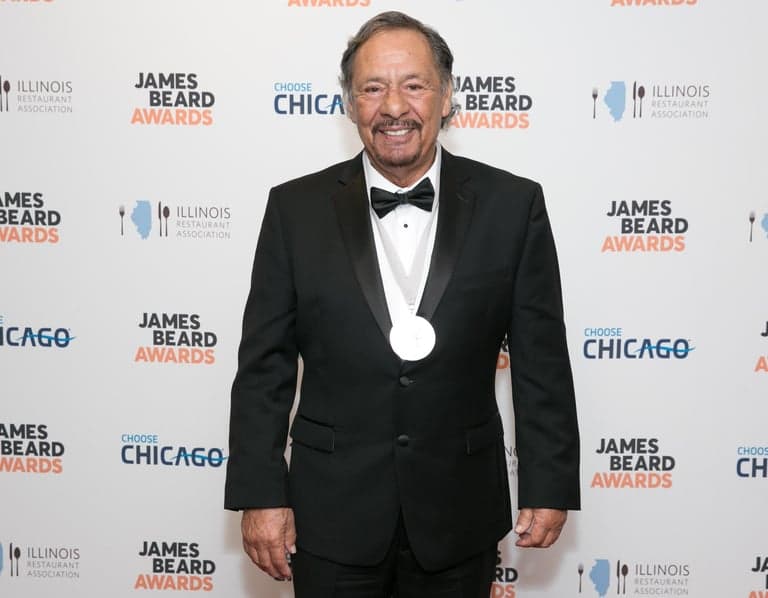
La Taqueria has occupied the same Mission Street corner since 1973, when founder Miguel Jara, who grew up in Tijuana, built it out himself. It is credited by Bon Appetit with creating the Mission-style burrito, was named the best burrito in America by FiveThirtyEight in 2014, and won the James Beard Foundation's America's Classics award in 2017. Jara, in the Foundation's words, 'rejects rice as a filling, doubles down on the meat,' and griddles burritos crisp and golden (dorado).
The behavioral move sits in plain sight on the board. Where a typical taqueria menu sprawls into combos, sizes, add-on grids and a rice-or-no-rice fork, La Taqueria offers a near-square matrix: one burrito price, one taco price, the same six meats spelled out in a single word each. The famous omission, rice, is never offered, so it never has to be explained. The result is a menu that reads as a set of convictions rather than a set of options.
What they get right
The behavioral economics already at work.
The omission is the brand
Removing rice, the cheap filler every competitor uses to bulk a burrito, is a visible, costly refusal. Because rice is never offered, the menu spends zero words defending the choice; the absence does the talking. Reviews read the omission exactly as intended: The Infatuation's review is literally titled 'riceless burritos prove that less is more,' noting that without rice 'the meat, pinto beans, guacamole and cheese really get to show off.'
Riceless since 1973; James Beard America's Classics 2017, James Beard Foundation
One price, so the choice is identity not math
Every burrito is $6.75 and every taco $3.75, regardless of meat. With price held constant, the diner never trades flavor against cost; they just pick who they are (carnitas person, lengua person). Flattening the price axis is a real menu-design lever, distinct from the food, and the effect is to make ordering fast and low-regret.
La Taqueria menu, as sampled 2026 (allmenus.com)
A menu you can read in one breath
The board is a tight matrix: two formats, six one-word meats, a short extras column. Fewer options lowers the cognitive cost of deciding and the post-purchase second-guessing that long menus invite. The classic 'jam study' showed more options can depress both engagement and satisfaction; La Taqueria's grid is the inverse bet, and it has held for fifty years.
~6 meats, 2 core formats, 1 price each, Iyengar and Lepper, 2000 (choice overload)
The best version is the secret you must ask for
Dorado, the griddled finish that the James Beard Foundation calls the defining technique, is off-menu and free. Keeping the signature unlisted turns ordering it into a small in-group signal and lets the staff, not the board, reveal it. The effect is engagement and word of mouth at no menu cost; it is not evidence that prices are being hidden, since the base price is unchanged.
Dorado style is off-menu and free, Wikipedia: La Taqueria
Partitioned 'super' keeps the headline price low
There is no premium 'super burrito' line. The upgrade is assembled from named add-ons (avocado $1.20, cream $0.50, extra meat $1.20), so the advertised entry point stays $6.75 and each enhancement is a separate, small decision. Breaking a total into labeled parts is a documented framing lever; here it protects the cheap, legible anchor.
Morwitz, Greenleaf and Johnson, 1998 (partitioned pricing)
What we’d test
The rewrite, with the expected lift and the honest caveat.
Name the riceless burrito on the board, do not just omit rice
Add a one-line header such as 'Burritos, no rice, always' above the grid. The absence is currently invisible to first-timers who assume rice and feel the gap as a mistake; naming the omission frames it as a confident choice. This is a wording change to the menu copy only.
Expect Fewer first-time complaints that the burrito 'forgot' rice, and stronger association of the no-rice identity with the brand.
Caveat Tests menu wording, the header text, only. It does not touch the recipe, what goes in the burrito, or the kitchen.
Print the dorado option as a checkbox, not a secret
List 'Ask for it dorado (griddled), no charge' as a small line under burritos. Off-menu items convert only the in-the-know; printing it lets every guest opt into the best version while keeping the same flat price. This changes only what the board lists, not the griddle step or any cost.
Expect Higher share of dorado orders and fewer guests who later learn they 'should have' asked, with price held constant.
Caveat Tests menu listing and labeling only. It does not change the cooking technique, the griddle process itself, or pricing.
Order the meats by popularity, not alphabetically
Sequence the six meats so the most-ordered (carne asada, carnitas) sit first in the grid rather than in a neutral order. Position drives selection independent of the food; leading with the proven winners nudges undecided first-timers toward the items the kitchen is most known for.
Expect A modest shift toward the flagship meats among new customers, with no change to regulars who already know their order.
Caveat Tests item ordering and layout on the board only. It does not change the meats offered, their quality, or their price.
What diners actually say
Synthesized from public reviews, the reality check that grounds every recommendation.
They praise
- Routinely called the best burrito many reviewers have ever had, and 'worth the hype'
- The no-rice build lets the meat, beans, guacamole and cheese 'show off' (The Infatuation)
- Dorado, griddled, finish earns near-universal love and James Beard recognition
- Flat, cheap, legible pricing: a sub-$7 burrito that still feels generous
They criticize
- Almost always a long line, and notably short hours for a taqueria
- Some longtime regulars say prices crept up and portions shrank, 'a victim of its own success'
- Without rice the last bites get messy, and a minority simply miss the rice
The verdict
As a piece of menu craft, La Taqueria is close to airtight: a one-screen grid of single-word meats at one flat price, with the cheapest filler deliberately removed and the best version kept off-menu and free. The design converts editorial confidence into perceived authenticity, and it has done so for fifty years and a James Beard award. The menu-design upside for anyone copying it is the discipline of subtraction: hold price flat so the choice is identity, name your omissions so they read as conviction, and let one free, unlisted upgrade do your word-of-mouth.
Common questions
- Why does La Taqueria have no rice?
- La Taqueria has refused rice since founder Miguel Jara opened it in 1973, choosing to double down on the meat instead, and a $6.75 riceless burrito carries the meat, pinto beans, cheese, and salsa. Because rice is never offered, the menu spends zero words defending the choice, so the costly omission reads as conviction and helped earn the James Beard America's Classics award in 2017.
- How much is a burrito at La Taqueria?
- Every burrito is a flat $6.75 and every taco a flat $3.75, regardless of which of the six meats you choose. Holding the price constant across meats means you never trade flavor against cost; you just pick which meat person you are, which makes ordering fast and low-regret.
- What is the secret menu item at La Taqueria?
- The dorado burrito, any meat burrito griddled until crisp and golden, is off-menu and costs nothing extra at the same $6.75 price. Keeping the signature finish unlisted turns ordering it into a small in-group signal and drives word of mouth, since the base price never changes.
- What is the most expensive item at La Taqueria?
- The flour quesadilla with meat is the priciest printed item at $7.25, sitting modestly above the $6.75 flagship burrito. The whole board stays inside a single sub-$8 price band, so the menu reads in one breath with the meat, not the price, as the only real choice.
Sources (6)
- James Beard Foundation: 2017 America's Classic, La Taqueria
- La Taqueria menu and prices (as sampled 2026)
- Wikipedia: La Taqueria (founding, no-rice, dorado, FiveThirtyEight)
- The Infatuation: La Taqueria's riceless burritos prove that less is more
- Choice overload (jam study), Iyengar & Lepper, 2000
- Partitioned pricing, Morwitz, Greenleaf & Johnson, 1998
More breakdowns
 Zuni CafeA-
A 75.00 chicken that takes about 75 minutes, and the menu says so. A practical warning that also happens to reduce uncertainty, printed in the margin.
Read the Zuni Cafe breakdown →A 1988 supper club hidden down a Gold Street alley, where live jazz, $18 martinis and tableside theater are the product and the food only has to clear the bar the room has raised.
Read the Bix breakdown →An elegant, romantic neighborhood bistro in Lower Pacific Heights serving modern French cooking with a Californian accent, from chef JP Carmona and the B Patisserie team.
Read the Routier breakdown →A Tenderloin Creole institution where one cheap, famous beignet gets bundled into a four-way Flight that quietly triples the check.
Read the Brenda's French Soul Food breakdown → NopaA
NopaAA 2006 Divisadero gathering place whose daily wood-fired menu prints prices as plain numbers, no dollar signs, no cents, anchored by a 49 brisket.
Read the Nopa breakdown → Marufuku RamenA-
A four-bowl Hakata tonkotsu menu that lets you tune firmness, spice, and richness without ever asking you to design the bowl. Constrained customization, done well.
Read the Marufuku Ramen breakdown →Your menu next
Get this for your own menu, free.
Send your menu and we’ll send back the same breakdown, what you get right, what we’d test, and why.
Brenda's French Soul Food
A Tenderloin Creole institution where one cheap, famous beignet gets bundled into a four-way Flight that quietly triples the check.
Read it →