Bix menu, graded
You are paying for the room, not the calories.
Sutherland says the food is often a restaurant's marketing and the value lives in the room and the ritual as much as the plate. Bix is the clearest proof of it in San Francisco.
Menu-craft grade
An atmosphere-as-product masterclass: the hidden entrance, the tableside theater and a flat-priced bar that sells itself. By design the room raises the bar the food has to clear, which caps what the menu copy alone can do.
Graded on how well the menu uses behavioral economics, not the food.
Menu and prices verified September 2026
A 3-minute audio read of the analysis
- Type
- Independent
- Where
- San Francisco, Jackson Square
- Cuisine
- American supper club
- Footprint
- 1 location
- Since
- 1988
- Ownership
- Independent, SF Legacy Business
The mechanics, drawn
The same menu, mapped onto an axis, so the behavioral move is something you can see, not just read.
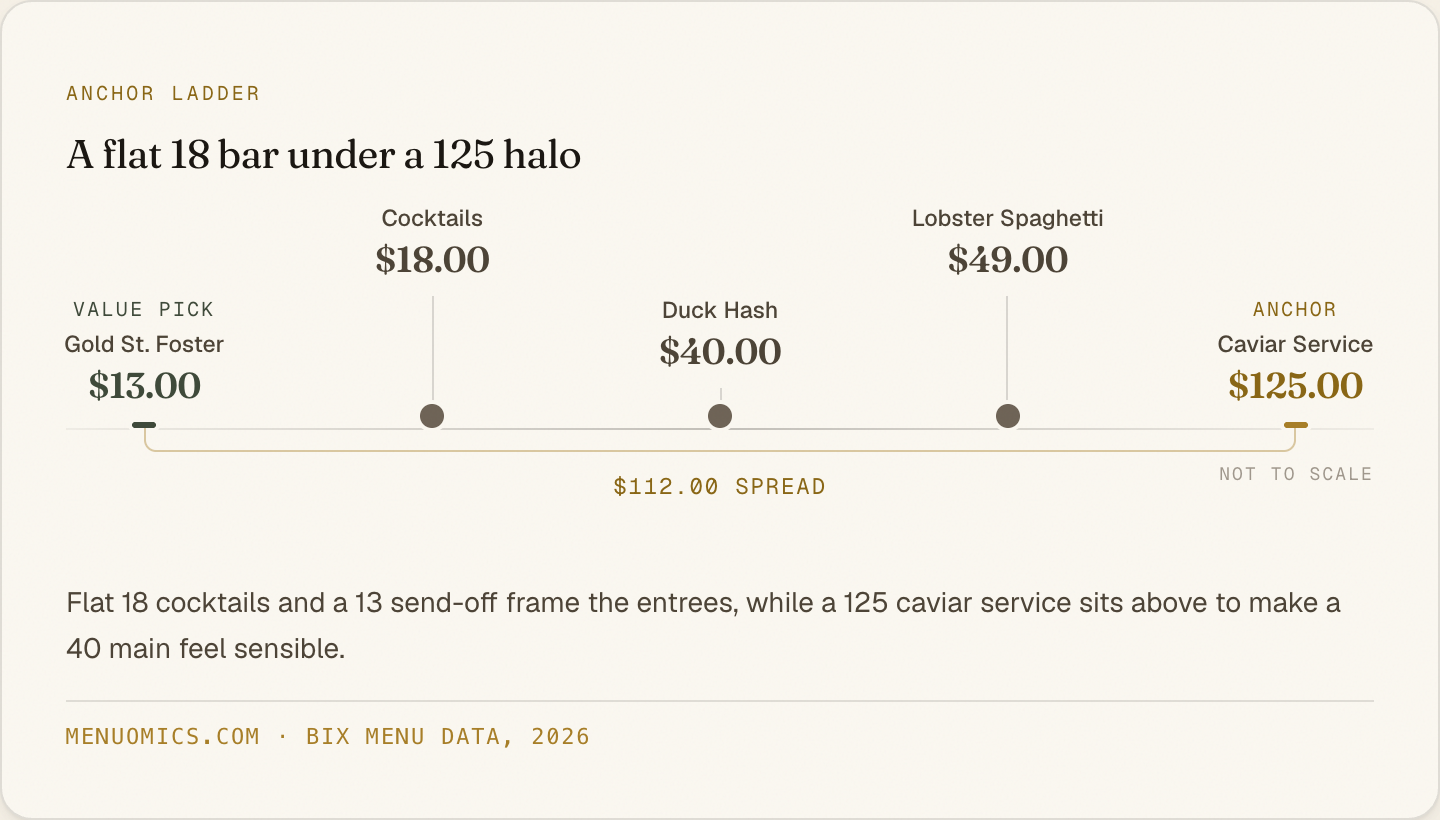
A flat 18 bar under a 125 halo
Flat 18 cocktails and a 13 send-off frame the entrees, while a 125 caviar service sits above to make a 40 main feel sensible.
Download this chart (PNG) · free to reuse with credit, see reuse terms.
The setup
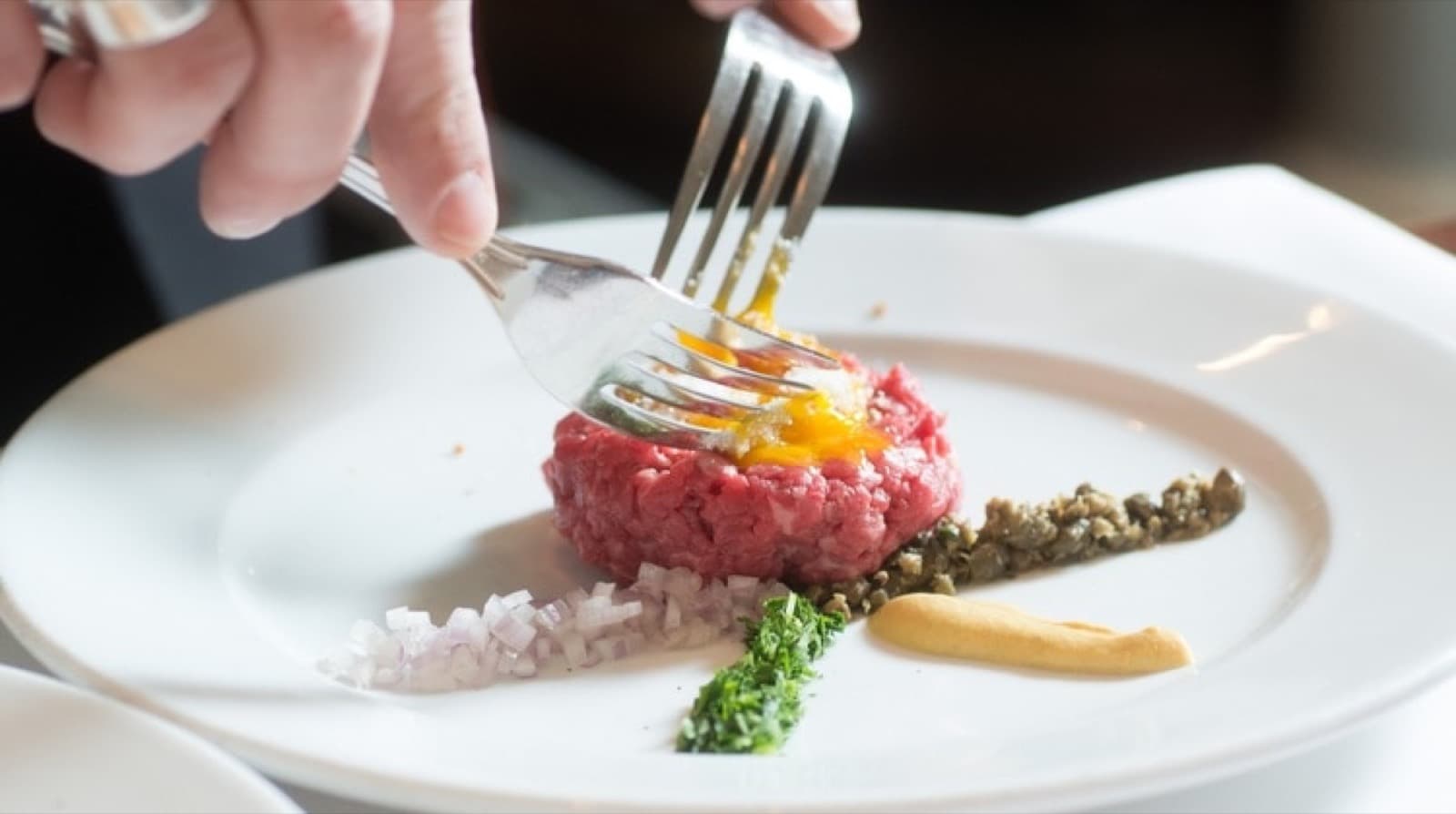
Bix sits down a narrow alley at 56 Gold Street behind an unmarked door. Inside: a two-story art-deco room, a mahogany bar, nightly jazz, and steak tartare mixed at your table. Independent reviewers are unusually honest about the trade: they go for the atmosphere, and say the food did not fully live up to the night. They go back anyway.
That observed pattern is the reading: people pay for the room and the ritual as much as the meal, so the food only has to clear a bar the atmosphere has already raised. A place that knows it sells the room first.
What they get right
The behavioral economics already at work.
The hidden entrance is the hook, not a flaw
An unmarked door down an alley should hurt business (the classic restaurant-in-an-alley failure). Bix reads the opposite way: the walk down Gold Street is the opening scene, a secret you were let in on. Mystique, not friction.
Rory Sutherland on framing a constraint as an asset
Tableside theater is a remembered peak
We remember an experience by its peak and its end. Tartare mixed at the table makes the food into a performance you recount later, which is the value the room is built to deliver.
Kahneman, the peak-end rule
The drinks are flat-priced and front-and-center
A single confident "$18" for every cocktail removes deliberation at the highest-margin line, and the bar is literally the first thing you meet. The room sells the drink.
Rory Sutherland on restaurant economics
The $125 caviar is a halo, and $49 caps the entrees
The $125 Petrovich caviar service is a luxury add-on that almost nobody orders; it sets a high reference point but it is not the entree anchor. The entrees top out near the $49 Lobster Spaghetti, so against the caviar halo a $40 Duck Hash reads as the sensible main. The luxury line exists to flatter the rest of the page.
anchoring; Kahneman & Tversky, 1974
Atmosphere is the product, and it is priced like one
At a check reviewers call high for food they rate as merely fine, guests are knowingly buying the jazz, the deco room and the occasion. Bix charges for the experience, not the protein.
What we’d test
The rewrite, with the expected lift and the honest caveat.
Sell the experience in the menu copy
If the room is the product, the menu header and dish copy should name the occasion the room delivers, not just list ingredients dish-by-dish. Let the wording set the expectation the food is measured against.
Expect Copy that primes guests for the night, fewer "food was just okay" letdowns
Caveat Menu copy only; keep the floor on the plate, since a weak dish still breaks the spell.
Print a dessert and digestif send-off section
End the menu with a short, named closing section built around the flambe Gold St. Foster ($13) and an after-dinner drink, so the page itself finishes on the most theatrical, memorable item rather than trailing off.
Expect More dessert and digestif attach, a stronger remembered close
Caveat A layout and sectioning change to the printed menu, not a pacing or service instruction.
Name a signature martini
Bix is famous for the martini but the list prints cocktails flat with no named house pour. A named house martini on the page gives the story a hero and an easy "I'll have the Bix."
Caveat Keep the flat $18 simplicity; add a name, not pricing complexity.
What diners actually say
Synthesized from public reviews, the reality check that grounds every recommendation.
They praise
- The room and the "old San Francisco" feeling
- Live jazz every night
- The martinis and the bar
- Tableside service as theater
They criticize
- Food can be secondary to the vibe
- Pricey for what's on the plate
- Loud, and pacing can feel rushed
The verdict
Bix is the purest local proof of Sutherland's restaurant economics: the hidden alley, the deco room, the nightly jazz and the tableside theater are the product, and the martinis are the margin. The food only has to clear a bar the atmosphere has already raised. On the menu, the work is to make the copy sell that experience, end the page on a memorable send-off, and give the famous martini a name.
Common questions
- How much does dinner at Bix in San Francisco cost?
- Cocktails are a flat $18, the signature Duck Hash a la Bix is $40, and entrees top out near the $49 Lobster Spaghetti, with a $125 caviar service above. The flat $18, with no charm ending, reads as a confident supper-club signal, and the high caviar line makes a $40 main feel like the sensible pick.
- What is Bix famous for?
- Bix earns a B+ grade for selling the room, with nightly jazz, an art-deco bar and steak tartare mixed tableside for $18. The tartare is the remembered peak Kahneman describes: theater you recount later, which is the value the room is built to deliver.
- Why is the Bix entrance hidden down an alley?
- Bix sits behind an unmarked door at 56 Gold Street, and the walk down the alley is the opening scene rather than a flaw. An entrance that should hurt business instead frames a constraint as mystique, a secret you were let in on.
- Is Bix worth the price?
- Reviewers call the check high for food they rate as merely fine, yet they return for the 1988 supper-club atmosphere. You are knowingly buying the jazz, the deco room and the occasion, so the food only has to clear a bar the room has already raised.
More breakdowns
 Zuni CafeA-
A 75.00 chicken that takes about 75 minutes, and the menu says so. A practical warning that also happens to reduce uncertainty, printed in the margin.
Read the Zuni Cafe breakdown →An elegant, romantic neighborhood bistro in Lower Pacific Heights serving modern French cooking with a Californian accent, from chef JP Carmona and the B Patisserie team.
Read the Routier breakdown →The James Beard 'America's Classic' that builds its whole reputation on what it leaves out: no rice, six meats, one price, off-menu dorado.
Read the La Taqueria breakdown →A Tenderloin Creole institution where one cheap, famous beignet gets bundled into a four-way Flight that quietly triples the check.
Read the Brenda's French Soul Food breakdown → NopaA
NopaAA 2006 Divisadero gathering place whose daily wood-fired menu prints prices as plain numbers, no dollar signs, no cents, anchored by a 49 brisket.
Read the Nopa breakdown → Marufuku RamenA-
A four-bowl Hakata tonkotsu menu that lets you tune firmness, spice, and richness without ever asking you to design the bowl. Constrained customization, done well.
Read the Marufuku Ramen breakdown →Your menu next
Get this for your own menu, free.
Send your menu and we’ll send back the same breakdown, what you get right, what we’d test, and why.
Harris' Restaurant
A 1984 steakhouse at 2100 Van Ness Avenue that dry-ages its beef behind a streetside glass window, so the single best argument for the price is visible before you even sit down.
Read it →