
Marufuku Ramen menu, graded
Guided customization within tight rails: a few well-framed choices feel personal without triggering choice overload.
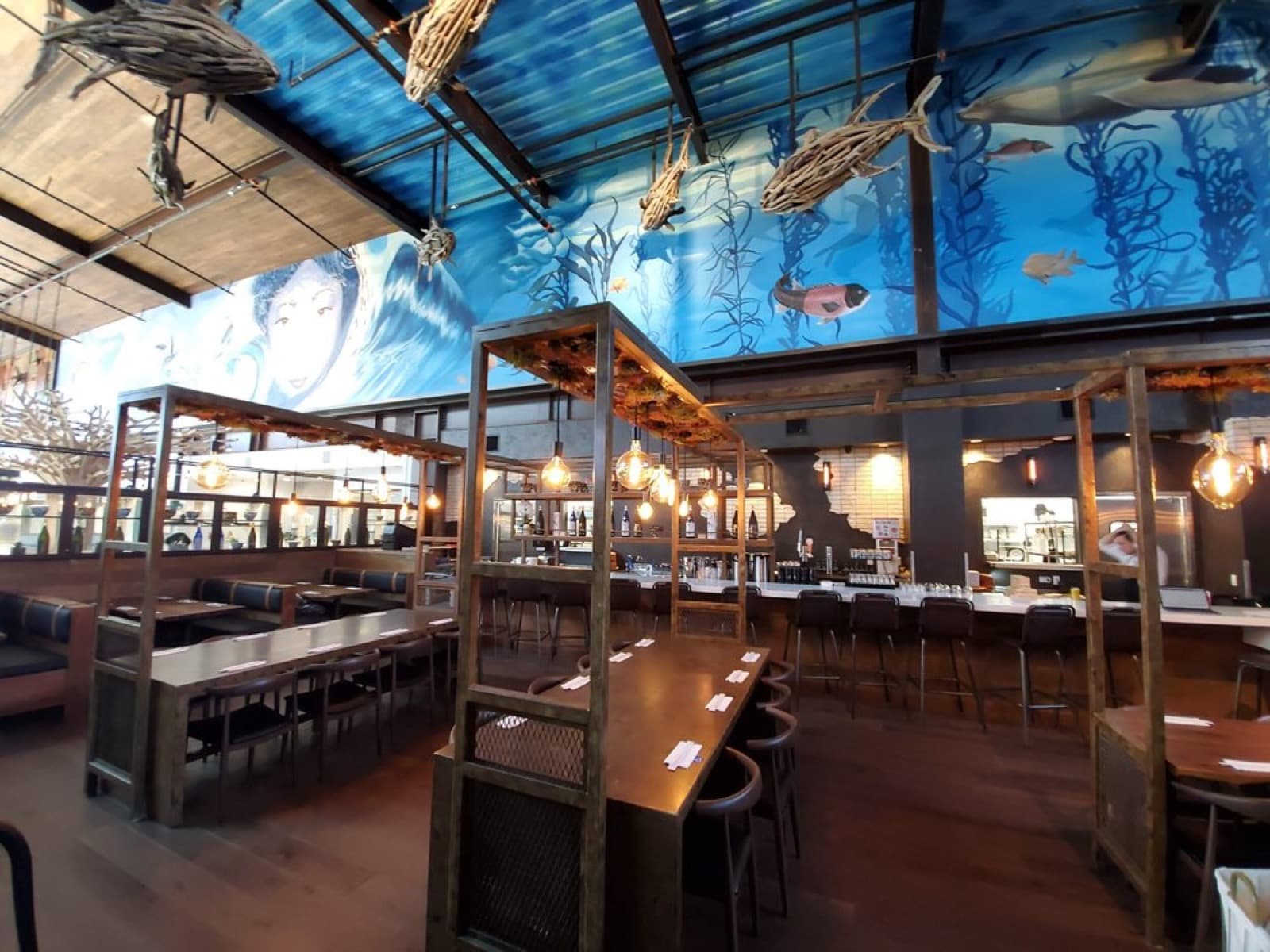
The famous Japantown line orders from a menu with only four core bowls. The restraint is the design.
Menu-craft grade
A tight, four-bowl signature menu with a few high-value customization choices and a clean DX anchor reads as confident and easy to order from.
Graded on how well the menu uses behavioral economics, not the food.
Menu and prices verified September 2026
A 3-minute audio read of the analysis
- Type
- Independent
- Where
- San Francisco, Japantown (Japan Center)
- Cuisine
- Japanese, Hakata tonkotsu ramen
- Footprint
- Flagship in SF Japantown; group has expanded to several locations
- Since
- 2017
- Ownership
- Marufuku Ramen group (independent, founder-led)
The mechanics, drawn
The same menu, mapped onto an axis, so the behavioral move is something you can see, not just read.
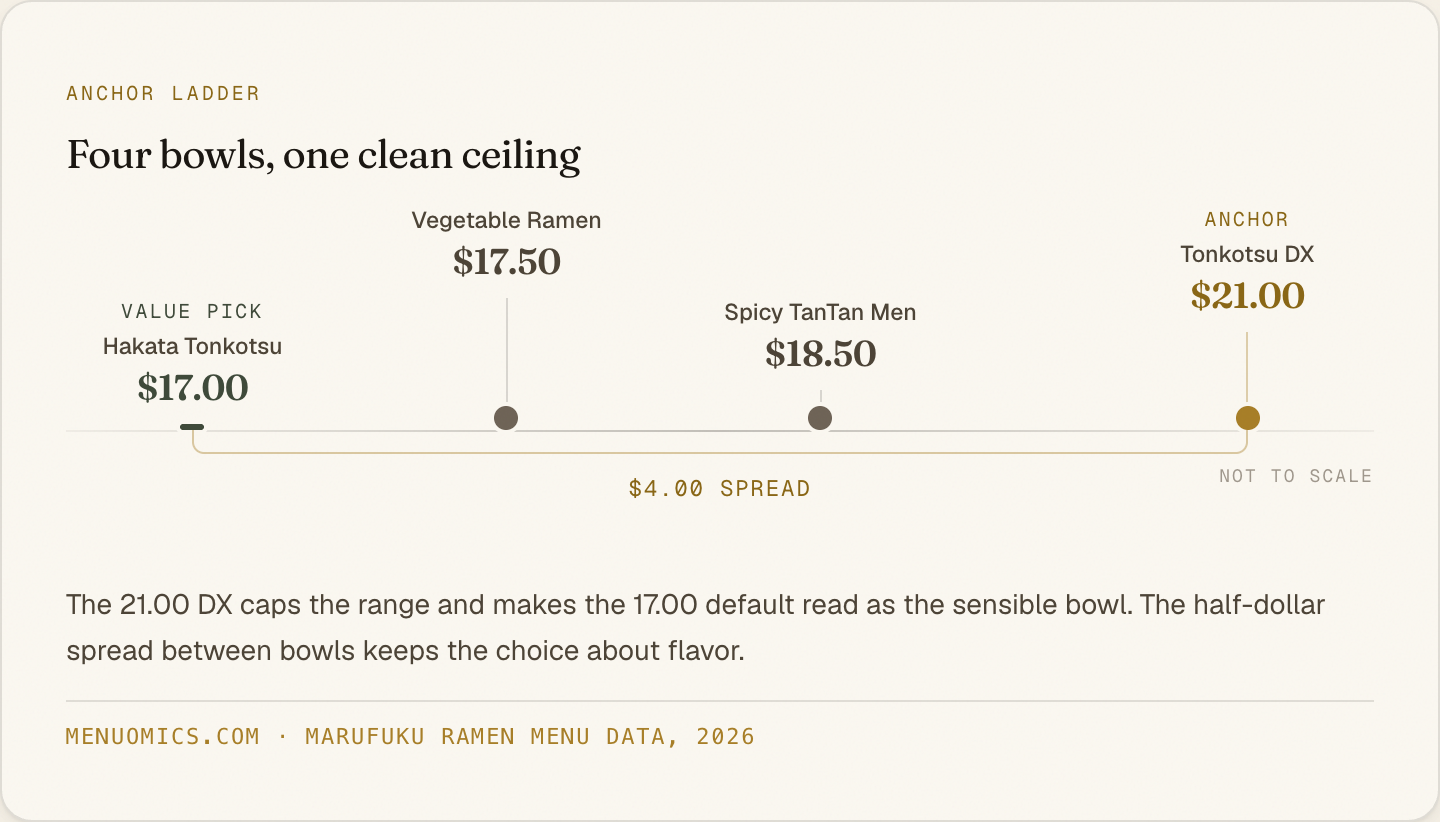
Four bowls, one clean ceiling
The 21.00 DX caps the range and makes the 17.00 default read as the sensible bowl. The half-dollar spread between bowls keeps the choice about flavor.
Build the bowl in small parts
The base bowl carries the price; the refill and extra broth are broken out as tiny named line items so the total feels lighter.
Download this chart (PNG) · free to reuse with credit, see reuse terms.
The setup
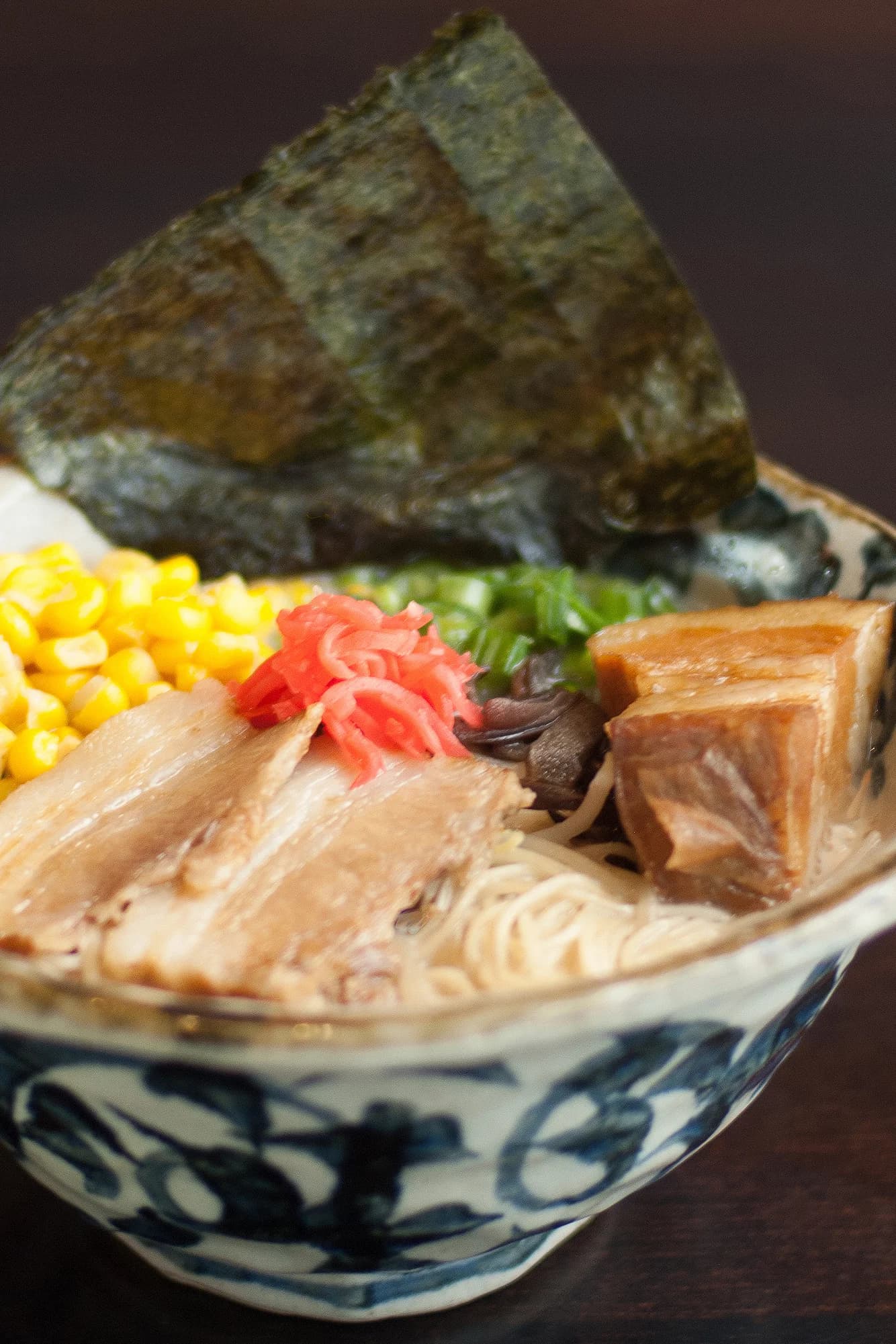
Marufuku opened in SF Japantown in 2017 serving Hakata-style tonkotsu: a milky pork broth simmered over 20 hours, ultra-thin artisanal noodles, and chashu from selected pork, in the restaurant's own description. The core menu is deliberately small: four bowls, Hakata Tonkotsu, Chicken Paitan, Spicy TanTan Men, and a Vegetable Ramen with spinach noodles.
Inside that small set, the menu hands you a few specific dials: noodle firmness, a spice level from not spicy to ultra spicy, and a kae-dama noodle refill. The behavioral setup is the contrast: a famously long line, a near-binary entree choice, and just enough personalization to make the bowl feel like yours.
What they get right
The behavioral economics already at work.
A four-bowl menu beats a fifty-bowl menu
The core menu is four ramen. A short, well-curated set is associated with easier decisions and more satisfied buyers than a sprawling one; the effect here is faster ordering for a line that is often out the door.
Large assortments can suppress purchase satisfaction versus small ones, Iyengar and Lepper, 2000 (choice overload)
The DX is the anchor
The Hakata Tonkotsu DX at $21.00 sits four dollars above the $17.00 standard. A visible high-end version makes the mid bowl read as the reasonable, generous default rather than the cheap one.
A higher reference price pulls choices toward the middle option, Simonson and Tversky, 1992 (compromise effect)
Customization is partitioned, not bundled
Firmness and spice are free dials, while noodles, broth, and refills are broken out as small named line items ($1.75 kae-dama, $6.50 extra broth). Splitting add-ons into small parts is associated with lower perceived total cost than one large number.
Partitioned add-ons reduce perceived total spend, Morwitz, Greenleaf and Johnson, 1998 (partitioned pricing)
Round prices, no charm endings
Prices are round or half-dollar with no .99 charm pricing ($17.00, $18.50, $21.00). Clean, non-charm prices are associated with a quality-and-craft signal rather than a discount signal, which fits a 20-hour broth.
Round, non-charm prices read as quality cues, Cornell, Yang and Kimes 2009 (drop the dollar sign)
The line is the menu's loudest item
Reviewers repeatedly cite the line out the door, then conclude the wait is justified. Visible queues function as social proof and raise expected value before a single bowl is read.
Visible queues raise perceived value of the wait, Rory Sutherland, the countdown clock
What we’d test
The rewrite, with the expected lift and the honest caveat.
Name the firmness and spice scales on the menu
Print the noodle-firmness and spice options as a short labeled scale on the menu, with the house default marked, rather than leaving them as a verbal at-the-counter question. A marked default speeds the decision and makes the bowl feel chosen.
Expect Faster ordering and fewer at-counter clarifications for the same kitchen output.
Caveat This touches menu wording and how options are presented, not the noodles themselves, the cook, or service pace.
Place the DX directly beside the standard Tonkotsu
List the $21.00 DX immediately adjacent to the $17.00 Hakata Tonkotsu so the upgrade and its anchor are read together, instead of separated on the layout.
Expect Stronger framing of the $17.00 bowl as the default and a measurable lift in DX selection share.
Caveat This is item ordering and adjacency on the menu only, not portioning, plating, or recipe.
Section kae-dama and toppings as an Add to your bowl strip
Group kae-dama, extra noodle, and extra broth under one clearly labeled add-on section so the small partitioned prices are seen as enhancements to the bowl already chosen.
Expect Higher add-on attach rate, especially the $1.75 kae-dama, without raising headline bowl prices.
Caveat This touches menu sectioning and labeling, not kitchen prep, portion size, or staffing.
What diners actually say
Synthesized from public reviews, the reality check that grounds every recommendation.
They praise
- Broth rated rich, milky, and worth the wait, 5 of 5 on the ramen alone for many reviewers
- Ultra-thin Hakata noodles and chashu consistently called out as standouts
- Soft egg included in the bowl read as good value
- Customization of firmness and spice makes the bowl feel personal
They criticize
- Long lines and waits out the door are the most common complaint
- Prices run a little high for ramen at $17 and up per bowl
- Small core menu can feel limited for larger or repeat groups
The verdict
Marufuku runs a near-textbook constrained menu: four confident bowls, a clean $21.00 DX anchor over a $17.00 default, and customization split into small, legible add-ons rather than a build-your-own free-for-all. The menu-design upside is that this same restraint, anchor adjacency, a marked-default firmness and spice scale, and a tidy kae-dama add-on section, can lift upgrade and attach rates without touching the kitchen or the famous line.
Common questions
- Why does Marufuku Ramen have only four bowls?
- The core menu is four bowls: Hakata Tonkotsu, Chicken Paitan, Spicy TanTan Men, and a Vegetable Ramen, which earns it an A- for confident, easy ordering. A short, well-curated set makes for faster decisions and more satisfied diners than a sprawling one, which matters for a line often out the door.
- How much is ramen at Marufuku?
- The signature Hakata Tonkotsu lists at $17.00, the Spicy TanTan Men at $18.50, and the Vegetable Ramen at $17.50, with the Chicken Paitan also at $17.00. Pricing the Paitan level with the Tonkotsu makes the choice about flavor, not cost.
- What is the Hakata Tonkotsu DX at Marufuku?
- The Hakata Tonkotsu DX is the deluxe bowl loaded with extra toppings at $21.00, four dollars above the standard $17.00 bowl. That visible high-end version acts as an anchor that makes the $17.00 Tonkotsu read as the sensible, generous default.
- What is kae-dama at Marufuku Ramen?
- Kae-dama is a Hakata-style noodle refill, fresh-boiled noodles dropped into your remaining broth, priced at just $1.75. Splitting it out as a tiny, partitioned add-on extends the meal and the ritual at almost no perceived cost, while an extra broth runs $6.50.
- Is Marufuku Ramen worth the wait?
- Marufuku holds a 4.3 of 5 on Yelp across more than 6,000 reviews, with many reviewers rating the bowls 5 of 5 on the ramen alone. The famous line itself works as social proof that raises expected value before a single bowl is read.
More breakdowns
 Zuni CafeA-
A 75.00 chicken that takes about 75 minutes, and the menu says so. A practical warning that also happens to reduce uncertainty, printed in the margin.
Read the Zuni Cafe breakdown →A 1988 supper club hidden down a Gold Street alley, where live jazz, $18 martinis and tableside theater are the product and the food only has to clear the bar the room has raised.
Read the Bix breakdown →An elegant, romantic neighborhood bistro in Lower Pacific Heights serving modern French cooking with a Californian accent, from chef JP Carmona and the B Patisserie team.
Read the Routier breakdown →The James Beard 'America's Classic' that builds its whole reputation on what it leaves out: no rice, six meats, one price, off-menu dorado.
Read the La Taqueria breakdown →A Tenderloin Creole institution where one cheap, famous beignet gets bundled into a four-way Flight that quietly triples the check.
Read the Brenda's French Soul Food breakdown → NopaA
NopaAA 2006 Divisadero gathering place whose daily wood-fired menu prints prices as plain numbers, no dollar signs, no cents, anchored by a 49 brisket.
Read the Nopa breakdown →Your menu next
Get this for your own menu, free.
Send your menu and we’ll send back the same breakdown, what you get right, what we’d test, and why.
Tony's Pizza Napoletana
A 13-time world pizza champion runs seven ovens and a dozen named styles, then prints a hard daily cap on the hero pies. The scarcity is on the page.
Read it →