
Domino's menu, graded
A value deal whose real job is to make you buy two things, not one
Domino's sells on price, but the lever is structural. A deal you can only take by buying two things, ordered through a cart built to add a third.
Menu-craft grade
A self-bundling deal engine: the $6.99 Mix & Match forces a two-or-more decision, the digital cart turns every order into an add-on ladder, and a public 'Moreflation' value signal anchors the whole menu as a bargain. Held back by aggressive partitioned-pricing surcharges (toppings, premium crusts, a class-action over the deal's fine print) that can make the headline feel like bait.
Graded on how well the menu uses behavioral economics, not the food.
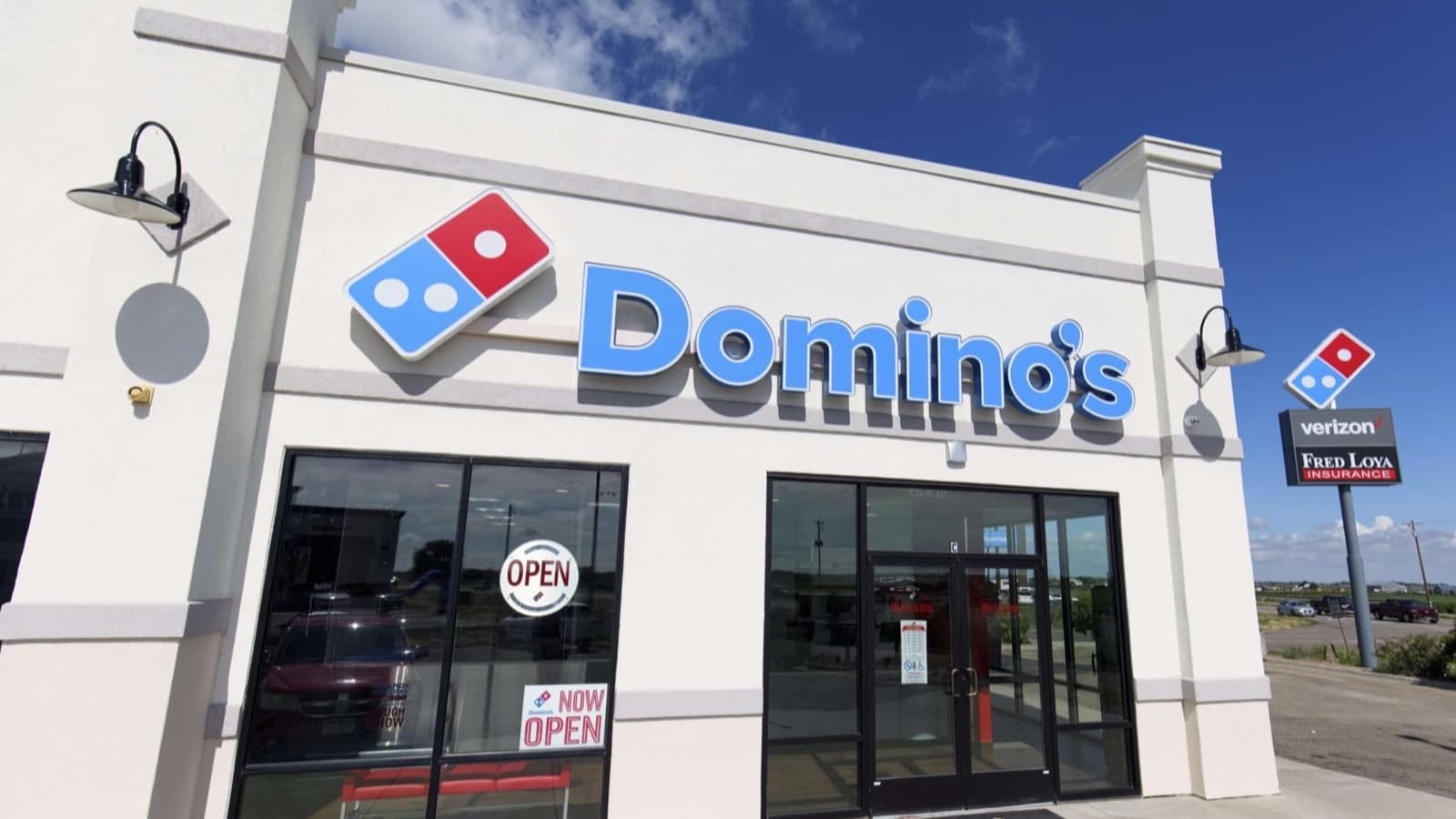
Menu and prices verified September 2026
A 3-minute audio read of the analysis
- Type
- Chain
- Where
- Ann Arbor, MI
- Cuisine
- Pizza delivery / carryout
- Footprint
- 21,000+ stores worldwide (~6,800 US)
- Since
- 1960
- Ownership
- Nasdaq: DPZ (transferred from NYSE Jan 2025)
The mechanics, drawn
The same menu, mapped onto an axis, so the behavioral move is something you can see, not just read.
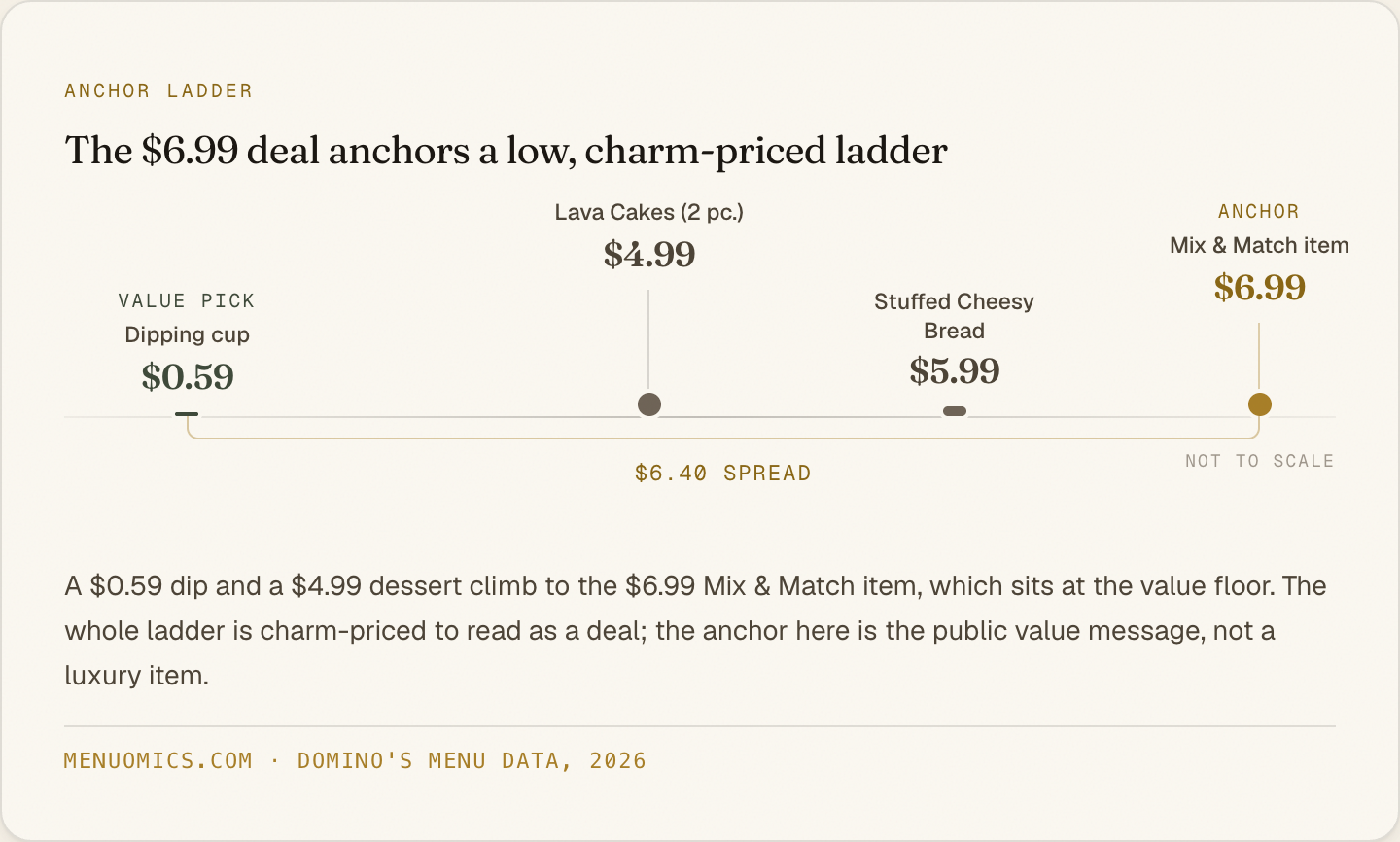
The $6.99 deal anchors a low, charm-priced ladder
A $0.59 dip and a $4.99 dessert climb to the $6.99 Mix & Match item, which sits at the value floor. The whole ladder is charm-priced to read as a deal; the anchor here is the public value message, not a luxury item.
Download this chart (PNG) · free to reuse with credit, see reuse terms.
The full ticket
What it actually rings up to.
The headline price is only the start. The real number is the journey from a base order to the check at the register, one easy yes at a time.
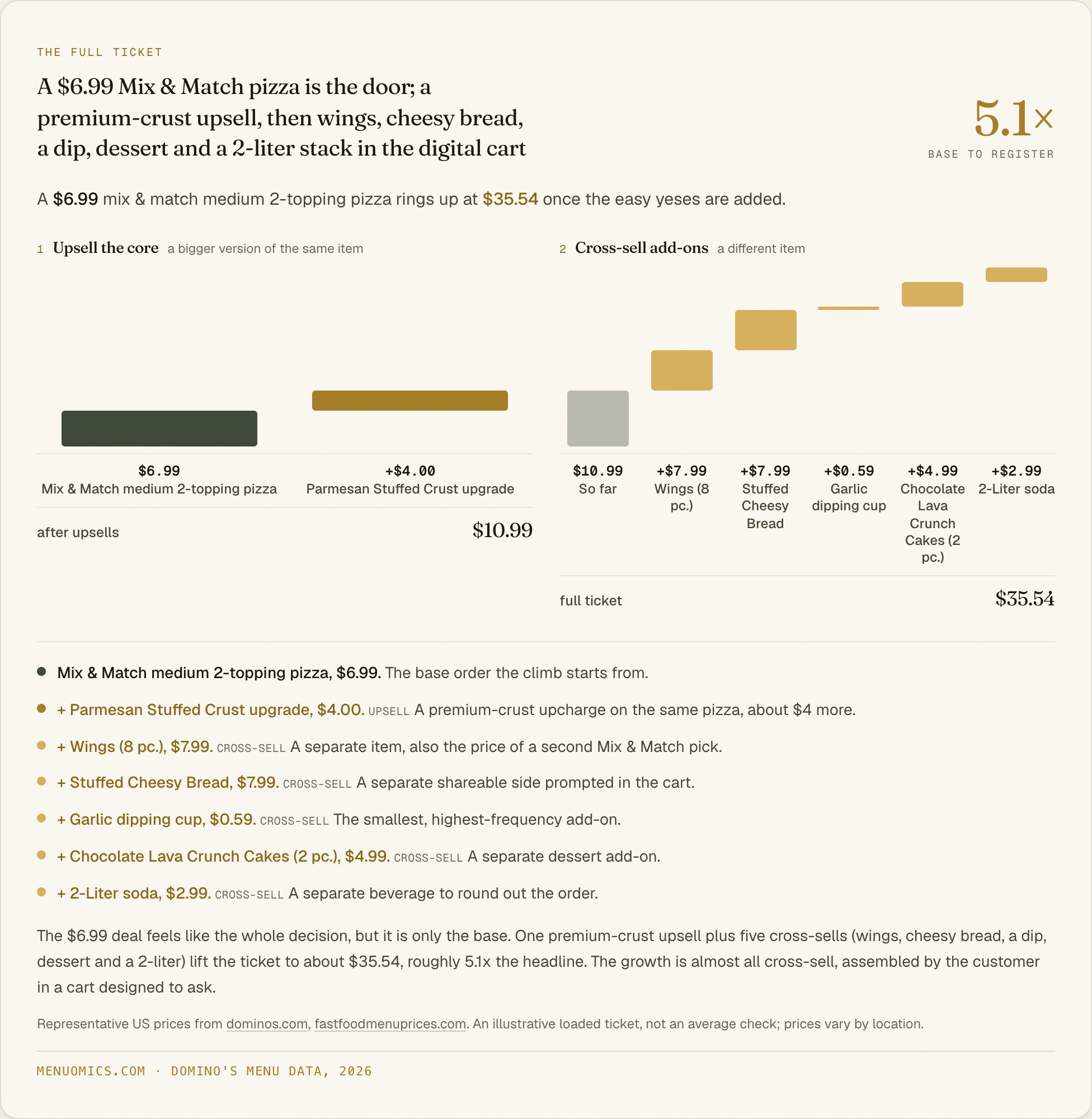
A $6.99 Mix & Match pizza is the door; a premium-crust upsell, then wings, cheesy bread, a dip, dessert and a 2-liter stack in the digital cart
A $6.99 mix & match medium 2-topping pizza rings up at $35.54 once the easy yeses are added.
- Mix & Match medium 2-topping pizza, $6.99. The base order the climb starts from.
- + Parmesan Stuffed Crust upgrade, $4.00. upsell A premium-crust upcharge on the same pizza, about $4 more.
- + Wings (8 pc.), $7.99. cross-sell A separate item, also the price of a second Mix & Match pick.
- + Stuffed Cheesy Bread, $7.99. cross-sell A separate shareable side prompted in the cart.
- + Garlic dipping cup, $0.59. cross-sell The smallest, highest-frequency add-on.
- + Chocolate Lava Crunch Cakes (2 pc.), $4.99. cross-sell A separate dessert add-on.
- + 2-Liter soda, $2.99. cross-sell A separate beverage to round out the order.
The $6.99 deal feels like the whole decision, but it is only the base. One premium-crust upsell plus five cross-sells (wings, cheesy bread, a dip, dessert and a 2-liter) lift the ticket to about $35.54, roughly 5.1x the headline. The growth is almost all cross-sell, assembled by the customer in a cart designed to ask.
Representative US prices from dominos.com, fastfoodmenuprices.com. An illustrative loaded ticket, not an average check; prices vary by location.
Download this chart (PNG) · free to reuse with credit, see reuse terms.
The setup
Domino's headline mechanic is the Mix & Match deal: select items (a medium 2-topping pizza, sides, desserts) are $6.99 each when you buy two or more. The price is the hook; the binding condition is 'two or more.' One pizza is not the deal. The deal is the bundle, and the menu makes you assemble it yourself. (Domino's does not state this as intent; this is our reading of the observed design.)
Run that through the all-digital ordering flow, where most US orders now originate, and a $6.99 entry point becomes a structured add-on ladder: pick two, then the cart offers wings, Stuffed Cheesy Bread, a dipping cup, Lava Cakes and a 2-liter, each a small yes after the first commitment. The interesting part is not the low price. It is what 'two or more' and a cart do to the size of the order.
What they get right
The behavioral economics already at work.
'Two or more' is a self-assembled bundle
The Mix & Match price only unlocks at two items, so the deal cannot be taken without building an order. A single combined value frame ('everything's $6.99') hurts less than itemized prices, and it converts the default order from one pizza into two-plus items before any add-ons. The customer assembles the bundle that a combo menu would normally pre-build.
Thaler, mental accounting; 'segregate gains, integrate losses'
The cart is an add-on ladder
Domino's runs the most digital-heavy ordering flow in pizza; the majority of US sales are digital. Once two items are in the cart, each subsequent prompt (wings, cheesy bread, a $0.59 dip, Lava Cakes, a 2-liter) is a small additional yes after a larger initial commitment, which is exactly the condition under which add-ons convert best.
Freedman & Fraser 1966 (foot-in-the-door)
'Moreflation' is the value anchor
Rather than anchor on a single luxury item, Domino's anchors on a public claim: a 'Moreflation' campaign positioning the brand against shrinkflation. A loud, framed value message sets a reference point ('this place is the deal') that makes every line on the menu read as fair, the same job a high-price anchor does in reverse.
value framing sets the reference point for the whole menu, anchoring; Tversky & Kahneman 1974
Charm pricing all the way down
Deals at $6.99 / $7.99, sides at $5.99 / $4.99 / $2.99, dips at $0.59: the menu uses 9-endings at nearly every line. Charm endings signal 'deal' and fit a value/casual room. This is the correct call for the positioning, not a default; a prestige room would price round, but Domino's should not.
Schindler & Naipaul on round-vs-charm pricing
Partitioned surcharges keep the headline low
Toppings (roughly $1.50 to $3.00 each by size) and premium-crust upgrades (a Parmesan Stuffed Crust runs about $4 more) sit on top of the $6.99 base, keeping the advertised number low while building the ticket. The risk is the well-known reversal: a class-action argued the Mix & Match framing was deceptive, which is what happens when partitioned pricing reads as a hidden upcharge rather than an honest add-on.
Morwitz et al. 1998; Burman & Biswas 2007
What we’d test
The rewrite, with the expected lift and the honest caveat.
Show the bundled total alongside the per-item price
On the deal page, name the most common Mix & Match combinations and print the bundled total ('2 mediums, $13.98') next to the $6.99-each line, so the two-or-more condition reads as a clear bundle rather than fine print. This both integrates the price and pre-empts the 'deceptive' reading that drew the class action.
Expect Higher deal take rate with fewer 'why is it more than $6.99' complaints
Caveat A menu-copy and pricing-presentation change only; it does not change the deal terms, the items or the price.
Present each cart add-on as a small, plain upcharge
In the add-on step, show toppings and premium-crust upgrades as explicit, modest line items ('+ Stuffed Crust $4') rather than rolling them silently into a re-quoted total. Partitioned pricing only keeps working while the surcharge feels worth it and visible; the moment it feels sneaky it backfires.
Caveat A presentation change to how add-ons are displayed; no change to the prices or the items themselves.
Morwitz et al. 1998; Burman & Biswas 2007
Engineer the build-your-own middle
On the build-your-own and size step, order the sizes so the size Domino's most wants to sell sits as the reasonable middle between a too-small and a too-large option, letting extremeness aversion do the work the deal page cannot.
Expect Mix shift toward the target size
Caveat A layout and ordering change only; it does not alter portions, prices or recipes.
What diners actually say
Synthesized from public reviews, the reality check that grounds every recommendation.
They praise
- Genuine low entry price
- Fast, reliable digital ordering
- Broad menu of sides and add-ons
- Frequent, legible deals
They criticize
- Mix & Match fine print drew a class action
- Toppings and crust upgrades add up fast
- Prices vary widely by franchise
- Quality reads as value-tier, not premium
The verdict
Read as menu design, Domino's is a value-priced room running a quietly structural play: a $6.99 deal that only unlocks at two items, a digital cart built as an add-on ladder, charm pricing top to bottom that correctly signals 'deal,' and a public 'Moreflation' message that anchors the whole menu as a bargain. The on-page work left is honesty under the same mechanics: print the bundled total beside the per-item price, show each add-on as a small plain upcharge, and engineer a clear middle size, so the partitioned surcharges stop reading as bait and the deal reads as the genuine value it can be.
Common questions
- Why does a Domino's order get so expensive?
- A loaded Domino's cart reaches about $35.54, roughly 5.1x the $6.99 Mix & Match headline. The $6.99 deal only unlocks at two or more items, so the price forces a self-assembled bundle, then the digital cart prompts wings, cheesy bread, a $0.59 dip, dessert and a 2-liter, each a small yes after the first commitment.
- How does the Domino's Mix & Match deal work?
- Mix & Match is $6.99 each when you buy two or more select items, so one pizza is not the deal. The binding condition is 'two or more,' which converts the default order from one pizza into a two-plus-item bundle the customer assembles themselves before any add-ons.
- Is the Domino's $6.99 deal a good value?
- The $6.99 entry price is genuinely low and earns a B+, but toppings (about $1.50 to $3.00 each) and a premium-crust upgrade (a Parmesan Stuffed Crust runs about $4 more) sit on top to keep the headline low. A class action argued the Mix & Match framing was deceptive, which is the risk when partitioned surcharges read as hidden upcharges.
- What is Domino's cheapest add-on?
- The garlic dipping cup is $0.59, the smallest and highest-frequency add-on in the cart. It is the kind of near-trivial yes that converts best once two items are already committed in the digital order.
- How much is a meal at Domino's?
- A meal at Domino's starts around $6.99 for the base order and lands near $35.54 once the usual add-ons go on, roughly 5.1x the headline price (representative 2026 US figures; they vary by location). That gap between the price that gets you in and the total you pay is the multiplier this page grades.
Head to head
More breakdowns
 Papa John'sB
A pizza chain that has sold on 'Better Ingredients' since 1995, then hands you a free garlic dipping sauce and a whole pepperoncini in every box. The premium story and the free ritual do most of the persuading before you taste the pizza.
Read the Papa John's breakdown → In-N-Out BurgerA
Three burgers, no seasonal items, and a famous off-menu modifier ('Animal Style') that turns customers into evangelists. Restraint as strategy.
Read the In-N-Out Burger breakdown → Chick-fil-AA
A famously simple chicken sandwich, an easy 'make it a meal' bundle, and free dipping sauces, wrapped in the most-praised service in fast food. The menu stays out of the way so the hospitality can do the selling.
Read the Chick-fil-A breakdown → Chili's Grill & BarA-
A $10.99 bundle dragged Chili's out of a slump and back to the top of casual-dining traffic. Read closely, '3 For Me' is one round number doing the work of three separate decisions.
Read the Chili's Grill & Bar breakdown → Jersey Mike'sB+
Numbered subs in three sizes, a free signature modifier called 'Mike's Way,' and a Giant pitched as the smart-value pick. The size ladder, not the combo, is where the menu does its work.
Read the Jersey Mike's breakdown → Logan's RoadhouseB
A steakhouse that reviewers rank dead last still runs a value menu most casual chains would be proud of. The food is panned; the menu design is not. That gap is the whole point.
Read the Logan's Roadhouse breakdown →Your menu next
Get this for your own menu, free.
Send your menu and we’ll send back the same breakdown, what you get right, what we’d test, and why.
Jersey Mike's
Numbered subs in three sizes, a free signature modifier called 'Mike's Way,' and a Giant pitched as the smart-value pick. The size ladder, not the combo, is where the menu does its work.
Read it →