Logan's Roadhouse menu, graded
Change the menu, not the kitchen: a competent value-menu design under a low-rated room
Our thesis is change the menu, not the kitchen. Logan's is the clean test: a 2.6-star room with a menu that is quietly doing competent behavioral work.
Menu-craft grade
A genuinely well-engineered value menu under a panned kitchen: complimentary peanuts and bottomless rolls decouple eating from paying, a $11.99 three-course bundle integrates losses and sets a hard value anchor, and a steak ladder runs from a sub-$11 sirloin floor to a ~$27 Porterhouse. Held back by no descriptive copy where the food most needs reframing, and a top steak that is left to fend for itself with no anchor above it on the steak page.
Graded on how well the menu uses behavioral economics, not the food.
Menu and prices verified September 2026
A 3-minute audio read of the analysis
- Type
- Chain
- Where
- Nashville, TN
- Cuisine
- American steakhouse, casual
- Footprint
- ~130 locations
- Since
- 1991
- Ownership
- SSCP Management (acquired from SPB Hospitality, March 2026)
The mechanics, drawn
The same menu, mapped onto an axis, so the behavioral move is something you can see, not just read.
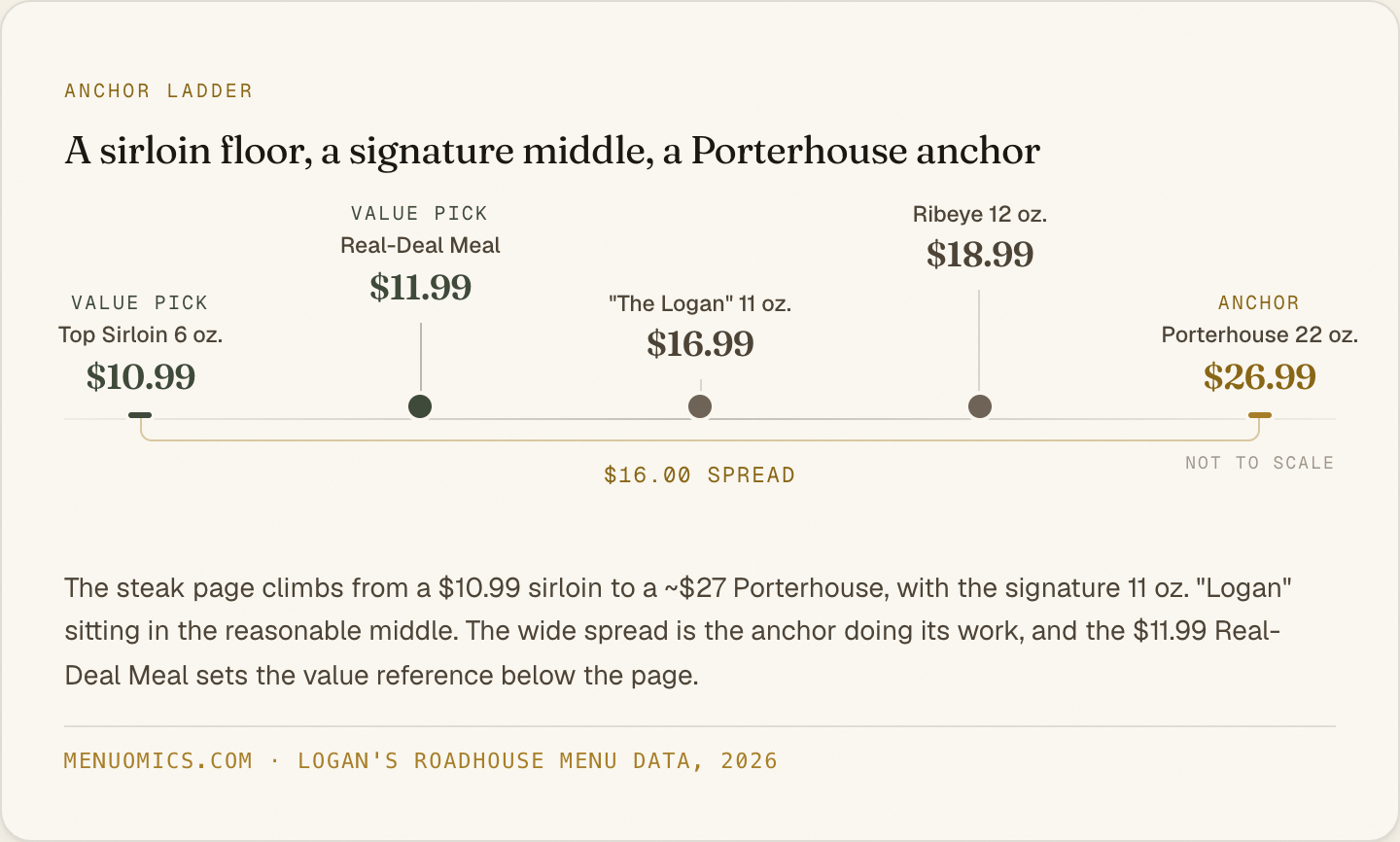
A sirloin floor, a signature middle, a Porterhouse anchor
The steak page climbs from a $10.99 sirloin to a ~$27 Porterhouse, with the signature 11 oz. "Logan" sitting in the reasonable middle. The wide spread is the anchor doing its work, and the $11.99 Real-Deal Meal sets the value reference below the page.
Download this chart (PNG) · free to reuse with credit, see reuse terms.
The setup
Logan's Roadhouse is one of the lowest-rated steakhouse chains in the country: 2.6 stars across roughly 14,700 Yelp reviews, and a 2024 Tasting Table ranking of thirteen steakhouse chains put it dead last. The complaints are about the kitchen and the floor: overdone steaks, slow service, long waits. None of that is a menu-design problem.
That is exactly why it is a useful case study. Menu design is separable from food quality, and a badly-reviewed room is the sharpest way to show it. Read only as a piece of paper, Logan's menu runs several of the same levers the well-rated chains in this catalog run: decoupled refills, an integrated bundle, a clear value anchor and a charm-priced floor. The kitchen and the menu are graded separately here, and only the menu is on trial.
What they get right
The behavioral economics already at work.
The free peanuts and bottomless rolls decouple eating from paying
In-shell peanuts on the table and bottomless yeast rolls mean the meter is off before the entree even arrives. Free, unmetered food does the same work here as Olive Garden's breadsticks: it makes the rest of the check feel like fair value and it gives the table something to do during the long waits reviewers complain about. Read as design, it is a loss-leader buying a feeling, not just a snack.
Prelec & Loewenstein, "The Red and the Black," 1998; we read this as effect, the chain does not state it as intent
The $11.99 three-course meal integrates the bill
The Real-Deal Meal folds a salad, an entree, a side and a drink into one round-feeling $11.99 number instead of a column of separate charges. One combined price hurts less than four itemized ones, and "three courses for less than a drive-thru order" is a value claim the chain markets directly.
a single bundled price is felt as one loss, not several, Thaler, mental accounting, "segregate gains, integrate losses"
The bundle sets a hard value anchor for the page
An $11.99 full sit-down meal sets a low reference point that the rest of the menu is read against, so an $18.99 ribeye reads as a deliberate step up rather than as expensive. The value floor is doing reference-point work for everything above it.
anchoring; Tversky & Kahneman 1974
The specials run on a clock, the menu does not
Around the always-on core sit time-boxed deals: $9.99 lunch specials (11am to 4pm), American Roadhouse Meals at $10.99 (3 to 6pm), and a Wednesday sirloin special. Each carves out a different daypart and a different diner, the lunch crowd, the early-bird, the midweek regular, without touching the main menu's prices. Time-boxing turns a discount into a reason to come on a specific day.
limited-time and daypart framing raises perceived value, Worchel et al. 1975 (scarcity); read as effect, not stated intent
Charm pricing is the right call for this room
Every price ends in .99 or .49 with a visible dollar sign. For a value-positioned casual steakhouse that is correct: charm endings signal a deal and fit the audience. This is the opposite call from a premium steakhouse, which should drop the cents to read as quality, and getting the positioning right is itself a design win.
Schindler & Naipaul on round-vs-charm pricing as positioning, not a default
What we’d test
The rewrite, with the expected lift and the honest caveat.
Reset expectations with descriptive copy on the steaks
The steak lines are bare, cut, weight and method. Since reviews fault the steak, the only menu-design lever available is wording that resets what a guest expects and reads quality back into the plate: name the mesquite wood-grilling, the USDA Choice grade and the hand-cut prep in sensory language on the page, the way Cheesecake Factory writes its entrees. Descriptive labels lift perceived quality and steer the order, they do not change the kitchen.
Expect Higher perceived quality and a steadier mix at the point of choice
Caveat A menu-copy and naming change only; it does not touch how the steak is cooked, sized or sourced.
Wansink, Painter & van Ittersum, 2001; it lifts which item people pick, not what they will pay
Tag one favorite per section
Nothing on the menu is marked as popular, yet "The Logan" sirloin and the yeast rolls are the chain's best-known items. A single "guest favorite" tag per section, aimed at the value-seeking, infrequent diner this chain draws, applies social proof exactly where it works hardest.
Expect Higher attach on the tagged items, especially among first-timers
Caveat A naming and labeling change only; one per section, if everything is a favorite, nothing is.
Cai, Chen & Fang, AER 2009, strongest on infrequent customers
Give the steak page a clear good/better/best
The steaks run from a $10.99 sirloin to a ~$27 Porterhouse, but the page does not visibly stage them as a ladder. Ordering and grouping them as a deliberate good/better/best, with "The Logan" as the reasonable middle, makes the dish the chain most wants to sell the natural compromise choice.
Expect Mix shift toward the signature middle cut
Caveat A layout and ordering change only; no change to cuts, prices or portions.
What diners actually say
Synthesized from public reviews, the reality check that grounds every recommendation.
They praise
- The free in-shell peanuts and bottomless yeast rolls are a genuine, well-loved value mechanic
- The $11.99 three-course Real-Deal Meal is an honestly strong bundle for the price
- Charm pricing is correctly matched to the value positioning
- A clear value floor that makes the rest of the menu read as fair
They criticize
- Steaks are frequently reported overdone or inconsistent (a kitchen issue, not a menu one)
- Slow service and long waits come up repeatedly in reviews
- Steak descriptions are bare where the food most needs reframing
- No social-proof or popularity cues anywhere on the page
The verdict
Logan's Roadhouse is the cleanest illustration of our thesis: change the menu, not the kitchen. The room is panned, 2.6 stars, last of thirteen steakhouse chains, but the menu itself is doing competent behavioral work: free peanuts and bottomless rolls decouple eating from paying, an $11.99 three-course bundle integrates the bill and sets a hard value anchor, the specials run on a daypart clock, and charm pricing fits the value positioning. The design gains left are on the page, not in the kitchen: descriptive copy that resets steak expectations, one social-proof tag per section, and a steak ladder staged as a clear good/better/best.
Common questions
- Is Logan's Roadhouse any good?
- Logan's earns a B for menu design even though reviewers rank it dead last of thirteen steakhouse chains at 2.6 Yelp stars across roughly 14,700 reviews. The complaints are about the kitchen and slow service, not the menu, which is separable: read as a piece of paper, the menu runs competent value mechanics.
- Is the Logan's Roadhouse Real-Deal Meal a good value?
- The Real-Deal Meal starts at $11.99 for a salad, an entree, a side, a drink and the bottomless rolls, and it is an honestly strong bundle. One combined price hurts less than four separate charges, and the low $11.99 floor sets a value anchor that makes an $18.99 ribeye read as a deliberate step up, not as expensive.
- What is the cheapest steak at Logan's Roadhouse?
- The 6 oz Center-Cut Top Sirloin is about $10.99, the value floor of the steak page, which climbs to a 22 oz Porterhouse near $27. The free in-shell peanuts and bottomless yeast rolls turn the meter off before the entree even arrives, making the rest of the check feel like fair value.
- Why are Logan's Roadhouse prices charm-ended at .99?
- Every Logan's price ends in .99 or .49 with a visible dollar sign, which is the correct call for a value-positioned casual steakhouse. Charm endings signal a deal and fit the audience, the opposite of a white-tablecloth steakhouse that drops the cents to read as premium.
- What is the most expensive item at Logan's Roadhouse?
- On the standard menu, the priciest single item is the 22 oz. Porterhouse, about $26.99 in representative 2026 US pricing (it varies by location; group packs and combo deals can cost more). That top price also does quiet work as the menu's anchor: it is the number that makes everything below it read as reasonable.
Sources (8)
- Logan's Roadhouse, official menu
- Logan's Roadhouse, Real-Deal Meal
- RestaurantNews, Logan's three-course Real-Deal Meal for less than fast food (Mar 2025)
- Tasting Table, the steakhouse chain not worth visiting (Logan's, ranked last of 13)
- Yelp, Logan's Roadhouse brand reviews (2.6 stars)
- Cornell, removing the "$" lifted spend ~8%/person (Yang, Kimes & Sessarego, 2009)
- Descriptive labels +27% sales, Wansink, Painter & van Ittersum, 2001
- "Most popular" tags +13-20%, Cai, Chen & Fang, AER 2009
Head to head
More breakdowns
 Texas RoadhouseB
Free fresh-baked rolls with cinnamon butter and a bucket of peanuts land before you order. Read as menu design, that is decoupling: the meter is off before the first price is read.
Read the Texas Roadhouse breakdown → In-N-Out BurgerA
Three burgers, no seasonal items, and a famous off-menu modifier ('Animal Style') that turns customers into evangelists. Restraint as strategy.
Read the In-N-Out Burger breakdown → Chick-fil-AA
A famously simple chicken sandwich, an easy 'make it a meal' bundle, and free dipping sauces, wrapped in the most-praised service in fast food. The menu stays out of the way so the hospitality can do the selling.
Read the Chick-fil-A breakdown → Chili's Grill & BarA-
A $10.99 bundle dragged Chili's out of a slump and back to the top of casual-dining traffic. Read closely, '3 For Me' is one round number doing the work of three separate decisions.
Read the Chili's Grill & Bar breakdown → Domino'sB+
The $6.99 Mix & Match looks like a low price. Its real design is the words 'two or more': a self-bundle that turns one cheap pizza into a full cart.
Read the Domino's breakdown → Jersey Mike'sB+
Numbered subs in three sizes, a free signature modifier called 'Mike's Way,' and a Giant pitched as the smart-value pick. The size ladder, not the combo, is where the menu does its work.
Read the Jersey Mike's breakdown →Your menu next
Get this for your own menu, free.
Send your menu and we’ll send back the same breakdown, what you get right, what we’d test, and why.
Texas Roadhouse
Free fresh-baked rolls with cinnamon butter and a bucket of peanuts land before you order. Read as menu design, that is decoupling: the meter is off before the first price is read.
Read it →