Jersey Mike's menu, graded
The size ladder is the engine: a Giant priced as 'best value per inch' makes the Regular the safe middle, while a free named modifier carries the brand
Jersey Mike's runs the In-N-Out playbook with one more lever: a three-rung size ladder that lets the menu upsell you without ever calling it an upsell.
Menu-craft grade
A clean three-tier size ladder (Mini/Regular/Giant) and a free signature modifier ('Mike's Way') that does the same identity work In-N-Out's 'Animal Style' does, both legible and well executed; held back by a board that reads as a numbered price-comparison list and a combo that is bolted on rather than engineered as the default the way the best chains do it.
Graded on how well the menu uses behavioral economics, not the food.
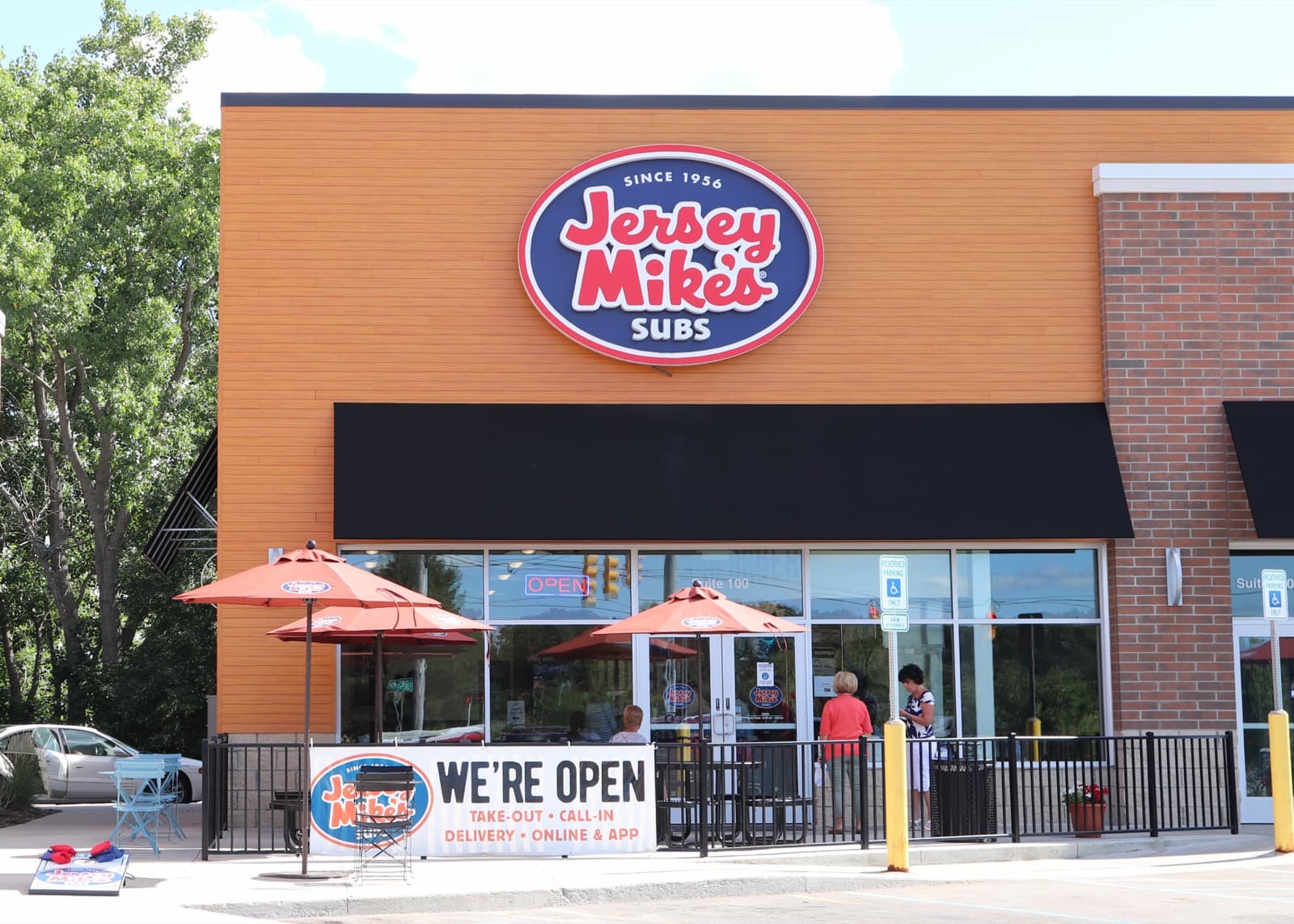
Menu and prices verified September 2026
A 3-minute audio read of the analysis
- Type
- Chain
- Where
- Manasquan, NJ
- Cuisine
- Fast casual, sub sandwiches
- Footprint
- 3,300+ locations (US and Canada, mid-2026)
- Since
- 1956 (as Mike's Subs); Cancro bought it 1975, franchised from 1987
- Ownership
- Public since July 2026 (NYSE: JMKE, ~$1B IPO at $23/share); Blackstone, majority owner since Jan 2025, retains control (Peter Cancro founder)
The mechanics, drawn
The same menu, mapped onto an axis, so the behavioral move is something you can see, not just read.
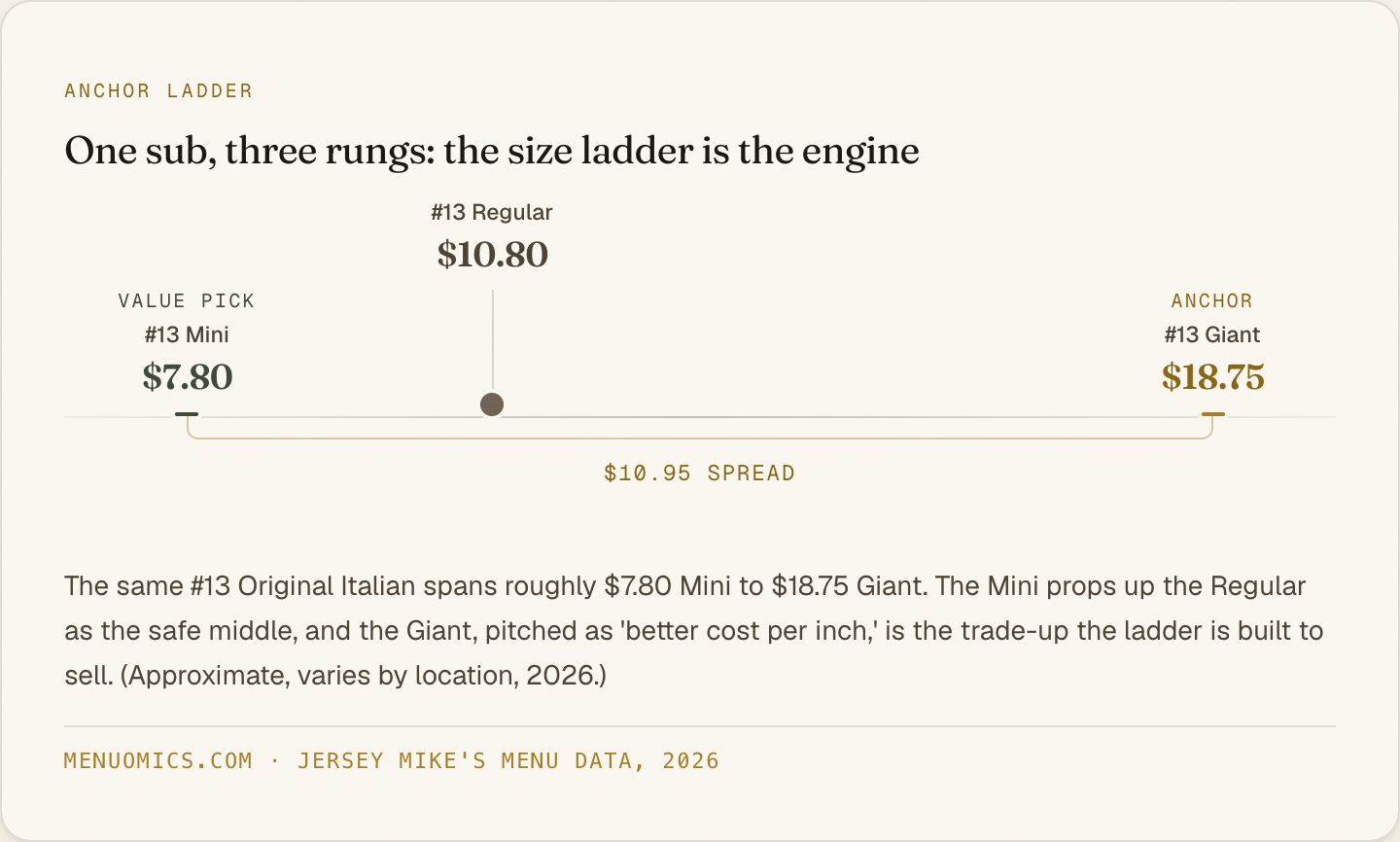
One sub, three rungs: the size ladder is the engine
The same #13 Original Italian spans roughly $7.80 Mini to $18.75 Giant. The Mini props up the Regular as the safe middle, and the Giant, pitched as 'better cost per inch,' is the trade-up the ladder is built to sell. (Approximate, varies by location, 2026.)
Download this chart (PNG) · free to reuse with credit, see reuse terms.
The full ticket
What it actually rings up to.
The headline price is only the start. The real number is the journey from a base order to the check at the register, one easy yes at a time.
Size up the sub, then add chips, a drink and a cookie
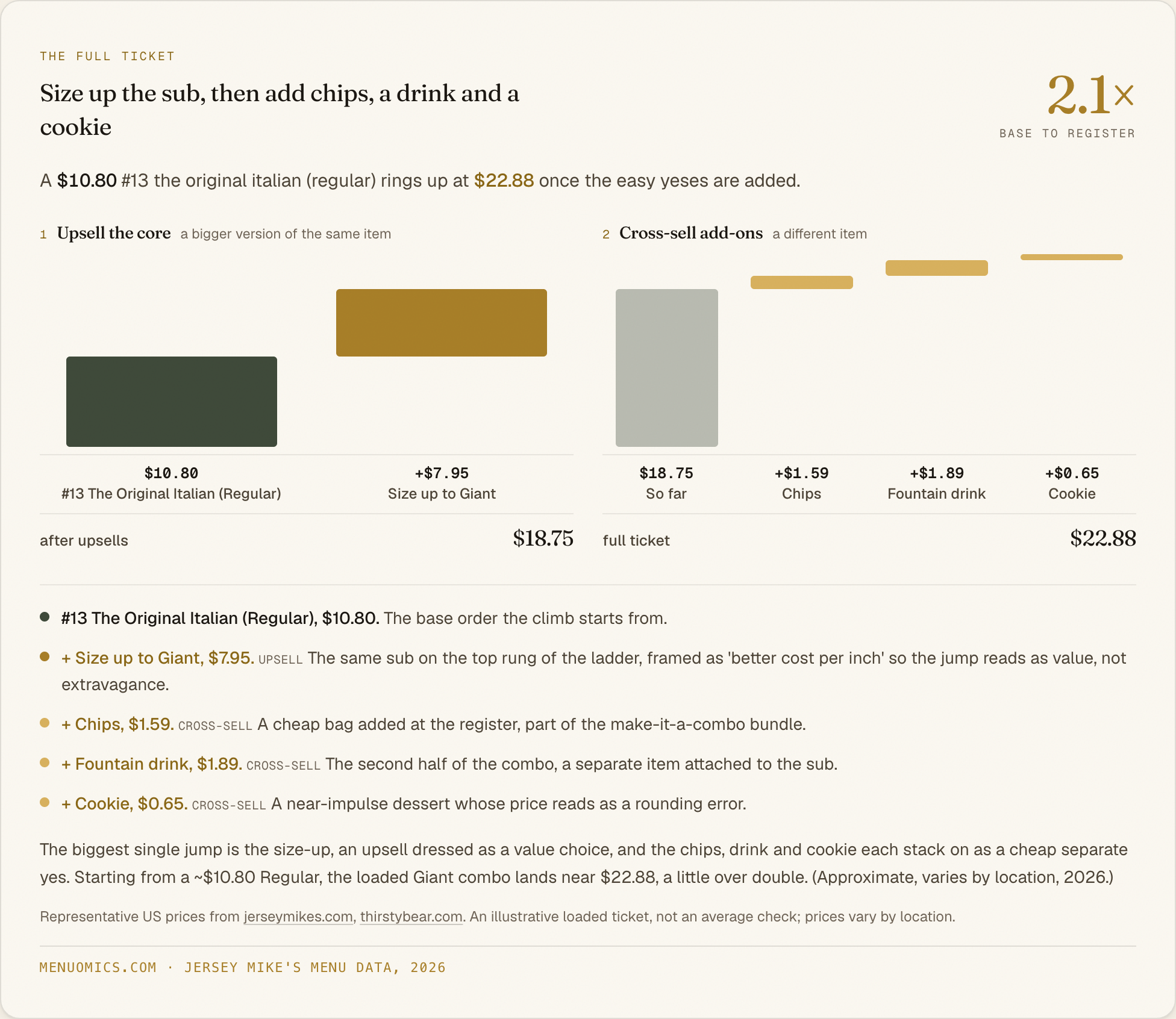
A $10.80 #13 the original italian (regular) rings up at $22.88 once the easy yeses are added.
- #13 The Original Italian (Regular), $10.80. The base order the climb starts from.
- + Size up to Giant, $7.95. upsell The same sub on the top rung of the ladder, framed as 'better cost per inch' so the jump reads as value, not extravagance.
- + Chips, $1.59. cross-sell A cheap bag added at the register, part of the make-it-a-combo bundle.
- + Fountain drink, $1.89. cross-sell The second half of the combo, a separate item attached to the sub.
- + Cookie, $0.65. cross-sell A near-impulse dessert whose price reads as a rounding error.
The biggest single jump is the size-up, an upsell dressed as a value choice, and the chips, drink and cookie each stack on as a cheap separate yes. Starting from a ~$10.80 Regular, the loaded Giant combo lands near $22.88, a little over double. (Approximate, varies by location, 2026.)
Representative US prices from jerseymikes.com, thirstybear.com. An illustrative loaded ticket, not an average check; prices vary by location.
Download this chart (PNG) · free to reuse with credit, see reuse terms.
The setup
Jersey Mike's sells sub sandwiches by number ('#13 The Original Italian') in three sizes, Mini, Regular and Giant, plus a Wrap. Every cold sub can be ordered 'Mike's Way,' the founder's free topping set: onions, lettuce, tomatoes, red wine vinegar, olive oil, oregano and salt. The chain traces 'Mike's Way' to Michael Ingravallo, the original 'Jersey Mike,' and the recipe of the 1950s and 60s family shop. (Source: Jersey Mike's history; Tasting Table.)
The behavioral spine here is the size ladder. Where In-N-Out flattens its board to three near-equal burgers, Jersey Mike's spreads each sub across three price rungs and lets guides pitch the Giant as 'better cost per inch.' That turns the Regular into a comfortable middle and the Giant into a 'treat yourself / feed two' justification. 'Mike's Way' then does the In-N-Out 'Animal Style' job: a named, free, insider way to order that customers teach each other. The chain does not state all of this as intent; this is the read of the observed design.
What they get right
The behavioral economics already at work.
The size ladder is the upsell that never says 'upsell'
Three rungs, Mini, Regular, Giant, turn a single buying decision into a choose-your-tier decision. The Mini makes the Regular feel like the sensible middle, and the Giant, pitched as 'better cost per inch,' supplies a value justification to trade up. The menu lets you spend more while feeling like you got the smart deal, which is more durable than a hard upsell.
the compromise effect, Simonson 1989; extreme-aversion / decoy framing, Ariely
'Mike's Way' is a free named modifier that builds belonging
Like In-N-Out's 'Animal Style,' 'Mike's Way' is not a separate SKU; it is a way to order any sub, and it is free. Naming the founder's topping set gives customers an insider phrase they teach friends and a provenance story ('the original Jersey Mike's recipe') that reassures. The word does the work a paid premium topping could not.
word-of-mouth / observational learning; Sutherland on reassurance and provenance; Jersey Mike's history
Numbered subs cut the decision cost
Ordering '#13' instead of reciting six cured meats lowers the effort of choosing and speeds the line, and the number becomes a memorable handle people reorder by. The numbering is a fluency aid that also quietly standardizes the most profitable builds at the top of the list.
processing-fluency and choice-friction research
The Giant cheesesteak is the anchor the board is priced against
A Giant Big Kahuna near $19.35 is the high line most guests scan past. It sets the ceiling, so a ~$10.80 Regular #13 reads as moderate rather than expensive. The priciest item rarely sells most, but it reframes everything cheaper than it.
anchoring; Tversky and Kahneman 1974
What we’d test
The rewrite, with the expected lift and the honest caveat.
State the Giant's value case in words on the board
The size ladder already does the work, but a single line such as 'Giant feeds two' or 'best value, Giant' names the justification the guide currently has to supply out loud. Putting the value frame in the menu's own words makes the trade-up feel like the guest's idea. This is wording on an existing size, not a new item or a price change.
Expect More Regular-to-Giant trade-ups, since the value reason is stated where the choice is made
Caveat Menu wording only: it labels a size that already exists, it does not change prices or portions.
Lead the cold-sub section with the combo as one line, not an afterthought
Right now 'make it a combo' reads as an add-on to a sandwich price, so the three charges stay partitioned. Presenting the sub-plus-chips-plus-drink as a single named combo line, with the a la carte sub set smaller beneath, integrates the bill into one less-painful number the way the strongest chains do. This is a layout and item-ordering change, not a price change.
Expect Higher combo attach, because the integrated price is read first
Caveat Menu layout and ordering only: it does not change prices, portions, or the food.
Hold charm cents on the add-ons, keep the subs clean
Charm endings ($0.65 cookie, $1.59 chips) earn their keep on the cheap tack-ons where a deal signal helps; the subs themselves should not turn the board into a price-comparison column of cents. Keep the small cross-sells in charm and let the sub prices sit quietly, so the eye stays on the food and the size choice, not on comparing numbers.
Expect The board reads as food and sizes, not as a price list, while the add-ons still read as easy value
Caveat Pricing-presentation only: this is about how numbers are formatted on the board, not what is charged.
What diners actually say
Synthesized from public reviews, the reality check that grounds every recommendation.
They praise
- Subs sliced fresh to order
- Genuine generosity on free toppings ('Mike's Way' and extras at no charge
- Giant size is a real value for sharing
- 'Mike's Way' is a brand people teach their friends
They criticize
- Prices have climbed; a loaded Giant combo gets expensive
- Lines can be slow at peak because everything is made to order
- The combo feels bolted on rather than the obvious default
The verdict
Jersey Mike's menu is quietly well engineered: a three-rung size ladder lets it upsell without ever naming an upsell, and 'Mike's Way' runs the same free-named-modifier play that makes In-N-Out's board sing. The menu-design upside is small and surgical: put the Giant's value case in the board's own words, present the combo as one integrated line instead of an add-on, and keep charm cents on the tack-ons while letting the sub prices stop reading as a comparison list. The structure is already doing the work; the wording just needs to say so.
Common questions
- Is Jersey Mike's worth the price?
- Jersey Mike's earns a B+, with the #13 Original Italian about $10.80 in a Regular and a free 'Mike's Way' topping set on any cold sub. The subs are sliced fresh to order, and the free named modifier does the same brand-building work as In-N-Out's 'Animal Style,' an insider phrase customers teach each other.
- How much do Jersey Mike's sizes cost?
- The #13 Original Italian runs about $7.80 Mini, $10.80 Regular and $18.75 Giant. The three-rung size ladder is the engine: the Mini makes the Regular feel like the safe middle, and the Giant, pitched as 'better cost per inch,' is the trade-up the ladder is built to sell.
- How expensive does a Jersey Mike's combo get?
- A loaded Giant combo lands near $22.88, a little over double the $10.80 Regular, about a 2.1x climb. The biggest jump is the size-up to Giant, an upsell dressed as a value choice, then chips, a drink and a cookie each stack on as a cheap separate yes.
- What is 'Mike's Way' at Jersey Mike's?
- 'Mike's Way' is a free way to order any cold sub: onions, lettuce, tomatoes, red wine vinegar, olive oil, oregano and salt, the founder's set, added at no charge. It is not a separate item but a named, free, insider order that builds belonging and reassures with a provenance story.
- What is the most expensive item at Jersey Mike's?
- On the standard menu, the priciest single item is the #56 Big Kahuna Cheese Steak (Giant), about $19.35 in representative 2026 US pricing (it varies by location; group packs and combo deals can cost more). That top price also does quiet work as the menu's anchor: it is the number that makes everything below it read as reasonable.
Head to head
More breakdowns
 In-N-Out BurgerA
Three burgers, no seasonal items, and a famous off-menu modifier ('Animal Style') that turns customers into evangelists. Restraint as strategy.
Read the In-N-Out Burger breakdown → Chick-fil-AA
A famously simple chicken sandwich, an easy 'make it a meal' bundle, and free dipping sauces, wrapped in the most-praised service in fast food. The menu stays out of the way so the hospitality can do the selling.
Read the Chick-fil-A breakdown → Chili's Grill & BarA-
A $10.99 bundle dragged Chili's out of a slump and back to the top of casual-dining traffic. Read closely, '3 For Me' is one round number doing the work of three separate decisions.
Read the Chili's Grill & Bar breakdown → Domino'sB+
The $6.99 Mix & Match looks like a low price. Its real design is the words 'two or more': a self-bundle that turns one cheap pizza into a full cart.
Read the Domino's breakdown → Logan's RoadhouseB
A steakhouse that reviewers rank dead last still runs a value menu most casual chains would be proud of. The food is panned; the menu design is not. That gap is the whole point.
Read the Logan's Roadhouse breakdown → Texas RoadhouseB
Free fresh-baked rolls with cinnamon butter and a bucket of peanuts land before you order. Read as menu design, that is decoupling: the meter is off before the first price is read.
Read the Texas Roadhouse breakdown →Your menu next
Get this for your own menu, free.
Send your menu and we’ll send back the same breakdown, what you get right, what we’d test, and why.
Logan's Roadhouse
A steakhouse that reviewers rank dead last still runs a value menu most casual chains would be proud of. The food is panned; the menu design is not. That gap is the whole point.
Read it →