Papa John's menu, graded
Sell on 'better ingredients' to justify the premium, then make a free garlic sauce and a pepperoncini the signature ritual nobody else owns
How a quality slogan, a free garlic sauce, and a Papa Dough currency that expires in 60 days keep a specialty pizza feeling worth the premium.
Menu-craft grade
A coherent quality-signal play: the 'Better Ingredients' story since 1995 justifies a specialty premium, and the free garlic sauce plus pepperoncini in every box is one of the best low-cost signature rituals in pizza, cheap to give and hard to copy. Held back by a value engine (the $6.99 Papa Pairings deal) that mirrors Domino's rather than leading, a Papa Dough currency that leans on a 60-day expiry, and a brand still working through the fallout of the 2018 founder controversy and the sales decline behind a 300-store closure plan.
Graded on how well the menu uses behavioral economics, not the food.
Menu and prices verified September 2026
A 4-minute audio read of the analysis
- Type
- Chain
- Where
- Louisville / Jeffersontown, Kentucky (with an Atlanta global HQ)
- Cuisine
- Pizza delivery / carryout
- Footprint
- ~3,500 US restaurants (~6,000 worldwide, 2026)
- Since
- 1984 (Jeffersonville, Indiana; founder John Schnatter)
- Ownership
- Public, Nasdaq: PZZA (IPO 1993)
The mechanics, drawn
The same menu, mapped onto an axis, so the behavioral move is something you can see, not just read.
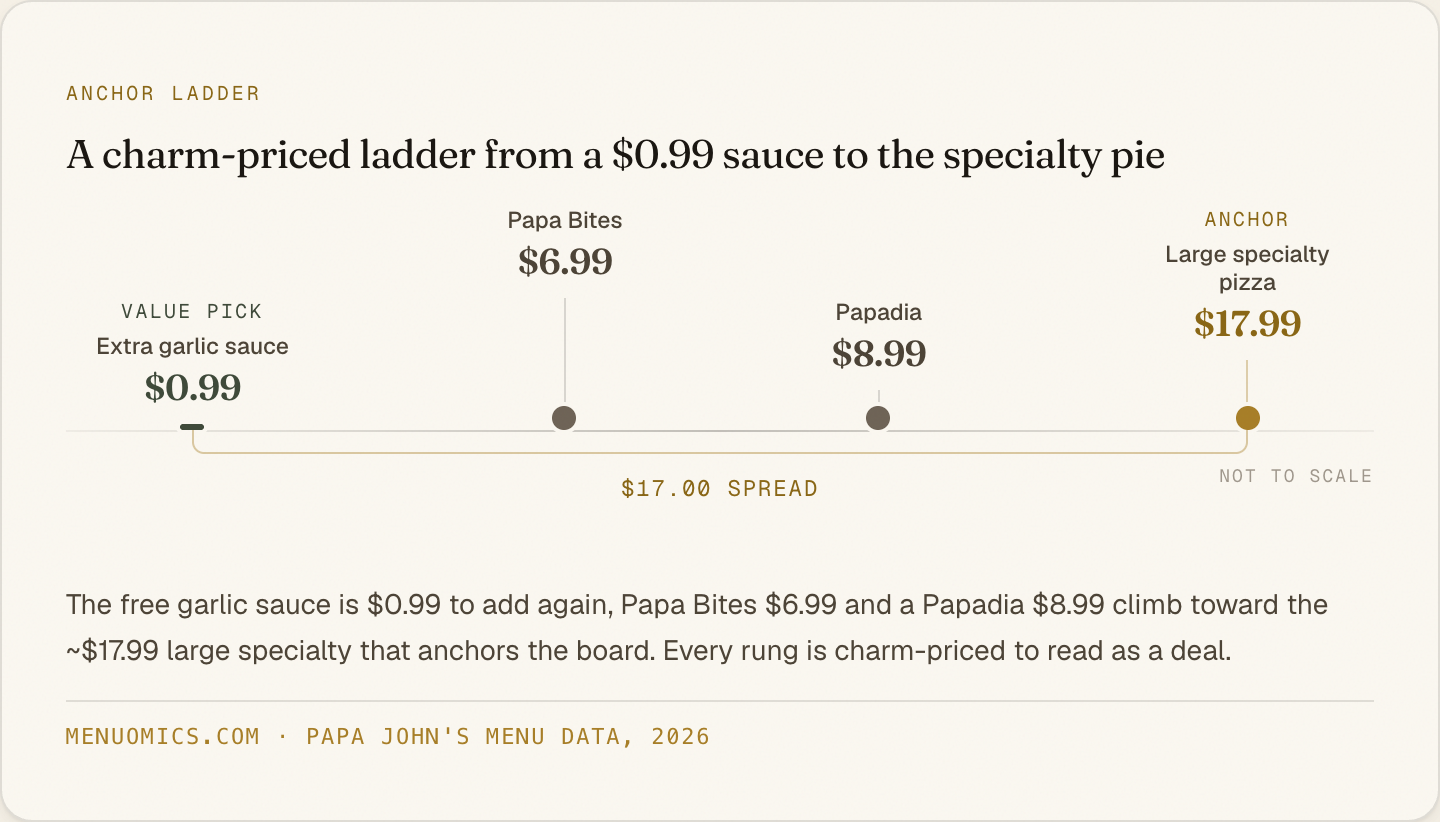
A charm-priced ladder from a $0.99 sauce to the specialty pie
The free garlic sauce is $0.99 to add again, Papa Bites $6.99 and a Papadia $8.99 climb toward the ~$17.99 large specialty that anchors the board. Every rung is charm-priced to read as a deal.
Download this chart (PNG) · free to reuse with credit, see reuse terms.
The full ticket
What it actually rings up to.
The headline price is only the start. The real number is the journey from a base order to the check at the register, one easy yes at a time.
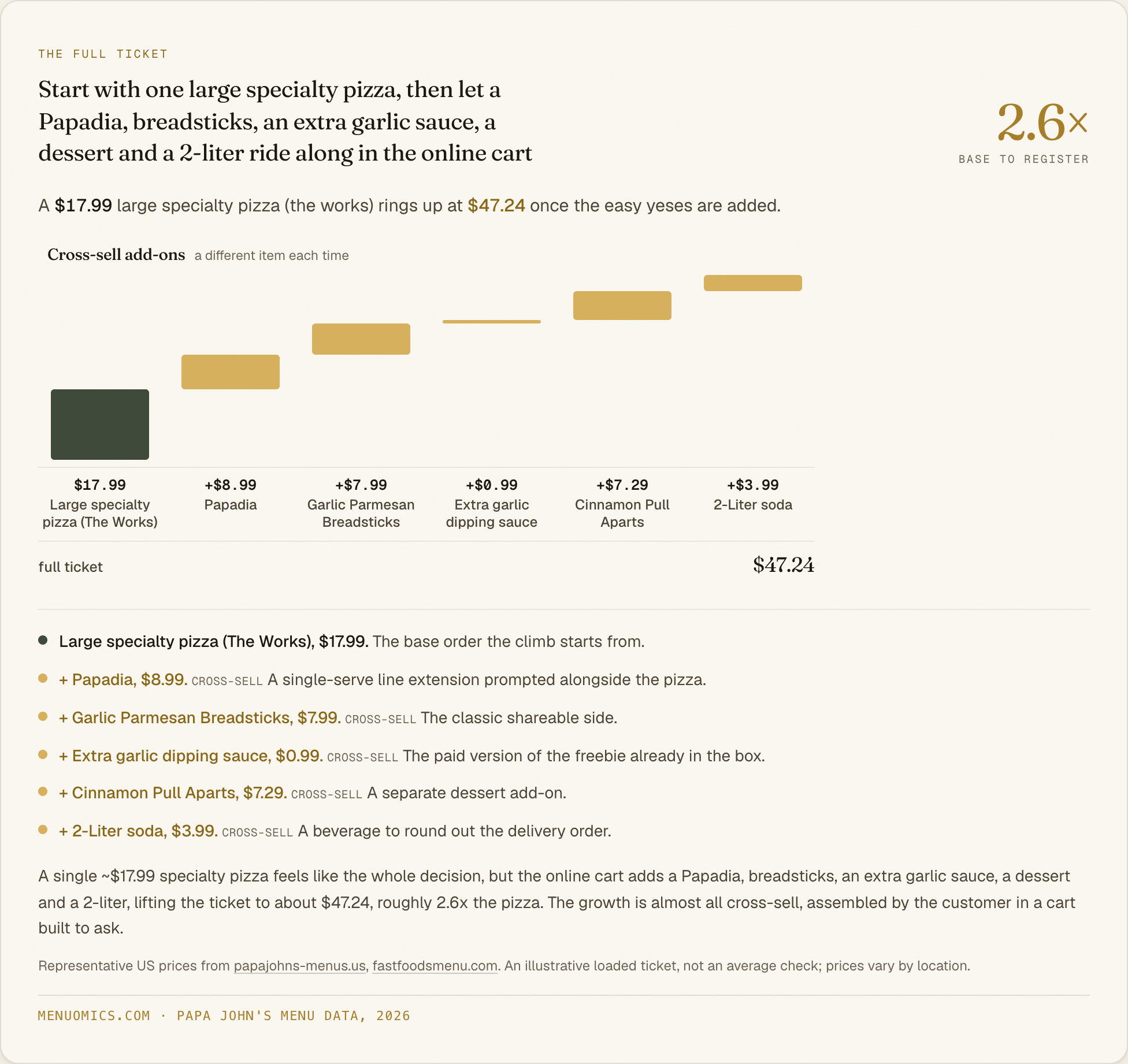
Start with one large specialty pizza, then let a Papadia, breadsticks, an extra garlic sauce, a dessert and a 2-liter ride along in the online cart
A $17.99 large specialty pizza (the works) rings up at $47.24 once the easy yeses are added.
- Large specialty pizza (The Works), $17.99. The base order the climb starts from.
- + Papadia, $8.99. cross-sell A single-serve line extension prompted alongside the pizza.
- + Garlic Parmesan Breadsticks, $7.99. cross-sell The classic shareable side.
- + Extra garlic dipping sauce, $0.99. cross-sell The paid version of the freebie already in the box.
- + Cinnamon Pull Aparts, $7.29. cross-sell A separate dessert add-on.
- + 2-Liter soda, $3.99. cross-sell A beverage to round out the delivery order.
A single ~$17.99 specialty pizza feels like the whole decision, but the online cart adds a Papadia, breadsticks, an extra garlic sauce, a dessert and a 2-liter, lifting the ticket to about $47.24, roughly 2.6x the pizza. The growth is almost all cross-sell, assembled by the customer in a cart built to ask.
Representative US prices from papajohns-menus.us, fastfoodsmenu.com. An illustrative loaded ticket, not an average check; prices vary by location.
Download this chart (PNG) · free to reuse with credit, see reuse terms.
The setup
Papa John's has run one positioning since 1995: 'Better Ingredients. Better Pizza.' Where Domino's and Little Caesars sell on price and speed, Papa John's sells on the claim that the food is made with better stuff, fresh never-frozen dough and, in its telling, heavy spending on ingredients. That story is the whole point of the specialty lineup, a board of large specialty pizzas around $14.99 to $17.99 whose premium over a plain cheese reads as quality rather than markup.
The signature move sits in the box itself. Every pizza arrives with a free garlic dipping sauce and a whole pepperoncini pepper, a ritual founder John Schnatter carried over from the sub shop where he washed dishes as a student. Underneath the premium story runs a familiar value engine, the $6.99 Papa Pairings deal (two or more items at a fixed price) and a Papa Rewards program whose Papa Dough currency expires 60 days after you earn it. (Papa John's does not frame these as behavioral tactics; this is our reading of the observed design.)
What they get right
The behavioral economics already at work.
'Better Ingredients' justifies the premium
Papa John's has anchored on 'Better Ingredients. Better Pizza.' since 1995, pointing to fresh never-frozen dough and ingredient spend. The claim's job is not to be measured but to license a higher price: when a specialty pizza is framed as better-sourced, the premium over a plain cheese reads as quality rather than markup. A credible quality story lets a menu charge more without the number feeling unfair.
slogan in use since 1995, Papa John's, 'How We Make Better Pizza'; QSR Magazine
The free garlic sauce and pepperoncini are the signature ritual
Every box ships with a free garlic dipping sauce and a whole pepperoncini, a ritual Schnatter carried from the sub shop where he worked. It costs almost nothing to include yet raises perceived value and becomes a signature no rival owns. When the chain tested removing the pepper, the backlash was severe, which is the endowment effect: customers now feel they own the freebie and resist losing it.
removing the pepper drew an 'uproar,' per the company, The Takeout; Mashed, on the pepperoncini tradition
Papa Pairings self-assembles a bundle
The $6.99 Papa Pairings deal only unlocks at two or more items, the same structure as Domino's Mix & Match. A single combined value frame ('everything is $6.99') hurts less than itemized prices, and it converts the default order from one item into two-plus before any add-ons. The customer builds the bundle a combo menu would normally pre-build, and the deal reads as value while raising the order size.
Thaler, mental accounting; 'segregate gains, integrate losses'
Papa Dough is a currency with a countdown
Papa Rewards gives 1 point per dollar, and every 10 points becomes $1 in Papa Dough. The lever is the expiry: Papa Dough lapses 60 days after you earn it. An earned balance feels owned, and a short deadline turns 'I have credit' into 'I will lose credit,' which manufactures a near-term reason to order. A currency you can forfeit drives more visits than one that simply accrues.
Papa Dough expires 60 days after it is earned, Papa John's Papa Rewards FAQ
The best prices are app-gated
The strongest deals (Papa Pairings, member-only offers, Papa Dough redemption) live online and in the app. Gating the low prices behind a login sorts price-sensitive customers into the channel where the chain owns the data and the upsell flow, while walk-ins pay closer to sticker. The same pizza can cost two customers different amounts, which is deliberate segmentation dressed as convenience.
Papa Pairings and top coupons are online/app-only, Papa John's coupons page; EatDrinkDeals (2026)
What we’d test
The rewrite, with the expected lift and the honest caveat.
Name the ingredient claims the slogan gestures at
'Better Ingredients' is a promise the menu never itemizes. On the specialty pizzas, print the specific sourced claims the brand can actually stand behind (fresh never-frozen dough, named sauce, real cheese) as short descriptive labels next to each pie, so the premium is earned by concrete detail rather than a slogan a skeptic can wave off.
Expect Higher willingness to pay the specialty premium and fewer 'what makes it better' doubts
Caveat A menu-copy change only; claims must be true and verifiable, not invented.
Wansink, Painter & van Ittersum 2001 (descriptive labels +27%)
Make the free garlic sauce visible on the menu, not just in the box
The free garlic sauce and pepperoncini are a genuine gift, but they only surprise you after purchase. State the freebie on the pizza page ('every pizza comes with a free garlic sauce and a pepperoncini') so the reciprocity registers before the buy decision, where it can actually tip the choice, instead of after the money is spent.
Expect A stronger value perception at the point of decision
Caveat A presentation change only; it does not alter what ships in the box.
Show the bundled total on Papa Pairings
Because the $6.99 price only unlocks at two items, print the common two-item total ('2 items, $13.98') next to the per-item line so the two-or-more condition reads as a clear bundle rather than fine print. This integrates the price and pre-empts the 'why is it more than $6.99' reaction that the same structure drew for Domino's.
Expect Higher deal take rate with fewer surprise-total complaints
Caveat A copy and pricing-presentation change; it does not change the deal terms or items.
What diners actually say
Synthesized from public reviews, the reality check that grounds every recommendation.
They praise
- A clear, durable quality position ('Better Ingredients') that justifies a real premium.
- The free garlic sauce and pepperoncini are a cheap, memorable signature ritual no rival owns.
- Fresh never-frozen dough gives the premium story something concrete to stand on.
- The Shaq-a-Roni pairs a size upgrade with a genuine charity donation.
- Legible charm pricing and a simple $6.99 pairings deal that anyone can reason about.
They criticize
- The value engine (Papa Pairings) mirrors Domino's Mix & Match rather than leading.
- Papa Dough leans on a 60-day expiry that pressures redemption more than it rewards loyalty.
- Prices vary widely by franchise and channel, and app-gating means two customers rarely pay the same.
- The 'Better Ingredients' claim is asserted more than itemized on the menu.
- The brand is still working through the 2018 founder controversy and a sales decline behind a 300-store closure plan.
The verdict
Read as menu design, Papa John's is the premium story of the pizza category: a 'Better Ingredients' claim it has run since 1995 to license a specialty premium, and a free garlic sauce and pepperoncini in every box that is one of the smartest low-cost signature rituals in the business, cheap to give and impossible for rivals to copy. What holds it to a B is the machinery underneath, a $6.99 pairings deal that follows Domino's instead of leading, a Papa Dough currency that leans on a 60-day countdown, and app-gated prices that fragment trust, all under a brand still recovering from the 2018 founder controversy and the sales slide behind its store closures. The signature is excellent; the value engine and the loyalty math are where the work remains.
Common questions
- Why does Papa John's put garlic sauce and a pepper in every box?
- Papa John's includes a free garlic dipping sauce and a whole pepperoncini in every pizza box as a signature ritual. Founder John Schnatter carried the pepper over from the sub shop where he worked, and when the chain once tested removing it the backlash was severe. A small free extra like this raises perceived value and gives the brand a memorable signature.
- What is the most expensive pizza at Papa John's?
- The priciest standing single item is an Epic Stuffed Crust specialty pizza, which can run past $20 in a large depending on toppings and market. Large specialty pizzas typically sit around $14.99 to $17.99. That ceiling makes an ordinary large specialty read as the sensible pick, which is the job a high anchor does on any menu.
- How does Papa Rewards and Papa Dough work?
- You earn 1 point per dollar spent online, and every 10 points converts to $1 in Papa Dough to spend on any menu item. Papa Dough expires 60 days after you earn it. The short expiry turns a loyalty balance into a reason to order again soon, which is the point of a currency you can lose.
- What does 'Better Ingredients. Better Pizza.' mean?
- It is Papa John's tagline since 1995, positioning the chain on ingredient quality rather than price. The company points to fresh never-frozen dough and says it spends heavily on ingredients. The claim's real work is to justify a specialty premium, so the price reads as quality rather than markup.
- How much is a meal at Papa John's?
- A meal at Papa John's starts around $17.99 for the base order and lands near $47.24 once the usual add-ons go on, roughly 2.6x the headline price (representative 2026 US figures; they vary by location). That gap between the price that gets you in and the total you pay is the multiplier this page grades.
Sources (6)
- Papa John's, 'Better Ingredients. Better Pizza.' (official)
- Papa John's, Papa Rewards / Papa Dough (official)
- The Takeout, why every box gets a pepperoncini
- Papa John's IR, Shaq-a-Roni 'pizza with purpose'
- Restaurant Dive, Papa John's to close 300 restaurants (2026)
- Wikipedia, Papa John's (founding, rebrand, controversy)
Head to head
More breakdowns
 Domino'sB+
The $6.99 Mix & Match looks like a low price. Its real design is the words 'two or more': a self-bundle that turns one cheap pizza into a full cart.
Read the Domino's breakdown → Olive GardenB+
Never-ending breadsticks read less like generosity than like decoupled pricing: a loss-leader and a recurring scarcity event working in concert.
Read the Olive Garden breakdown → Palmetto SuperfoodsB
A California acai chain whose menu leads with the one promise every acai shop gets accused of breaking: '100% Real Acai, every time.'
Read the Palmetto Superfoods breakdown → SweetgreenB+
The salad chain that names every bowl for its ingredients and farmers, then offers a handful of signature defaults so you don't have to build from scratch.
Read the Sweetgreen breakdown → Chipotle Mexican GrillA-
Chipotle's menu is a build-your-own assembly line with no prices on the rail, so you customize first and total up last, with guac quoted as a tidy little add-on.
Read the Chipotle Mexican Grill breakdown → StarbucksA-
Tall is the small. The names hide the ounces, the app hides the payment, and a pumpkin drink restarts the whole calendar every August. The most studied size menu in the world.
Read the Starbucks breakdown →Your menu next
Get this for your own menu, free.
Send your menu and we’ll send back the same breakdown, what you get right, what we’d test, and why.
Dutch Bros
A drive-thru coffee stand with almost no food, a nearly infinite drink builder, and a crew who come to your car window. The app gives you a free birthday drink, the stickers are free, and the secret menu is written by the customers. A habit engine dressed as a coffee cart.
Read it →