Flour + Water Pizzeria menu, graded
Sell craft and pedigree, not options: a short, confident menu at a premium price where the restraint is the signal.
Flour + Water Pizzeria runs the opposite of the chain playbook: no low anchor, no upsell grid, just a short, confident list where the restraint and the $20-plus price are the positioning.
Menu-craft grade
A ten-pie menu, five red and five white, priced in a tight $18 to $23 band, where the shortness is the pitch. Borrowed pedigree from the pasta flagship, visible dough craft behind glass, and a curated natural-wine list justify a $20-plus pizza without a single discount or upsell grid.
Graded on how well the menu uses behavioral economics, not the food.
Menu and prices verified September 2026
A 3-minute audio read of the analysis
- Type
- Independent
- Where
- North Beach, San Francisco
- Cuisine
- Neapolitan-Californian pizza
- Footprint
- 1 location
- Since
- 2023
- Ownership
- Flour + Water Hospitality Group (co-chefs Thomas McNaughton and Ryan Pollnow)
The mechanics, drawn
The same menu, mapped onto an axis, so the behavioral move is something you can see, not just read.
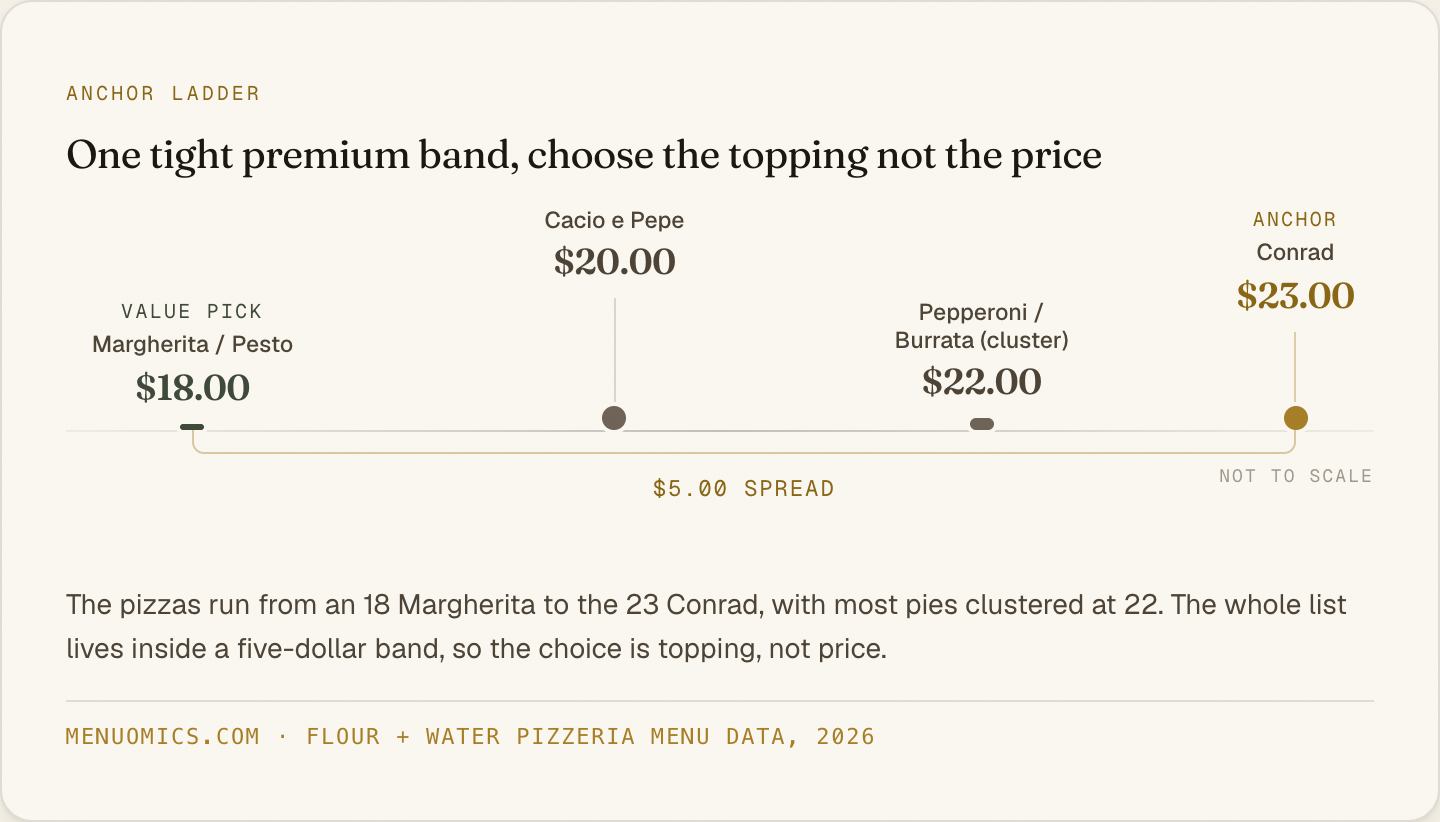
One tight premium band, choose the topping not the price
The pizzas run from an 18 Margherita to the 23 Conrad, with most pies clustered at 22. The whole list lives inside a five-dollar band, so the choice is topping, not price.
Download this chart (PNG) · free to reuse with credit, see reuse terms.
The full ticket
What it actually rings up to.
The headline price is only the start. The real number is the journey from a base order to the check at the register, one easy yes at a time.
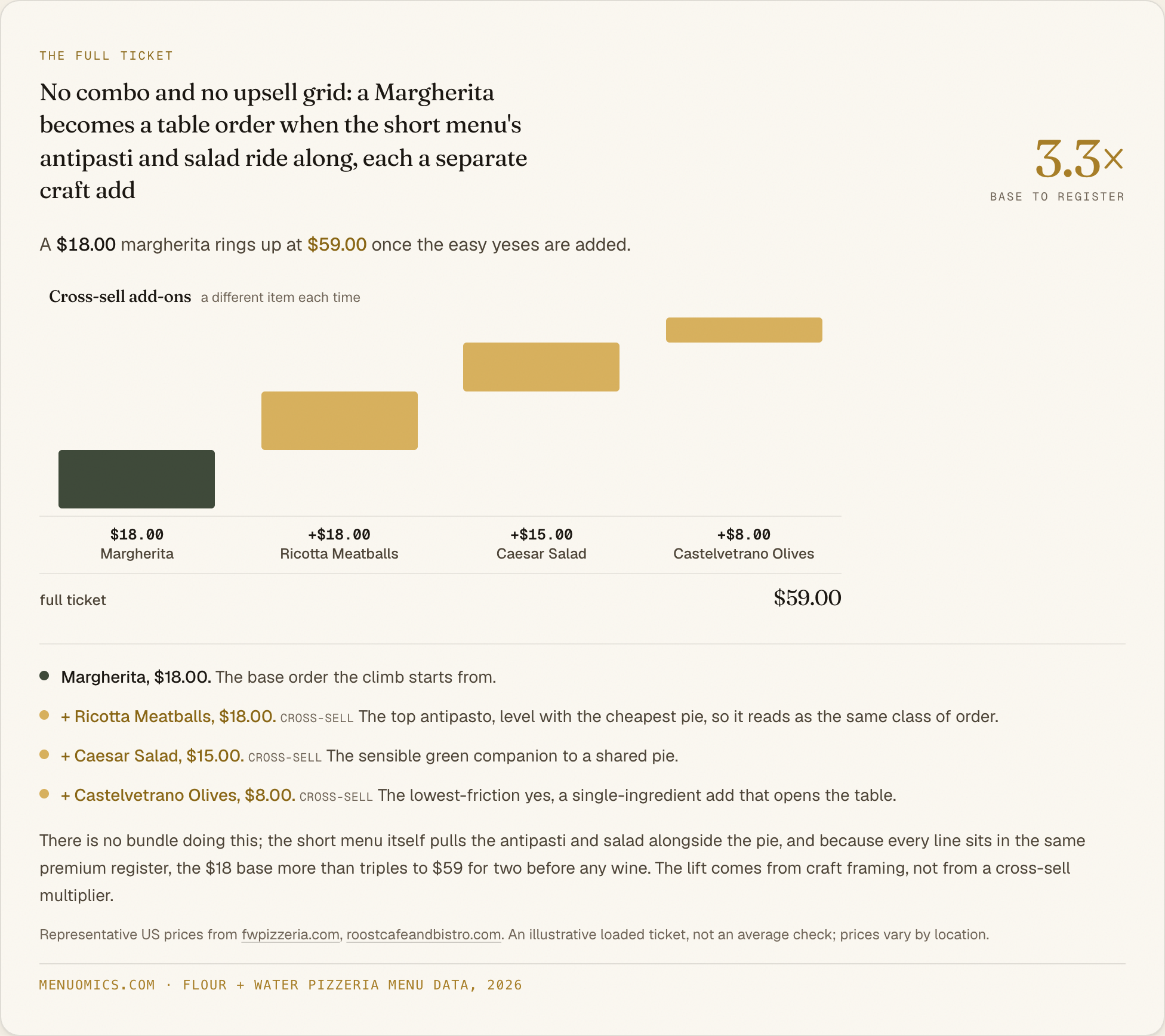
No combo and no upsell grid: a Margherita becomes a table order when the short menu's antipasti and salad ride along, each a separate craft add
A $18.00 margherita rings up at $59.00 once the easy yeses are added.
- Margherita, $18.00. The base order the climb starts from.
- + Ricotta Meatballs, $18.00. cross-sell The top antipasto, level with the cheapest pie, so it reads as the same class of order.
- + Caesar Salad, $15.00. cross-sell The sensible green companion to a shared pie.
- + Castelvetrano Olives, $8.00. cross-sell The lowest-friction yes, a single-ingredient add that opens the table.
There is no bundle doing this; the short menu itself pulls the antipasti and salad alongside the pie, and because every line sits in the same premium register, the $18 base more than triples to $59 for two before any wine. The lift comes from craft framing, not from a cross-sell multiplier.
Representative US prices from fwpizzeria.com, roostcafeandbistro.com. An illustrative loaded ticket, not an average check; prices vary by location.
Download this chart (PNG) · free to reuse with credit, see reuse terms.
The setup
Flour + Water Pizzeria opened on June 28, 2023 at 532 Columbus Avenue in North Beach, in the former Rose Pistola space, as the standalone pizza concept of the Flour + Water Hospitality Group led by co-chefs Thomas McNaughton and Ryan Pollnow. The group's flagship, the Mission pasta restaurant Flour + Water, has been one of San Francisco's most acclaimed Cal-Italian rooms since 2009, and the pizzeria trades directly on that name. The dough is naturally leavened, made from local organic wheat and fermented for at least three days, and the 4,000-square-foot room built by Lundberg Design puts a glass-walled dough room in view so guests watch the dough being made. The menu is deliberately short: five red pies and five white, a handful of antipasti and salads, soft serve for dessert, and a curated natural-wine list from beverage director Samuel Bogue that includes two house blends, the orange Pasta Water and the chilled red Pasta Sauce.
The behavioral interest is that almost every lever here points away from the chain pizza playbook. There is no cheap anchor pie, no build-your-own upsell grid, and no bundle math. Instead the pizzeria offers a tight $18 to $23 price band, a famous name that vouches for quality before the first bite, and craft made literally visible behind glass, so the diner reads the pies as worth a premium and chooses on topping rather than on price. The shortness of the list reads as confidence, and the higher number reads as proof. (Flour + Water Pizzeria does not frame these as behavioral tactics; this is our reading of the observed design.)
What they get right
The behavioral economics already at work.
The short list is the quality signal
Five red pies and five white, and nothing more. A sprawling menu invites the suspicion that a kitchen is hedging; a ten-pie list says the kitchen has decided what it does. Fewer options also lower the cognitive cost of choosing and the second-guessing that long menus invite, so the diner reads restraint as mastery rather than as limited range.
Iyengar and Lepper, 2000 (choice overload)
Pedigree borrowed from the pasta flagship
The pizzeria carries the Flour + Water name, one of San Francisco's most acclaimed Cal-Italian rooms since 2009, under the same co-chefs. That established reputation is a hard-to-fake signal that transfers to the new room, so a diner treats the pies as serious before the first bite. The spinoff spends none of the menu defending its quality; the name has already vouched for it.
The Infatuation review: the pizzeria "shares DNA with the Cal-Ital pasta royalty known as Flour + Water"
The craft is made literally visible
A glass-walled dough room lets guests watch the naturally leavened, three-day-fermented dough being made and spun behind the bar. Seeing the work is a stronger justification for a $20-plus pizza than any adjective, because effort observed is effort believed. The room turns provenance into proof rather than a claim printed on the page.
Sutherland on signalling: visible effort raises perceived value
Provenance storytelling justifies the number
The menu and the room lean on sourcing cues: local organic wheat, a three-day ferment, Northern California producers and farmers, named cheeses like taleggio and burrata. Origin and descriptive labels are associated with higher appeal and willingness to pay than plain names, and here they frame a $22 pie as the fair price of specific, traceable ingredients.
descriptive labels lifted sales about 27%, Wansink, Painter and van Ittersum, 2001 (descriptive labels)
A curated wine list, not a long one
Beverage director Samuel Bogue keeps a streamlined natural-wine list, crisp to textured whites, light to full reds, orange and sparkling, plus two house blends made with a Richmond winery. A short, opinionated list reads as a recommendation rather than a catalog, so the diner defers to the curation and orders a glass they would not have picked from a database.
Flour + Water Pizzeria beverage program (Samuel Bogue, Subject to Change Co. house blends)
What we’d test
The rewrite, with the expected lift and the honest caveat.
Print the three-day ferment on the pizza header
The dough room shows the craft, but the menu itself can carry a one-line header over the pies, naturally leavened, three-day ferment, local organic wheat, so the justification reaches the diner reading the list rather than only the diner watching the bar. This tests menu copy, a single header line, not the recipe or the room.
Expect A clearer link between the price and the process, so the $18 to $23 band reads as earned rather than steep to first-timers.
Caveat Wording only; the dough, the ferment, and the ingredients do not change.
Name one pie as the house signature
A short list gives no cue to the undecided about where to start. A light printed tag on one pie, the Conrad or the critic-favorite Hawaiian, marking it the house pie or most-ordered, would put on the page the guidance a chain gets from a combo. Keep it to one line so the menu's restraint holds.
Expect A higher share of tables land on the intended signature, with less menu-scanning hesitation.
Caveat Menu wording only; no change to the pizzas offered or how they are made.
Suggest a house-blend pour beside two pies
The house Pasta Water and Pasta Sauce blends are the clearest expression of the wine curation. A quiet by-the-glass suggestion on a couple of pies, the orange blend with the Cacio e Pepe, the chilled red with the Pepperoni, turns the wine from an afterthought into part of the order and leans on the curation the diner already trusts.
Expect More glasses attached per table, the higher-margin line, without a hard sell.
Caveat Menu copy only; one pairing cue per pie, since the room trades on restraint.
What diners actually say
Synthesized from public reviews, the reality check that grounds every recommendation.
They praise
- Blistered, thin, naturally leavened crust that lives up to the Flour + Water name
- The mozzarella sticks are singled out by critics as best-in-class
- The cacio e pepe and spicy-sweet Hawaiian pies as standouts
- The glass dough room makes the craft part of the experience
- A tight, well-curated natural-wine list with playful house blends
They criticize
- A $18 to $23 pizza is a premium for a casual format
- The short menu leaves little for anyone who wants range
- The Margherita is called perfectly nice but less exciting than the specialty pies
- North Beach parking and prime-time waits are a hassle
- Snacks and salads push a two-person check well past the pizza price alone
The verdict
Flour + Water Pizzeria is the clean opposite of the chain pizza playbook, and it earns the grade by conviction rather than by discounting. There is no cheap anchor, no upsell grid, and no bundle; there is a ten-pie list in a $18 to $23 band, a famous name that vouches for the kitchen before the first bite, and dough craft made visible behind glass. The shortness reads as confidence and the higher number reads as proof, which is a coherent, honest premium play. The menu-craft upside for anyone copying it is discipline: keep the list short so it reads as decided, let the process be seen so the price is believed, and curate the wine so the diner defers to your taste instead of a database.
Common questions
- How much is a pizza at Flour + Water Pizzeria?
- Pizzas run $18 to $23 (2026), from an $18 Margherita or Pesto up to the $23 Conrad, with most red and white pies clustered at $22. The tight $18 to $23 band means you are never really choosing on price, only on topping, which is exactly what a short, confident pizza list is built to do.
- What is the most expensive item at Flour + Water Pizzeria?
- The Conrad, a white pie with mushroom, kale, taleggio, mozzarella, red onion, and roasted garlic, is the priciest single item at $23 (2026), just above the $18 Ricotta Meatballs starter. That $23 ceiling sits only a few dollars over the $18 Margherita, so the whole menu reads as one premium tier rather than a cheap-to-splurge ladder.
- What is Flour + Water Pizzeria known for?
- It is known for naturally leavened, three-day-fermented dough from local organic wheat, a glass-walled room where you watch the dough being made, and its lineage from the acclaimed Flour + Water pasta restaurant. The pedigree and the visible craft do the work that a long menu or a discount would do elsewhere, which is why the pies can hold a $20-plus price.
- Is Flour + Water Pizzeria related to the original Flour + Water restaurant?
- Yes. Both are part of the Flour + Water Hospitality Group under co-chefs Thomas McNaughton and Ryan Pollnow, alongside the 2009 Mission pasta flagship. The pizzeria borrows the flagship's reputation as a built-in quality signal, so a diner reads the pies as serious before tasting one, and the menu never has to argue for the price.
Sources (8)
- Flour + Water Pizzeria official site and menu
- SFist, "Flour + Water Pizzeria Gets North Beach Opening Date" (2023)
- Resy, "Flour + Water Pizzeria Opens in San Francisco's North Beach" (2023)
- The Infatuation, Flour + Water Pizzeria review (North Beach)
- Flour + Water Pizzeria menu and prices (as sampled 2026)
- Choice overload (jam study), Iyengar & Lepper, 2000
- Descriptive labels +27% sales, Wansink, Painter & van Ittersum, 2001
- Rory Sutherland, EconTalk on Alchemy
Head to head
More breakdowns
 Pearl 6101B+
A neighborhood Outer Richmond Cal-Mediterranean restaurant from the Pizzetta 211 team, whose menu prints prices as bare round numbers with no dollar signs and no cents.
Read the Pearl 6101 breakdown → JudahliciousB-
An Outer Sunset juice bar near Ocean Beach where a $13 acai bowl arrives with a long, specific superfood ingredient list, the standard way a raw-vegan menu communicates what is in the food.
Read the Judahlicious breakdown →A family-run St. Helena restaurant from chef Elliot Bell, who spent a decade at The French Laundry, serving hearth-cooked New American food with an unusual-for-wine-country seafood streak.
Read the Charlie's breakdown →A farm-to-table restaurant in a restored St. Helena barn on Highway 29, where Long Meadow Ranch grows and raises much of what lands on the plate, from grass-fed beef to estate olive oil.
Read the Farmstead breakdown → Restaurant Gary DankoA
Tiered courses, round whole-dollar prices, a caviar anchor, build-your-own freedom and a tableside cheese cart. Danko is already doing what we'd recommend.
Read the Restaurant Gary Danko breakdown → Zuni CafeA-
A 75.00 chicken that takes about 75 minutes, and the menu says so. A practical warning that also happens to reduce uncertainty, printed in the margin.
Read the Zuni Cafe breakdown →Your menu next
Get this for your own menu, free.
Send your menu and we’ll send back the same breakdown, what you get right, what we’d test, and why.
Del Popolo
The famous glass-walled shipping-container pizza truck that became an 855 Bush Street restaurant, then closed in 2026 so founder Jon Darsky could take the same tiny, wood-fired menu into freezer cases.
Read it →