Farmstead menu, graded
Provenance is the pitch. The ranch grew it, so the menu says so.
Most menus claim quality with adjectives. Farmstead's short supply chain lets it show the receipts instead: the ranch raised the cattle, pressed the oil and grew the greens, and the menu just keeps saying so.
Menu-craft grade
The menu's whole story is provenance you can trust: grass-fed, farm-egg and estate-olive-oil framing on nearly every line, backed by a ranch that actually grows and raises it. What holds it short of an A is a top steak priced 'as-quoted' with no visible anchor, and provenance stated so often it can blur.
Graded on how well the menu uses behavioral economics, not the food.
Menu and prices verified September 2026
A 4-minute audio read of the analysis
- Type
- Independent
- Where
- St. Helena, Napa Valley
- Cuisine
- Farm-to-table American
- Footprint
- 1 location
- Since
- 2010
- Ownership
- The Hall family's Long Meadow Ranch (Ted, Laddie, Christine and Chris Hall)
The mechanics, drawn
The same menu, mapped onto an axis, so the behavioral move is something you can see, not just read.
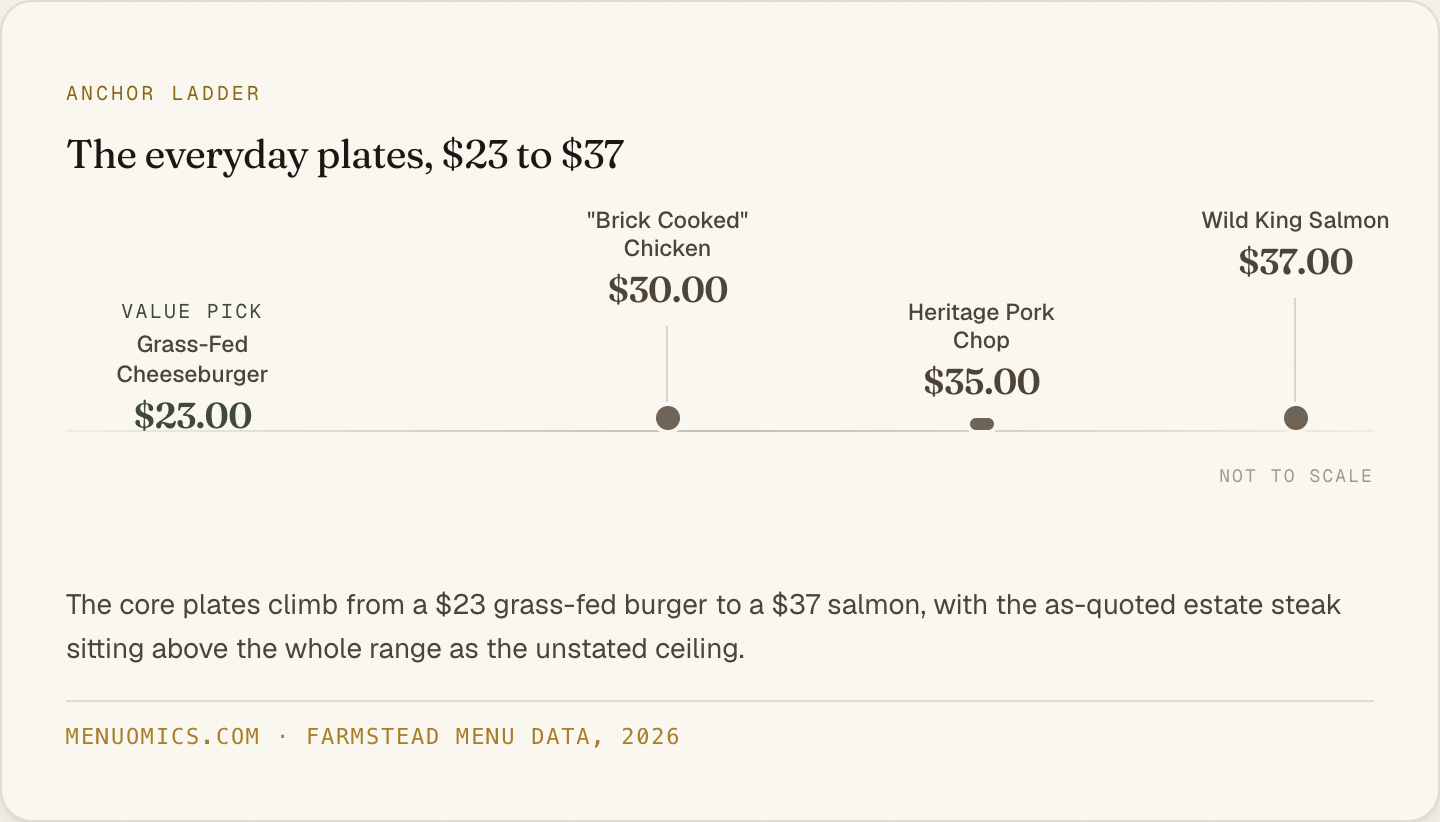
The everyday plates, $23 to $37
The core plates climb from a $23 grass-fed burger to a $37 salmon, with the as-quoted estate steak sitting above the whole range as the unstated ceiling.
Download this chart (PNG) · free to reuse with credit, see reuse terms.
The setup
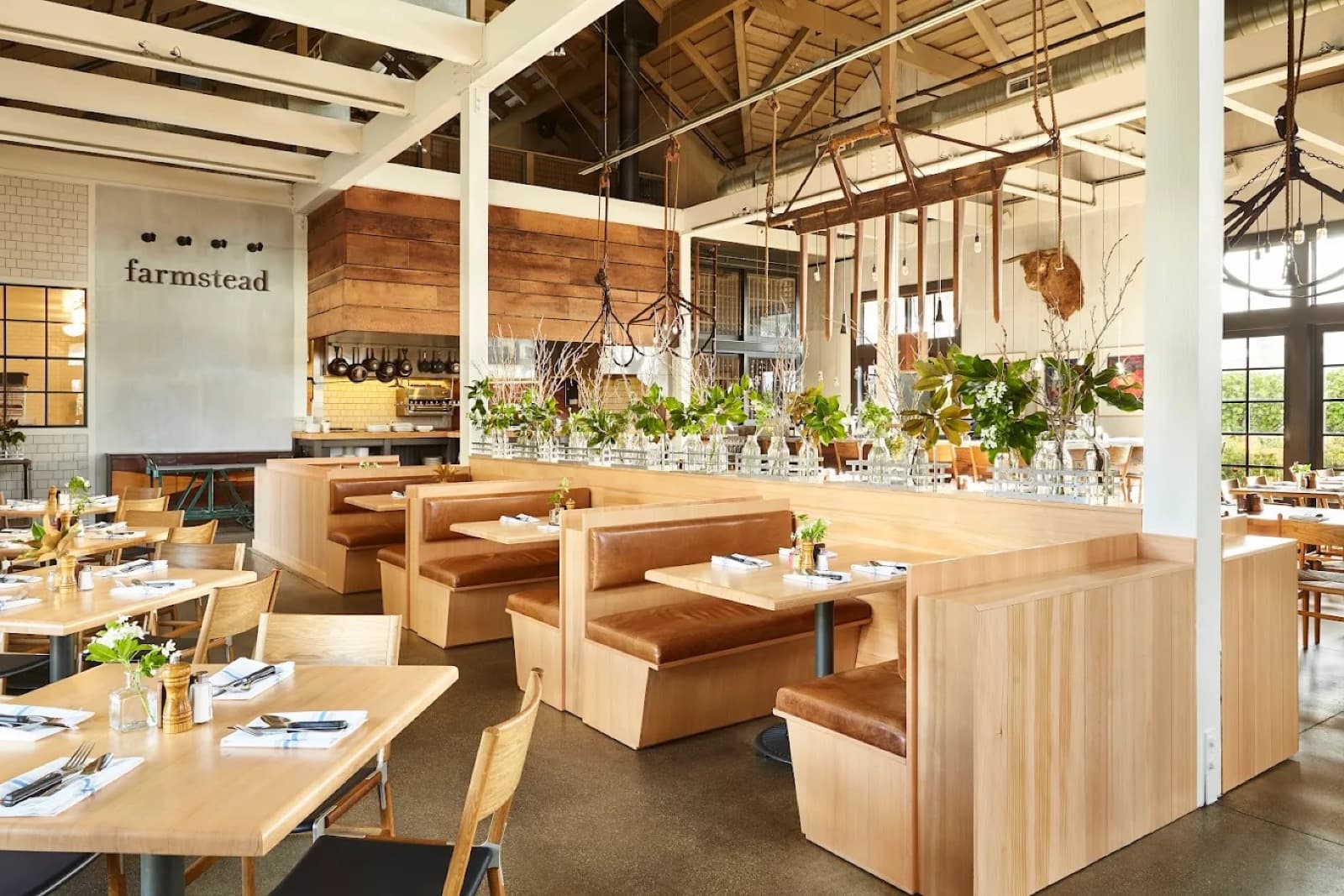
Farmstead opened in 2010 in a restored barn at 738 Main Street, the stretch of Highway 29 that runs through St. Helena, next to a former plant nursery. It is the restaurant arm of Long Meadow Ranch, the Hall family's diversified Napa farm, and that is the point of the whole enterprise: the ranch runs grass-fed cattle and lamb, keeps its own chickens, presses estate olive oil from one of the oldest orchards in the valley, and makes estate wine, so much of what the kitchen cooks is grown or raised in-house. The menu reads as a farmhouse a la carte, with a burger around $23, plates into the high $30s, a steak frites priced as-quoted, and larger family-style options for groups.
The result is a menu whose central move is provenance. Almost every line carries a sourcing cue: grass-fed beef, farm eggs, estate olive oil, Farmstead bacon, Bay Area artisan cheeses. That framing lifts perceived quality and quietly justifies the price, and the estate itself is a costly signal a distributor-fed kitchen cannot fake. (Farmstead does not frame these as behavioral tactics; this is our reading of the observed design.)
What they get right
The behavioral economics already at work.
The estate itself is the costly signal
Long Meadow Ranch grows and raises much of the menu: grass-fed cattle, its own eggs, estate olive oil, estate wine. A working farm behind the restaurant is expensive and hard to fake, so it proves quality before you order in a way no adjective can, and it lets the menu charge for provenance a distributor-fed kitchen cannot claim.
Rory Sutherland on costly signalling and reducing uncertainty
"Grass-fed," "farm egg," "estate": descriptive sourcing on every line
Nearly every item names its origin, and origin cues do the work of taste adjectives: they raise perceived quality and the price a diner will accept. The evidence for descriptive labels is real, though the original Wansink figure should be read cautiously; the direction of the effect is what holds, not the exact percentage.
descriptive labels lifted sales in the original study, a figure to treat cautiously, Wansink, Painter & van Ittersum, 2001
The vertical-integration story builds trust
A diner facing a $37 plate is really weighing a risk. 'We raised this' collapses that risk: the ranch's control of its own beef, oil and produce is a provenance story that answers the quality question before the food arrives, which is why the menu tells it over and over.
Sutherland; provenance as trust and uncertainty reduction
Share plates let the table trade up together
The 'for the table' openers and the two-size beef tartare turn ordering into a group yes rather than an individual splurge. A shared plate spreads the cost across the table and raises the total everyone agrees to, because no single person feels they overspent.
Thaler, mental accounting; shared-cost decoupling
The as-quoted steak is a soft anchor
The grass-fed steak frites is the priciest single plate, and pricing it as-quoted keeps it above the fixed $23 to $37 range without printing a number. It nudges the everyday plates toward reasonable, but a stated ceiling would anchor harder than an unstated one.
a high reference point reframes the options below it, anchoring; Kahneman & Tversky, 1974
What we’d test
The rewrite, with the expected lift and the honest caveat.
Name a house steak with a printed price
The top plate is currently 'as-quoted,' so it anchors weakly. Printing a fixed price for the estate-beef steak, sitting visibly above the $23 to $37 plates, would set a clear ceiling that makes the salmon and pork chop read as the sensible middle.
Expect Core plates read as more reasonable against a visible top
Caveat A menu-pricing choice, and market cuts genuinely vary; the fix is to show a number when the cut allows.
Point at the 'our own' dishes
Provenance is stated on almost every line, which flattens it. Marking the two or three dishes most fully raised on the ranch as the house signatures would concentrate the estate story where it sells hardest, instead of spreading it evenly.
Expect Higher mix on the highest-provenance plates
Caveat A menu-wording change only; keep it to the dishes the ranch genuinely grows end to end.
Bring the smoker and the ranch onto the page
The smoker sits in the front yard and the ranch is the reason to be here, but the menu leans on single words. A short line of provenance on a signature or two, the kind Farmstead already earns, turns visible proof into printed reassurance.
Expect Higher perceived value on the hero dishes
Caveat Menu copy only; the farmhouse voice is plain, so narrate a dish or two, not the whole card.
What diners actually say
Synthesized from public reviews, the reality check that grounds every recommendation.
They praise
- Genuinely farm-to-table, with ingredients the ranch grew and raised
- The restored barn and front patio setting
- Grass-fed burger and steak frites are diner favorites
- The estate wine and olive oil tie the meal to the land
- Warm, buzzy farmhouse atmosphere
They criticize
- Some diners find the price-to-value ratio underwhelming
- The top steak's as-quoted pricing surprises checks
- Provenance language is repeated so often it can blur
- Can feel loud and crowded at peak times
- Not the destination-dining experience some expect in Napa
The verdict
Farmstead has the strongest possible answer to the question every menu dodges: not 'is this good,' but 'how do you know.' The ranch grew it, raised it and pressed it, so the menu can sell provenance the honest way, by having actually farmed the thing. The craft is real and the estate is the proof. The gains left are sharpening: print a price on the top steak so it anchors, concentrate the 'our own' story on a few hero dishes instead of every line, and let a signature or two carry a sentence of the farm's story onto the page.
Common questions
- How much does it cost to eat at Farmstead at Long Meadow Ranch?
- Most plates run about $23 to the high $30s: the grass-fed cheeseburger is around $23, the wild king salmon around $37, and the grass-fed steak frites is priced as-quoted (one recent diner reported $82). It is upscale-casual, not a fine-dining tasting menu, and prices shift with the season because the kitchen cooks what the ranch is producing. (Representative 2026.)
- What is Farmstead's connection to Long Meadow Ranch?
- Farmstead is the restaurant of Long Meadow Ranch, the Hall family's Napa farming operation, and much of the menu is grown or raised by the ranch itself: grass-fed beef and lamb, eggs, estate olive oil, honey, produce and estate wine. That short supply chain is the menu's whole argument, because ingredients the house grew are a costly quality signal a distributor menu cannot copy.
- What should I order at Farmstead?
- The grass-fed dishes are the point: the cheeseburger, the beef tartare, the steak frites, all built on the ranch's own cattle. Brunch leans on cheddar biscuits, farm eggs and Farmstead bacon. The menu keeps steering you toward what the ranch produced, so the safest order is whatever it calls its own.
- Is Farmstead a Michelin restaurant?
- Farmstead earned a Michelin Bib Gourmand in 2017 and has since held the Michelin Plate for its produce-driven farmhouse cooking. The rating matters less than the sourcing: the menu sells provenance first, and the Michelin nods simply confirm that the estate-grown story is real, not marketing.
Sources (7)
- Long Meadow Ranch, Farmstead restaurant (official)
- Farmstead menu prices (SinglePlatform)
- Farmstead, MICHELIN Guide
- Forbes, Farmstead celebrates 10 years (2020)
- Napa Wine Project, Long Meadow Ranch & Farmstead
- Descriptive labels +27% sales, Wansink, Painter & van Ittersum, 2001
- Rory Sutherland, EconTalk on Alchemy
Head to head
More breakdowns
 Pearl 6101B+
A neighborhood Outer Richmond Cal-Mediterranean restaurant from the Pizzetta 211 team, whose menu prints prices as bare round numbers with no dollar signs and no cents.
Read the Pearl 6101 breakdown → JudahliciousB-
An Outer Sunset juice bar near Ocean Beach where a $13 acai bowl arrives with a long, specific superfood ingredient list, the standard way a raw-vegan menu communicates what is in the food.
Read the Judahlicious breakdown →A family-run St. Helena restaurant from chef Elliot Bell, who spent a decade at The French Laundry, serving hearth-cooked New American food with an unusual-for-wine-country seafood streak.
Read the Charlie's breakdown →The North Beach pizza spinoff of the acclaimed Flour + Water pasta flagship, where a ten-pie menu at $18 to $23, a glass dough room, and a curated natural-wine list sell craft and pedigree at a premium.
Read the Flour + Water Pizzeria breakdown → Restaurant Gary DankoA
Tiered courses, round whole-dollar prices, a caviar anchor, build-your-own freedom and a tableside cheese cart. Danko is already doing what we'd recommend.
Read the Restaurant Gary Danko breakdown → Zuni CafeA-
A 75.00 chicken that takes about 75 minutes, and the menu says so. A practical warning that also happens to reduce uncertainty, printed in the margin.
Read the Zuni Cafe breakdown →Your menu next
Get this for your own menu, free.
Send your menu and we’ll send back the same breakdown, what you get right, what we’d test, and why.
State Bird Provisions
A Michelin-starred Fillmore room where small plates roam by on dim-sum carts at $3 to $14 each, so you say yes one plate at a time and the check climbs on its own.
Read it →