The French Laundry menu, graded
Price the experience, not the plate
Most menus ask you to price every plate. This one charges once, for the whole experience, and lets supplements and wine do the climbing.
Menu-craft grade
A fixed prix-fixe with no a la carte, no printed dollar signs and one prepaid service-included price that removes every per-item decision. Supplements anchor high, the vegetable menu matches the chef's price, and scarcity is the reservation. The menu craft is close to a finished proof.
Graded on how well the menu uses behavioral economics, not the food.
Menu and prices verified September 2026
A 3-minute audio read of the analysis
- Type
- Independent
- Where
- Yountville, Napa Valley
- Cuisine
- French / Californian fine dining
- Footprint
- 1 location
- Since
- 1994 (Keller purchase)
- Ownership
- Thomas Keller Restaurant Group; chef-owned since 1994
The mechanics, drawn
The same menu, mapped onto an axis, so the behavioral move is something you can see, not just read.
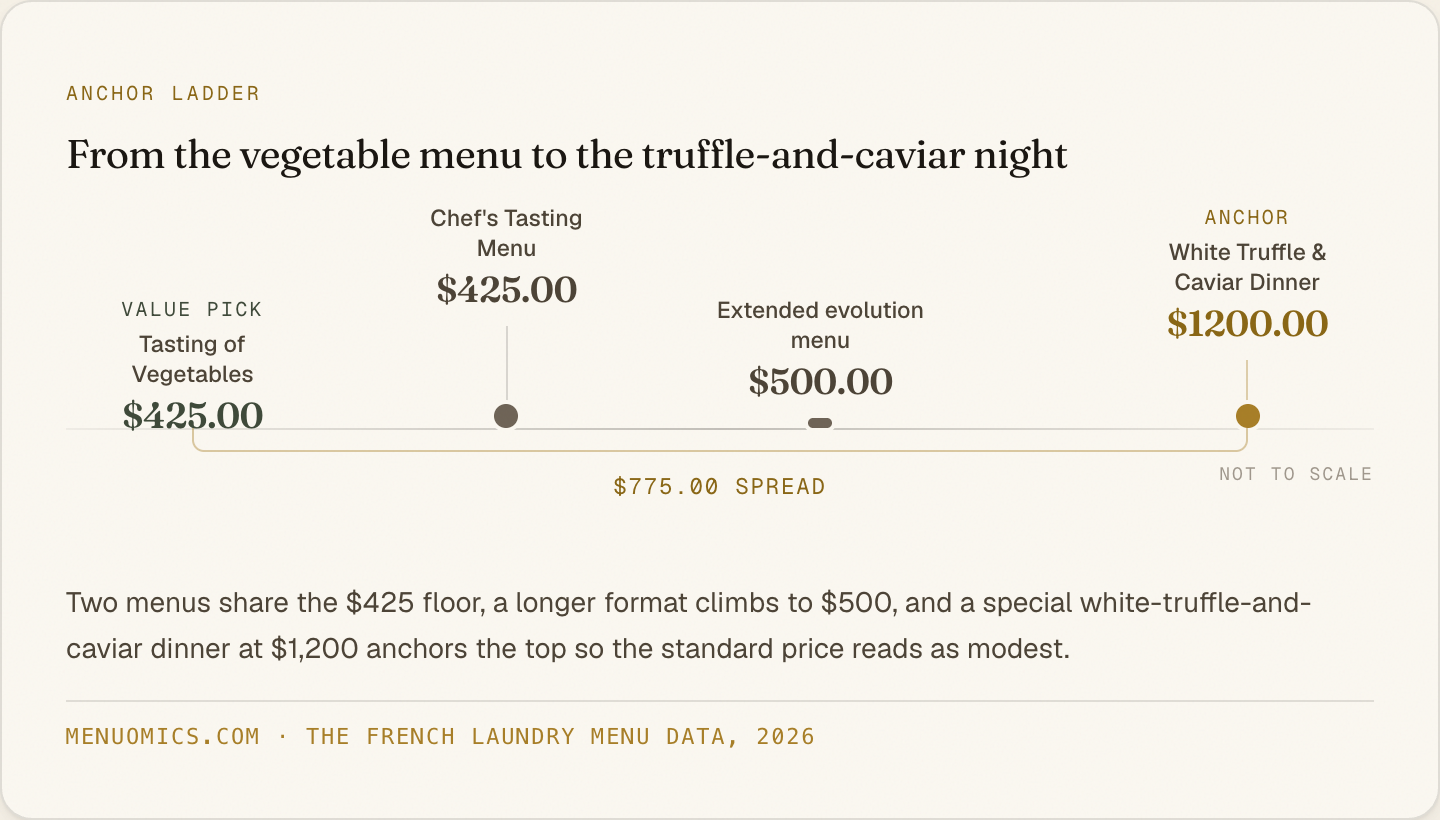
From the vegetable menu to the truffle-and-caviar night
Two menus share the $425 floor, a longer format climbs to $500, and a special white-truffle-and-caviar dinner at $1,200 anchors the top so the standard price reads as modest.
Download this chart (PNG) · free to reuse with credit, see reuse terms.
The setup
The French Laundry does not hand you a menu with prices down the right margin. You choose between two nine-course tasting menus written fresh that day, the Chef's Tasting Menu and a vegetarian Tasting of Vegetables, both $425 per person as of 2026, with the 20% service charge already included and paid in advance when you booked through Tock. There is no a la carte. There are no printed dollar signs. The card you read at the table is a list of dishes, not a list of prices, and the number you agreed to is already behind you.
That structure quietly does what a behavioral-economics audit would recommend. Charging once removes every per-item decision and every running tally of pain. Pricing the two menus identically frames the vegetable option as an equal, not a downgrade. Optional supplements like caviar, white truffle and wagyu sit above the fixed price as the only add-ons, so they anchor high while the $425 reads as the sensible floor. And the reservation itself is scarce and prepaid, which raises perceived value before a single plate arrives. (The French Laundry does not frame these as behavioral tactics; this is our reading of the observed design.)
What they get right
The behavioral economics already at work.
No printed dollar sign on the card
The menu at the table lists dishes, not prices. Cornell found that simply removing the dollar sign lifted spend about 8% per person, because the money cue is what makes diners flinch. The French Laundry goes further than dropping the symbol: the number is prepaid and out of sight before you sit, so the card is pure anticipation with no arithmetic attached.
removing the '$' lifted spend about 8% per person, Cornell (Yang, Kimes & Sessarego, 2009)
One fixed price removes every per-item decision
There is no a la carte, so there is nothing to add up. Paying once, in advance, decouples the consumption from the payment entirely; by the time the food arrives the spending is a settled fact, not a live count. Rory Sutherland's curated set-menu principle applies: a tight structure you did not have to assemble maximizes the feeling of having chosen well.
Thaler on mental accounting; Prelec & Loewenstein on decoupling; Sutherland on the set menu
Supplements are the only add-ons, and they anchor high
The only way to spend more per course is a supplement: caviar around $60 to $75, wagyu around $100 to $135, seasonal white truffle. Sitting above the fixed $425, these upgrades set a high reference point that makes the base menu read as the sensible floor. They do this work whether or not a given table orders one.
an early high number reframes everything below it, anchoring; Tversky & Kahneman, 1974
The vegetable menu matches the chef's price
The Tasting of Vegetables is $425, exactly the Chef's Tasting price. Pricing them as equals reframes the vegetarian choice as a genuine preference rather than a cheaper compromise, so no diner feels they are trading down. Above both sits a $500 extended menu, which quietly makes the $425 pair look like the reasonable middle.
framing effects; Simonson & Tversky, 1992 on extremeness aversion
The reservation is scarce and prepaid
Tables release on Tock on the first of the month, roughly two months out, and disappear in minutes; you pay for the meal like a ticket before you arrive. Worchel's work shows scarce goods are rated higher for the scarcity alone. A table you competed for and prepaid is already valued up before the first course lands.
scarce goods are rated more valuable for the scarcity alone, Worchel, Lee & Adewole, 1975
What we’d test
The rewrite, with the expected lift and the honest caveat.
Name the reason the plates are small
Keller's small-portions-across-many-courses idea rests on a law of diminishing returns: the first bite is the best, so keep it to a few bites. A single printed line naming that philosophy would let a first-timer read a modest portion as intention rather than stinginess. Wording only, and one line, since this room earns its authority through restraint.
Expect Fewer 'portions felt small' reactions from first-timers
Caveat Menu or card copy only; no change to dishes, portions or price.
Mark the signature as the anchor it already is
Oysters and Pearls is the dish everyone knows before they arrive. A quiet cue that it is the enduring signature gives the undecided a confident default on a menu that changes nightly, and reinforces the one fixed point diners can hold onto. A whisper, not a badge.
Expect Lower choice anxiety on a daily-changing card
Caveat Menu wording only; keep the cue subtle to fit the room.
Present the service charge in the menu's own voice
The 20% service charge is included and prepaid, which is exactly right, but it can surface as a surprise for diners who expect to tip. A warm one-line framing at booking, that the price already pays the team fairly and nothing more is expected, closes the loop so the included charge reads as a courtesy rather than a catch.
Caveat Presentation of the existing charge only; this does not change what is charged.
What diners actually say
Synthesized from public reviews, the reality check that grounds every recommendation.
They praise
- Precision and consistency across decades
- The Oysters and Pearls signature
- Impeccable, unhurried service
- The daily-rewritten menu keeps regulars returning
- Service included, so no tipping math at the table
They criticize
- Among the most expensive meals in the country
- Reservations are notoriously hard to get
- Formality can feel stiff to some diners
- Prepaid ticketing punishes any change of plans
- Supplements and wine push the real total far past $425
The verdict
The French Laundry is close to what a behavioral-economics menu audit produces when it is done right: one prepaid, service-included price that removes every per-item decision, no printed dollar signs, a vegetable menu priced as an equal, supplements that anchor high above the base, and a reservation whose scarcity raises value before the food arrives. The remaining menu-craft gains are small and about wording: name the small-portion philosophy so it reads as intent, mark the enduring signature for the undecided, and frame the included service charge warmly so it never lands as a surprise.
Common questions
- How much does dinner at The French Laundry cost?
- The base nine-course tasting menu is $425 per person as of 2026, with the 20% service charge already included and prepaid when you book through Tock. Wine, supplements like caviar or white truffle, and tax are extra, so a typical night with wine lands closer to $600 to $900 a head. The single price buys the whole experience rather than any one plate.
- Is there a vegetarian option at The French Laundry?
- Yes. The kitchen writes two nine-course menus every day, the Chef's Tasting Menu and a vegetarian Tasting of Vegetables, both priced at $425 per person as of 2026. Offering the vegetable menu at the same price frames it as a peer of the chef's tasting, not a lesser consolation, so the choice reads as a preference rather than a compromise.
- Do you tip at The French Laundry?
- No. A 20% service charge is built into the prepaid $425 menu price as of 2026, so no tip is expected at the table. Folding gratuity into one prepaid figure moves the money conversation off the table entirely, and the only charges settled at the end are wine and supplements you actively chose.
- How hard is it to get a French Laundry reservation?
- Standard reservations release on Tock on the first of each month for roughly two months out and are gone within minutes, prepaid like tickets. That scarcity is part of the product: a table you competed for and paid for in advance reads as more valuable before the first course arrives.
- Who owns The French Laundry?
- Chef Thomas Keller, who bought the Yountville restaurant in 1994 and runs it through the Thomas Keller Restaurant Group. Single-owner control is what lets the menu stay this disciplined: no a la carte, no printed dollar signs, and a rule that no ingredient repeats within a meal.
Sources (9)
- The French Laundry, official site (Thomas Keller Restaurant Group)
- The French Laundry reservations and menus, Tock
- The French Laundry, Wikipedia (history, ownership, Michelin)
- The French Laundry, World's 50 Best 'Best of the Best' (No. 1 in 2003, 2004)
- The French Laundry Cost: Is $425 Worth the Dough? (2026 pricing, service charge, corkage)
- How to Get French Laundry Reservations (2026)
- Cornell, removing the “$” lifted spend ≈8%/person (Yang, Kimes & Sessarego, 2009)
- Scarcity raises perceived value, Worchel, Lee & Adewole, 1975
- Mental accounting & decoupling, Thaler (1999); Prelec & Loewenstein (1998)
Head to head
More breakdowns
 Zuni CafeA-
A 75.00 chicken that takes about 75 minutes, and the menu says so. A practical warning that also happens to reduce uncertainty, printed in the margin.
Read the Zuni Cafe breakdown →A 1988 supper club hidden down a Gold Street alley, where live jazz, $18 martinis and tableside theater are the product and the food only has to clear the bar the room has raised.
Read the Bix breakdown →An elegant, romantic neighborhood bistro in Lower Pacific Heights serving modern French cooking with a Californian accent, from chef JP Carmona and the B Patisserie team.
Read the Routier breakdown →The James Beard 'America's Classic' that builds its whole reputation on what it leaves out: no rice, six meats, one price, off-menu dorado.
Read the La Taqueria breakdown →A Tenderloin Creole institution where one cheap, famous beignet gets bundled into a four-way Flight that quietly triples the check.
Read the Brenda's French Soul Food breakdown → NopaA
NopaAA 2006 Divisadero gathering place whose daily wood-fired menu prints prices as plain numbers, no dollar signs, no cents, anchored by a 49 brisket.
Read the Nopa breakdown →Your menu next
Get this for your own menu, free.
Send your menu and we’ll send back the same breakdown, what you get right, what we’d test, and why.
Charlie's
A family-run St. Helena restaurant from chef Elliot Bell, who spent a decade at The French Laundry, serving hearth-cooked New American food with an unusual-for-wine-country seafood streak.
Read it →