Texas Roadhouse menu, graded
Free bread and peanuts turn the meter off before you order
A value steakhouse whose loudest signals are the things it gives away. The free bread and peanuts do real behavioral work, and the steak ladder quietly anchors against a near-$60 platter.
Menu-craft grade
A coherent value steakhouse: free fresh-baked rolls and complimentary peanuts decouple snacking from the bill, a wide good-better-best steak ladder anchors against a near-$60 three-rack platter, and charm .99 pricing fits the room. Held back by a menu that leans on a bare price grid with little descriptive or provenance copy and surcharges that aggregate quietly, so the on-page design under-sells the made-from-scratch story the brand actually has.
Graded on how well the menu uses behavioral economics, not the food.
Menu and prices verified September 2026
A 4-minute audio read of the analysis
- Type
- Chain
- Where
- Louisville, KY
- Cuisine
- American steakhouse, casual
- Footprint
- ~830 restaurants system-wide (Q2 2026, incl. Bubba's 33 and Jaggers)
- Since
- 1993
- Ownership
- NASDAQ: TXRH (Texas Roadhouse, Inc.; also operates Bubba's 33 and Jaggers)
The mechanics, drawn
The same menu, mapped onto an axis, so the behavioral move is something you can see, not just read.
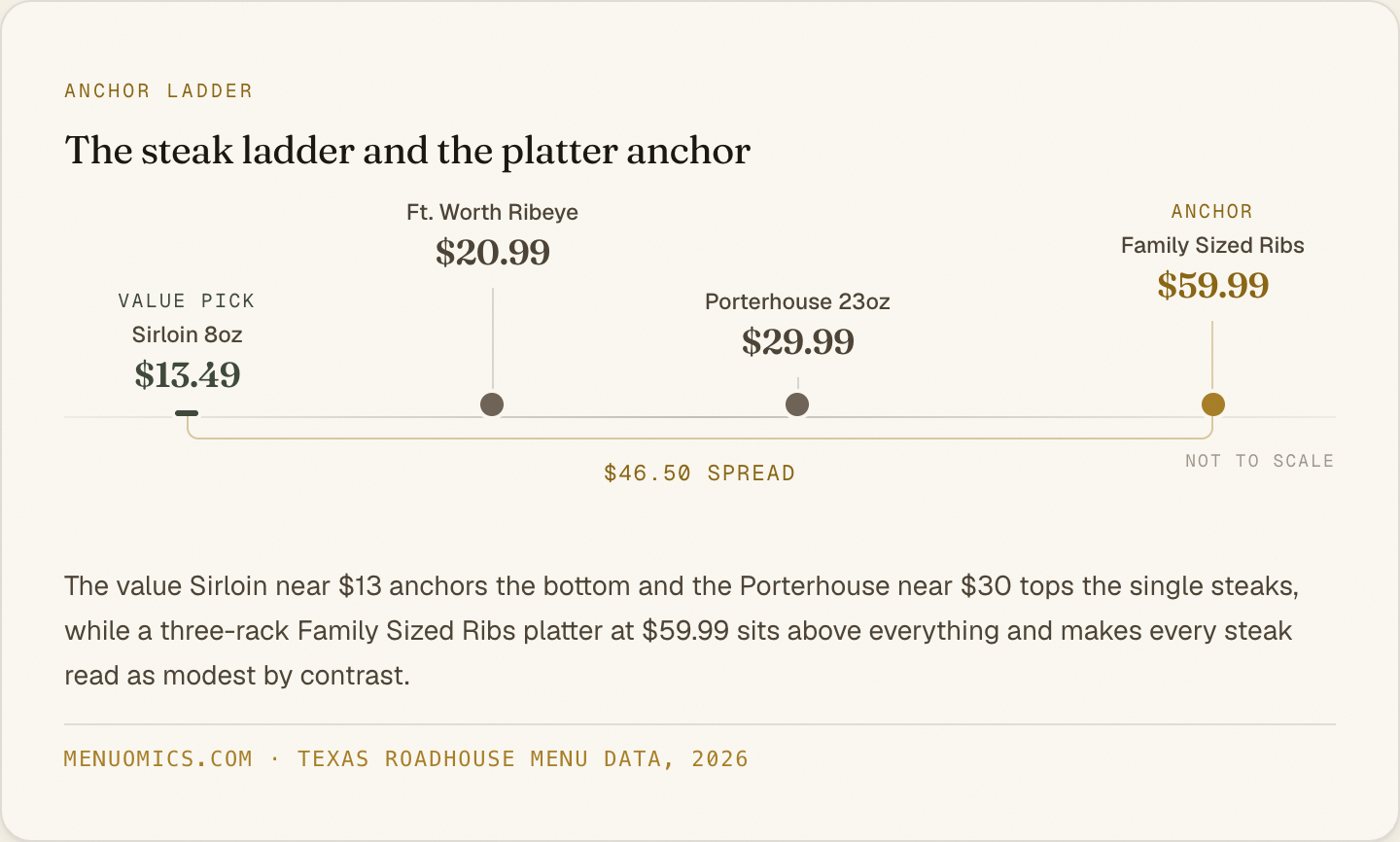
The steak ladder and the platter anchor
The value Sirloin near $13 anchors the bottom and the Porterhouse near $30 tops the single steaks, while a three-rack Family Sized Ribs platter at $59.99 sits above everything and makes every steak read as modest by contrast.
Download this chart (PNG) · free to reuse with credit, see reuse terms.
The full ticket
What it actually rings up to.
The headline price is only the start. The real number is the journey from a base order to the check at the register, one easy yes at a time.
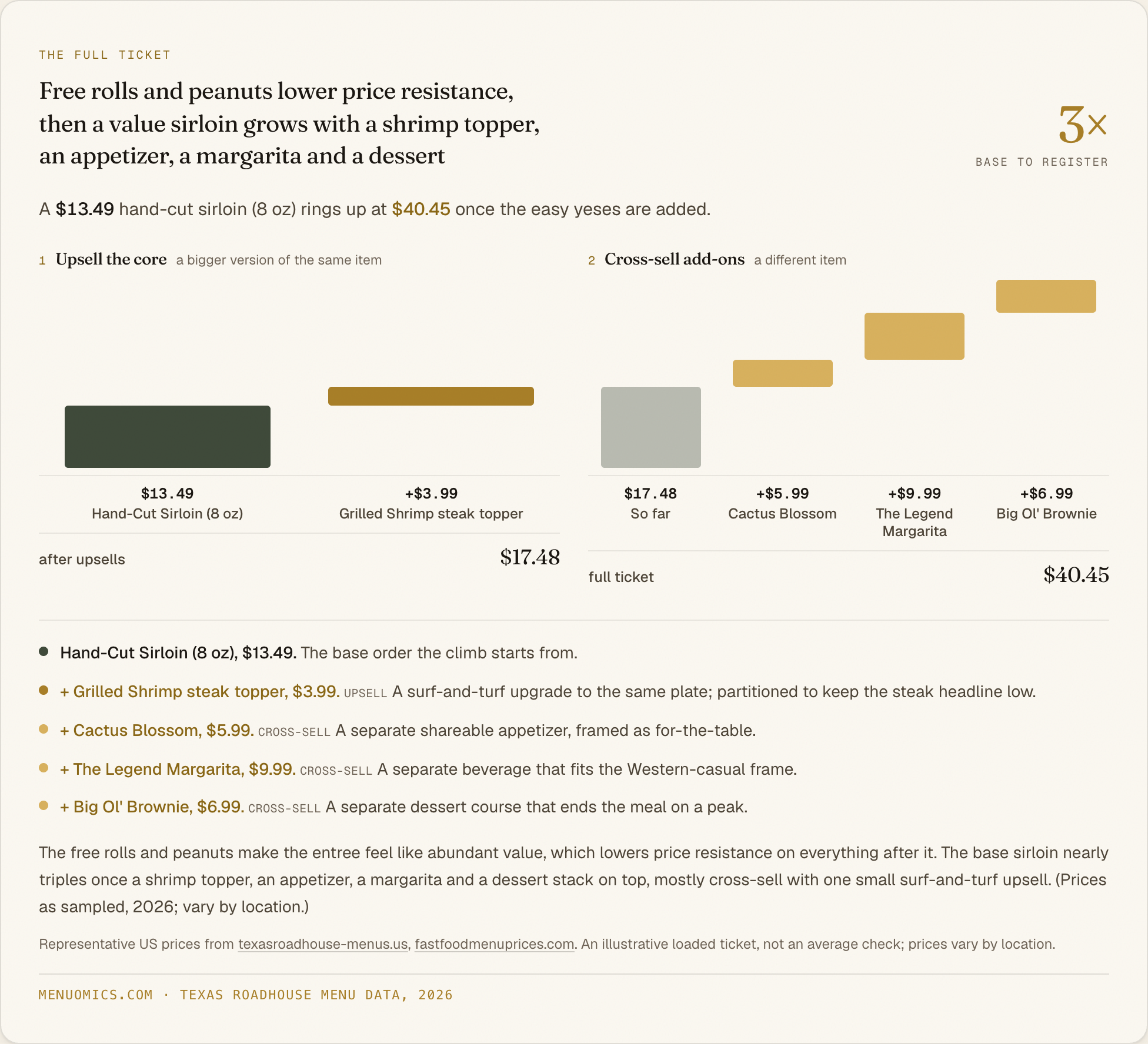
Free rolls and peanuts lower price resistance, then a value sirloin grows with a shrimp topper, an appetizer, a margarita and a dessert
A $13.49 hand-cut sirloin (8 oz) rings up at $40.45 once the easy yeses are added.
- Hand-Cut Sirloin (8 oz), $13.49. The base order the climb starts from.
- + Grilled Shrimp steak topper, $3.99. upsell A surf-and-turf upgrade to the same plate; partitioned to keep the steak headline low.
- + Cactus Blossom, $5.99. cross-sell A separate shareable appetizer, framed as for-the-table.
- + The Legend Margarita, $9.99. cross-sell A separate beverage that fits the Western-casual frame.
- + Big Ol' Brownie, $6.99. cross-sell A separate dessert course that ends the meal on a peak.
The free rolls and peanuts make the entree feel like abundant value, which lowers price resistance on everything after it. The base sirloin nearly triples once a shrimp topper, an appetizer, a margarita and a dessert stack on top, mostly cross-sell with one small surf-and-turf upsell. (Prices as sampled, 2026; vary by location.)
Representative US prices from texasroadhouse-menus.us, fastfoodmenuprices.com. An illustrative loaded ticket, not an average check; prices vary by location.
Download this chart (PNG) · free to reuse with credit, see reuse terms.
The setup
Texas Roadhouse opens every meal with two things it does not charge for: fresh-baked rolls with cinnamon honey butter, baked in small batches through service, and (by request) complimentary in-shell peanuts. The steaks are hand-cut in-house and the sides are made from scratch, and the whole thing is priced as casual, not premium. It is easy to read this as plain generosity. Read as menu design, the free bread and peanuts do something specific to how a guest feels about paying for everything that follows. (The chain does not state this as intent; this is our reading of the observed design.)
The interesting part is not the free bread. It is what the free bread does to price resistance on the steak, the appetizer, the margarita and the brownie that come after it.
What they get right
The behavioral economics already at work.
Free rolls and peanuts decouple snacking from paying
When the bread and peanuts are free and arrive before any order, every bite feels free and the meter is off. Decoupling consumption from payment is one of the more reliable ways to lower price resistance on everything that follows. The rolls and peanuts function as loss-leaders buying exactly that feeling.
the company has reported spending tens of millions a year on bread and peanuts, Prelec & Loewenstein, "The Red and the Black," 1998
The steak ladder engineers a middle
Sirloin, ribeye, strip and filet, each offered in multiple ounce counts, lay out an explicit good-better-best. Extremeness aversion pushes guests off the very cheapest and very priciest toward the reasonable middle, which is where a value steakhouse wants the mix to land.
adding a higher tier raises the middle option's share, Simonson & Tversky, 1992
A near-$60 platter anchors the page
The Family Sized Ribs at $59.99, three full racks, sit far above every single entree. Once a guest has seen $59.99 on the card, a $20-something steak reads as modest by contrast. The anchor does its work whether or not anyone orders it.
a high number near the top reframes everything below it, anchoring; Tversky & Kahneman 1974
Charm pricing matches the value frame
The .99 and .49 endings are the right call here: charm endings signal a deal and fit a value-casual room. Round whole-dollar pricing signals premium and would fight the everyday, family-dinner positioning. This is charm used as positioning, not as a default.
Schindler & Naipaul on round-vs-charm pricing
Surf-and-turf toppers are a partitioned upsell
A grilled-shrimp steak topper at about $3.99 keeps the headline steak price low and stacks a small, plainly worth-it add on top. Partitioned this way the add-on reads as a treat rather than a hidden fee, the same mechanic that makes premium toppings work elsewhere.
Morwitz et al. 1998; Burman & Biswas 2007
What we’d test
The rewrite, with the expected lift and the honest caveat.
Name the rolls and peanuts as free on the page
The free rolls and complimentary peanuts are the brand's most distinctive asset, yet they barely appear in menu copy. Calling them out explicitly as "complimentary, fresh-baked" and "complimentary peanuts" on the page reinforces the meter-is-off feeling at the point of choice, where it lowers resistance to the paid items.
Expect The free items read as part of the value at the moment of ordering, reinforcing the decoupling
Caveat A menu-copy change only; it does not alter the items, portions or what is served.
Give the signature cuts a line of provenance
The steak section leans on bare cut names. The brand already has a true, sourceable story, hand-cut in-house by an on-site butcher, made-from-scratch sides, that the menu under-uses. A short sensory or method line on the hero cuts ("hand-cut in-house daily") can lift perceived value, the cleanest, best-evidenced naming effect there is.
Expect Higher perceived value on the hero steaks
Caveat Menu copy only; describe only what is genuinely true, and keep it to the few signatures rather than narrating the whole card.
Keep toppers and add-ons small and visibly worth it
Steak toppers, side upgrades and combo add-ons keep headline entree prices low, which is smart. But partitioned pricing reverses the moment the stack of small charges starts to feel large or sneaky, the drip-pricing backlash. Keep each add-on modest and plainly presented on the page.
Caveat A pricing-presentation change; keep each add small and clearly shown, not a portion or recipe change.
Morwitz et al. 1998; Burman & Biswas 2007
What diners actually say
Synthesized from public reviews, the reality check that grounds every recommendation.
They praise
- Genuine value and large portions
- The free rolls and cinnamon butter
- Hand-cut steaks and from-scratch sides
- Consistently top customer-satisfaction scores
They criticize
- Steak doneness can be inconsistent
- Long waits at peak times
- Loud, high-energy room is not for everyone
- Menu copy under-sells the made-from-scratch story
The verdict
Read as menu design, Texas Roadhouse runs a coherent value-steakhouse playbook: free rolls and peanuts that decouple snacking from the bill, an explicit good-better-best steak ladder, a near-$60 three-rack platter that anchors the page, and charm pricing that fits the room. The on-page work left is mostly amplification: name the free items as free where guests choose, give the hand-cut signatures a true line of provenance, and keep the topper and add-on stack small and honestly presented.
Common questions
- Is Texas Roadhouse a good value?
- Texas Roadhouse earns a B, with an 8 oz hand-cut sirloin about $13.49 and free fresh-baked rolls plus complimentary peanuts before you order. It ranked No. 1 in full-service dining on the 2025 ACSI at a score of 84, and the free bread and peanuts decouple snacking from the bill so the meter is off before the first price is read.
- How much does a Texas Roadhouse dinner add up to?
- A loaded order reaches about $40.45, roughly 3.0x the $13.49 sirloin. The free rolls and peanuts make the entree feel like abundant value, which lowers resistance as a $3.99 shrimp topper, a $5.99 Cactus Blossom, a $9.99 Legend Margarita and a Big Ol' Brownie stack on top.
- What is the most expensive item at Texas Roadhouse?
- The Family Sized Ribs, three full racks, are $59.99, the highest single number on the card. It anchors the page: once a guest has seen $59.99, a $20-something steak reads as modest by contrast, whether or not anyone actually orders the platter.
- Are Texas Roadhouse steaks really hand-cut?
- Yes, the steaks are hand-cut in-house and the sides are made from scratch, and the sirloin runs an explicit good-better-best ladder from about $9.99 to $15.99 by ounce. The bare price grid actually under-sells this made-from-scratch story, one of the few on-page improvements the menu has left.
Head to head
More breakdowns
 Logan's RoadhouseB
A steakhouse that reviewers rank dead last still runs a value menu most casual chains would be proud of. The food is panned; the menu design is not. That gap is the whole point.
Read the Logan's Roadhouse breakdown → In-N-Out BurgerA
Three burgers, no seasonal items, and a famous off-menu modifier ('Animal Style') that turns customers into evangelists. Restraint as strategy.
Read the In-N-Out Burger breakdown → Chick-fil-AA
A famously simple chicken sandwich, an easy 'make it a meal' bundle, and free dipping sauces, wrapped in the most-praised service in fast food. The menu stays out of the way so the hospitality can do the selling.
Read the Chick-fil-A breakdown → Chili's Grill & BarA-
A $10.99 bundle dragged Chili's out of a slump and back to the top of casual-dining traffic. Read closely, '3 For Me' is one round number doing the work of three separate decisions.
Read the Chili's Grill & Bar breakdown → Domino'sB+
The $6.99 Mix & Match looks like a low price. Its real design is the words 'two or more': a self-bundle that turns one cheap pizza into a full cart.
Read the Domino's breakdown → Jersey Mike'sB+
Numbered subs in three sizes, a free signature modifier called 'Mike's Way,' and a Giant pitched as the smart-value pick. The size ladder, not the combo, is where the menu does its work.
Read the Jersey Mike's breakdown →Your menu next
Get this for your own menu, free.
Send your menu and we’ll send back the same breakdown, what you get right, what we’d test, and why.
Shake Shack
A burger near $7.19 in a category where rivals sell at a dollar. Shake Shack does not discount; it sells provenance, refuses a value menu, and lets the sourcing copy justify every cent.
Read it →