
Red Lobster menu, graded
Reciprocity via free biscuits, a premium feast anchor, and an all-you-can-eat promo with no ceiling
How free biscuits, a premium feast anchor, and one reckless all-you-can-eat promo add up on the check.
Menu-craft grade
The free Cheddar Bay Biscuit habit is one of the best reciprocity plays in casual dining, and the Ultimate Feast is a clean premium anchor. But menu craft includes guardrails, and the permanent Endless Shrimp promo was an unlimited mechanic with no cost ceiling that helped push the chain into Chapter 11. Strong signature levers, one headline pricing blunder.
Graded on how well the menu uses behavioral economics, not the food.
Menu and prices verified September 2026
A 4-minute audio read of the analysis
- Type
- Chain
- Where
- Orlando, Florida (HQ)
- Cuisine
- Seafood, casual dining
- Footprint
- About 540 US locations (Aug 2026), down from roughly 700 before the 2024 bankruptcy, with more closures signaled
- Since
- 1968, Lakeland, Florida, by Bill Darden (with partner Charley Woodsby)
- Ownership
- RL Investor Holdings LLC, backed by funds affiliated with Fortress Investment Group. Red Lobster exited Chapter 11 in September 2024 under CEO Damola Adamolekun.
The mechanics, drawn
The same menu, mapped onto an axis, so the behavioral move is something you can see, not just read.
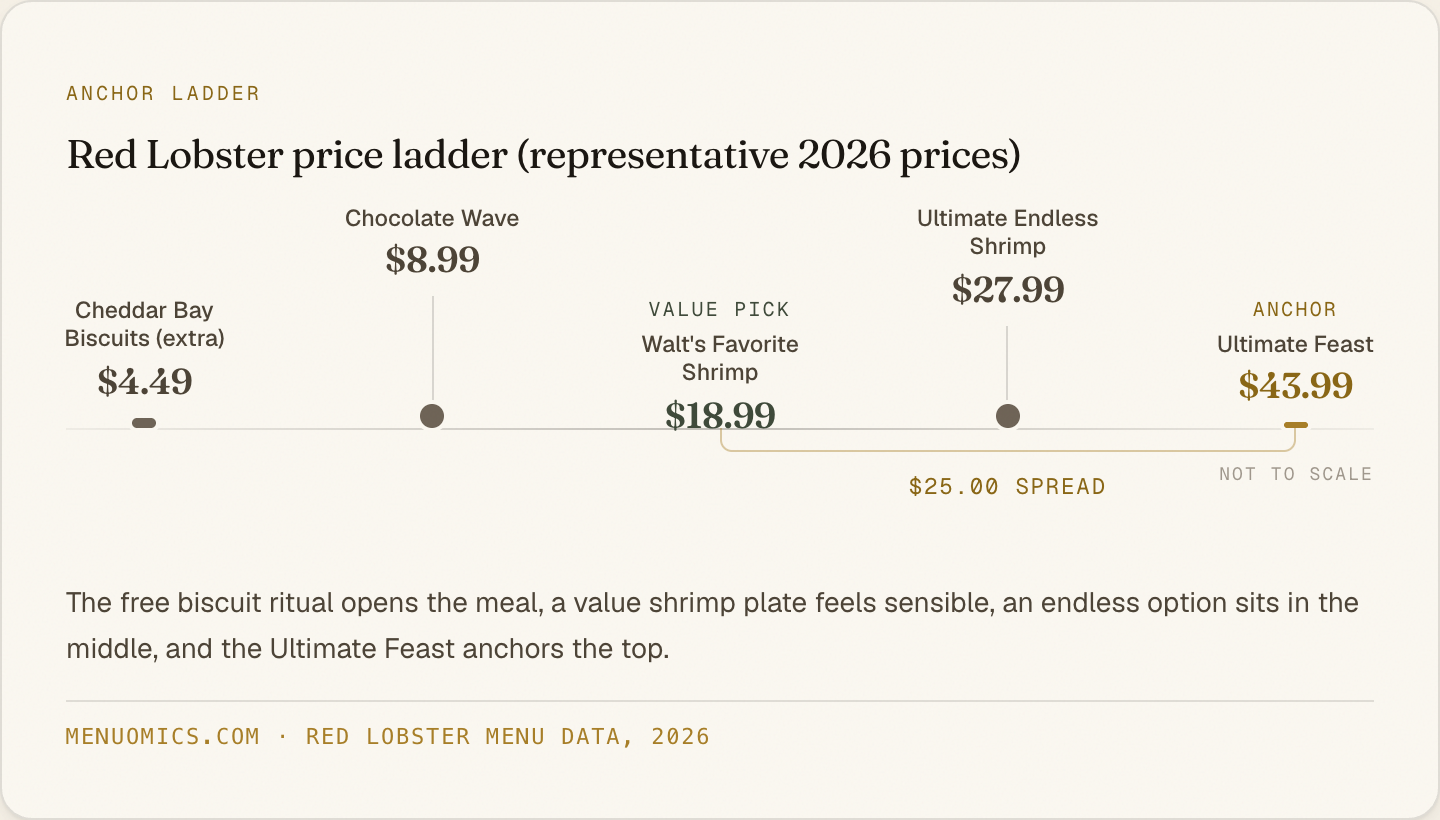
Red Lobster price ladder (representative 2026 prices)
The free biscuit ritual opens the meal, a value shrimp plate feels sensible, an endless option sits in the middle, and the Ultimate Feast anchors the top.
Download this chart (PNG) · free to reuse with credit, see reuse terms.
The full ticket
What it actually rings up to.
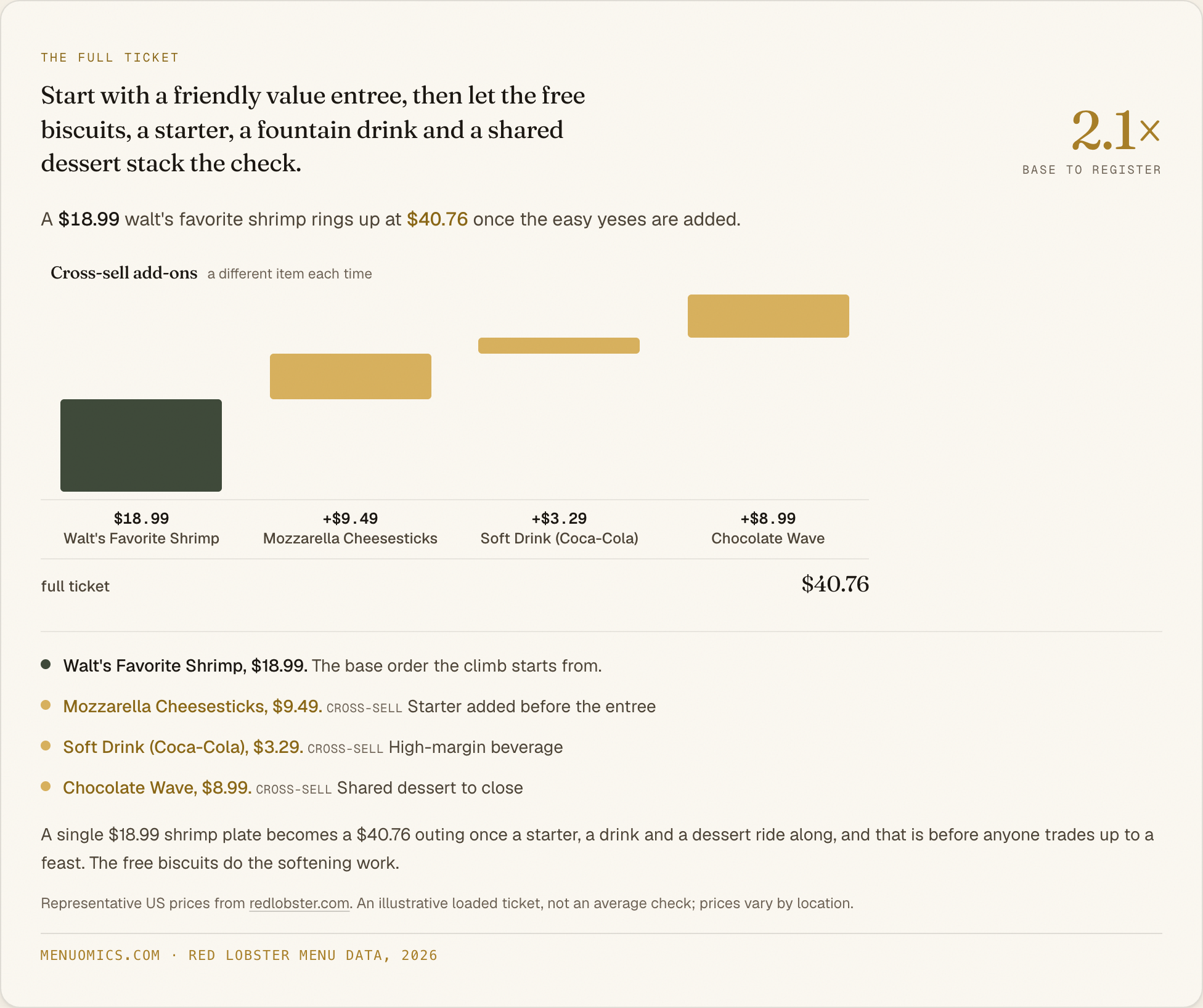
The headline price is only the start. The real number is the journey from a base order to the check at the register, one easy yes at a time.
Start with a friendly value entree, then let the free biscuits, a starter, a fountain drink and a shared dessert stack the check.
A $18.99 walt's favorite shrimp rings up at $40.76 once the easy yeses are added.
- Walt's Favorite Shrimp, $18.99. The base order the climb starts from.
- Mozzarella Cheesesticks, $9.49. cross-sell Starter added before the entree
- Soft Drink (Coca-Cola), $3.29. cross-sell High-margin beverage
- Chocolate Wave, $8.99. cross-sell Shared dessert to close
A single $18.99 shrimp plate becomes a $40.76 outing once a starter, a drink and a dessert ride along, and that is before anyone trades up to a feast. The free biscuits do the softening work.
Representative US prices from redlobster.com. An illustrative loaded ticket, not an average check; prices vary by location.
Download this chart (PNG) · free to reuse with credit, see reuse terms.
The setup
Red Lobster opened in 1968 in Lakeland, Florida, when Bill Darden bet that inland Americans would pay for seafood. General Mills bought it in 1970 and scaled it into the largest seafood casual chain in the country. By late summer 2026 it operates around 540 US restaurants, well below the roughly 700 it ran a few years earlier, after closing about 130 locations during a 2024 Chapter 11 bankruptcy. It is now owned by RL Investor Holdings, an affiliate of Fortress Investment Group, and is trying to claw its way back to steady footing.
The menu is a study in classic casual-dining psychology: a free warm-bread ritual that opens every meal, a top-of-menu lobster-and-crab feast that makes the mid-priced plates look reasonable, and a long history of abundance promos built to pull traffic. It is also a cautionary tale, because the permanent Endless Shrimp deal shows what happens when a value mechanic has no ceiling. (Red Lobster does not frame these as behavioral tactics; this is our reading of the observed design.)
What they get right
The behavioral economics already at work.
The free biscuits are a reciprocity engine
Every table gets a warm basket of Cheddar Bay Biscuits before ordering, refilled on request, at no charge. Giving something first creates a felt obligation to give back, which shows up as bigger orders, better tips and loyalty. The biscuits are so iconic they are sold as a boxed mix in grocery stores, which is free advertising for the in-store ritual.
Two biscuits free with every entree; extra half dozen about $4.49, redlobster.com biscuits and extras
The Ultimate Feast anchors the whole menu
At about $43.99, the Ultimate Feast is the priciest standard plate and it sits high on the page. Diners rarely order the most expensive item, but seeing it recalibrates what counts as reasonable, so a $19 shrimp plate or a $28 endless option reads as sensible by comparison. The $140.99 family feast pushes the ceiling even higher.
Ultimate Feast about $43.99; Walt's Favorite Shrimp about $18.99, redlobster.com signature feasts
Endless Shrimp is a mechanic with no ceiling
All-you-can-eat works only when average consumption stays under the fixed price. When Red Lobster made a roughly $20 Endless Shrimp permanent in 2023, heavy eaters and cheap shrimp math turned it into a loss leader with no brake. The promo bled about $11 million and layered on costly supply obligations, and it became a marquee reason the chain filed for Chapter 11 in 2024. Great traffic hook, broken as pricing craft.
About $11 million loss on permanent Endless Shrimp; filed Chapter 11 in May 2024, Restaurant Dive, what led to Red Lobster's bankruptcy
Feasts and combos bundle to lift the ticket
Signature Feasts and create-your-own combinations pile lobster, crab and shrimp into one price. Bundling hides the per-item cost and reframes the decision from whether to add more protein to which proteins to pick, which reliably raises spend versus ordering plates one at a time.
Create Your Own Ultimate Feast about $48.99 versus a single $18.99 shrimp plate, redlobster.com signature feasts
The middle tier is where the margin hides
The endless option at about $27.99 sits neatly between the value shrimp plate and the $43.99 feast. A well-placed middle choice pulls diners up from the cheapest plate while letting them feel thrifty relative to the anchor, which is exactly the compromise most tables land on.
Three-step climb: about $18.99, then $27.99, then $43.99, redlobster.com menu
What we’d test
The rewrite, with the expected lift and the honest caveat.
Name the free biscuits on the menu, do not just serve them
The giveaway lands harder when the menu says it out loud. A short line at the top that frames the biscuits as a gift converts a silent perk into a stated favor, which strengthens the sense of obligation before a single order is placed.
Expect Higher attach on starters and desserts and a stronger opening impression, at zero added food cost.
Caveat Keep it to one warm line; overselling a free item reads as a gimmick.
Retire open-ended Endless wording for bounded abundance
The word Endless promises unlimited and invites the worst-case eater. A bounded name that still signals generosity keeps the abundance appeal while capping the exposure the kitchen has to absorb. This is wording and framing, not a discount cut.
Expect Preserves the value pull while removing the runaway per-guest cost that helped sink the chain.
Caveat Guests anchored on the old unlimited deal may push back, so phase the language in.
Flag one high-margin combo as the house pick beside the anchor
Place a single, clearly labeled recommendation on the mid-priced combo that sits just below the Ultimate Feast. A house pick badge routes undecided diners toward a plate the kitchen wants to sell, using the nearby anchor to make it feel like the smart, moderate choice.
Expect Shifts mix toward a chosen, better-margin combo rather than the cheapest plate.
Caveat Badge exactly one item; more than one and the signal disappears.
What diners actually say
Synthesized from public reviews, the reality check that grounds every recommendation.
They praise
- The free Cheddar Bay Biscuit ritual is one of the strongest and most beloved reciprocity plays in all of casual dining.
- The Ultimate Feast is a clean, legible premium anchor that does real work for every plate beneath it.
- Signature Feasts and create-your-own combos bundle proteins in a way that reliably lifts the ticket without feeling pushy.
- Signature names like Walt's Favorite Shrimp and Cheddar Bay give the menu memorable, brandable hooks.
- A clear three-step price ladder from value shrimp to endless to feast gives most tables an easy compromise choice.
They criticize
- The permanent Endless Shrimp promo was an unlimited mechanic with no cost ceiling, a pricing failure that helped force a bankruptcy filing.
- Years of traffic-chasing discount promos trained guests to wait for deals and eroded margin.
- Menu prices sit high against the perceived quality, and reviews repeatedly cite a value gap.
- Anchor sprawl, with multiple premium feasts stacked near the top, muddies the read of what the flagship actually is.
- The design did not protect the business: a shrinking footprint shows the levers pulled traffic but not durable profit.
The verdict
Red Lobster shows what happens when a brand nails the crowd-pleasing behavioral moves but skips the guardrails. The free biscuits are a textbook reciprocity engine, the Ultimate Feast is a tidy anchor, and the combos bundle spend the way casual dining is supposed to. Yet menu craft is not just about pulling people in, it is about pricing the mechanics so they survive contact with real appetites, and the permanent Endless Shrimp deal failed that test so badly it helped bankrupt the company. Genuinely strong instincts, one very expensive lesson in ceilings. That earns a B-.
Common questions
- Are Red Lobster's Cheddar Bay Biscuits really free?
- Yes. Every entree comes with a warm basket of Cheddar Bay Biscuits at no charge, refilled on request. Extra half dozens to go run about $4.49. The giveaway is a classic reciprocity move that softens the table before ordering.
- What is the most expensive standard entree at Red Lobster?
- The Ultimate Feast, at roughly $43.99 in 2026, is the priciest standard plate and acts as the menu's anchor. A four-person Ultimate Family Feast runs about $140.99.
- Did Endless Shrimp really cause Red Lobster's bankruptcy?
- It was a major factor. Making the roughly $20 Endless Shrimp permanent in 2023 lost the company about $11 million and added costly supply obligations, and it became a marquee reason cited when Red Lobster filed for Chapter 11 in May 2024.
- Who owns Red Lobster now?
- After exiting Chapter 11 in September 2024, Red Lobster is owned by RL Investor Holdings, an affiliate of Fortress Investment Group, led by CEO Damola Adamolekun.
- How much is a meal at Red Lobster?
- A meal at Red Lobster starts around $18.99 for the base order and lands near $40.76 once the usual add-ons go on, roughly 2.1x the headline price (representative 2026 US figures; they vary by location). That gap between the price that gets you in and the total you pay is the multiplier this page grades.
Head to head
More breakdowns
 In-N-Out BurgerA
Three burgers, no seasonal items, and a famous off-menu modifier ('Animal Style') that turns customers into evangelists. Restraint as strategy.
Read the In-N-Out Burger breakdown → Chick-fil-AA
A famously simple chicken sandwich, an easy 'make it a meal' bundle, and free dipping sauces, wrapped in the most-praised service in fast food. The menu stays out of the way so the hospitality can do the selling.
Read the Chick-fil-A breakdown → Chili's Grill & BarA-
A $10.99 bundle dragged Chili's out of a slump and back to the top of casual-dining traffic. Read closely, '3 For Me' is one round number doing the work of three separate decisions.
Read the Chili's Grill & Bar breakdown → Domino'sB+
The $6.99 Mix & Match looks like a low price. Its real design is the words 'two or more': a self-bundle that turns one cheap pizza into a full cart.
Read the Domino's breakdown → Jersey Mike'sB+
Numbered subs in three sizes, a free signature modifier called 'Mike's Way,' and a Giant pitched as the smart-value pick. The size ladder, not the combo, is where the menu does its work.
Read the Jersey Mike's breakdown → Logan's RoadhouseB
A steakhouse that reviewers rank dead last still runs a value menu most casual chains would be proud of. The food is panned; the menu design is not. That gap is the whole point.
Read the Logan's Roadhouse breakdown →Your menu next
Get this for your own menu, free.
Send your menu and we’ll send back the same breakdown, what you get right, what we’d test, and why.
Applebee's
The archetypal casual-dining value play, where a memorable named-price bundle and a dollar margarita do most of the persuading.
Read it →