The Anchovy Bar menu, graded
Small plates, sold by the piece, that add up to a real check.
Every plate here is small and priced to be added one at a time. The format looks like a casual snack bar; the check it builds is anything but casual.
Menu-craft grade
A raw bar priced by the piece, a marquee named anchovy that signals quality for the whole page, and a wine list that carries the margin. The check is built to accumulate one small yes at a time. A menu that changes nightly and prints few cues keeps it from an A.
Graded on how well the menu uses behavioral economics, not the food.
Menu and prices verified September 2026
A 3-minute audio read of the analysis
- Type
- Independent
- Where
- San Francisco, California
- Cuisine
- Seafood and wine bar
- Footprint
- 1 location
- Since
- 2020
- Ownership
- Independent, chef-owned (Stuart Brioza & Nicole Krasinski, Atomic Workshop)
The mechanics, drawn
The same menu, mapped onto an axis, so the behavioral move is something you can see, not just read.
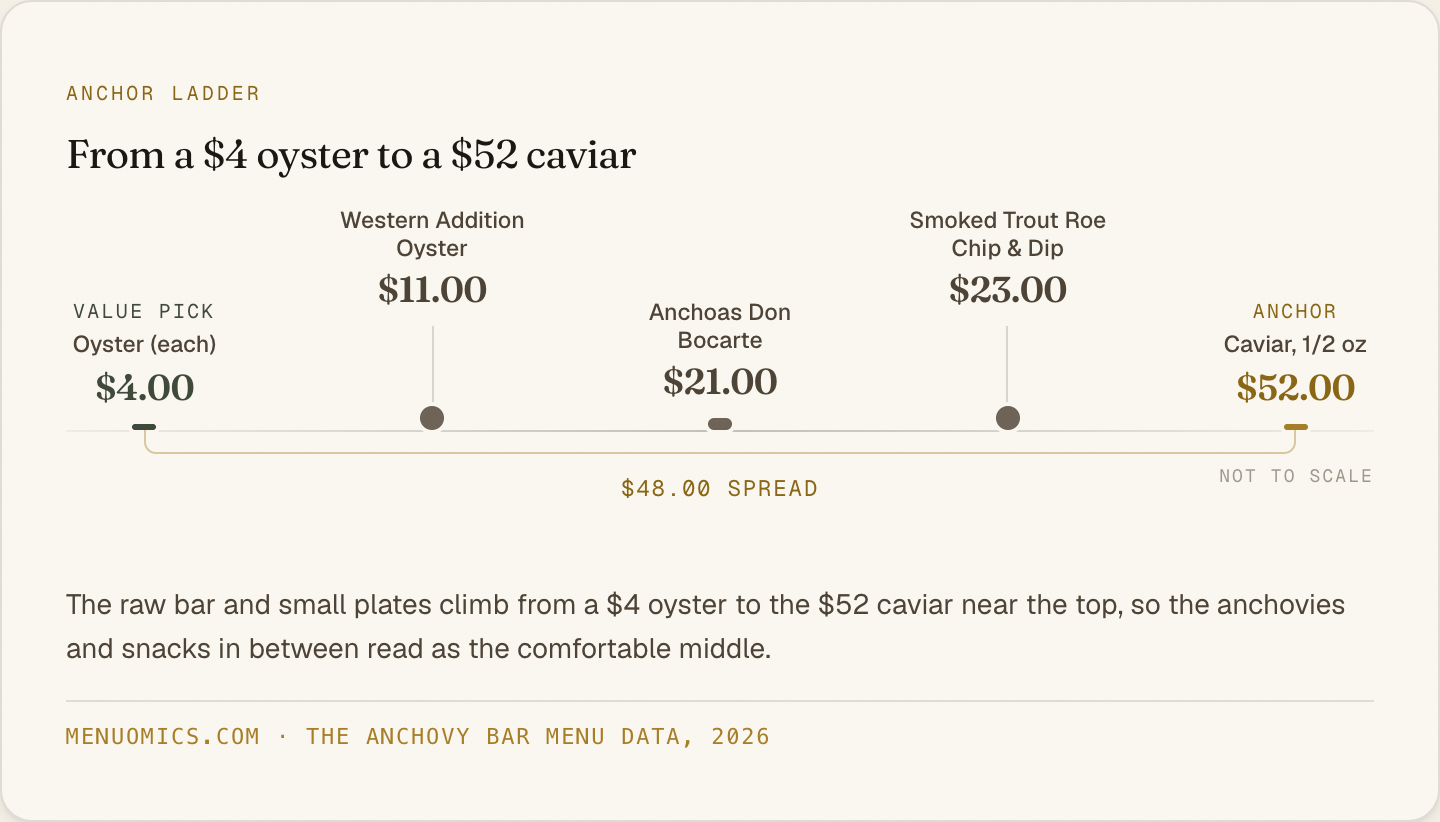
From a $4 oyster to a $52 caviar
The raw bar and small plates climb from a $4 oyster to the $52 caviar near the top, so the anchovies and snacks in between read as the comfortable middle.
Download this chart (PNG) · free to reuse with credit, see reuse terms.
The full ticket
What it actually rings up to.
The headline price is only the start. The real number is the journey from a base order to the check at the register, one easy yes at a time.
Small plates, sold by the piece, that add up one yes at a time
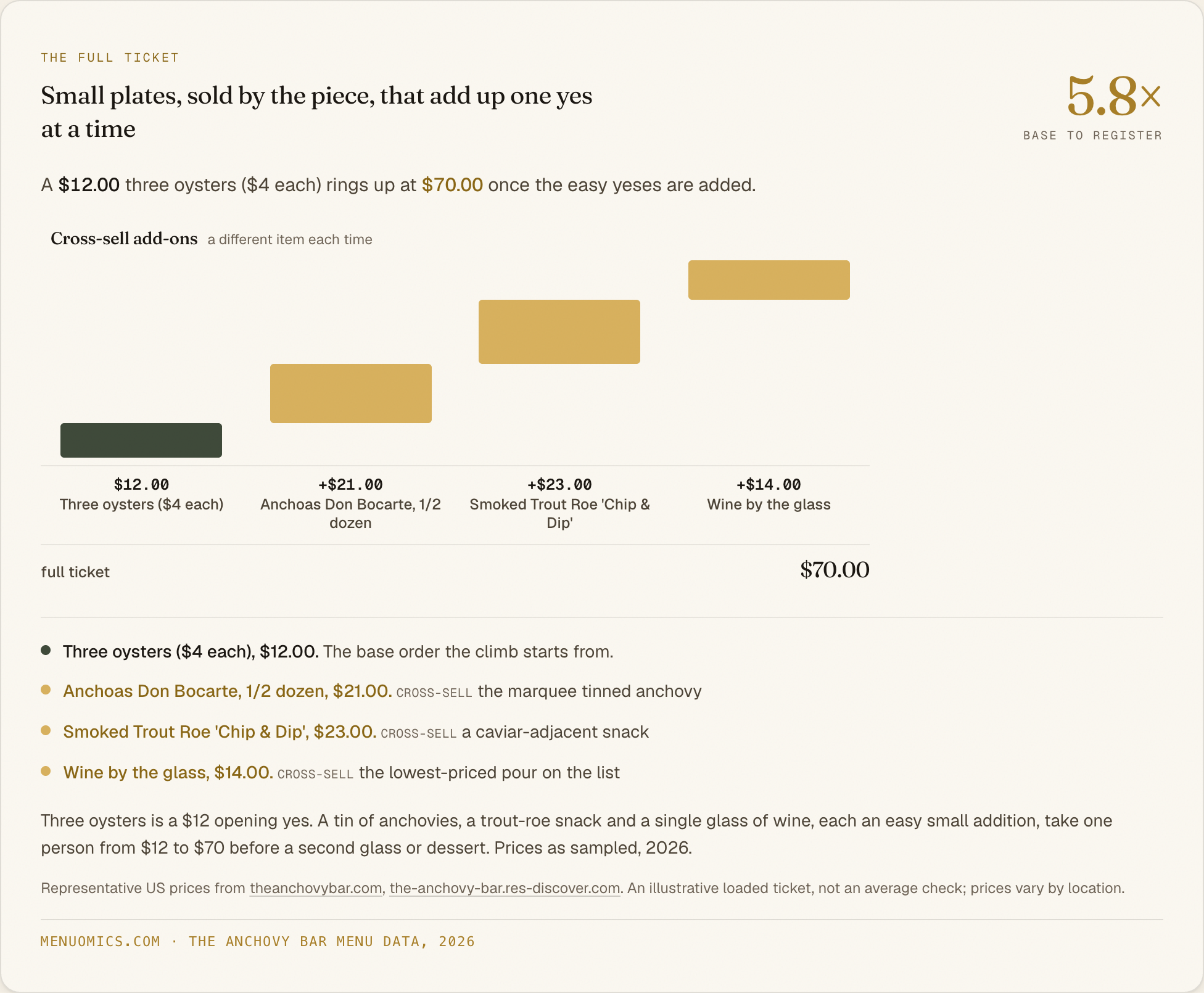
A $12.00 three oysters ($4 each) rings up at $70.00 once the easy yeses are added.
- Three oysters ($4 each), $12.00. The base order the climb starts from.
- Anchoas Don Bocarte, 1/2 dozen, $21.00. cross-sell the marquee tinned anchovy
- Smoked Trout Roe 'Chip & Dip', $23.00. cross-sell a caviar-adjacent snack
- Wine by the glass, $14.00. cross-sell the lowest-priced pour on the list
Three oysters is a $12 opening yes. A tin of anchovies, a trout-roe snack and a single glass of wine, each an easy small addition, take one person from $12 to $70 before a second glass or dessert. Prices as sampled, 2026.
Representative US prices from theanchovybar.com, the-anchovy-bar.res-discover.com. An illustrative loaded ticket, not an average check; prices vary by location.
Download this chart (PNG) · free to reuse with credit, see reuse terms.
The setup
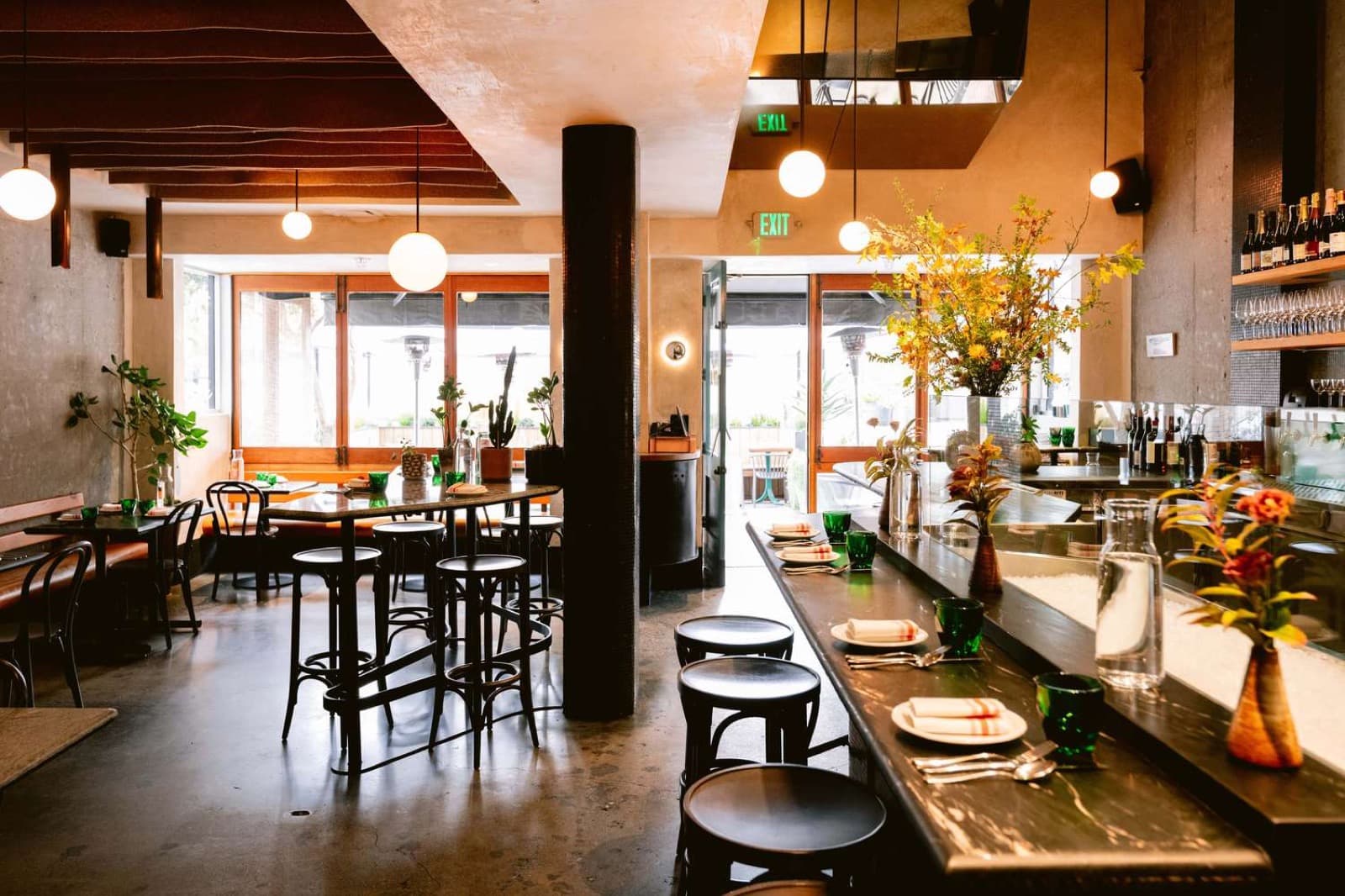
The Anchovy Bar opened in 2020 at 1740 O'Farrell Street, the third San Francisco room from Stuart Brioza and Nicole Krasinski of State Bird Provisions and The Progress. The concept is narrow on purpose: local Bay anchovies when they run from spring into fall, a raw bar of West Coast oysters and clams sold by the piece, imported Spanish and Italian anchovies year round, snacky small plates, and a wine, sherry and beer list that reads as an equal partner to the food. Nothing on the menu is an entree in the usual sense. It is a page of small dishes, most in the high teens to low thirties, with a $4 oyster at the bottom and a $52 half-ounce of caviar near the top.
That structure is the interesting part. A $4 oyster is an almost frictionless yes, and once a table has said yes once, the anchovies, the tinned fish, the trout-roe chip and dip and a glass of wine each arrive as another small, easy addition rather than one large commitment. The bill is assembled from a dozen little decisions, and the wine list quietly carries the margin underneath. (The Anchovy Bar does not frame these as behavioral tactics; this is our reading of the observed design.)
What they get right
The behavioral economics already at work.
Oysters sold by the piece
The raw bar prints each oyster at $4, six at $22 and a dozen at $44. Selling by the piece lets the check start at a single low number instead of a set-price platter, and a $4 yes is easy to repeat. Ordering three, then three more, feels smaller than committing to a dozen up front, even when the plate arrives at the same size.
splitting a price into parts changes how large the total feels, Morwitz, Greenleaf & Johnson, 1998
The named anchovy is a quality signal for the whole page
The Anchoas Don Bocarte from Santoña is one of the most respected anchovy tins in the world, sold at $21 for a half-dozen. Putting a famous, hard-to-fake premium product on the page tells the diner that the $4 oyster and the nightly small plates are chosen by people who know the difference. The tin does the vouching that menu adjectives cannot.
Sutherland on costly signalling; Don Bocarte widely rated among the world's finest anchovies
Small plates that accumulate
Almost nothing here is a full entree. The page is a run of $16 to $30 plates meant to be added a few at a time, so the total is assembled from many small, separately decided charges rather than one large one. Each addition is decoupled from the final bill, which is exactly how a snacky format quietly reaches a serious check.
Thaler, mental accounting; Prelec & Loewenstein on decoupling
The wine list carries the margin
This is a wine bar as much as a seafood bar, with an organic and biodynamic glass list running $14 to $21, plus sherry flights and beer. Briny, salty food is built to be eaten with a drink in hand, and a second and third glass ride along with the plates. The highest-margin line is poured, not plated.
Sutherland on restaurant economics: the profit is in the drinks
The caviar anchors the top of the page
A half-ounce of Tsar Nicoulai sturgeon caviar at $52 sits near the top of a menu whose plates otherwise run in the teens and twenties. Once a diner has read $52, a $23 trout-roe snack and a $21 tin of anchovies read as the reasonable middle. The caviar rarely needs to sell; it reframes everything below it.
a high reference price pulls the rest of the page toward the middle, Tversky & Kahneman, 1974
What we’d test
The rewrite, with the expected lift and the honest caveat.
Mark the plates that pair with a specific pour
The food is built to be eaten with a drink, and the wine list is the margin. A quiet by-the-glass suggestion on a few anchor plates, the sherry with the tinned anchovies, a Txakoli with the oysters, turns the drink from an afterthought into part of the order.
Expect More glasses attached per table, the highest-margin line
Caveat Menu copy only; one pairing cue per plate, since the room sells restraint.
Give the raw bar a suggested trio
Oysters sold by the piece already open the check well. A small printed suggestion, a starting trio across bays, gives the undecided a confident default and gently sets three as the opening number rather than one.
Expect A higher opening oyster count without pressure
Caveat A wording and layout nudge; keep the by-the-piece freedom intact.
Let the Don Bocarte line say why it matters
The menu names the town, Santoña, but assumes the diner knows what that tin is. One short clause of provenance on that single line would let the quality signal land for the table that does not already know, without turning the spare menu into sales copy. Treat this as a light touch, not a rewrite.
Expect The signature tin reads as the special-occasion order it is
Caveat One line only; descriptive-label effects are real but modest, and this menu earns authority through restraint.
What diners actually say
Synthesized from public reviews, the reality check that grounds every recommendation.
They praise
- The anchovies, local and imported
- Fresh, creative seafood that changes nightly
- A thoughtful organic and biodynamic wine list
- Warm, knowledgeable service
- An intimate, easygoing bar to eat at
They criticize
- Pricey for small plates
- Small plates add up fast
- Limited hours, closed Tuesday and Wednesday
- Hard to get a reservation
- The narrow anchovy-forward concept is not for everyone
The verdict
The Anchovy Bar looks like a casual snack-and-wine counter and prices like one plate at a time, which is exactly why the check climbs the way it does. A $4 oyster opens an easy run of small yeses, a world-class named anchovy vouches for the whole page, and the wine list pours the margin underneath. The menu work left is small: pair a few plates to a specific glass, suggest an opening oyster trio, and let the signature tin tell the table why it is the order.
Common questions
- How much does The Anchovy Bar in San Francisco cost?
- Oysters are $4 each (2026), most anchovy and seafood small plates run $16 to $30, and a half-ounce of caviar is $52, so a couple sharing a few plates with wine usually lands in the $60 to $90 a head range. The plates are small and priced to be added one at a time, which is how the check climbs without any single number looking large.
- What is The Anchovy Bar known for?
- It is known for local Bay anchovies in season, a raw bar of West Coast oysters sold by the piece, tinned Spanish anchovies like the Anchoas Don Bocarte, and a wine-forward list. The named anchovy, one of the most respected tins in the world, does the quiet work of signaling that everything else on the page is chosen with the same care.
- Do I need a reservation at The Anchovy Bar?
- Reservations open 30 days out on OpenTable, and walk-ins are welcome at the bar and outdoor tables nightly (2026). The bar seating is not a consolation prize here, it is the format: a raw bar and a wine list are built for the counter, where snacks and a glass accumulate at your own pace.
- Who owns The Anchovy Bar?
- It is owned by chefs Stuart Brioza and Nicole Krasinski, whose Atomic Workshop group also runs State Bird Provisions and The Progress next door. The shared kitchen lets the group treat a $4 oyster and a $52 caviar as the same act of sourcing, which is what lets the low end open the check and the high end anchor it.
Sources (8)
- The Anchovy Bar, official site and menu
- The Anchovy Bar, full menu with prices (res-discover)
- Sunset, 'A Wine Bar Devoted to Anchovies Will Open in SF'
- The Infatuation, The Anchovy Bar review
- La Cucina Italiana on The Anchovy Bar and 'The Anchovy Project'
- Partitioned pricing, Morwitz, Greenleaf & Johnson, 1998
- Mental accounting & decoupling, Thaler (1999); Prelec & Loewenstein (1998)
- Rory Sutherland, EconTalk on Alchemy
Head to head
More breakdowns
 Zuni CafeA-
A 75.00 chicken that takes about 75 minutes, and the menu says so. A practical warning that also happens to reduce uncertainty, printed in the margin.
Read the Zuni Cafe breakdown →A 1988 supper club hidden down a Gold Street alley, where live jazz, $18 martinis and tableside theater are the product and the food only has to clear the bar the room has raised.
Read the Bix breakdown →An elegant, romantic neighborhood bistro in Lower Pacific Heights serving modern French cooking with a Californian accent, from chef JP Carmona and the B Patisserie team.
Read the Routier breakdown →The James Beard 'America's Classic' that builds its whole reputation on what it leaves out: no rice, six meats, one price, off-menu dorado.
Read the La Taqueria breakdown →A Tenderloin Creole institution where one cheap, famous beignet gets bundled into a four-way Flight that quietly triples the check.
Read the Brenda's French Soul Food breakdown → NopaA
NopaAA 2006 Divisadero gathering place whose daily wood-fired menu prints prices as plain numbers, no dollar signs, no cents, anchored by a 49 brisket.
Read the Nopa breakdown →Your menu next
Get this for your own menu, free.
Send your menu and we’ll send back the same breakdown, what you get right, what we’d test, and why.
KFC
The chicken chain built on the bucket: a shareable anchor whose per-piece math reads as a deal, sold under a secret recipe no competitor can reverse-engineer. We grade the menu craft behind the Colonel, not the nostalgia.
Read it →