Baskin-Robbins menu, graded
Baskin-Robbins sells engineered variety: a 31-flavor wall that should trigger choice paralysis, defused with free pink-spoon tastes, then monetized by a scoop ladder where every scoop after the first costs about $1.50 and an ice cream cake case that makes each cone look cheap by comparison.
How free tastes, a $1.50 second scoop, and a case of $50 cakes turn a $3.99 cone into a $17 register total without any single step feeling like a splurge.
Menu-craft grade
The variety-plus-sampling system is a genuinely effective answer to choice overload, the scoop ladder's quantity discount is honest arithmetic, and the cake case supplies a clean high anchor. It loses ground for price opacity (the official site publishes no prices at all), a widening gap between member and walk-in pricing, and a signature discount day that excludes the very add-ons the rest of the menu is built to sell.
Graded on how well the menu uses behavioral economics, not the food.
Menu and prices verified September 2026
A 4-minute audio read of the analysis
- Type
- Chain
- Where
- Canton, Massachusetts (headquarters)
- Cuisine
- Ice cream, sundaes, shakes, and ice cream cakes
- Footprint
- ~2,100 US shops (2026), about 7,800 worldwide
- Since
- 1945 (Glendale, California; founders Burt Baskin and Irv Robbins)
- Ownership
- Inspire Brands (backed by Roark Capital) via the $11.3 billion Dunkin' Brands acquisition in 2020; virtually all shops franchised
The mechanics, drawn
The same menu, mapped onto an axis, so the behavioral move is something you can see, not just read.
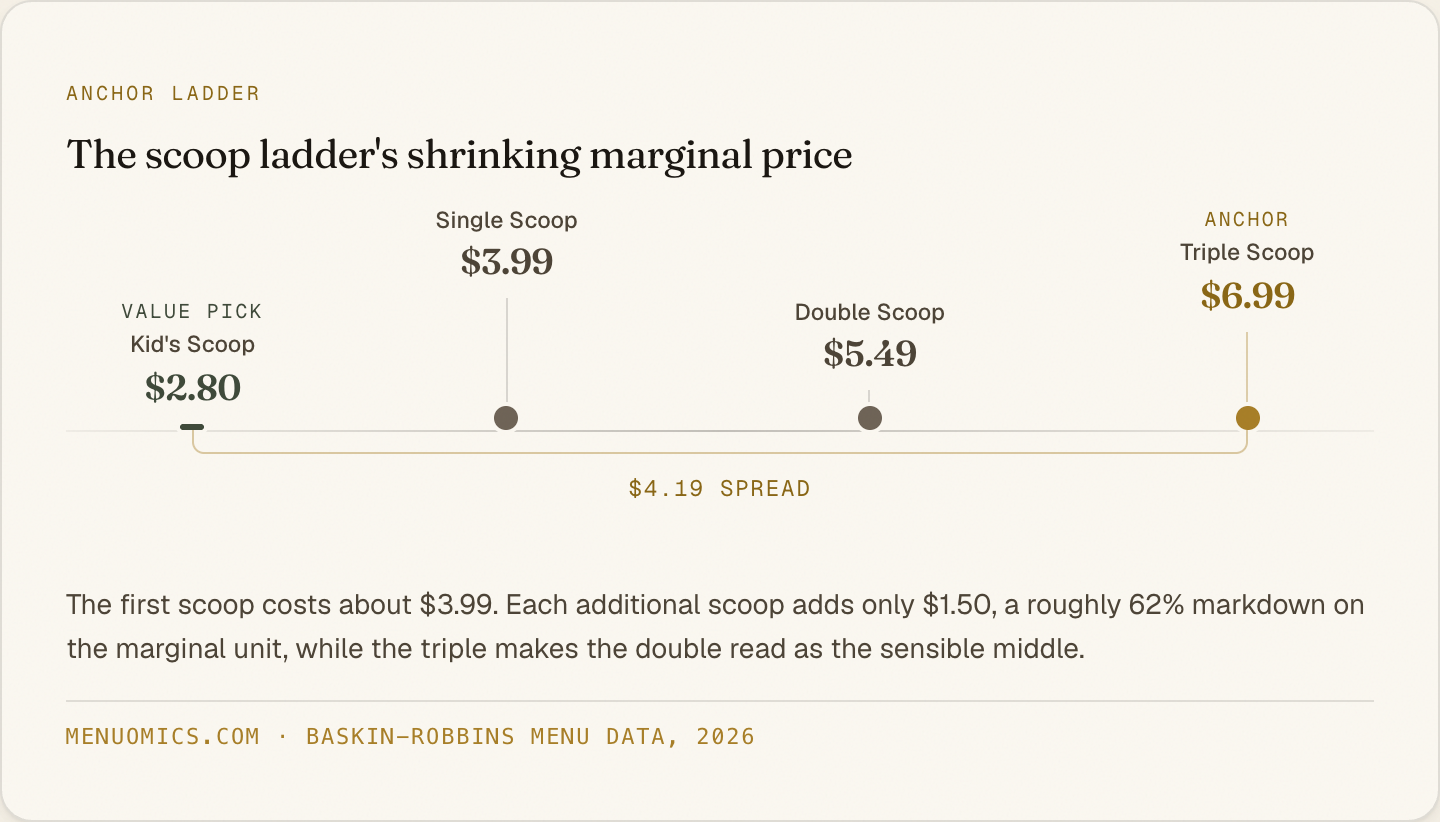
The scoop ladder's shrinking marginal price
The first scoop costs about $3.99. Each additional scoop adds only $1.50, a roughly 62% markdown on the marginal unit, while the triple makes the double read as the sensible middle.
Download this chart (PNG) · free to reuse with credit, see reuse terms.
The full ticket
What it actually rings up to.
The headline price is only the start. The real number is the journey from a base order to the check at the register, one easy yes at a time.
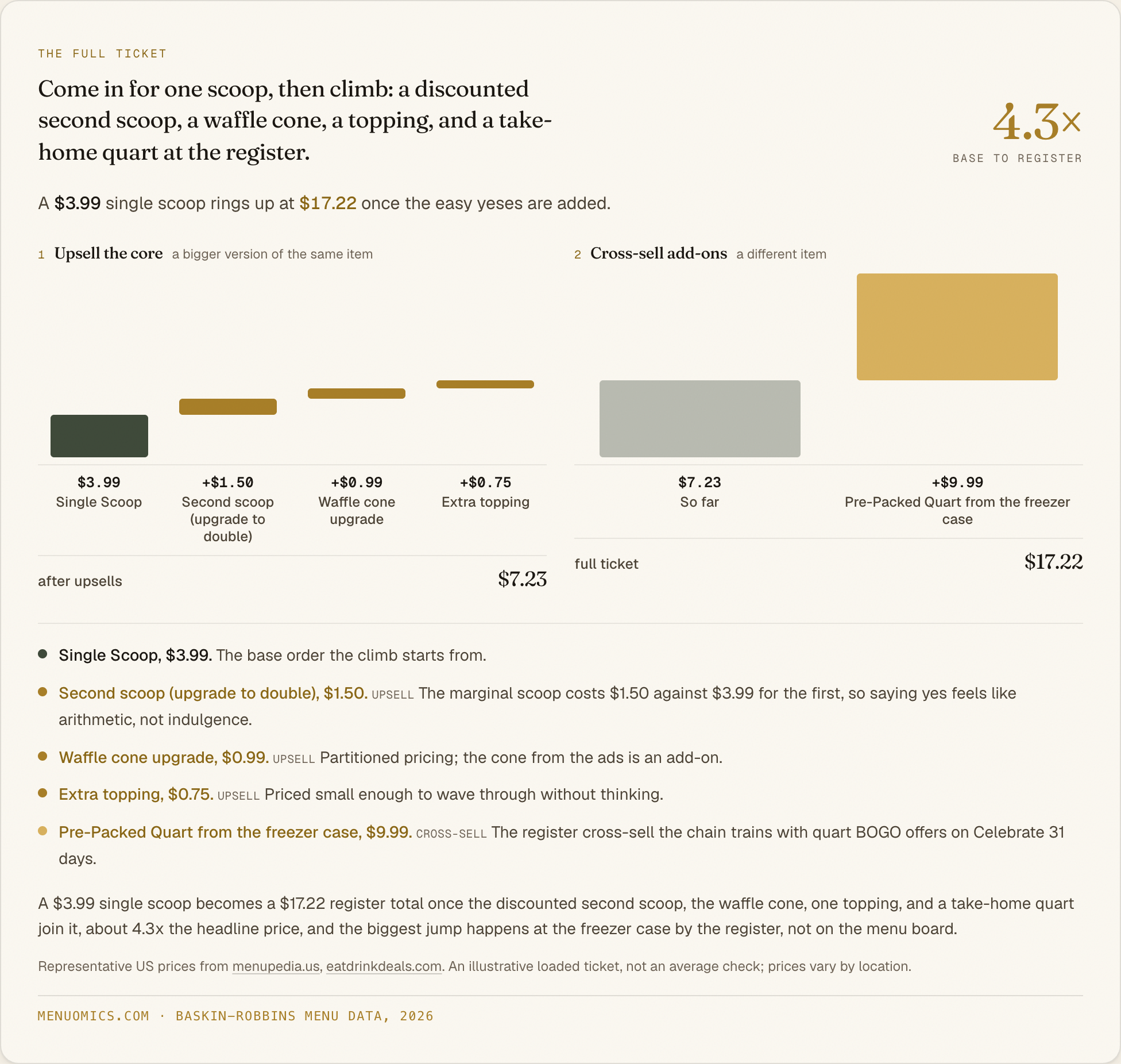
Come in for one scoop, then climb: a discounted second scoop, a waffle cone, a topping, and a take-home quart at the register.
A $3.99 single scoop rings up at $17.22 once the easy yeses are added.
- Single Scoop, $3.99. The base order the climb starts from.
- Second scoop (upgrade to double), $1.50. upsell The marginal scoop costs $1.50 against $3.99 for the first, so saying yes feels like arithmetic, not indulgence.
- Waffle cone upgrade, $0.99. upsell Partitioned pricing; the cone from the ads is an add-on.
- Extra topping, $0.75. upsell Priced small enough to wave through without thinking.
- Pre-Packed Quart from the freezer case, $9.99. cross-sell The register cross-sell the chain trains with quart BOGO offers on Celebrate 31 days.
A $3.99 single scoop becomes a $17.22 register total once the discounted second scoop, the waffle cone, one topping, and a take-home quart join it, about 4.3x the headline price, and the biggest jump happens at the freezer case by the register, not on the menu board.
Representative US prices from menupedia.us, eatdrinkdeals.com. An illustrative loaded ticket, not an average check; prices vary by location.
Download this chart (PNG) · free to reuse with credit, see reuse terms.
The setup
Baskin-Robbins was founded in 1945 in Glendale, California, by brothers-in-law Burt Baskin and Irv Robbins, who merged their separate shops and in 1953 took the Carson-Roberts ad agency's advice to sell the count itself: 31 flavors, one for every day of the month. The number was a solution to a problem the founders understood early. A wall of flavors pulls people in the door, but it also freezes them at the glass. So the chain paired its variety with the little pink taster spoon and a standing policy that you can sample any flavor free until you find the one you want. More than 1,400 flavors have rotated through the case since 1945, with a Flavor of the Month giving the undecided a fresh default.
Today the brand belongs to Inspire Brands, the Roark Capital restaurant group that bought Dunkin' Brands for $11.3 billion in 2020, and its roughly 2,100 US shops run a quiet ladder. The first scoop costs about $3.99 and every scoop after it about $1.50, while the cone and the toppings are priced as separate add-ons. A case of decorated ice cream cakes stretching past $50 sits in view of every cone order, and around it hangs a deal layer (a free welcome scoop in the app, 31% off scoops on the 31st of the month) that trades discounts for membership. (Baskin-Robbins does not frame any of this as behavioral tactics; this is our reading of the observed design.)
What they get right
The behavioral economics already at work.
Thirty-one flavors, with the paralysis engineered out
The 31-flavor wall is the most famous variety play in food retail, and on paper it should backfire. In the classic jam study, shoppers flocked to a 24-flavor tasting table but bought a tenth as often as those who saw six. Baskin-Robbins sells the big assortment as identity, then quietly removes the cost of choosing: free tastes kill the risk of a bad pick, the rotating Flavor of the Month gives browsers one fresh default, and the case always carries the classics most guests actually order. A later meta-analysis found choice overload is far from universal, and a managed wall like this one is a good example of why.
24-jam display drew more shoppers but converted ~3% vs ~30% for the 6-jam display, Iyengar & Lepper, 2000 (the jam study)
The pink spoon is reciprocity you can eat
The taster spoon exists because customers were defaulting to vanilla rather than gambling the price of a cone on an unknown flavor. A free spoonful solves that, and it does a second job on the way: a small unrequested gift creates a mild obligation to buy, the reciprocity effect that makes free samples one of retail's most reliable tools. The company treats unlimited sampling as official policy and has said guests should taste as many flavors as they like, though franchised owners set the mood store by store.
Unlimited free tastes on the pink spoon are stated company policy, Mashed; Baskin-Robbins statement to People
The second scoop costs less than half the first
A single runs about $3.99, a double $5.49, a triple $6.99. Every scoop after the first costs $1.50, roughly a 62% markdown on the marginal unit. That is a genuine quantity discount, but it also works as an anchor: once the first scoop has set $3.99 as the price of ice cream, $1.50 more feels almost free, and the triple exists mostly so the double reads as the sensible middle choice.
Single ~$3.99, double ~$5.49, triple ~$6.99: each added scoop costs $1.50, Menupedia Baskin-Robbins 2026 US pricing
The cone and the toppings are sold in pieces
The board quotes the scoop, and everything that makes the treat photogenic is an add-on: about $0.99 for a fresh waffle cone, more for a chocolate-dipped one, about $0.75 per extra topping. Research on partitioned pricing shows that splitting a total into a base plus small surcharges lowers the perceived cost and raises demand. The exclusion list on the chain's own discount day (waffle cones, toppings, and sundaes never get the 31% off) is a decent map of where the protected margin lives.
Partitioned prices lower perceived totals and increase demand, Morwitz, Greenleaf & Johnson, 1998
The cake case is the ceiling
Every scoop is ordered within sight of decorated cakes running from about $28.99 for a third-sheet to $89.99 for a double sheet. Against those numbers a $6.99 triple looks like restraint, which is what a high anchor is for. The cakes also move the brand into a different mental account: a birthday cake is a planned, occasion-budget purchase ordered days ahead, so the same small shop collects both the $4 impulse and the $50 event without either price contaminating the other.
Cakes in the case run from about $28.99 (1/3 sheet) to $89.99 (double sheet), HackTheMenu Baskin-Robbins cake prices, 2026
What we’d test
The rewrite, with the expected lift and the honest caveat.
Put social proof on the flavor wall
Thirty-one unlabeled tubs still ask the guest to do all the work. Tag the top three sellers and give the Flavor of the Month an eye-level callout so the undecided can commit faster, which also shortens the line behind them.
Expect Faster decisions and a sales shift toward tagged flavors.
Caveat Tags must reflect real sales; guests notice when every store has the same 'favorites.'
Cai, Chen & Fang, AER 2009
Say the marginal scoop price out loud
The ladder's best fact is hidden in subtraction. Quoting the second scoop as an add-on price instead of a new total makes the quantity discount explicit at the exact moment of choice.
Expect Higher double and triple attach without touching prices.
Caveat Franchisees with different price spreads need their own numbers; the reframe only works when the marginal price is genuinely small.
Make the quart a standing register prompt
Celebrate 31 already pairs scoop discounts with buy-one-get-one 50% off pre-packed quarts, proving the take-home cross-sell works. Surface a single 'add a quart' prompt at app checkout and at the register year-round instead of once a month.
Expect Higher freezer-case attach on ordinary days.
Caveat One dismissible prompt only; repeated nags suppress conversion and sour the treat occasion.
What diners actually say
Synthesized from public reviews, the reality check that grounds every recommendation.
They praise
- Unlimited free tastes on the pink spoon remain one of the most generous sampling policies in food retail, and they directly defuse the menu's own choice overload.
- Celebrate 31 is deal design tied to brand identity: 31% off on the 31st is easy to remember and reinforces the flavor count instead of cheapening it.
- The scoop ladder's quantity discount is real arithmetic, not an illusion; the marginal scoop genuinely costs a fraction of the first.
- The Flavor of the Month has rotated fresh defaults through the case for decades, keeping a 1945 brand's assortment current at more than 1,400 flavors introduced.
- The app's welcome offer is honest acquisition: a free single scoop after any $1 purchase, real product rather than a token percentage off.
They criticize
- Total price opacity: the official website quotes no prices at all, and franchise spreads mean a single scoop can cost $3.50 or $4.49 depending on the door you walk through.
- The US footprint has shrunk for two decades, from about 2,900 shops in the mid-2000s to roughly 2,100 today, as premium scoop shops took the top of the market.
- Celebrate 31 excludes waffle cones, toppings, and sundaes, which are precisely the add-ons the menu spends the other thirty days promoting.
- The best offers are gated behind Rewards enrollment, so walk-in guests quietly pay more than members for identical orders.
- Add-ons stack fast: a double scoop in a dipped waffle cone with one extra topping runs past $7.50, scoop-shop-premium money delivered in a chain-store cup.
The verdict
The core mechanism is old and it still works: advertise abundance, remove the fear of choosing with a free taste, then let a steep quantity discount and a partitioned cone walk the ticket upward while a case of $50 cakes makes everything else look small. That is real craft, and every self-serve froyo shop since has borrowed pieces of it. What drags the grade is discipline around price communication. Nothing is posted officially, member and walk-in prices are drifting apart, and the one famous discount day carves out the exact add-ons the menu otherwise pushes, a combination that spends the trust the pink spoon took decades to earn. The machine is elegant; the pricing around it has gotten cagey.
Common questions
- Why does Baskin-Robbins have 31 flavors?
- The 31 was a 1953 idea from the Carson-Roberts ad agency: one flavor for every day of the month. It became the brand name when founders Burt Baskin and Irv Robbins merged their shops, and the chain has introduced more than 1,400 flavors since 1945, rotating them through the 31 slots.
- Are samples at Baskin-Robbins really free?
- Yes. Free tastes on the small pink spoons are official policy, and the company has said guests can sample as many flavors as they like before choosing. Shops are franchised, so generosity varies a little by owner, but sampling is core to the brand.
- What is Celebrate 31 at Baskin-Robbins?
- On the 31st of months with 31 days, participating US shops take 31% off regular and kid-sized scoops, an offer tied to Baskin-Robbins Rewards membership in recent years. Waffle cones, toppings, and sundaes are excluded, and there is often a companion deal such as buy one pre-packed quart, get a second 50% off.
- How much does a scoop cost at Baskin-Robbins in 2026?
- Representative 2026 US prices: about $2.80 for a kid's scoop, $3.99 for a single, $5.49 for a double, and $6.99 for a triple, with a waffle cone roughly $0.99 extra. Every shop is franchised, so prices vary noticeably by market.
- What is the most expensive item at Baskin-Robbins?
- On the standard menu, the priciest single item is the Full Sheet Cake, about $53.99 in representative 2026 US pricing (it varies by location; group packs and combo deals can cost more). That top price also does quiet work as the menu's anchor: it is the number that makes everything below it read as reasonable.
- How much is a meal at Baskin-Robbins?
- A meal at Baskin-Robbins starts around $3.99 for the base order and lands near $17.22 once the usual add-ons go on, roughly 4.3x the headline price (representative 2026 US figures; they vary by location). That gap between the price that gets you in and the total you pay is the multiplier this page grades.
Sources (8)
- Menupedia: Baskin-Robbins menu prices 2026
- HackTheMenu: Baskin-Robbins cake prices 2026
- Baskin-Robbins: Celebrate 31 returns (official blog)
- EatDrinkDeals: Baskin-Robbins deals and Celebrate 31 (2026)
- Restaurant Dive: Baskin-Robbins' new loyalty program (2024)
- Mashed: The importance of Baskin-Robbins' little pink sample spoons
- Wikipedia: Baskin-Robbins (history, ownership, store counts)
- Iyengar & Lepper (2000): the jam study
Head to head
More breakdowns
 The Cheesecake FactoryB+
A 21-page, 250-item menu should be a behavioral disaster. It's a roughly $4-billion chain. Here's what all that abundance is quietly doing.
Read the The Cheesecake Factory breakdown → McDonald'sA-
The Extra Value Meal is one of the most-copied ideas in food: fold the whole order into a single number that hurts less than three. Then McValue and the app pile value on top, and the McRib drops in as an event.
Read the McDonald's breakdown → Taco BellA-
A sub-$3 value menu sets the floor, $5/$7/$9 boxes name the deal after its own price, and a never-ending limited-time calendar keeps a reason to come back on the board. Taco Bell sells value loudly, and it works: it gained traffic while rivals shrank.
Read the Taco Bell breakdown → Dunkin'A-
A premium latte anchors the cheap iced coffee as the obvious default, the $6 Meal Deal bundles the breakfast, and Dunkin' Rewards turns the morning run into a streak. The menu craft is textbook; the strain is price creep and an app that increasingly decides the real price.
Read the Dunkin' breakdown → Panda ExpressB+
The whole order comes down to one question, how many entrees. A Bowl is one, a Plate is two, a Bigger Plate is three, and the menu is built so the middle Plate wins. Orange Chicken is the anchor everyone orders, and a quiet $1.50 premium upcharge lifts the check while the headline price stays put.
Read the Panda Express breakdown → Raising Cane'sA-
The chicken-finger chain that built a billion-dollar machine by refusing to sell almost anything else.
Read the Raising Cane's breakdown →Your menu next
Get this for your own menu, free.
Send your menu and we’ll send back the same breakdown, what you get right, what we’d test, and why.
Hardee's
A burger chain with a split personality by design: scratch-made biscuits that dominate the morning, charbroiled Thickburgers anchored by a famously excessive Monster, and a value bag priced below the flagship burger it sits under.
Read it →