
McDonald's menu, graded
The combo is the default: bundle the bill into one number, then layer value and scarcity on top
Most of the menu's behavioral work happens before you taste anything: the combo is the default, the bill is bundled, and the deals are framed to feel like a win.
Menu-craft grade
The combo is engineered as the default through transparently integrated pricing (the chain states its Extra Value Meals run about 15% under a la carte), a stacked McValue and app-deal value layer, and the McRib as a recurring scarcity event; held back by charm pricing and a value story reviewers say has gotten muddier.
Graded on how well the menu uses behavioral economics, not the food.
Menu and prices verified September 2026
A 4-minute audio read of the analysis
- Type
- Chain
- Where
- Chicago, IL
- Cuisine
- Fast food, burgers
- Footprint
- ~13,800 US locations
- Since
- 1955
- Ownership
- NYSE: MCD, ~95% franchised
The mechanics, drawn
The same menu, mapped onto an axis, so the behavioral move is something you can see, not just read.
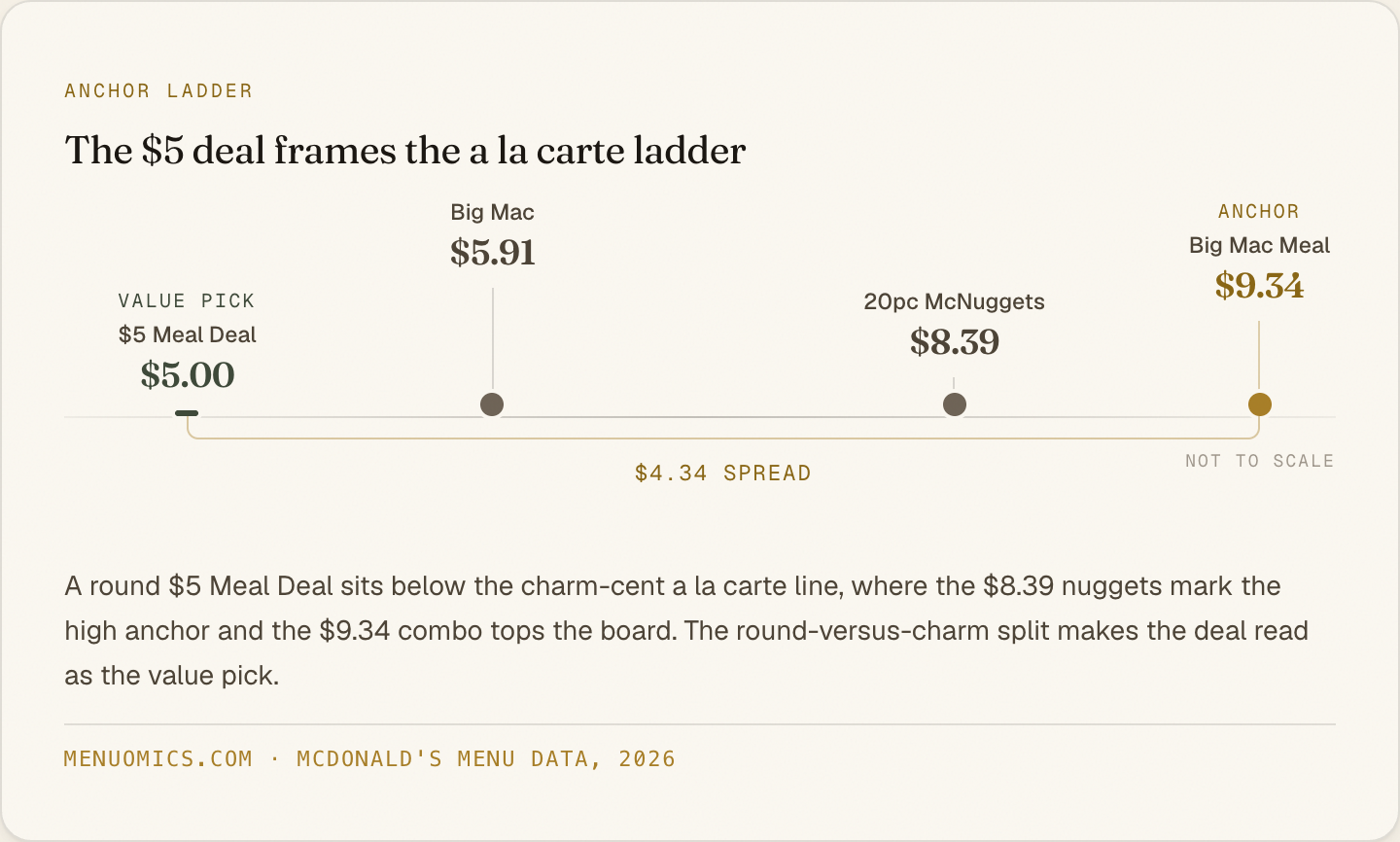
The $5 deal frames the a la carte ladder
A round $5 Meal Deal sits below the charm-cent a la carte line, where the $8.39 nuggets mark the high anchor and the $9.34 combo tops the board. The round-versus-charm split makes the deal read as the value pick.
Download this chart (PNG) · free to reuse with credit, see reuse terms.
The full ticket
What it actually rings up to.
The headline price is only the start. The real number is the journey from a base order to the check at the register, one easy yes at a time.
Make it a meal, then size up and tack on dessert
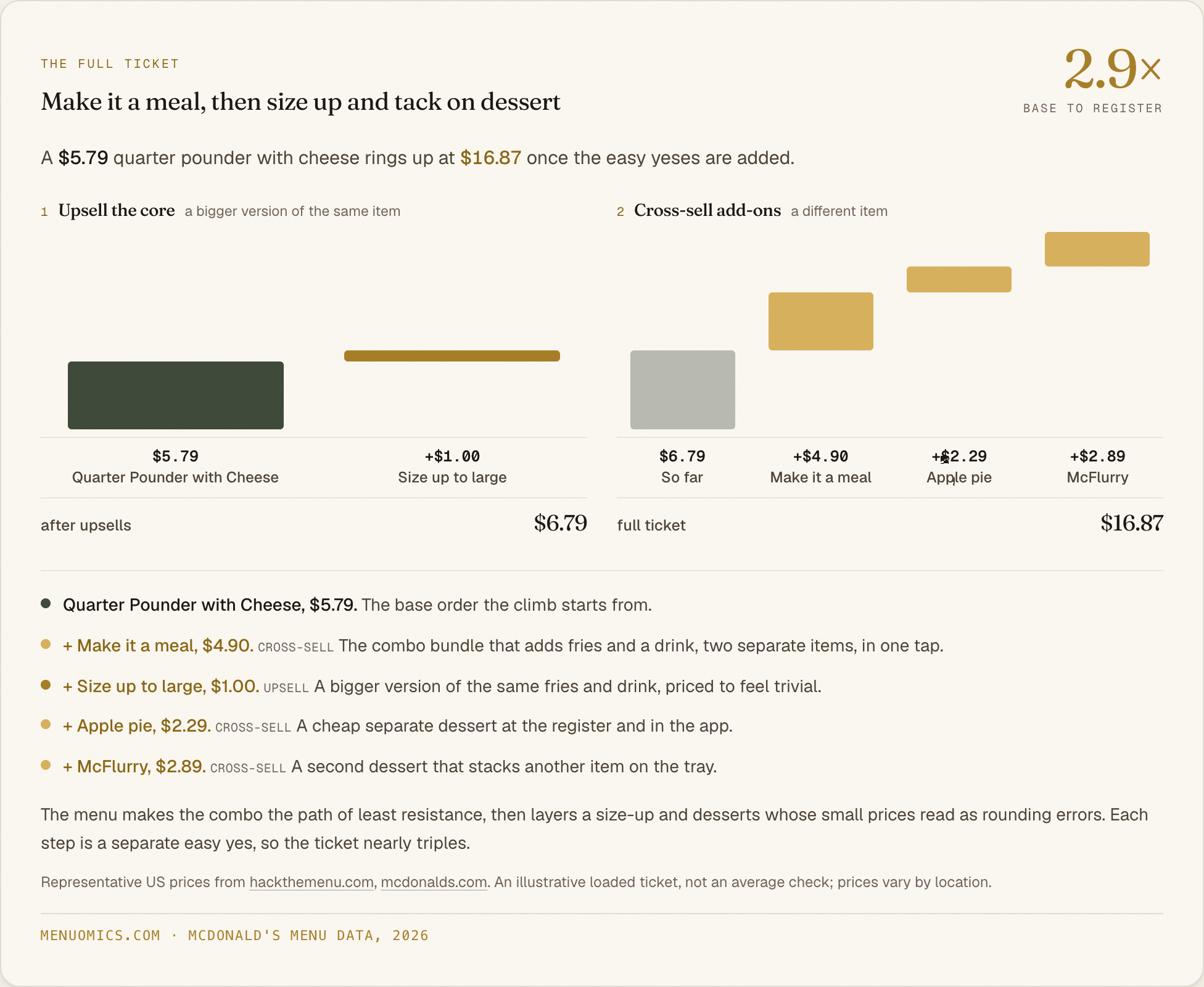
A $5.79 quarter pounder with cheese rings up at $16.87 once the easy yeses are added.
- Quarter Pounder with Cheese, $5.79. The base order the climb starts from.
- + Make it a meal, $4.90. cross-sell The combo bundle that adds fries and a drink, two separate items, in one tap.
- + Size up to large, $1.00. upsell A bigger version of the same fries and drink, priced to feel trivial.
- + Apple pie, $2.29. cross-sell A cheap separate dessert at the register and in the app.
- + McFlurry, $2.89. cross-sell A second dessert that stacks another item on the tray.
The menu makes the combo the path of least resistance, then layers a size-up and desserts whose small prices read as rounding errors. Each step is a separate easy yes, so the ticket nearly triples.
Representative US prices from hackthemenu.com, mcdonalds.com. An illustrative loaded ticket, not an average check; prices vary by location.
Download this chart (PNG) · free to reuse with credit, see reuse terms.
The setup
McDonald's describes itself, in its own words, as serving "moments of feel-good" with "affordable prices" and "the speed, choice and personalization" customers expect. The menu is built around the Extra Value Meal, the chain's name for the combo: an entree plus fries and a drink sold as one item. McDonald's says these bundles run about 15% less than buying the pieces separately, which is roughly the price of the drink taken off.
That single move is the lesson. A combo is partitioned pricing run in reverse: instead of itemizing three charges, the menu integrates them into one number, which is the less painful way to present a loss. On top of that sits the McValue layer (a $5 Meal Deal, Buy One Add One for $1, an Under $3 menu) and the app, where deals are framed as exclusive wins. And once or twice a year the McRib appears as a scarcity event. The chain does not state all of this as intent; this is the read of the observed design.
What they get right
The behavioral economics already at work.
The combo integrates the loss
Three separate charges, an entree, fries, a drink, hurt more than one combined price. The Extra Value Meal folds them into a single number, and one bill stings less than an itemized column. The chain's own "about 15% less than separately" framing also lets the bundle read as a discount rather than the default it functions as.
Thaler, mental accounting, integrate losses; McDonald's states Extra Value Meals run ~15% under a la carte
Round-number deals are the value signal
"$5 Meal Deal," "add one for $1," "Under $3": the deals are priced as clean, round, memorable numbers while regular items carry charm cents. Round headline prices are easy to recall and act as reference points that make the rest of the board feel fair, which matters most when the broader complaint is that fast food got expensive.
anchoring; Tversky and Kahneman 1974
The app reframes the same food as a win
App-only and daily deals turn an ordinary order into a captured discount. Framing a purchase as a deal you unlocked changes how the spend feels, independent of the absolute price, and the rewards layer adds a reason to come back. The value lives in the framing as much as the number.
transaction utility (Thaler), the pleasure of getting a good deal, distinct from the item's value
The McRib runs on a clock, the menu does not
The core menu is always there; the McRib is pulled and returned, repeatedly under a "farewell tour" that has come back every year since 2022. Limited availability raises perceived value and turns a sandwich into a countdown. Note the honest caveat: a 2011 analysis found McRib runs tracked low pork prices, so the timing is at least partly cost-driven, not pure theater.
the 2010 nationwide return lifted that November's US sales ~4.8%, Worchel et al., 1975 (scarcity)
The Big Mac is the anchor you price against
The Big Mac is the dish customers and the press use to judge whether McDonald's is cheap or expensive, the Economist literally built an index on it. That single famous item is the reference point the value menu is implicitly measured against, which is why a low-priced combo around it reads as a deal.
anchoring; the Big Mac as the menu's de facto reference price
What we’d test
The rewrite, with the expected lift and the honest caveat.
Lead the board with the combo, price the sandwich quietly
Where a board shows a sandwich price first and the meal as an upcharge, the partitioned framing makes the combo feel like an add-on cost. Leading with the Extra Value Meal as the primary line, with the a la carte sandwich set smaller beneath it, presents the single integrated price as the default and the unbundled option as the exception. This is a layout and ordering change, not a price change.
Expect Higher combo attach, since the integrated price is read first
Caveat Menu layout and item-ordering only: it does not change prices, portions, or the food.
Keep deal prices round, keep a la carte in cents
The contrast is doing work: round "$5" and "$1" deal numbers are memorable and read as value, while charm-cent a la carte prices read as everyday retail. Hold that split deliberately rather than letting deal prices drift into "$5.49," which would blunt both the memorability and the value signal.
Expect Deals stay easy to recall and read as deals at the point of choice
Caveat Pricing-presentation only: this is about how the number is formatted on the board, not what is charged.
Name the McRib's return as a stated, time-boxed event on the board
When the McRib is in, a board line that states the window in words, "back for a limited time," converts a sandwich into a known, closing opportunity, the same mechanism that makes a stated wait or a countdown clock read better than an open-ended one. The wording carries the scarcity; the item already exists.
Expect Sharper urgency on the LTO while it is available
Caveat Menu wording only: it states the existing limited window, it does not change the product or the timing decision.
What diners actually say
Synthesized from public reviews, the reality check that grounds every recommendation.
They praise
- Genuinely cheap value deals when you use the app
- Fast, consistent, predictable everywhere
- The Big Mac and fries deliver what you expect
- The McRib's return is an event people look forward to
They criticize
- "Not cheap anymore," value lost vs a few years ago
- The ice cream machine is too often broken
- Real value now requires the app, not the counter
The verdict
McDonald's menu is a clinic in presenting the bill: the Extra Value Meal integrates three charges into one less-painful number and makes the combo the default, then McValue and the app stack a round-number value story on top and the McRib drops in as a scarcity event. The menu-design upside is to make that architecture explicit, lead with the bundle in the layout, hold the round-vs-charm price split on purpose, and state the McRib's window in words, so the value the menu is already engineering reads clearly at the moment of choice.
Common questions
- Why is McDonald's so expensive now?
- A Big Mac now averages about $5.91 and a Big Mac Extra Value Meal runs about $9.34, with a 20-piece McNuggets near $8.39. The menu earns an A- because the Extra Value Meal folds an entree, fries, and a drink into one number, which stings less than three separate charges and makes the combo feel like the default.
- Is the McDonald's combo cheaper than ordering separately?
- McDonald's states its Extra Value Meals run about 15% less than buying the pieces a la carte, roughly the price of the drink taken off. Framing the bundle as a discount lets it read as a deal rather than the default it actually functions as.
- What is the cheapest deal at McDonald's?
- The $5 Meal Deal is the McValue headline, a round number framed as the obvious pick with a McDouble or McChicken, 4-piece McNuggets, small fries, and a small drink. Round deal prices are easy to recall and make the charm-cent a la carte board feel fair by comparison.
- How much can a McDonald's order add up to?
- A $5.79 Quarter Pounder can climb to a $16.87 ticket, nearly 2.9 times the base, once you make it a meal, size up, and add an apple pie and a McFlurry. Each step is a small, separate yes whose price reads like a rounding error.
- Why does the McRib keep coming back?
- The McRib runs on a clock the rest of the menu does not, returning under a 'farewell tour' that has come back every year since 2022. Limited availability raises perceived value, and its 2010 nationwide return lifted that November's US sales about 4.8%.
- What is the most expensive item at McDonald's?
- On the standard menu, the priciest single item is the 20-piece Chicken McNuggets, about $8.39 in representative 2026 US pricing (it varies by location; group packs and combo deals can cost more). That top price also does quiet work as the menu's anchor: it is the number that makes everything below it read as reasonable.
Head to head
More breakdowns
 In-N-Out BurgerA
Three burgers, no seasonal items, and a famous off-menu modifier ('Animal Style') that turns customers into evangelists. Restraint as strategy.
Read the In-N-Out Burger breakdown → The Cheesecake FactoryB+
A 21-page, 250-item menu should be a behavioral disaster. It's a roughly $4-billion chain. Here's what all that abundance is quietly doing.
Read the The Cheesecake Factory breakdown → Taco BellA-
A sub-$3 value menu sets the floor, $5/$7/$9 boxes name the deal after its own price, and a never-ending limited-time calendar keeps a reason to come back on the board. Taco Bell sells value loudly, and it works: it gained traffic while rivals shrank.
Read the Taco Bell breakdown → Dunkin'A-
A premium latte anchors the cheap iced coffee as the obvious default, the $6 Meal Deal bundles the breakfast, and Dunkin' Rewards turns the morning run into a streak. The menu craft is textbook; the strain is price creep and an app that increasingly decides the real price.
Read the Dunkin' breakdown → Panda ExpressB+
The whole order comes down to one question, how many entrees. A Bowl is one, a Plate is two, a Bigger Plate is three, and the menu is built so the middle Plate wins. Orange Chicken is the anchor everyone orders, and a quiet $1.50 premium upcharge lifts the check while the headline price stays put.
Read the Panda Express breakdown → Raising Cane'sA-
The chicken-finger chain that built a billion-dollar machine by refusing to sell almost anything else.
Read the Raising Cane's breakdown →Your menu next
Get this for your own menu, free.
Send your menu and we’ll send back the same breakdown, what you get right, what we’d test, and why.
Starbucks
Tall is the small. The names hide the ounces, the app hides the payment, and a pumpkin drink restarts the whole calendar every August. The most studied size menu in the world.
Read it →