Raising Cane's menu, graded
When a menu sells essentially one thing, the only question left for the guest is how many of it they want, and that single-axis focus is the entire lever: it strips decision friction, signals quality through repetition, and lets a tiny board move enormous volume.
How a menu you can read in one breath became one of the highest-volume restaurants in America.
Menu-craft grade
On pure menu craft, this is one of the most disciplined boards in fast food. A guest can read the whole thing in one breath, the combos climb on a single clean axis (how many fingers), and Cane's Sauce gives a frictionless cross-sell most chains would kill for. The minus is honest: the same radical simplicity is also a revenue ceiling, with no dessert, no breakfast, no real value tier, and a thin one-sauce moat, so the menu leaves expansion money on the table that a broader engineer would capture.
Graded on how well the menu uses behavioral economics, not the food.
Menu and prices verified September 2026
A 4-minute audio read of the analysis
- Type
- Chain
- Where
- Baton Rouge, Louisiana
- Cuisine
- Chicken fingers
- Footprint
- 900+ US locations (1,000th opened 2026)
- Since
- 1996 (Baton Rouge, Louisiana)
- Ownership
- Privately held; co-founded and led by Todd Graves
The mechanics, drawn
The same menu, mapped onto an axis, so the behavioral move is something you can see, not just read.
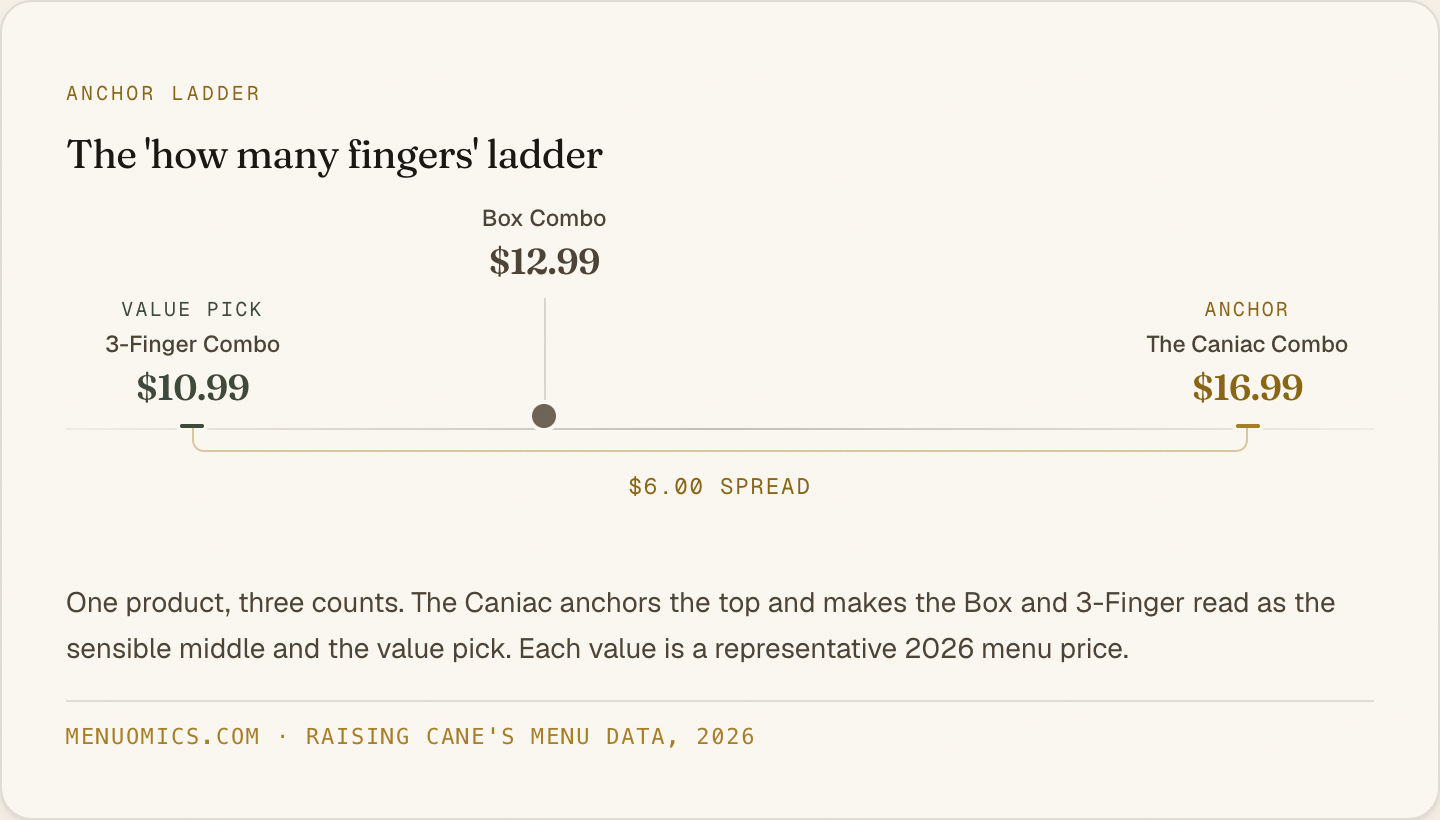
The 'how many fingers' ladder
One product, three counts. The Caniac anchors the top and makes the Box and 3-Finger read as the sensible middle and the value pick. Each value is a representative 2026 menu price.
Download this chart (PNG) · free to reuse with credit, see reuse terms.
The full ticket
What it actually rings up to.
The headline price is only the start. The real number is the journey from a base order to the check at the register, one easy yes at a time.
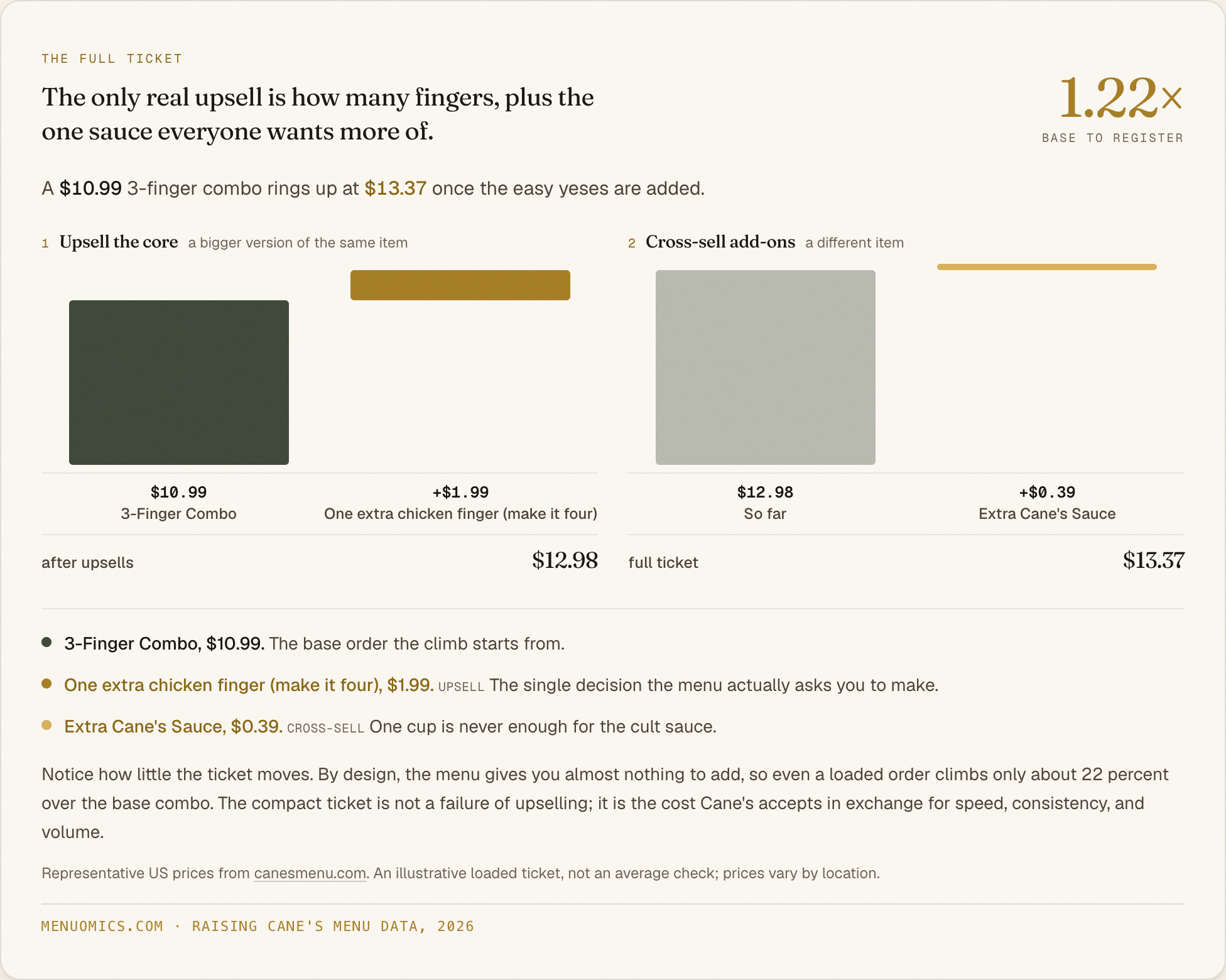
The only real upsell is how many fingers, plus the one sauce everyone wants more of.
A $10.99 3-finger combo rings up at $13.37 once the easy yeses are added.
- 3-Finger Combo, $10.99. The base order the climb starts from.
- One extra chicken finger (make it four), $1.99. upsell The single decision the menu actually asks you to make.
- Extra Cane's Sauce, $0.39. cross-sell One cup is never enough for the cult sauce.
Notice how little the ticket moves. By design, the menu gives you almost nothing to add, so even a loaded order climbs only about 22 percent over the base combo. The compact ticket is not a failure of upselling; it is the cost Cane's accepts in exchange for speed, consistency, and volume.
Representative US prices from canesmenu.com. An illustrative loaded ticket, not an average check; prices vary by location.
Download this chart (PNG) · free to reuse with credit, see reuse terms.
The setup
Most restaurants treat the menu as a place to add. Raising Cane's treats it as a place to subtract. The chain Todd Graves and Craig Silvey opened near the LSU campus in Baton Rouge in 1996 sells one protein, chicken fingers, in a short ladder of combos: the 3-Finger Combo, the Box Combo, the Caniac Combo, a finger sandwich, and a kids meal. The sides barely change (crinkle-cut fries, Texas toast, coleslaw), the drinks are mostly lemonade and tea, and the one piece of theater is Cane's Sauce, a secret recipe the company guards closely. There is no build-your-own, no grilled option, no dessert, no breakfast. The folklore of retail says more options sell more. Cane's quietly posts one of the highest average unit volumes in the industry, roughly $6.56 million per restaurant per year by QSR's 2025 count, second only to Chick-fil-A, on a menu most chains would consider dangerously thin.
That is the trick worth studying. By collapsing the menu to a single axis, the chain converts the hardest moment in any restaurant, the decision, into a near-reflex: you are not choosing what to eat, only how many fingers. Speed at the register, consistency in the kitchen, and confidence in the guest all fall out of that one design choice, and the company leans into it culturally with its 'One Love' slogan, the idea that doing one thing well beats doing many things adequately. (Raising Cane's does not frame these as behavioral tactics; this is our reading of the observed design.)
What they get right
The behavioral economics already at work.
A menu you can read in one breath
The classic case for a short menu is the jam study: when Iyengar and Lepper set up tasting tables with either 6 or 24 jams, the big display drew more lookers but far fewer buyers, with roughly 30 percent of shoppers purchasing from the 6-jam table versus about 3 percent from the 24-jam table. Cane's behaves as if it believes that finding to the bone. But honesty matters here, because the picture is contested: Scheibehenne, Greifeneder and Todd's 2010 meta-analysis of around 50 experiments found the average choice-overload effect was close to zero, with huge variance between studies. The safest reading is that fewer options do not automatically sell more, yet they reliably buy something else Cane's clearly wants, speed at the register, fewer abandoned decisions, and a guest who feels confident rather than overwhelmed.
Jam study: ~30% bought from 6 options vs ~3% from 24; 2010 meta-analysis mean effect ~0, Iyengar & Lepper (2000); Scheibehenne, Greifeneder & Todd (2010)
Doing one thing is the marketing
A single-item menu is a credibility claim. A guest reasons, almost automatically, that a kitchen which makes only chicken fingers must make them well, because it has nothing to hide behind and no excuse for inconsistency. That signal shows up in the numbers: Cane's posts an average unit volume of roughly $6.56 million per restaurant, among the very highest in fast food and second only to Chick-fil-A, and it has climbed past KFC in US systemwide sales on a far smaller footprint. Narrowness is not a limitation the brand apologizes for; it is the proof of competence it advertises.
~$6.56M average unit volume, 2nd highest in fast food, Restaurant Business / QSR 50 (2025)
The only decision is 'how many fingers'
The combos are not three different meals; they are one meal at three counts. The Caniac at roughly $16.99 sits at the top of the board as the high anchor, which quietly makes the Box at about $12.99 and the 3-Finger at about $10.99 feel like the sensible middle and the bargain. Because every rung is the same product, the guest never compares apples to oranges, only three to four to six, and the per-finger step (close to two dollars) matches the price of an a la carte extra finger almost exactly. The board has been engineered so the single live decision is also the single price lever.
Ladder: ~$10.99 -> ~$12.99 -> ~$16.99 on one axis, Raising Cane's representative 2026 menu pricing
The sauce is the cross-sell and the habit
On a menu this spare, Cane's Sauce does the work a dozen add-ons do elsewhere. Its recipe is kept private by company leadership, which turns an ordinary dipping cup into a small piece of theater and a genuine point of difference. Practically, it is the only natural cross-sell on the board: extra cups cost only around 39 cents, the attach is nearly guilt-free, and devotees who order three or four cups have effectively been trained to add to every ticket. A focused menu does not mean zero upsell; it means one upsell, repeated until it is a ritual.
Secret recipe; extra sauce ~$0.39 per cup, Raising Cane's Chicken Fingers, Wikipedia
No customization is a throughput strategy
Because there is no build-your-own and almost nothing to modify, the back-and-forth that slows most order counters simply does not happen at Cane's. Every order resolves to a count and a drink, the kitchen makes one thing on repeat, and the line moves. That operational simplicity is the hidden engine behind the AUV: a restaurant that can turn guests faster, with fewer errors and fewer questions, extracts more revenue from the same four walls, even with a menu most chains would consider too small to survive.
Top-tier AUV on a single-product, low-customization model, Restaurant Business / QSR 50 (2025)
What we’d test
The rewrite, with the expected lift and the honest caveat.
Foreground the finger count on the board
Relabel the combos so the finger count is the first thing the eye lands on, for example reading the rung as 'Box, four fingers' rather than leading with the brand name. The decision the menu actually wants the guest to make becomes literally the largest word, shaving a beat off the most common moment of hesitation.
Expect Slightly faster ordering and cleaner trade-ups between rungs.
Caveat Named combos like the Caniac carry real brand equity, so over-genericizing the labels could weaken a hard-won identity.
Scheibehenne, Greifeneder & Todd (2010)
Make the sauce add a one-tap prompt
At the point of order, surface a single optional prompt, 'Add an extra Cane's Sauce for about 39 cents?', as a one-tap yes. The cult sauce is already the brand's strongest cross-sell, and turning it into an explicit, low-stakes question captures the guests who would have wanted a second cup but never asked.
Expect Higher sauce attach rate with little added friction.
Caveat Push it too hard and a brand built on generosity can start to feel like it is nickel-and-diming, which is exactly the perception Cane's cannot afford.
Tag the Box as the popular middle
Present the three combos in ascending order with a quiet 'most popular' marker on the Box Combo, so the high Caniac anchor still does its job while undecided guests are gently guided to the profitable middle rung rather than defaulting down to the cheapest.
Expect A modest shift of indifferent guests from the 3-Finger up to the Box.
Caveat Social-proof tags can backfire if they read as manipulative, and the simplicity payoff may be small, so the change should be tested, not assumed.
What diners actually say
Synthesized from public reviews, the reality check that grounds every recommendation.
They praise
- Radical legibility: the entire menu is comprehensible at a glance, which all but eliminates analysis paralysis at the counter.
- The combo ladder is unusually honest, scaling one product on one axis so price tracks finger count in a way guests can verify in their heads.
- Cane's Sauce is a genuine moat and the cleanest cross-sell in fast food, cheap enough to add without thought and distinctive enough to drive loyalty.
- Focus translates into proof: a single-item kitchen delivers the consistency and throughput behind one of the highest average unit volumes in the industry.
- The menu and the brand voice agree; 'One Love' is not a slogan bolted onto a sprawling board but an accurate description of what the kitchen actually does.
They criticize
- The same simplicity is a hard revenue ceiling: with no dessert, no breakfast, and no appetizers, there is almost nothing to upsell beyond an extra finger and a sauce.
- There is no true value tier; the cheapest adult combo lands near $10.99, leaving budget-driven diners with few real entry points.
- The model is famous for lines, and at peak the wait that simplicity is supposed to prevent reappears as a queue out front.
- Price transparency is weak, with boards and online listings often not posting clear prices and figures swinging by market, which undercuts the otherwise frictionless experience.
- The differentiation rests heavily on one sauce, an easily reverse-engineered flavor profile, so if the mystique ever fades the moat is thinner than the volume suggests.
The verdict
Raising Cane's is the strongest argument in fast food against the reflex to add. By selling essentially one thing and asking the guest only how many, it turns the menu into a single clean lever and converts that focus into speed, consistency, and volume most chains with three times the items cannot touch. It earns its grade by executing a focused strategy almost flawlessly, and it stops just short of the top only because the discipline that makes it great also caps it, with no value floor, no dessert ceiling, and a moat that is, in the end, one cup of sauce. As a study in behavioral craft, though, it is close to ideal: proof that a tiny, confident menu can out-earn a generous one.
Common questions
- Why does Raising Cane's only sell chicken fingers?
- Focus is the strategy. Selling one product lets the kitchen run faster and more consistently, removes nearly every decision for the guest, and signals quality, and it has helped Cane's reach roughly $6.56 million in average annual sales per restaurant, among the highest in fast food.
- What is the most expensive combo at Raising Cane's?
- The Caniac Combo, around $16.99 in 2026 depending on location, with six chicken fingers, crinkle fries, Texas toast, coleslaw, a larger drink, and extra Cane's Sauce. It anchors the top of the menu.
- Does a smaller menu really sell more?
- Not automatically. The famous jam study found shoppers bought far more from 6 options than 24, but a 2010 meta-analysis of around 50 experiments put the average effect near zero. What a short menu reliably delivers is speed, fewer abandoned decisions, and guest confidence, which is what Cane's optimizes for.
- How much is a meal at Raising Cane's?
- A meal at Raising Cane's starts around $10.99 for the base order and lands near $13.37 once the usual add-ons go on, roughly 1.22x the headline price (representative 2026 US figures; they vary by location). That gap between the price that gets you in and the total you pay is the multiplier this page grades.
Sources (6)
- Raising Cane's Chicken Fingers, Wikipedia
- Fox Business: Raising Cane's launches major 2026 expansion
- Restaurant Business: chains with the highest average unit volumes
- Iyengar & Lepper (2000), When Choice Is Demotivating (PDF)
- Scheibehenne, Greifeneder & Todd (2010), Can There Ever Be Too Many Options? (PDF)
- Raising Cane's menu and 2026 prices
Head to head
More breakdowns
 The Cheesecake FactoryB+
A 21-page, 250-item menu should be a behavioral disaster. It's a roughly $4-billion chain. Here's what all that abundance is quietly doing.
Read the The Cheesecake Factory breakdown → McDonald'sA-
The Extra Value Meal is one of the most-copied ideas in food: fold the whole order into a single number that hurts less than three. Then McValue and the app pile value on top, and the McRib drops in as an event.
Read the McDonald's breakdown → Taco BellA-
A sub-$3 value menu sets the floor, $5/$7/$9 boxes name the deal after its own price, and a never-ending limited-time calendar keeps a reason to come back on the board. Taco Bell sells value loudly, and it works: it gained traffic while rivals shrank.
Read the Taco Bell breakdown → Dunkin'A-
A premium latte anchors the cheap iced coffee as the obvious default, the $6 Meal Deal bundles the breakfast, and Dunkin' Rewards turns the morning run into a streak. The menu craft is textbook; the strain is price creep and an app that increasingly decides the real price.
Read the Dunkin' breakdown → Panda ExpressB+
The whole order comes down to one question, how many entrees. A Bowl is one, a Plate is two, a Bigger Plate is three, and the menu is built so the middle Plate wins. Orange Chicken is the anchor everyone orders, and a quiet $1.50 premium upcharge lifts the check while the headline price stays put.
Read the Panda Express breakdown → PopeyesB-
The chain that proved a sold-out sign sells harder than any coupon. We grade the menu craft behind the chicken-sandwich phenomenon, not the hype.
Read the Popeyes breakdown →Your menu next
Get this for your own menu, free.
Send your menu and we’ll send back the same breakdown, what you get right, what we’d test, and why.
Wendy's
A burger chain whose whole menu is organized around a value ladder: cheap named bundles at the bottom, a bacon-stacked premium anchor up top, and a Frosty engineered to ride along on every ticket.
Read it →