Dunkin' menu, graded
Anchor the cheap coffee with a premium latte, bundle the breakfast, and gamify the daily visit, so the run becomes a habit and the check climbs on customization
Dunkin' is engineered for frequency: a premium latte makes the $3.99 iced coffee feel like the sensible default, a flat $6 bundle removes the math, and a points-and-streaks loyalty game turns the daily run into a habit.
Menu-craft grade
Textbook menu craft: premium $6.49 lattes anchor a $3.99 iced coffee as the everyday default, the $6 Meal Deal is a clean good-better-best bundle, Dunkin' Rewards gamifies frequency rather than spend, and a modular size-shot-swirl ladder lifts the check without new items. Held short of an A by heavy reliance on app-gated pricing and a value-trust erosion that the visible 2025 'fill line' shrinkflation episode amplified.
Graded on how well the menu uses behavioral economics, not the food.
Menu and prices verified September 2026
A 2-minute audio read of the analysis
- Type
- Chain
- Where
- Canton, MA
- Cuisine
- Coffee and doughnut quick-service
- Footprint
- ~10,000 US locations; ~14,500 worldwide
- Since
- 1950 (Quincy, MA)
- Ownership
- Private; Inspire Brands (Roark Capital)
The mechanics, drawn
The same menu, mapped onto an axis, so the behavioral move is something you can see, not just read.
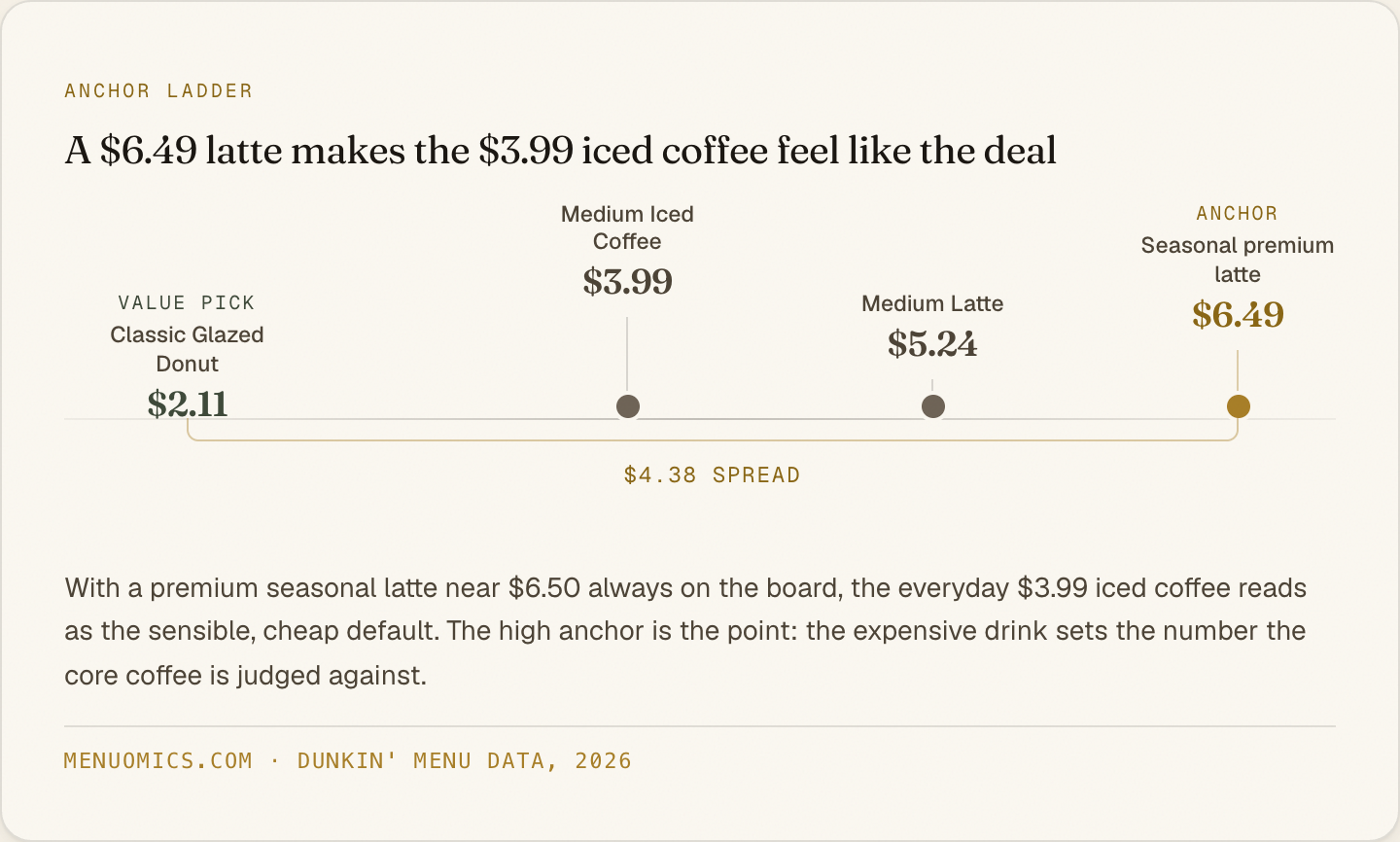
A $6.49 latte makes the $3.99 iced coffee feel like the deal
With a premium seasonal latte near $6.50 always on the board, the everyday $3.99 iced coffee reads as the sensible, cheap default. The high anchor is the point: the expensive drink sets the number the core coffee is judged against.
Download this chart (PNG) · free to reuse with credit, see reuse terms.
The full ticket
What it actually rings up to.
The headline price is only the start. The real number is the journey from a base order to the check at the register, one easy yes at a time.
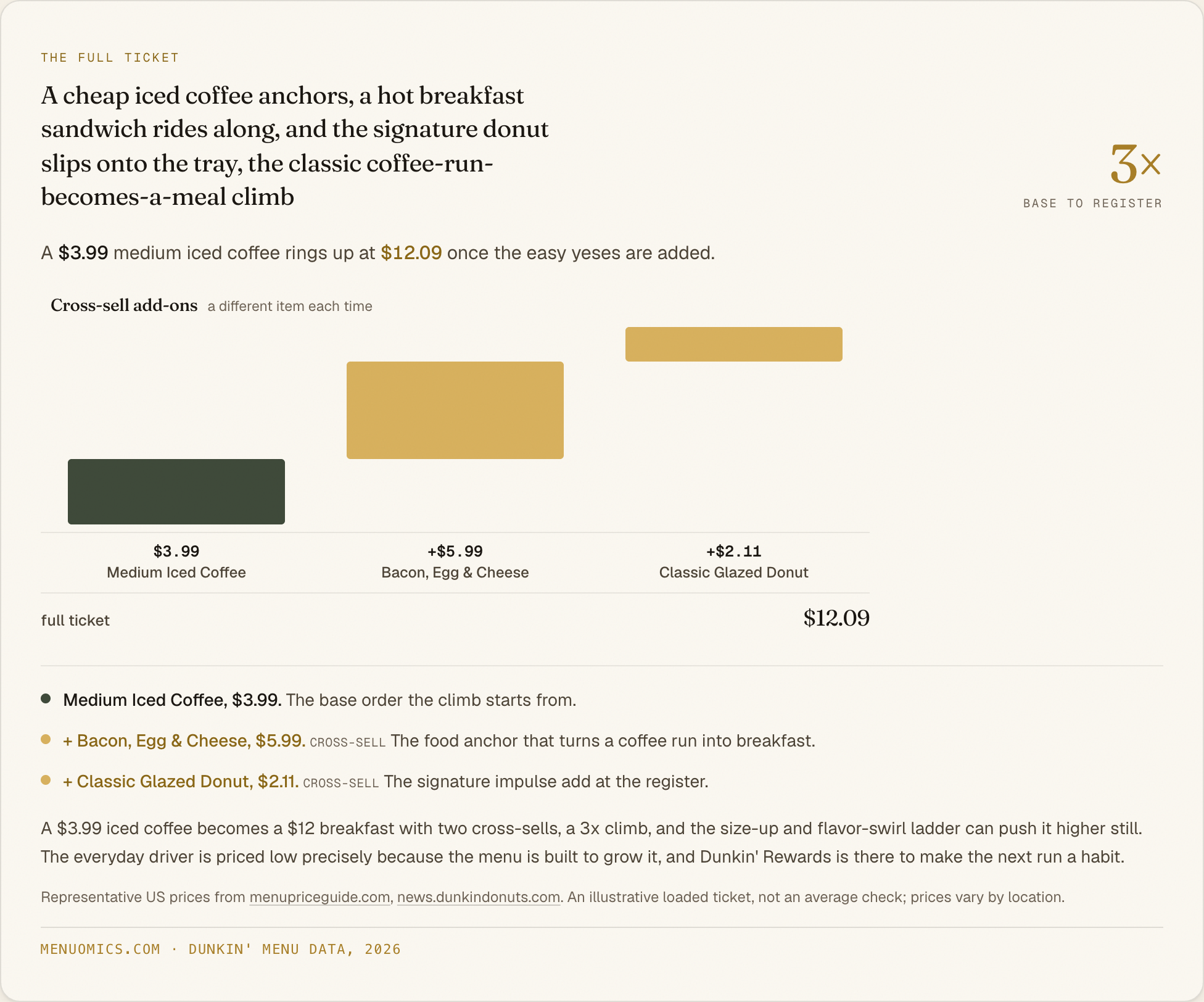
A cheap iced coffee anchors, a hot breakfast sandwich rides along, and the signature donut slips onto the tray, the classic coffee-run-becomes-a-meal climb
A $3.99 medium iced coffee rings up at $12.09 once the easy yeses are added.
- Medium Iced Coffee, $3.99. The base order the climb starts from.
- + Bacon, Egg & Cheese, $5.99. cross-sell The food anchor that turns a coffee run into breakfast.
- + Classic Glazed Donut, $2.11. cross-sell The signature impulse add at the register.
A $3.99 iced coffee becomes a $12 breakfast with two cross-sells, a 3x climb, and the size-up and flavor-swirl ladder can push it higher still. The everyday driver is priced low precisely because the menu is built to grow it, and Dunkin' Rewards is there to make the next run a habit.
Representative US prices from menupriceguide.com, news.dunkindonuts.com. An illustrative loaded ticket, not an average check; prices vary by location.
Download this chart (PNG) · free to reuse with credit, see reuse terms.
The setup
Dunkin' opened in 1950 in Quincy, Massachusetts, founded by Bill Rosenberg, and is now a privately held part of Inspire Brands (backed by Roark Capital), which took it off the Nasdaq in a roughly $11.3 billion deal in late 2020. It runs about 10,000 US locations, having opened its 10,000th in October 2025, and roughly 14,500 worldwide. In 2019 it dropped 'Donuts' from the name to signal a beverage-led identity: coffee and espresso, not the donut, drive the business.
What makes the board worth reading is how completely it is tuned for habit. A premium seasonal latte anchors the top, a flat $6 Meal Deal removes the per-item math, Dunkin' Rewards gamifies how often you come in, and a modular size-shot-swirl ladder grows the check without adding items. Over all of it sits 'America Runs on Dunkin',' a 20-year platform that frames the brand as a daily utility rather than a treat. (Dunkin' does not frame these as behavioral tactics; this is our reading of the observed design.)
What they get right
The behavioral economics already at work.
A $6.49 premium latte anchors the $3.99 coffee as the default
Seasonal cloud and protein lattes at $6.49 and up sit at the top of the board, which reframes a $3.99 medium iced coffee as the sensible, cheap choice. The premium drink does not need to sell in volume; it exists to set a high reference point so the everyday coffee inherits a value feeling it would not have on a flat board.
anchoring (Tversky & Kahneman 1974); $6.49+ seasonal lattes above the $3.99 iced coffee
The $6 Meal Deal names the bundle after its price
Dunkin' packages a Bacon, Egg and Cheese sandwich, hash browns and a medium coffee for a flat $6, versus roughly $9 to $11 a la carte. Naming the deal after its price removes per-item comparison and lifts the ticket above a lone coffee, and it put Dunkin' squarely into the fast-food value-meal wars as a frequency play.
the $6 Meal Deal (sandwich, hash browns, medium coffee); bundling and a stated 30 to 45 percent saving
Rewards and Boosted Status gamify frequency, not spend
Dunkin' Rewards gives 10 points per dollar with redemptions from 150 points, and Boosted Status rewards 12 visits in a month with 12 points per dollar for three months, an explicit frequency game. Paying through the app and points dilutes the felt cost of each run and converts the purchase into a streak-driven habit, where price is least salient at the moment of choice.
Dunkin' Rewards (10 points per dollar; 150-point redemption) and Boosted Status (12 visits to 12 points per dollar)
A steady limited-time calendar keeps a reason to come now
A disciplined seasonal cadence, the spring banana line, the Dunkin' Zero energy range, fall pumpkin spice, with explicit 'limited time' framing manufactures urgency and a reason to visit now. The novelty resets the board repeatedly without permanently cluttering it, and scarcity reliably raises perceived value.
Worchel, Lee & Adewole 1975; Dunkin's seasonal LTO cadence (banana, Dunkin' Zero, pumpkin)
Size, shots and swirls grow the check without new items
Every drink scales small to medium to large, with add-on espresso shots, flavor swirls and a non-dairy milk upcharge, a clean modular ladder that lifts the average check without a single new SKU. Over it all sits 'America Runs on Dunkin',' a platform that frames the brand as a daily utility rather than a treat, reinforcing the habitual repeat purchase the rest of the menu is built to reward.
the size, espresso-shot, flavor-swirl and milk-swap ladder; the 'America Runs on Dunkin'' platform (2006)
What we’d test
The rewrite, with the expected lift and the honest caveat.
Show the $6 Meal Deal savings on the board
The deal saves roughly a third off a la carte, but the saving is not stated where the choice is made. Printing 'about $10 of breakfast for $6' next to it makes the discount concrete and anchors the bundle as a win, which is when a stated saving lifts perceived value most. The math already favors the deal; the board just has to show it.
Expect A higher meal-deal attach rate as the saving reads on the page, lifting the average ticket
Caveat Menu-copy only: it states the existing bundle saving, it does not change pricing or portions.
Pair the donut with the coffee at the point of choice
Dropping 'Donuts' from the name turned the signature product into a silent cross-sell. Surfacing a one-tap 'complete your coffee with a glazed donut' at the beverage step, described in sensory terms, puts the highest-margin impulse item back in front of the guest exactly when they have already decided to buy. The item already exists; the placement carries it.
Expect A lift in donut and Munchkin attach as the pairing reads at the coffee step
Caveat Menu-layout only: it surfaces an existing item, it does not change pricing or the product.
Surface the size-up and swirl upgrade inline
The size and flavor-swirl ladder exists, but the small upcharge is rarely shown next to the drink. Placing 'go large or add a swirl for a little more' inline makes the good/better step legible at the moment of decision, the way a visible trade-up nudges the mix up without a hard push. The upgrade already exists; the layout carries it.
Expect A higher rate of large sizes and add-ons as the upgrade reads as the easy next step
Caveat Menu-layout only: it surfaces an existing upgrade, it does not change pricing or portions.
What diners actually say
Synthesized from public reviews, the reality check that grounds every recommendation.
They praise
- A legible value anchor: the $6 Meal Deal puts three items at a flat price, roughly 30 to 45 percent under a la carte, with no math to do
- A well-built habit engine: a low 150-point redemption threshold plus Boosted Status gamifies how often you visit, not just how much you spend
- A clean, modular upsell ladder: sizes, espresso shots, swirls and milk swaps raise the check through customization without bloating the menu
- Disciplined freshness: regular seasonal drops keep the board lively, and 'America Runs on Dunkin'' has anchored a daily-routine identity for nearly 20 years
They criticize
- Price creep undercuts the value promise: customers have documented 33 to 37 percent increases on the same orders over three to four years
- The November 2025 'fill line' episode, iced drinks poured only to a marked line, went viral as shrinkflation and read as deceptive
- App-gated and loyalty-gated deals fragment price transparency and quietly penalize walk-up, non-app customers
- Premium-drink drift: $6.49 protein and cloud lattes push a self-styled value brand into Starbucks price territory
- Dropping 'Donuts' in 2019 de-emphasized the signature, lowest-cost product that historically anchored both value and identity
The verdict
Read as menu design, Dunkin' is built end to end for frequency: a premium latte anchors the cheap iced coffee as the obvious default, the flat $6 Meal Deal removes the per-item math, Dunkin' Rewards and Boosted Status gamify how often you come in, and a modular size-shot-swirl ladder grows the check without a single new item. It is textbook craft, and 'America Runs on Dunkin'' has spent two decades framing the whole thing as a daily utility. The strain is the value brand's hardest problem: documented price creep, premium lattes drifting into Starbucks territory, and a November 2025 'fill line' episode that made shrinkflation visible, all of which erode the everyman trust the model runs on. The upside left on the table is honest and cheap: show the meal-deal saving on the board, pair the donut back with the coffee, and surface the size and swirl upgrade inline, so the value and the signature the menu already has are legible at the moment of choice.
Common questions
- Is the Dunkin' $6 Meal Deal worth it?
- The $6 Meal Deal bundles a Bacon, Egg and Cheese sandwich, hash browns and a medium coffee for a flat $6, versus roughly $9 to $11 bought separately, a stated 30 to 45 percent saving. Naming the deal after its price removes per-item comparison and lifts the average ticket above a lone coffee. For a regular breakfast order it is usually the cheapest path.
- How does Dunkin' Rewards work?
- Dunkin' Rewards gives 10 points per dollar with redemptions starting at 150 points, and a Boosted Status tier rewards 12 visits in a calendar month with 12 points per dollar for three months. It is built to gamify frequency, not just spend, and paying through the app dilutes the felt cost of each run, turning the purchase into a streak-driven habit.
- Why did Dunkin' Donuts drop 'Donuts' from its name?
- In January 2019 the company rebranded from 'Dunkin' Donuts' to just 'Dunkin'' to signal that it is beverage-led: coffee and espresso drive the business, not the donut. The move sharpened the coffee positioning, but it also de-emphasized the signature, lowest-cost product that historically anchored both the value story and the brand identity; the donut is now a cross-sell, not the hero.
- Why is Dunkin' getting more expensive?
- Customers have documented 33 to 37 percent increases on the same orders over three to four years, driven partly by coffee-bean cost inflation, and premium 'cloud' and protein lattes now run past $6.49, pushing a self-styled value brand toward Starbucks prices. A November 2025 backlash over iced drinks filled only to a marked line added a shrinkflation worry on top of the price creep.
- What is the most expensive item at Dunkin'?
- On the standard menu, the priciest single item is the Seasonal premium latte, about $6.49 in representative 2026 US pricing (it varies by location; group packs and combo deals can cost more). That top price also does quiet work as the menu's anchor: it is the number that makes everything below it read as reasonable.
- How much is a meal at Dunkin'?
- A meal at Dunkin' starts around $3.99 for the base order and lands near $12.09 once the usual add-ons go on, roughly 3x the headline price (representative 2026 US figures; they vary by location). That gap between the price that gets you in and the total you pay is the multiplier this page grades.
Sources (6)
- Dunkin', Wikipedia (founding, ownership, name change, scale)
- Restaurant Dive, Dunkin' hits 10,000 US stores (2025)
- Dunkin' Newsroom, the $6 Meal Deal
- Dunkin' Rewards (official program page)
- menupriceguide.com, Dunkin' menu with prices (2026, representative)
- Fortune, Dunkin' 'ice line' shrinkflation backlash (Nov 2025)
Head to head
More breakdowns
 The Cheesecake FactoryB+
A 21-page, 250-item menu should be a behavioral disaster. It's a roughly $4-billion chain. Here's what all that abundance is quietly doing.
Read the The Cheesecake Factory breakdown → McDonald'sA-
The Extra Value Meal is one of the most-copied ideas in food: fold the whole order into a single number that hurts less than three. Then McValue and the app pile value on top, and the McRib drops in as an event.
Read the McDonald's breakdown → Taco BellA-
A sub-$3 value menu sets the floor, $5/$7/$9 boxes name the deal after its own price, and a never-ending limited-time calendar keeps a reason to come back on the board. Taco Bell sells value loudly, and it works: it gained traffic while rivals shrank.
Read the Taco Bell breakdown → Panda ExpressB+
The whole order comes down to one question, how many entrees. A Bowl is one, a Plate is two, a Bigger Plate is three, and the menu is built so the middle Plate wins. Orange Chicken is the anchor everyone orders, and a quiet $1.50 premium upcharge lifts the check while the headline price stays put.
Read the Panda Express breakdown → Raising Cane'sA-
The chicken-finger chain that built a billion-dollar machine by refusing to sell almost anything else.
Read the Raising Cane's breakdown → PopeyesB-
The chain that proved a sold-out sign sells harder than any coupon. We grade the menu craft behind the chicken-sandwich phenomenon, not the hype.
Read the Popeyes breakdown →Your menu next
Get this for your own menu, free.
Send your menu and we’ll send back the same breakdown, what you get right, what we’d test, and why.
Subway
The chain that proved a price can be too cheap: how the $5 Footlong anchored Subway into a corner it spent a decade climbing out of.
Read it →