Panda Express menu, graded
A good-better-best ladder built on entree count: the Bowl (one entree), Plate (two) and Bigger Plate (three) make the middle Plate the comfortable compromise, with Orange Chicken as the anchor everyone orders and a quiet premium upcharge that lifts the check.
Most menus sell you dishes. Panda Express sells you a number, one, two or three entrees, and engineers the middle Plate into the comfortable compromise, with Orange Chicken as the anchor and a small premium upcharge doing the quiet work.
Menu-craft grade
The Bowl, Plate, Bigger Plate ladder is one of the cleanest compromise-effect designs in fast food: it reduces the whole order to a single question, how many entrees, and engineers the middle Plate to win. Orange Chicken is a genuine anchor that sets what normal tastes and costs, and the roughly $1.50 premium upcharge is textbook partitioned pricing that lifts the check without changing the headline number. It misses an A because the playbook is narrower than the strongest chains here, with little bundling depth or scarcity engine, and the upcharge plus the location-to-location price gaps are the menu's most common gripe.
Graded on how well the menu uses behavioral economics, not the food.
Menu and prices verified September 2026
A 3-minute audio read of the analysis
- Type
- Chain
- Where
- Rosemead, CA
- Cuisine
- American Chinese fast food
- Footprint
- ~2,500 US locations
- Since
- 1983 (Glendale, CA)
- Ownership
- Private; Panda Restaurant Group (Cherng family)
The mechanics, drawn
The same menu, mapped onto an axis, so the behavioral move is something you can see, not just read.
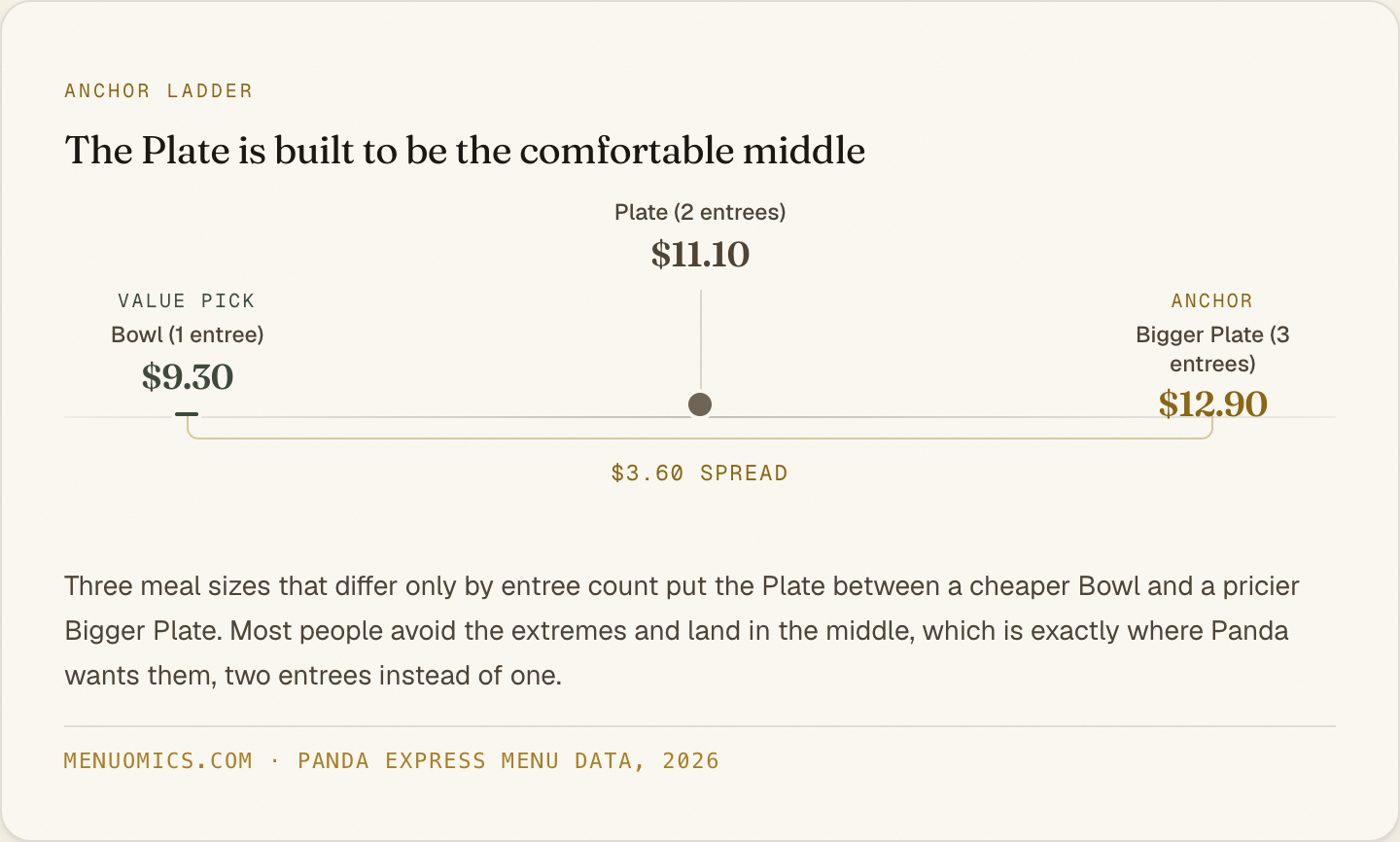
The Plate is built to be the comfortable middle
Three meal sizes that differ only by entree count put the Plate between a cheaper Bowl and a pricier Bigger Plate. Most people avoid the extremes and land in the middle, which is exactly where Panda wants them, two entrees instead of one.
Download this chart (PNG) · free to reuse with credit, see reuse terms.
The full ticket
What it actually rings up to.
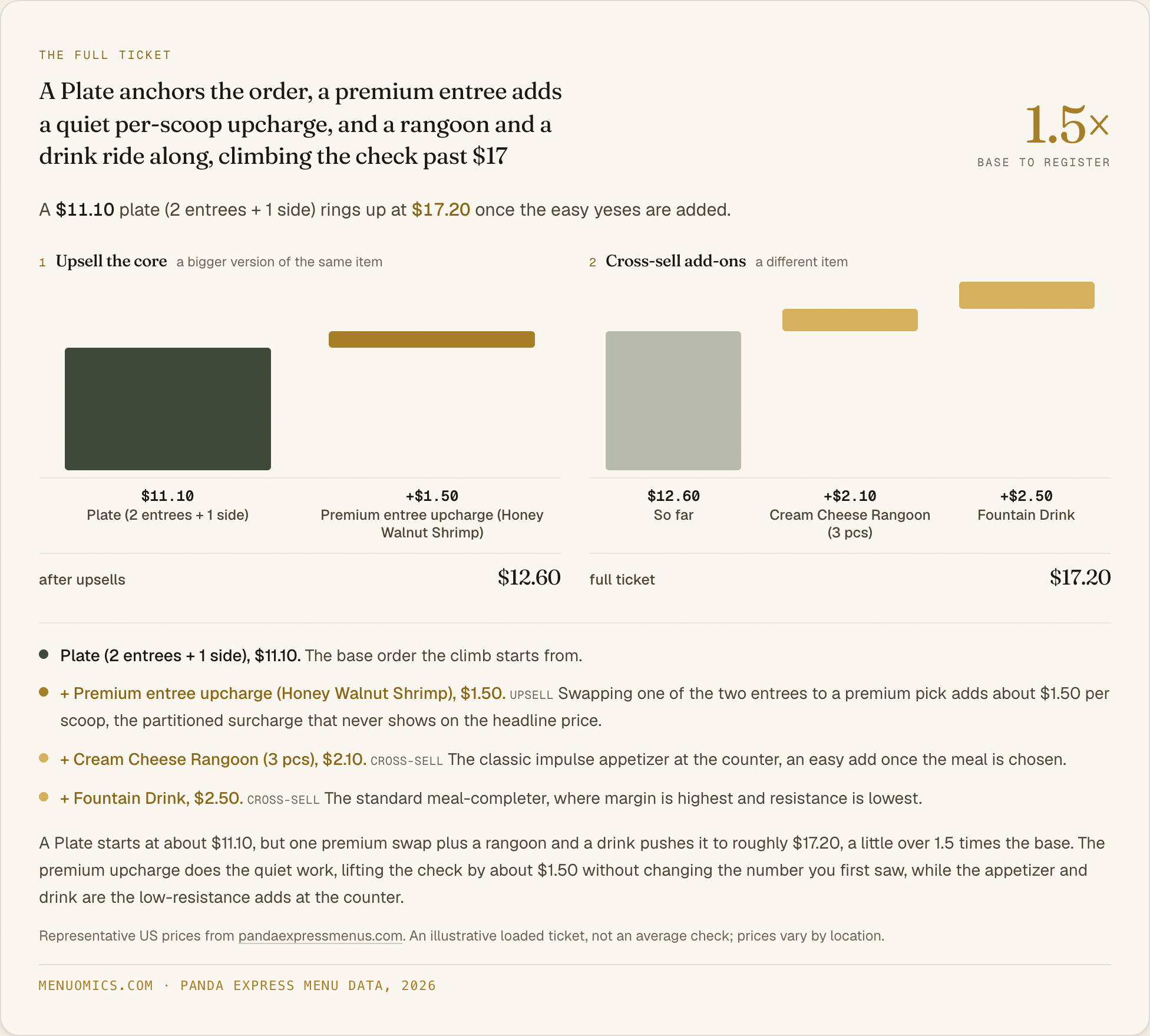
The headline price is only the start. The real number is the journey from a base order to the check at the register, one easy yes at a time.
A Plate anchors the order, a premium entree adds a quiet per-scoop upcharge, and a rangoon and a drink ride along, climbing the check past $17
A $11.10 plate (2 entrees + 1 side) rings up at $17.20 once the easy yeses are added.
- Plate (2 entrees + 1 side), $11.10. The base order the climb starts from.
- + Premium entree upcharge (Honey Walnut Shrimp), $1.50. upsell Swapping one of the two entrees to a premium pick adds about $1.50 per scoop, the partitioned surcharge that never shows on the headline price.
- + Cream Cheese Rangoon (3 pcs), $2.10. cross-sell The classic impulse appetizer at the counter, an easy add once the meal is chosen.
- + Fountain Drink, $2.50. cross-sell The standard meal-completer, where margin is highest and resistance is lowest.
A Plate starts at about $11.10, but one premium swap plus a rangoon and a drink pushes it to roughly $17.20, a little over 1.5 times the base. The premium upcharge does the quiet work, lifting the check by about $1.50 without changing the number you first saw, while the appetizer and drink are the low-resistance adds at the counter.
Representative US prices from pandaexpressmenus.com. An illustrative loaded ticket, not an average check; prices vary by location.
Download this chart (PNG) · free to reuse with credit, see reuse terms.
The setup
Panda Express was founded in 1983 in Glendale, California by Andrew and Peggy Cherng, ten years after the couple opened their first sit-down restaurant, Panda Inn, in Pasadena in 1973. It is the flagship of the privately held Panda Restaurant Group, still owned by the Cherng family and headquartered in Rosemead, California, and it has grown to roughly 2,500 US locations, the largest American Chinese fast-food chain in the country. The food is American Chinese, wok-cooked entrees served over rice or noodles, and the signature dish, Orange Chicken, was created by chef Andy Kao in 1987 and remains the best-selling item by a wide margin.
What makes the board interesting is how little it asks you to decide. The core menu is not a list of dishes but a ladder of meal sizes, Bowl, Plate and Bigger Plate, set apart only by how many entrees you get, one, two or three. The format turns ordering into a good-better-best choice in which the middle Plate is the natural compromise, Orange Chicken anchors what people pick and what they think it should cost, and premium entrees add a small per-scoop upcharge that quietly raises the total. (Panda Express does not frame these as behavioral tactics; this is our reading of the observed design.)
What they get right
The behavioral economics already at work.
The Bowl, Plate, Bigger Plate ladder is a compromise-effect machine
The core menu is three meal sizes that differ only by entree count: a Bowl with one entree near $9.30, a Plate with two near $11.10, and a Bigger Plate with three near $12.90. Faced with a low, middle and high option, most people avoid the extremes and reach for the middle, which is exactly where Panda puts the Plate. The decision is no longer what to order but how many entrees, and the structure quietly steers that answer to two.
Simonson & Tversky 1992 (extremeness aversion); Panda's Bowl ($9.30), Plate ($11.10) and Bigger Plate ($12.90) ladder
Orange Chicken is the anchor that sets what normal costs
Orange Chicken is the dish nearly everyone orders, the best-selling item by a wide margin, and at about $6.50 a la carte it sets the reference point for the whole board. Once a single scoop of the icon reads as roughly $6.50, two entrees in a Plate for $11.10 looks like a deal rather than a splurge. The signature does double duty: it is the craving that gets you in the door and the number everything else is judged against.
anchoring (Tversky & Kahneman 1974); Orange Chicken a la carte ~$6.50, the chain's best-selling dish
The roughly $1.50 premium upcharge is partitioned pricing
Premium entrees like Honey Walnut Shrimp and Black Pepper Sirloin Steak do not carry their own headline price on the meal board; they add about $1.50 per scoop on top of the Bowl, Plate or Bigger Plate you already chose. Splitting the cost into a small add-on rather than a higher all-in price makes the total feel lower than it is, because people anchor on the base and underweight the surcharge. It is the same trick as a plus-shipping line: the headline stays cheap and the extra slips through.
Morwitz, Greenleaf & Johnson 1998 (partitioned pricing lowers perceived total cost); Panda's ~$1.50 premium-entree upcharge
Build your own makes the customer feel like the author
Every meal is assembled the same way, pick a size, pick a side, pick your entrees, so the experience feels like building your own plate rather than choosing from fixed combos. That sense of authorship raises how much people value the meal, and the menu keeps the choice set small enough, one decision at a time, that the freedom never becomes friction. The format also makes the trade-up to a third entree or a premium scoop feel like the customer's own idea.
choice architecture and the authorship effect; Panda's pick-a-size, pick-a-side, pick-your-entrees build-your-own format
The default is a meal, not a dish
A la carte exists, but the board leads with Bowls and Plates, so the path of least resistance is a full meal with a side rather than a single entree. Because the side of rice or noodles is bundled into the size price rather than sold separately, the meal reads as the obvious unit, and a Plate's two entrees plus a side feels like better value than buying entrees one by one. The framing pushes nearly everyone past a single-entree purchase before they have decided what to eat.
default and bundling effects; Panda's meal-size board leads with Bowl and Plate over a la carte
What we’d test
The rewrite, with the expected lift and the honest caveat.
Label the Plate as the most popular choice
The Plate is almost certainly the best-selling size, but the board does not say so. Adding a simple Most Popular tag to the Plate stacks social proof on top of the compromise effect already steering people there, making the middle option the obvious default. The nudge is honest as long as the claim is true, and it does the most work precisely on the size the menu is already built to sell.
Expect A higher Plate share of mix as the social-proof cue reinforces the compromise middle
Caveat Menu-copy only, and only if the Plate genuinely is the most popular size; it changes wording, not pricing, portions or the food.
Print the plus $1.50 next to every premium entree
Today the premium upcharge often surfaces only at the register or in the app, which is the single most common complaint about the menu. Printing plus $1.50 directly beside Honey Walnut Shrimp and the steak entrees removes the surprise and reframes the premium as a small, voluntary upgrade rather than a hidden fee. Counterintuitively, making the cost visible can lift premium attach, because a clearly priced upgrade feels fair while a surprise one breeds resentment.
Expect Fewer upcharge complaints and a steadier, possibly higher premium attach rate
Caveat Menu-copy only: it discloses an existing surcharge, it does not change pricing, portions or what is served.
Show the per-entree value across the ladder
The jump from Bowl to Plate adds a whole second entree for under two dollars, but the board never states that math. Showing the effective cost per entree, where the Plate and Bigger Plate clearly beat the Bowl, makes the trade-up read as value rather than spend and reinforces the climb the ladder is built to encourage. The relationship already exists in the prices; the menu just has to make it visible.
Expect More Bowl-to-Plate and Plate-to-Bigger-Plate trade-ups as the per-entree value reads on the board
Caveat Menu-layout only: it surfaces the existing price relationship, it does not change pricing, portions or the food.
What diners actually say
Synthesized from public reviews, the reality check that grounds every recommendation.
They praise
- Orange Chicken is a true icon, craveable enough to carry the whole brand and the reason most people walk in
- The Bowl, Plate, Bigger Plate ladder is one of the cleanest compromise-effect designs in fast food, simple to read and easy to choose
- Genuine value perception: generous, hot, made-to-order portions for a single-dollar-sign price
- The build-your-own format gives real customization and a sense of authorship with very little decision friction
- Calorie counts and a Wok Smart line are clearly marked on the board, which helps health-conscious choosers
They criticize
- The premium upcharge is the top gripe: a roughly $1.50-per-scoop surcharge that often is not visible until the register or app
- Large price gaps between standard storefronts and airport, mall, casino and delivery-app locations muddy the value story
- Portion and quality consistency swing by location and time of day, a common complaint about the entree scoops
- There is no real cheap anchor below the meal sizes, so once a premium entree goes on, the check climbs fast
- The playbook is narrow next to rivals: little bundling depth, scarcity calendar or loyalty muscle to keep people coming back
The verdict
Read as menu design, Panda Express runs one of the tidiest compromise-effect machines in fast food. The whole order collapses into a single question, how many entrees, and the Bowl, Plate and Bigger Plate ladder is engineered so the middle Plate wins; Orange Chicken anchors what people order and what they think it should cost; and a small, easy-to-miss premium upcharge lifts the check without touching the headline price. It is effective and admirably simple. What keeps it from the top tier is breadth and transparency: there is no deep bundle ladder or scarcity engine the way the strongest chains run, and the one move the menu hides, the roughly $1.50 premium upcharge, is also the move customers resent most. The upside left on the table is honest and small: tag the Plate as the popular default, print the upcharge where people choose, and show the per-entree value, so the structure the board already runs is legible at the moment of decision.
Common questions
- Why is the Panda Express Plate the most popular size?
- The Plate sits in the middle of a three-step ladder, Bowl (one entree), Plate (two) and Bigger Plate (three), and people reliably avoid the cheapest and priciest options and reach for the compromise in the middle. At about $11.10 for two entrees and a side, the Plate reads as the sensible default next to a $9.30 Bowl and a $12.90 Bigger Plate, which is exactly the behavioral effect, extremeness aversion, that the layout is built to trigger.
- How much is the premium upcharge at Panda Express?
- Premium entrees such as Honey Walnut Shrimp and Black Pepper Sirloin Steak add roughly $1.50 per scoop on top of any Bowl, Plate or Bigger Plate. It is a form of partitioned pricing: the small surcharge is added to the base you already chose rather than shown as a higher all-in price, so the total feels lower than it is. Exact amounts vary by location.
- What is the most expensive item at Panda Express?
- Among everyday orders the priciest single ticket is a Family Meal, around $43 for large entrees and sides, while the most expensive standard meal size is the Bigger Plate near $12.90. Premium entrees and high-traffic locations such as airports, malls and stadiums push any of these higher.
- Is Panda Express a good value?
- For a single-dollar-sign chain, most diners rate the portions generous and the food fresh and hot, and the Plate in particular reads as good value for two entrees and a side. The main value complaints are the premium upcharge, which can feel hidden until you pay, and the large price gaps at airport, mall and delivery-app locations.
- How much is a meal at Panda Express?
- A meal at Panda Express starts around $11.10 for the base order and lands near $17.20 once the usual add-ons go on, roughly 1.5x the headline price (representative 2026 US figures; they vary by location). That gap between the price that gets you in and the total you pay is the multiplier this page grades.
Sources (6)
- Wikipedia, Panda Express (founding, Cherng family, ownership, headquarters, Orange Chicken)
- Panda Express, official site (menu, Bowl/Plate/Bigger Plate, premium entrees)
- ScrapeHero, number of Panda Express locations in the USA (store count)
- Panda Express Menu Prices & Calories, 2026 (representative US prices)
- Panda Express Plate Menu, 2026 (Plate price and premium upcharge)
- USA Menu Hub, Panda Express Menu With Prices 2026 (cross-check)
More breakdowns
 The Cheesecake FactoryB+
A 21-page, 250-item menu should be a behavioral disaster. It's a roughly $4-billion chain. Here's what all that abundance is quietly doing.
Read the The Cheesecake Factory breakdown → McDonald'sA-
The Extra Value Meal is one of the most-copied ideas in food: fold the whole order into a single number that hurts less than three. Then McValue and the app pile value on top, and the McRib drops in as an event.
Read the McDonald's breakdown → Taco BellA-
A sub-$3 value menu sets the floor, $5/$7/$9 boxes name the deal after its own price, and a never-ending limited-time calendar keeps a reason to come back on the board. Taco Bell sells value loudly, and it works: it gained traffic while rivals shrank.
Read the Taco Bell breakdown → Dunkin'A-
A premium latte anchors the cheap iced coffee as the obvious default, the $6 Meal Deal bundles the breakfast, and Dunkin' Rewards turns the morning run into a streak. The menu craft is textbook; the strain is price creep and an app that increasingly decides the real price.
Read the Dunkin' breakdown → Raising Cane'sA-
The chicken-finger chain that built a billion-dollar machine by refusing to sell almost anything else.
Read the Raising Cane's breakdown → PopeyesB-
The chain that proved a sold-out sign sells harder than any coupon. We grade the menu craft behind the chicken-sandwich phenomenon, not the hype.
Read the Popeyes breakdown →Your menu next
Get this for your own menu, free.
Send your menu and we’ll send back the same breakdown, what you get right, what we’d test, and why.
Raising Cane's
The chicken-finger chain that built a billion-dollar machine by refusing to sell almost anything else.
Read it →