
Carl's Jr. menu, graded
Carl's Jr. runs two menus at once: a charbroiled indulgence board where signature singles run $8 to $9 and triple-patty anchors clear $14, and a quieter app-gated value layer (under-$4 Jr. burgers in select markets, a $5.99 build-your-own bundle, afternoon markdowns) that walk-in guests never see, with a 99-cent make-it-a-double offer bridging the two.
How an $8.99 Western Bacon Cheeseburger, a 99-cent double upgrade, and a $5.99 app-only bundle stretch one menu across two very different customers.
Menu-craft grade
The naming craft is elite: charbroiled, hand-breaded, hand-scooped, and natural-cut is the most disciplined descriptive labeling in fast food, and the 99-cent make-it-a-double is a model upsell. But the value architecture is fragmented. The under-$4 line runs only in select markets, the best deals are gated inside the app, and board prices have drifted high enough that customers rank the chain among the most overpriced in the category while US system sales fell 6% in 2025. Great vocabulary, shaky ladder.
Graded on how well the menu uses behavioral economics, not the food.
Menu and prices verified September 2026
A 4-minute audio read of the analysis
- Type
- Chain
- Where
- Franklin, Tennessee (CKE Restaurants headquarters); born in Anaheim, California
- Cuisine
- Fast-food charbroiled burgers
- Footprint
- ~1,000 US restaurants (2026), roughly 60% of them in California; part of CKE's ~3,800-restaurant two-brand system with Hardee's
- Since
- 1941 (Los Angeles hot dog cart; Carl and Margaret Karcher); the first Carl's Jr. restaurants opened in 1956 in Anaheim and Brea, California
- Ownership
- CKE Restaurants Holdings, owned by Roark Capital since 2013; sister brand of Hardee's
The mechanics, drawn
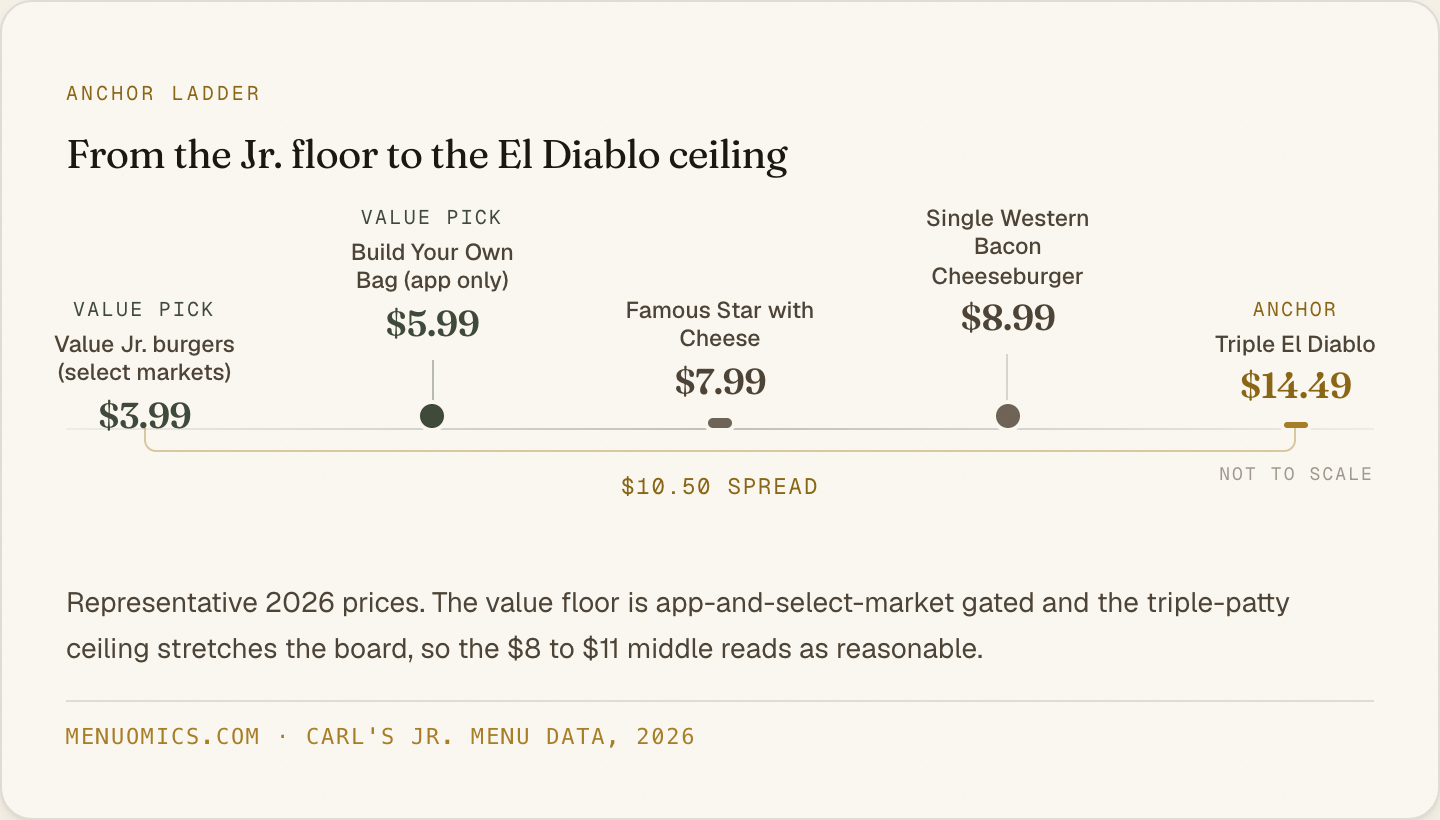
The same menu, mapped onto an axis, so the behavioral move is something you can see, not just read.
From the Jr. floor to the El Diablo ceiling
Representative 2026 prices. The value floor is app-and-select-market gated and the triple-patty ceiling stretches the board, so the $8 to $11 middle reads as reasonable.
Download this chart (PNG) · free to reuse with credit, see reuse terms.
The full ticket
What it actually rings up to.
The headline price is only the start. The real number is the journey from a base order to the check at the register, one easy yes at a time.
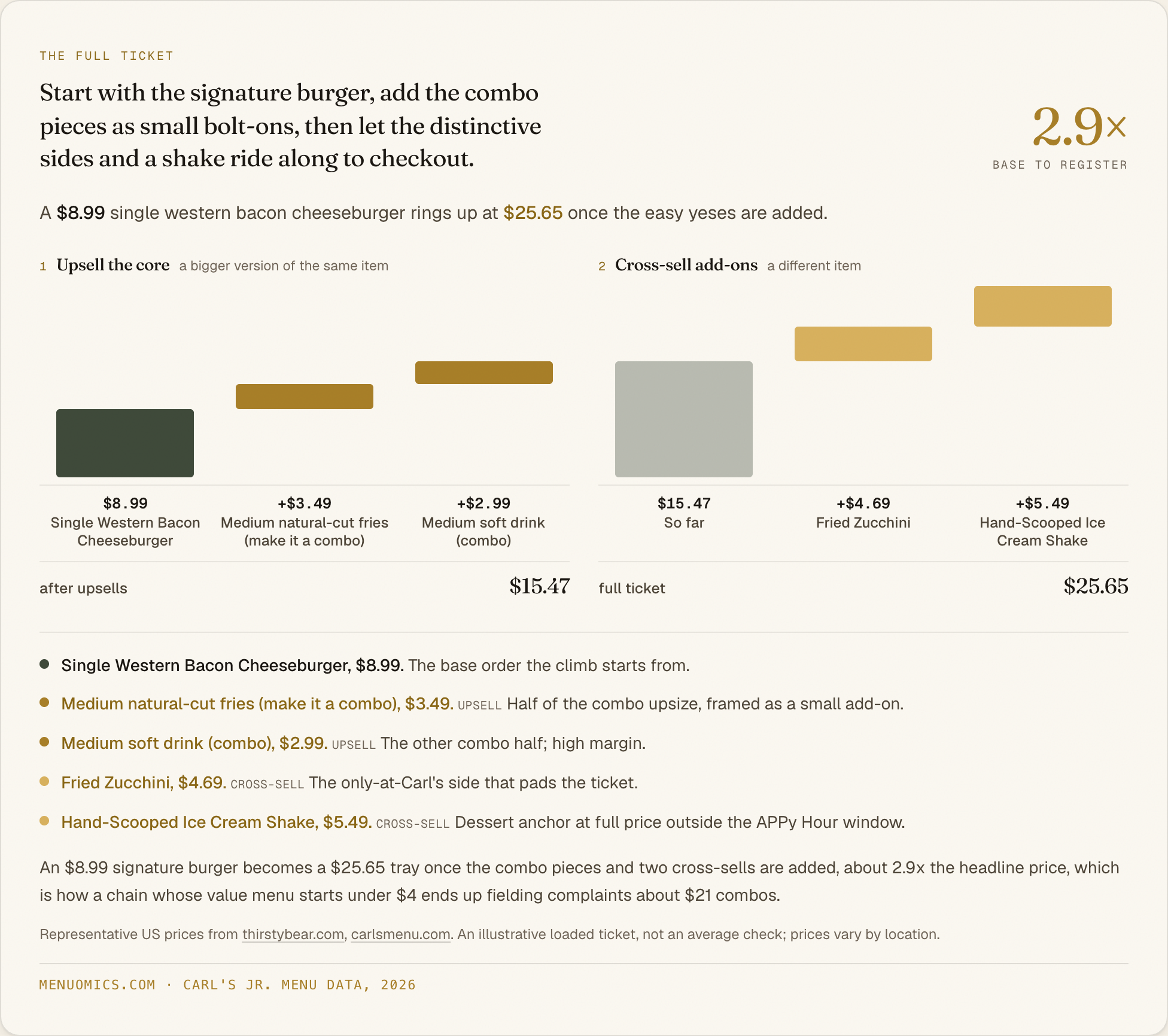
Start with the signature burger, add the combo pieces as small bolt-ons, then let the distinctive sides and a shake ride along to checkout.
A $8.99 single western bacon cheeseburger rings up at $25.65 once the easy yeses are added.
- Single Western Bacon Cheeseburger, $8.99. The base order the climb starts from.
- Medium natural-cut fries (make it a combo), $3.49. upsell Half of the combo upsize, framed as a small add-on.
- Medium soft drink (combo), $2.99. upsell The other combo half; high margin.
- Fried Zucchini, $4.69. cross-sell The only-at-Carl's side that pads the ticket.
- Hand-Scooped Ice Cream Shake, $5.49. cross-sell Dessert anchor at full price outside the APPy Hour window.
An $8.99 signature burger becomes a $25.65 tray once the combo pieces and two cross-sells are added, about 2.9x the headline price, which is how a chain whose value menu starts under $4 ends up fielding complaints about $21 combos.
Representative US prices from thirstybear.com, carlsmenu.com. An illustrative loaded ticket, not an average check; prices vary by location.
Download this chart (PNG) · free to reuse with credit, see reuse terms.
The setup
Carl and Margaret Karcher started with a hot dog cart in Los Angeles in 1941, bought with $311 borrowed against their Plymouth, moved the business to Anaheim, and opened the first Carl's Jr. restaurants in 1956. Today the chain runs about 1,000 US locations, roughly 60% of them in California, under CKE Restaurants, the Roark Capital company that also owns Hardee's, its mirror-image sibling east of a line running roughly from Idaho down to Texas. The board Carl's Jr. built on that history is the most indulgence-forward in fast food. Every burger is 'charbroiled,' the flagship is the Famous Star, the signature is the Western Bacon Cheeseburger with its onion rings and barbecue sauce, and the ceiling is a triple-patty El Diablo that clears fourteen dollars.
Underneath the big-burger theater runs a second, quieter menu. The More Bang Less Buck value line, four Jr. burgers and other items under $4, exists only in select markets. The $5.99 Build Your Own Bag lives inside the app. APPy Hour marks drinks down to $1, sides to $2, and hand-scooped shakes to $3 for three hours every afternoon, app users only. Between the two menus sits the cheapest-feeling upsell in the business, a 99-cent offer to make any burger a double. Walk in cold and you see $8 to $15 burgers; order through the app and the same brand behaves like a discounter. (Carl's Jr. does not frame these as behavioral tactics; this is our reading of the observed design.)
What they get right
The behavioral economics already at work.
The signature burger doubles as the recruitment offer
The Western Bacon Cheeseburger has been the menu's center of gravity for four decades, and its onion-ring-and-barbecue build is distinctive enough that fans rank the double version the best thing the chain sells. Carl's Jr. spends that equity deliberately: sign up for My Rewards and a free Western Bacon Cheeseburger (or Famous Star, or Hand-Breaded Chicken Sandwich) unlocks with any $1 purchase. Giving away the anchor item recruits the habit, and every order after that earns points toward the next visit.
New My Rewards members get a free Western Bacon Cheeseburger, Famous Star, or Hand-Breaded Chicken Sandwich with any $1+ purchase; 10 Stars per $1 spent, Carl's Jr. My Rewards page (carlsjr.com/myrewards)
Charbroiled, hand-breaded, hand-scooped, natural-cut
Almost nothing on this board is plain. The burgers are charbroiled, the chicken is hand-breaded, the shakes are hand-scooped, the fries are natural-cut. It is the most consistent descriptive-label discipline of any national burger chain, and the research says the words pay: descriptive menu labels lifted sales about 27% and improved post-meal ratings in Wansink's field study. The vocabulary is also what lets an $8 to $9 single burger sit next to a $6 rival without apologizing.
Descriptive menu labels lifted item sales roughly 27%, Wansink, Painter & van Ittersum, 2001
A 99-cent double is the softest upsell in fast food
Alongside the 2024 value relaunch, Carl's Jr. lets guests make any burger a double for 99 cents at participating locations. Against listed single-to-double gaps of $1.50 to $2, a sub-dollar add-on reads as nearly free, and because it is quoted separately rather than folded into one price, it gets the partitioned-pricing benefit: the headline price stays put while the ticket grows. It also delivers honest value per added dollar, which is why it works without resentment.
'Make any burger into a double for only 99 cents,' More Bang Less Buck launch, August 2024, Carl's Jr. press release via PR Newswire
Triple-patty ceilings make the doubles look sensible
The board keeps a visible top end: the Triple Western Bacon Cheeseburger and the Triple El Diablo list around $13 to $14.49 in 2026 trackers, and El Diablo was promoted from recurring limited-time offer to permanent menu item in April 2024. With triples sitting at fourteen and change, an $11 double lands as the moderate middle choice rather than an extravagance, which is exactly what a premium anchor is for.
El Diablo returned to the permanent menu April 24, 2024; triple versions list near $14.49 in 2026 trackers, PR Newswire (Apr 2024); 2026 menu price trackers
The board sells indulgence, the app sells the deals
Value at Carl's Jr. is deliberately hard to trip over. The under-$4 Jr. line runs in select markets, the $5.99 Build Your Own Bag is app-exclusive, and APPy Hour compresses $1 drinks, $2 sides, and $3 shakes into a daily 2-to-5 p.m. window, every deal charm-priced to the cent. Splitting the audience this way lets the chain hold full indulgence prices for walk-ins while defending price-sensitive traffic in the app, and the afternoon window adds a deadline that manufactures urgency.
BYOB at $5.99 and APPy Hour ($1 drinks, $2 sides, $3 shakes, 2 to 5 p.m. daily) are app-only offers, Carl's Jr. app promotions; 2026 menu trackers
What we’d test
The rewrite, with the expected lift and the honest caveat.
Put the value floor on every board
The under-$4 Jr. line exists only in select markets and shows clearly only in the app, so most walk-in guests face a board that starts around $7.49 and anchors high. Listing the Jr. line on every physical board would re-anchor the whole menu and let the $8 to $9 singles read as upgrades instead of entry prices.
Expect Improved value perception and traffic, the exact weaknesses named in the 2026 franchisee bankruptcy filing and the 2025 sales decline.
Caveat Franchisees squeezed by California's $20 fast-food wage will resist visible low prices; the select-market rollout exists for a reason.
Name the ladder and show it in one place
The deals are real but scattered: 2 for $5, 2 for $6, the $5.99 Build Your Own Bag, and APPy Hour all live on separate app screens. Rivals show what a named tier system does for the middle option. Collecting the existing offers into one ascending panel would let a mid-tier default emerge instead of forcing guests to hunt.
Expect Higher deal uptake and a compromise-effect pull toward the middle tier.
Caveat Consolidation makes any future price increase on a tier far more visible.
Show APPy Hour as a strike-through saving
APPy Hour quotes flat prices without showing what they replace. Displaying the everyday price struck through next to the deal price turns a cheap number into a visible saving, and a saving frame is what builds the habit of opening the app between 2 and 5.
Expect More afternoon app opens and higher attach rates on sides and shakes.
Caveat The posted reference price has to be the real everyday price or the frame reads as fake.
What diners actually say
Synthesized from public reviews, the reality check that grounds every recommendation.
They praise
- The most disciplined descriptive labeling in fast food: charbroiled, hand-breaded, hand-scooped, and natural-cut all describe real processes and earn their premium framing.
- The Western Bacon Cheeseburger is a genuine four-decade signature; reviewers and fans still rank the double version the best item on the menu.
- The 99-cent make-it-a-double is a model upsell: cheap-feeling, honest, and generous per added dollar.
- Fried zucchini is a real differentiator that no other national burger chain carries.
- Promoting El Diablo from a recurring limited-time offer to a permanent item in 2024 showed the chain reading demand signals instead of churning novelty.
They criticize
- Customers rank Carl's Jr. among the most overpriced fast-food burger chains, with Reddit threads citing $21-plus medium combos.
- US system sales fell 6% in 2025 and average unit volumes slipped 2.7% to $1.4 million, per Technomic figures cited in May 2026 news reports.
- A franchisee with 59 Carl's Jr. locations filed for bankruptcy in 2026, blaming California's $20 fast-food wage and, pointedly, the brand's lack of innovation.
- The best prices are app-gated and the value menu runs only in select markets, so the walk-in board and the app tell two different price stories.
- Price creep on display: the Big Carl launched in 2009 at $2.49 as a Big Mac undercut and now lists around $7.49.
The verdict
Judged purely as menu craft, Carl's Jr. is a tale of two documents. The naming layer is close to perfect: a vocabulary of real processes doing premium work, a forty-year signature anchoring the board, clean triple-patty ceilings, and a 99-cent double that may be the single best-feeling upsell in the category. The architecture underneath is where it leaks. The value floor exists only in some markets, the real deals are buried in an app, and the walk-in board has drifted high enough that customers now name the chain among the most overpriced in fast food while US sales shrink and a large franchisee files for bankruptcy. The craft says A, the coherence says C, and the register suggests customers have noticed the gap. B- overall.
Common questions
- Are Carl's Jr. and Hardee's the same company?
- Yes. Both are owned by CKE Restaurants, a Roark Capital company headquartered in Franklin, Tennessee. Carl's Jr. covers the West and Southwest while Hardee's covers the East and Midwest, with largely mirrored menus; Carl's Jr. keeps the Western Bacon Cheeseburger while Hardee's leans on biscuits and its Frisco Burger.
- Why is Carl's Jr. so expensive?
- Franchise pricing plus geography. Roughly 60% of US Carl's Jr. restaurants are in California, where the $20 fast-food minimum wage and high operating costs push menu boards up, and combos can pass $16 on delivery menus. The cheapest way to order is through the app: the $5.99 Build Your Own Bag, APPy Hour markdowns, and a free signature burger for new My Rewards members.
- What is on the Carl's Jr. value menu in 2026?
- The More Bang Less Buck menu, launched August 2024 in select markets, lists 10 items under $4, including four Jr. burgers such as the Bacon Cheese Jr. and Guac Jr., plus an offer to make any burger a double for 99 cents. The app adds the $5.99 Build Your Own Bag, 2 for $5 and 2 for $6 deals, and daily APPy Hour markdowns from 2 to 5 p.m.
- What is the best thing to order at Carl's Jr.?
- By fan consensus, the Double Western Bacon Cheeseburger: two charbroiled patties, bacon, American cheese, crispy onion rings, and barbecue sauce on a seeded bun. Chowhound ranked it the chain's best burger, and Reddit and TikTok treat it as the crown jewel of the menu.
- What is the most expensive item at Carl's Jr.?
- On the standard menu, the priciest single item is the Triple El Diablo, about $14.49 in representative 2026 US pricing (it varies by location; group packs and combo deals can cost more). That top price also does quiet work as the menu's anchor: it is the number that makes everything below it read as reasonable.
- How much is a meal at Carl's Jr.?
- A meal at Carl's Jr. starts around $8.99 for the base order and lands near $25.65 once the usual add-ons go on, roughly 2.9x the headline price (representative 2026 US figures; they vary by location). That gap between the price that gets you in and the total you pay is the multiplier this page grades.
Sources (8)
- Carl's Jr. full menu (official)
- More Bang Less Buck value menu (official, PR Newswire, Aug 2024)
- El Diablo returns permanently (official, PR Newswire, Apr 2024)
- Spokesman-Review: Carl's Jr. crushed by costs, crime and competition (May 2026)
- Restaurant Business: bankrupt Carl's Jr. franchisee blames California's $20 wage (2026)
- Mashed: overpriced fast-food burger chains, according to customers
- Wikipedia: Carl's Jr. (founding and ownership history)
- Thirsty Bear: Carl's Jr. menu price tracker (2026)
Head to head
More breakdowns
 The Cheesecake FactoryB+
A 21-page, 250-item menu should be a behavioral disaster. It's a roughly $4-billion chain. Here's what all that abundance is quietly doing.
Read the The Cheesecake Factory breakdown → McDonald'sA-
The Extra Value Meal is one of the most-copied ideas in food: fold the whole order into a single number that hurts less than three. Then McValue and the app pile value on top, and the McRib drops in as an event.
Read the McDonald's breakdown → Taco BellA-
A sub-$3 value menu sets the floor, $5/$7/$9 boxes name the deal after its own price, and a never-ending limited-time calendar keeps a reason to come back on the board. Taco Bell sells value loudly, and it works: it gained traffic while rivals shrank.
Read the Taco Bell breakdown → Dunkin'A-
A premium latte anchors the cheap iced coffee as the obvious default, the $6 Meal Deal bundles the breakfast, and Dunkin' Rewards turns the morning run into a streak. The menu craft is textbook; the strain is price creep and an app that increasingly decides the real price.
Read the Dunkin' breakdown → Panda ExpressB+
The whole order comes down to one question, how many entrees. A Bowl is one, a Plate is two, a Bigger Plate is three, and the menu is built so the middle Plate wins. Orange Chicken is the anchor everyone orders, and a quiet $1.50 premium upcharge lifts the check while the headline price stays put.
Read the Panda Express breakdown → Raising Cane'sA-
The chicken-finger chain that built a billion-dollar machine by refusing to sell almost anything else.
Read the Raising Cane's breakdown →Your menu next
Get this for your own menu, free.
Send your menu and we’ll send back the same breakdown, what you get right, what we’d test, and why.
Auntie Anne's
A pretzel chain built for places you were already walking through: the aroma pulls you off the concourse, and a short menu of dips, drinks, and nugget cups quietly triples the ticket.
Read it →