Chipotle Mexican Grill menu, graded
When the guest builds it, the guest defends it: customization plus a partitioned guac upcharge plus a menu that never shows the running total.
The menu you read while you order shows formats and proteins, not a running total. The behavioral work happens between the rice and the register.
Menu-craft grade
A build-your-own line with no prices in front of you turns every order into a self-assembled total you only learn at the register.
Graded on how well the menu uses behavioral economics, not the food.
Menu and prices verified September 2026
A 3-minute audio read of the analysis
- Type
- Chain
- Where
- Newport Beach, CA (HQ)
- Cuisine
- Fast-casual Mexican
- Footprint
- 3,700+ locations
- Since
- 1993
- Ownership
- Chipotle Mexican Grill, Inc. (NYSE: CMG)
The mechanics, drawn
The same menu, mapped onto an axis, so the behavioral move is something you can see, not just read.
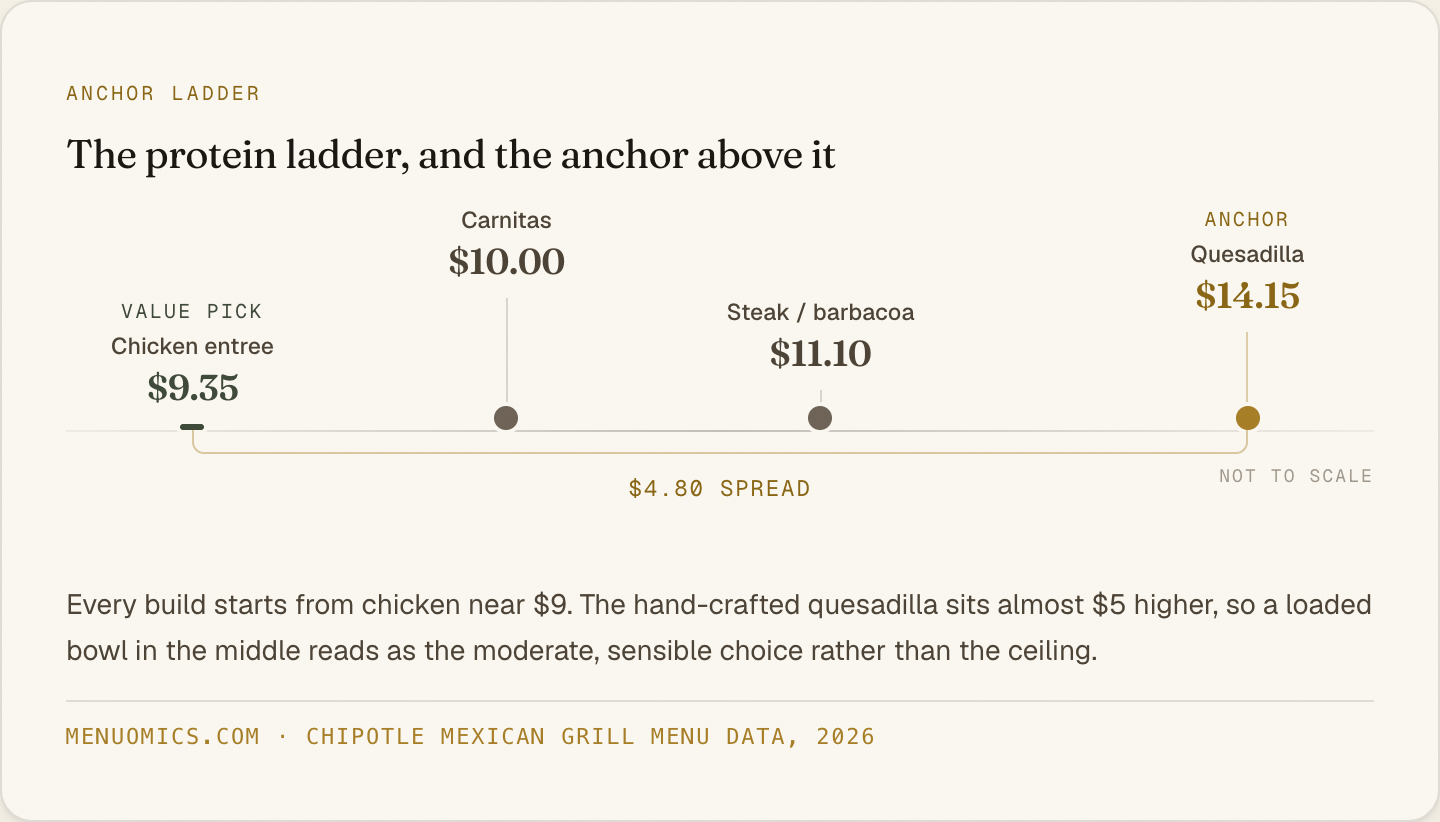
The protein ladder, and the anchor above it
Every build starts from chicken near $10. The hand-crafted quesadilla tops the ladder at about $12.25, so a loaded bowl in the middle reads as the moderate, sensible choice rather than the ceiling.
Download this chart (PNG) · free to reuse with credit, see reuse terms.
The full ticket
What it actually rings up to.
The headline price is only the start. The real number is the journey from a base order to the check at the register, one easy yes at a time.
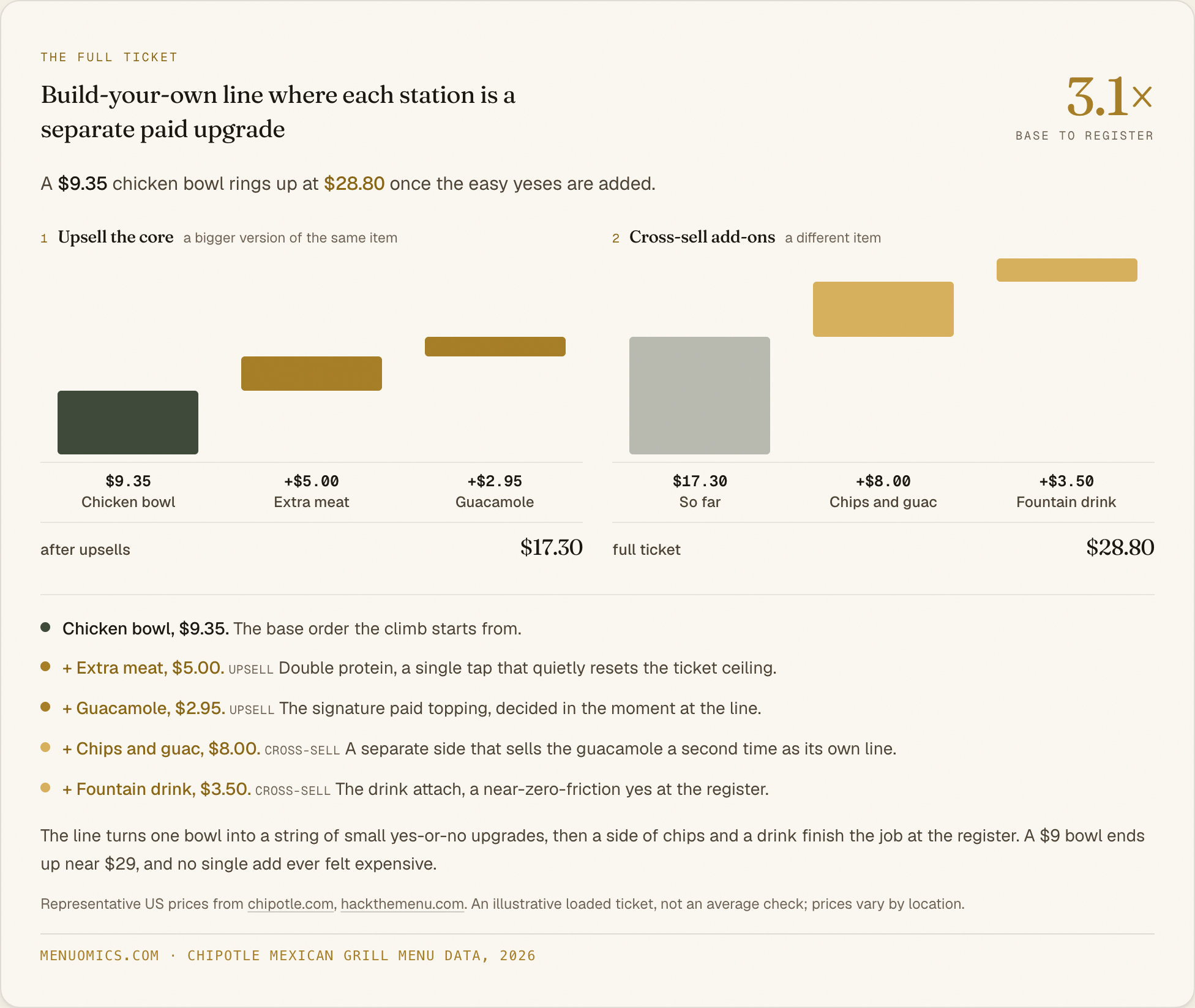
Build-your-own line where each station is a separate paid upgrade
A $9.80 chicken bowl rings up at $29.20 once the easy yeses are added.
- Chicken bowl, $9.80. The base order the climb starts from.
- + Extra meat, $4.60. upsell Double protein, a single tap that quietly resets the ticket ceiling.
- + Guacamole, $2.95. upsell The signature paid topping, decided in the moment at the line.
- + Chips and guac, $8.60. cross-sell A separate side that sells the guacamole a second time as its own line.
- + Fountain drink, $3.25. cross-sell The drink attach, a near-zero-friction yes at the register.
The line turns one bowl into a string of small yes-or-no upgrades, then a side of chips and a drink finish the job at the register. A $10 bowl ends up near $29, and no single add ever felt expensive.
Representative US prices from chipotle.com, chipotlemenus.us. An illustrative loaded ticket, not an average check; prices vary by location.
Download this chart (PNG) · free to reuse with credit, see reuse terms.
The setup
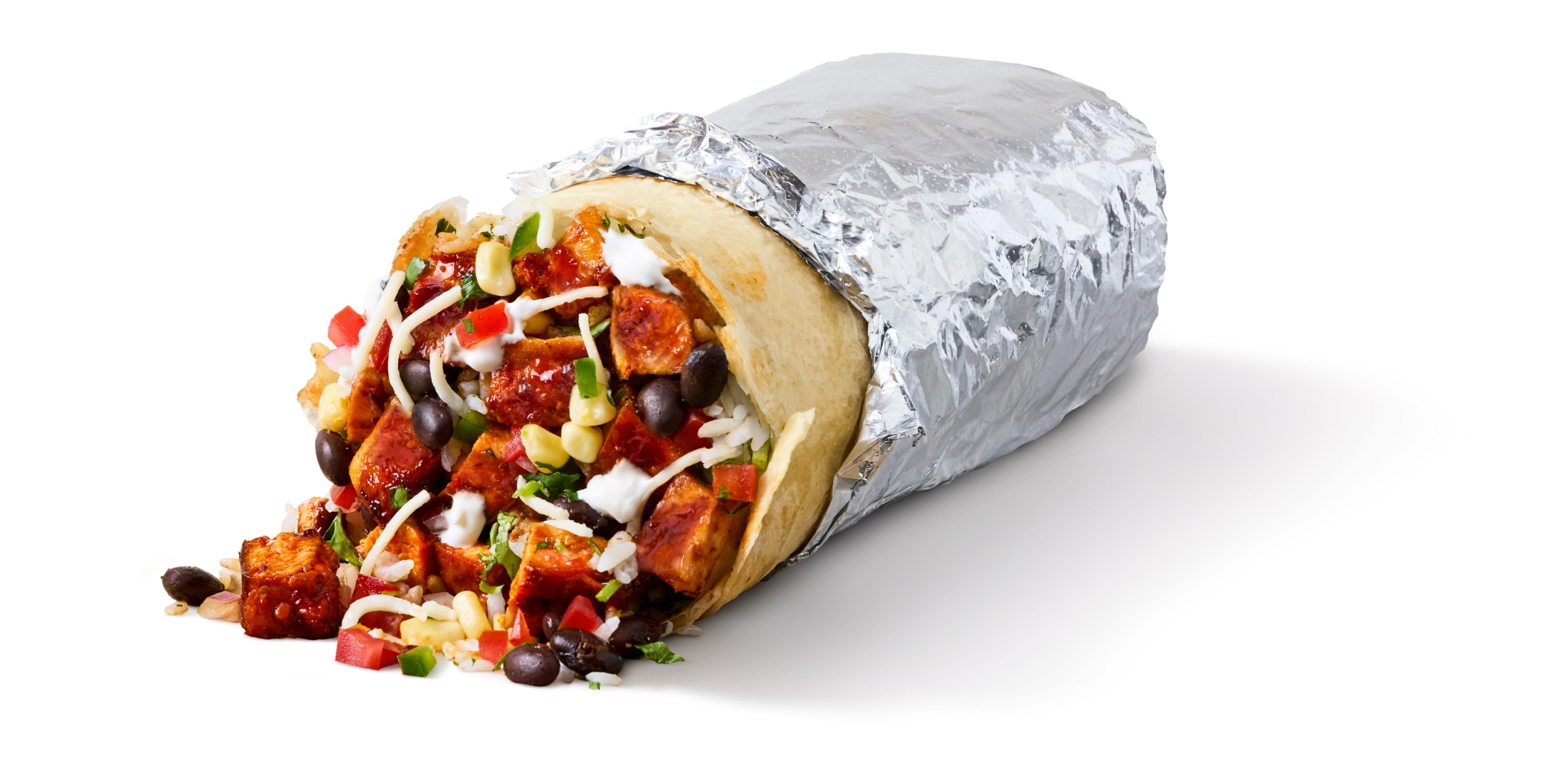
Chipotle opened in Denver in 1993 and now runs more than 3,700 locations under its own words: Food with Integrity, meaning responsibly sourced ingredients prepared with classic technique and served fast. The format is the product. You pick a vessel (bowl, burrito, tacos, quesadilla, salad), pick a protein, then call out toppings down a visible assembly line.
That line is the behavioral setup. The menu in front of a guest lists choices, not a price ladder, so the order is assembled before the cost is known. Each add (premium protein, queso, a scoop of guac) is presented as a small separate charge rather than a higher bowl price, and the total only resolves at the register.
What they get right
The behavioral economics already at work.
Partitioned pricing on guac and premiums
Guacamole and premium proteins are quoted as separate small adds rather than baked into a higher bowl price. Splitting a total into a base plus surcharges tends to raise willingness to add, because each piece looks small next to the base.
Guac added for ~$2.95 as a distinct line, not folded into bowl price, Morwitz, Greenleaf and Johnson, 1998 (partitioned pricing)
No running total on the order line
The menu a guest reads while building lists formats and proteins, not a live total. Separating the moment of choosing from the moment of paying loosens the felt cost of each add, since the number only resolves at the register.
Order-line menu shows formats and proteins; full prices live on app, boards, and paper menu, Thaler 1999; Prelec and Loewenstein 1998 (mental accounting)
Build-your-own ownership
Calling out each topping down the line makes the meal feel self-authored. Effort and choice tend to raise how much people value the result, so a bowl you assembled feels more yours, and adds you requested feel justified.
Every entree is assembled by the guest down a visible line, Norton, Mochon and Ariely, The IKEA Effect (2012)
The quesadilla anchor
The hand-crafted quesadilla tops the standard menu at $12-plus. A high reference item nearby makes a built bowl in the $10 to $12 range read as the moderate, sensible choice rather than the ceiling.
Quesadilla ~$11.25 chicken / ~$12.25 steak vs chicken entree ~$9.80, Menu-price aggregators (Sept 2026 sample)
Free guac as a steered default
Guac is free on Veggie and Sofritas builds but a paid add on everything else. Framing the same scoop as included or extra depending on the build nudges choice and makes the paid add feel like a fair, opt-in upgrade.
Guacamole no upcharge on Veggie and Sofritas; ~$2.95 elsewhere, Pricing Solutions, Add-On Pricing at Chipotle
What we’d test
The rewrite, with the expected lift and the honest caveat.
Quote guac inline as +$2.95 at the add point
Where guac is offered, label it with its exact add (for example +$2.95) right at the decision instead of leaving the number to the register. Naming a small partitioned price at the moment of choice is the cleanest version of how this menu already works.
Expect Steadier guac attach with fewer register surprises, because the add is named where the choice is made.
Caveat This touches pricing presentation and add-on labeling only, not the guac recipe, portion, or how it is made.
Print the quesadilla at the top of the entree list
On boards and the app, list the ~$12 hand-crafted quesadilla first in the entree section so it is read before bowls and burritos. Leading with the highest standard item sets a higher reference for everything below it.
Expect Built bowls in the $10 to $12 band read as moderate, lifting comfort with mid-list adds.
Caveat This touches item ordering and layout only, not the food, the kitchen, or staffing on the line.
Show a running subtotal as the build progresses
On the app, display a live subtotal that updates as proteins and adds are chosen, rather than revealing the total at checkout. This tests whether surfacing the number changes add behavior versus the current no-total order line.
Expect More deliberate add choices and possibly fewer adds, a clean read on how much the hidden total is doing.
Caveat This touches pricing display and checkout layout only, not portion sizes, sourcing, or menu copy.
What diners actually say
Synthesized from public reviews, the reality check that grounds every recommendation.
They praise
- Guacamole is hand-mashed daily and widely called worth the add
- Build-your-own format gives real control over the meal
- Responsibly sourced ingredients, the Food with Integrity story
- Fast, consistent, and easy to customize to a diet or macro target
They criticize
- Guac upcharge of about $3 feels steep and surprises to-go orders
- No prices on the order line, so the total is unclear until the register
- Portion and price consistency varies noticeably by location
The verdict
Chipotle's menu is a quietly excellent piece of behavioral design: a build-your-own line with no running total, premium proteins and guac quoted as small separate adds, and a $12-plus quesadilla anchoring the top so a built bowl feels moderate. The menu-design upside is to make the partitioning honest, name the guac add right where it is chosen and let the format keep doing the rest.
Common questions
- Why is Chipotle so expensive?
- A $9.80 chicken bowl commonly rings up near $29.20, a 3.0x jump, once extra meat ($4.60), guacamole ($2.95), chips and guac ($8.60), and a drink ($3.25) are added as small separate choices. The order line shows formats and proteins but no running total, so each "yes" feels minor and the real number only resolves at the register.
- Why doesn't Chipotle show prices on the order line?
- Chipotle's order-line menu lists formats and proteins without a running total, while full prices live on the app, in-store boards, and the paper menu. Separating the moment of choosing from the moment of paying loosens the felt cost of each add, so the bowl is fully assembled before the cost is known.
- How much does guacamole cost at Chipotle?
- Guacamole is added for about $2.95 on most builds (roughly $2.50 to $3.70 by market), but it is included at no upcharge on Veggie and Sofritas orders. Quoting it as a small separate line rather than baking it into a higher bowl price makes the add look minor next to the base, which tends to raise how often people add it.
- What is the most expensive item at Chipotle?
- The hand-crafted quesadilla is the anchor at roughly $11.25 for chicken and $12.25 for steak or barbacoa, the top of the standard menu. That $12-plus ceiling makes a built bowl in the $10 to $12 range read as the moderate, sensible choice rather than the priciest option.
- How much is a meal at Chipotle Mexican Grill?
- A meal at Chipotle Mexican Grill starts around $9.80 for the base order and lands near $29.20 once the usual add-ons go on, roughly 3x the headline price (representative 2026 US figures; they vary by location). That gap between the price that gets you in and the total you pay is the multiplier this page grades.
Sources (5)
Head to head
More breakdowns
 QdobaB+
The burrito chain that turned its rival's most famous surcharge into its own advertisement: queso and guacamole free on every entree, one flat price for the whole build.
Read the Qdoba breakdown → Olive GardenB+
Never-ending breadsticks read less like generosity than like decoupled pricing: a loss-leader and a recurring scarcity event working in concert.
Read the Olive Garden breakdown → Palmetto SuperfoodsB
A California acai chain whose menu leads with the one promise every acai shop gets accused of breaking: '100% Real Acai, every time.'
Read the Palmetto Superfoods breakdown → SweetgreenB+
The salad chain that names every bowl for its ingredients and farmers, then offers a handful of signature defaults so you don't have to build from scratch.
Read the Sweetgreen breakdown → StarbucksA-
Tall is the small. The names hide the ounces, the app hides the payment, and a pumpkin drink restarts the whole calendar every August. The most studied size menu in the world.
Read the Starbucks breakdown → CAVAB+
CAVA's menu is a build-your-own Mediterranean line that includes three scratch dips and unlimited toppings free, then concentrates the upsell on one flat premium-protein step and resells the dips as paid sides.
Read the CAVA breakdown →Your menu next
Get this for your own menu, free.
Send your menu and we’ll send back the same breakdown, what you get right, what we’d test, and why.
La Taqueria
The James Beard 'America's Classic' that builds its whole reputation on what it leaves out: no rice, six meats, one price, off-menu dorado.
Read it →