
Starbucks menu, graded
How renaming the sizes hides the ladder and sells the middle
Starbucks does not have a small. It has a Tall. Once you see what that one word is doing, you see the whole menu differently.
Menu-craft grade
A masterclass in size architecture and ritual: the Tall, Grande, Venti naming hides the ounce ladder and pulls everyone to the middle, propped up by an app that decouples payment and a seasonal LTO engine, held back only by dollar signs and a board so dense first-timers stall.
Graded on how well the menu uses behavioral economics, not the food.
Menu and prices verified September 2026
A 4-minute audio read of the analysis
- Type
- Chain
- Where
- Seattle, WA (Pike Place)
- Cuisine
- Coffeehouse
- Footprint
- ~16,500-17,000 US locations (2026)
- Since
- 1971
- Ownership
- NASDAQ: SBUX
The mechanics, drawn
The same menu, mapped onto an axis, so the behavioral move is something you can see, not just read.
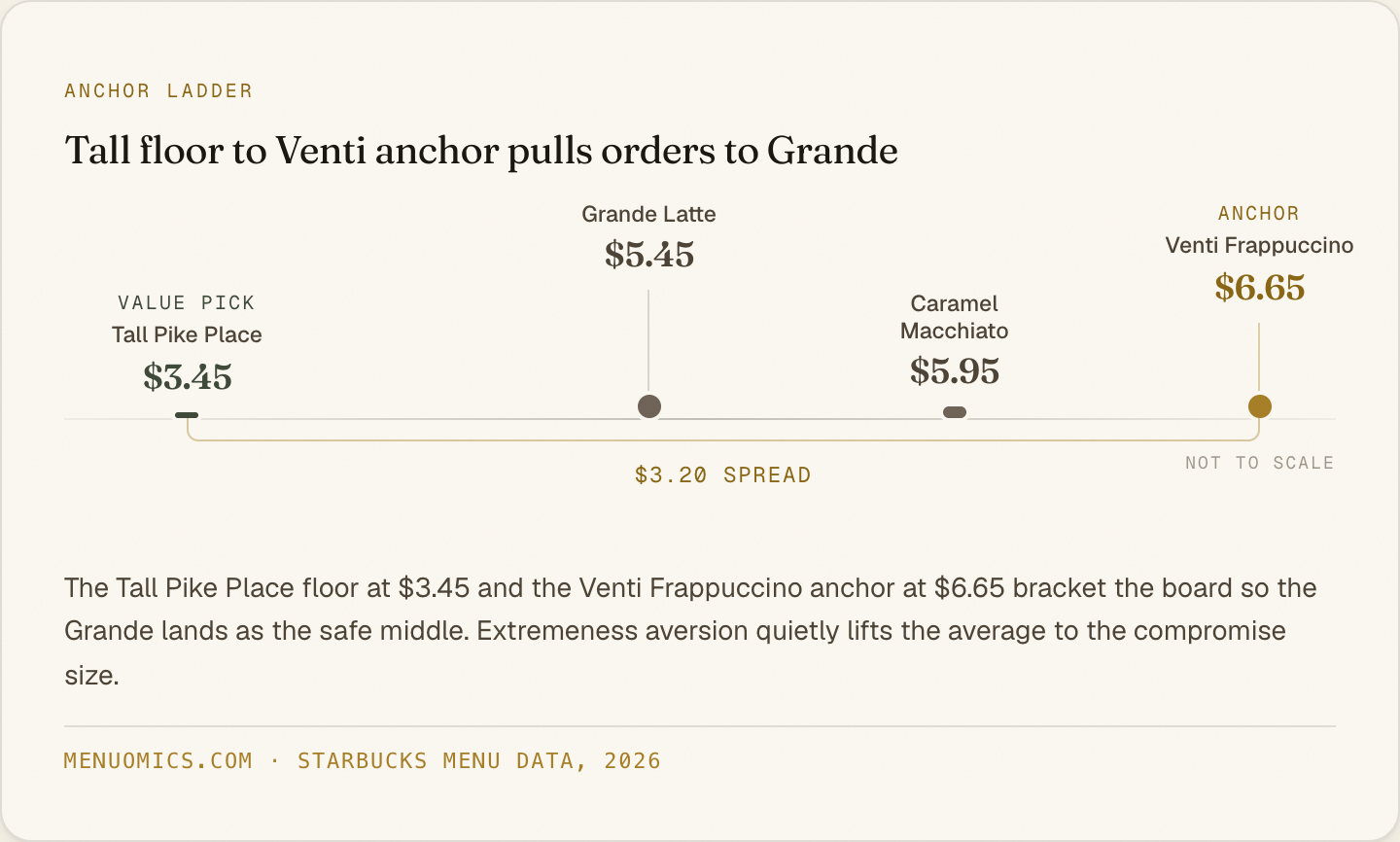
Tall floor to Venti anchor pulls orders to Grande
The Tall Pike Place floor at $3.45 and the Venti Frappuccino anchor at $6.65 bracket the board so the Grande lands as the safe middle. Extremeness aversion quietly lifts the average to the compromise size.
Download this chart (PNG) · free to reuse with credit, see reuse terms.
The full ticket
What it actually rings up to.
The headline price is only the start. The real number is the journey from a base order to the check at the register, one easy yes at a time.
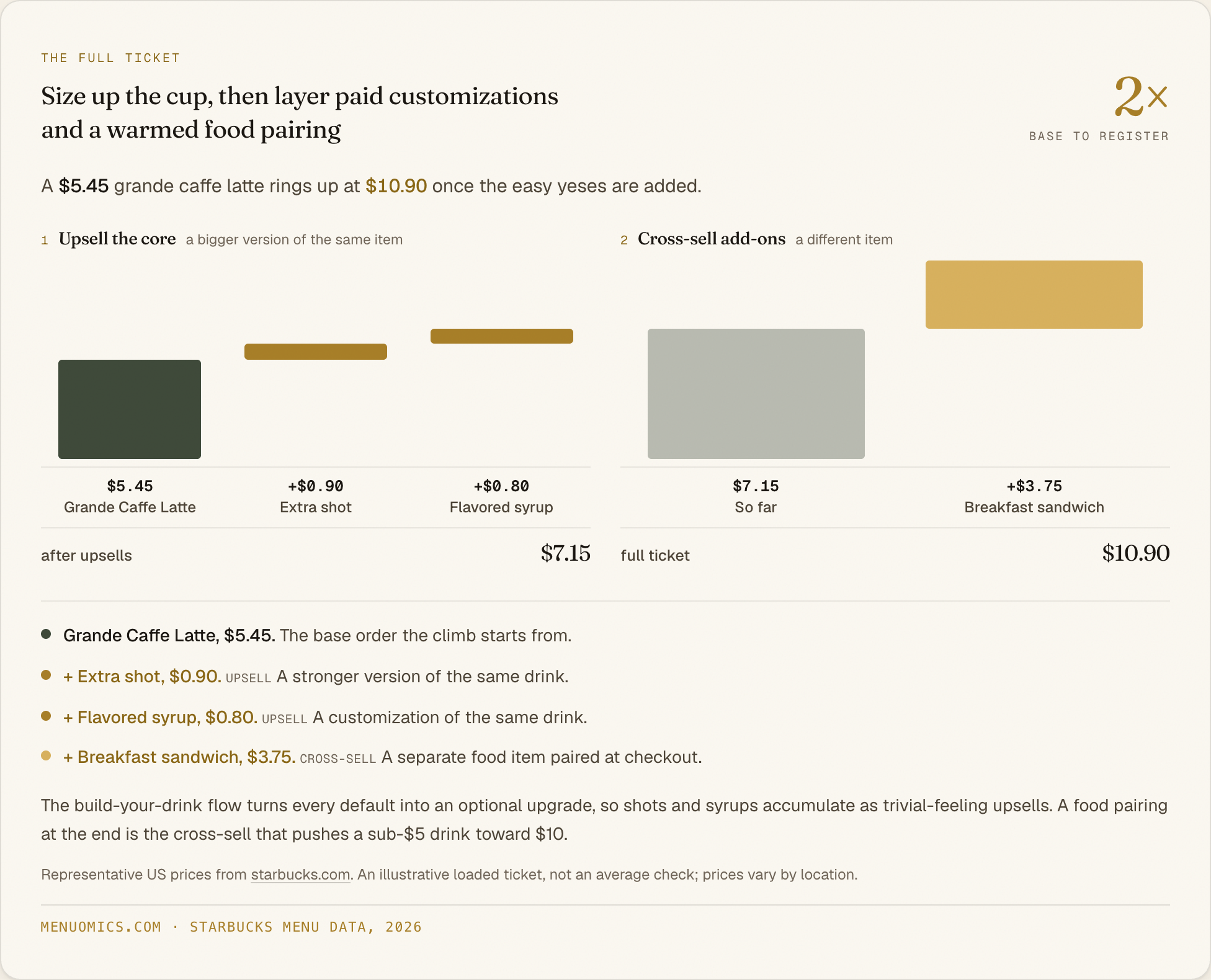
Size up the cup, then layer paid customizations and a warmed food pairing
A $5.45 grande caffe latte rings up at $10.90 once the easy yeses are added.
- Grande Caffe Latte, $5.45. The base order the climb starts from.
- + Extra shot, $0.90. upsell A stronger version of the same drink.
- + Flavored syrup, $0.80. upsell A customization of the same drink.
- + Breakfast sandwich, $3.75. cross-sell A separate food item paired at checkout.
The build-your-drink flow turns every default into an optional upgrade, so shots and syrups accumulate as trivial-feeling upsells. A food pairing at the end is the cross-sell that pushes a sub-$5 drink toward $10.
Representative US prices from starbucks.com. An illustrative loaded ticket, not an average check; prices vary by location.
Download this chart (PNG) · free to reuse with credit, see reuse terms.
The setup
Starbucks runs more than 16,000 US coffeehouses off a board that, famously, almost never prints an ounce. The size names are Tall (12 oz), Grande (16 oz), Venti (20 oz hot or 24 oz iced), with a 31 oz Trenta added for cold drinks in 2011 and a near-invisible 8 oz Short that stays off the menu. A Grande Caffe Latte runs about $5.45 and a Grande Pumpkin Spice Latte about $6.45 in 2026, with the cheapest drink a Tall Pike Place at roughly $3.45 (varies by location).
The interesting move is linguistic. By naming the smallest visible size Tall, a word that means large, and labeling the sizes in a different language than the ounces they hold, the board detaches the name from the quantity. You can no longer read the ladder at a glance, so you reach for the one that sounds normal: Grande, the middle. Layer on an app that pre-loads money so paying stops feeling like spending, and a seasonal drink that resets demand every fall, and you have the most quietly engineered menu in fast food.
What they get right
The behavioral economics already at work.
The size names hide the ladder
On a normal board you read Small, Medium, Large and instantly rank them by price-per-ounce. Starbucks prints Tall, Grande, Venti in a different language than the ounces, so the ladder is no longer legible at a glance. The effect is that you stop comparing value across sizes and reach for the name that sounds default. The smallest visible size being called Tall, a word for large, is the sharpest part of the trick.
Official Starbucks size board (Tall 12oz, Grande 16oz, Venti 20/24oz); names shown, ounces omitted
Grande is the compromise that wins
With Tall framed as the meager option and Venti as the indulgent one, the 16 oz Grande becomes the safe middle, and middles win. People asked to pick from three sizes disproportionately avoid the extremes, so the existence of a Venti (and the rarely-ordered Trenta above it) quietly pulls the average order up to Grande.
compromise option gains share when it sits between a low and a high, Simonson and Tversky, 1992 (compromise effect)
The app decouples the payment
Reloading the Starbucks Card in advance moves the moment of paying away from the moment of drinking. Once money is already on the card, ordering feels free, and the 2026 rewards refresh sweetens the reload itself. Decoupling the pain of paying from consumption is one of the most reliable spend levers in behavioral economics.
Thaler 1999; Prelec and Loewenstein 1998 (mental accounting)
Rewards tiers manufacture a reason to stretch
The reimagined program launching March 10, 2026 sorts members into Green, Gold (500 Stars, 1.2x earn) and Reserve (2,500 Stars, 1.7x earn), with a new 60-Star, $2-off redemption. Visible thresholds and escalating earn rates give regulars a target to push toward, the classic 'so close to the next tier' pull.
Gold at 500 Stars, Reserve at 2,500; 1x / 1.2x / 1.7x Stars per $1, Starbucks press, reimagined loyalty program, launches Mar 10, 2026
The PSL is a calendar, not a drink
The Pumpkin Spice Latte returns every late August (Aug 26 in 2025) and disappears in winter, which is the point: a permanent item cannot anchor a season. By making it a limited-time return, Starbucks turns a latte into the unofficial start of fall and gets a demand spike plus free press every year. Scarcity, in time rather than supply, raises both urgency and perceived value.
grande PSL $5.75 to $7.25, company-operated, Worchel et al., 1975 (scarcity)
What we’d test
The rewrite, with the expected lift and the honest caveat.
Print the ounces next to the names
The board shows Tall, Grande, Venti but not 12, 16, 20. Adding the ounce next to each name would make the ladder legible again and let value shoppers trade up to the cheaper-per-ounce Venti. Starbucks almost certainly would not run this, which is itself the tell: the omission is doing work.
Expect More size trade-ups by value-conscious guests; a likely shift away from the default Grande
Caveat A pricing-presentation and labeling change to the board only; it does not touch the drinks, recipes, or what the sizes actually cost.
Drop the dollar signs in-app and on the board
Prices read "$5.45" with the money cue intact. A Cornell field study found that removing the dollar sign lifted spend roughly 8% per person by muting the reminder that this is money leaving.
Expect Small lift in average ticket at the espresso-drink price point
Caveat A pricing-presentation change to how numbers are typeset, not a price change; single-venue study, test the magnitude rather than assume it.
Name one 'most-ordered' drink per section
The menu leans on size and seasonality but rarely tells a first-timer what to order. A single 'most popular' tag per category, latte, Frappuccino, cold brew, gives the chain's heavy new-and-tourist traffic a low-risk pick, exactly the audience social proof moves most.
Expect Higher attach on the tagged drink; faster decisions for first-timers
Caveat A menu naming and labeling change; it speaks to item selection, not to staffing, drink quality, or speed of service.
What diners actually say
Synthesized from public reviews, the reality check that grounds every recommendation.
They praise
- Consistent drink, same anywhere in the world
- The app and mobile order are genuinely convenient
- Seasonal drinks (PSL, holiday) feel like an event
- Rewards Stars add up fast for regulars
They criticize
- Prices keep climbing; a daily latte adds up
- The size names confuse first-timers ("why is the small called Tall?")
- Crowded board and long mobile-order queues stall newcomers
The verdict
Starbucks is the most quietly engineered menu in fast food: the size names detach price from quantity so the eye lands on the middle, the app decouples paying from drinking, and the PSL turns a season into a sales event. The menu-craft upside left on the table is honesty as a flourish, an ounce next to each name and a popular pick per section would actually help newcomers without giving up a thing the architecture is doing.
Common questions
- Why are Starbucks sizes Tall, Grande, and Venti?
- Tall is 12 oz, Grande is 16 oz, and Venti is 20 oz hot or 24 oz iced, with the smallest visible drink, a Tall Pike Place, at about $3.45. By naming sizes in a different language than the ounces they hold, the board detaches the name from the quantity so you stop comparing value and reach for the one that sounds normal.
- Why is the small called a Tall at Starbucks?
- The smallest size on the board is the 12 oz Tall, a word that means large, which earns the menu an A- for its size architecture. Calling the small a Tall makes the 16 oz Grande feel like the safe middle, and middles win because people avoid the extremes.
- What is the cheapest drink at Starbucks?
- A Tall Pike Place brewed coffee is the floor at about $3.45, versus a Grande Latte around $5.45 and a Venti Frappuccino near $6.65. The Venti anchor at the top makes the Grande in the middle read as the moderate, sensible choice.
- How much does a customized Starbucks drink cost?
- A $5.45 Grande Latte can ring up at $10.90, about 2.0 times the base, once you add an extra shot, a flavored syrup, and a breakfast sandwich. The build-your-drink flow turns every default into a trivial-feeling upsell that quietly doubles the ticket.
- Why does the Pumpkin Spice Latte come back every fall?
- The Grande Pumpkin Spice Latte runs about $6.45 and returns every late August, landing on August 26 in 2025. A permanent item cannot anchor a season, so making it a limited-time return turns a latte into the unofficial start of fall and a yearly demand spike.
- What is the most expensive item at Starbucks?
- On the standard menu, the priciest single item is the Caramel Frappuccino (Venti), about $6.65 in representative 2026 US pricing (it varies by location; group packs and combo deals can cost more). That top price also does quiet work as the menu's anchor: it is the number that makes everything below it read as reasonable.
- How much is a meal at Starbucks?
- A meal at Starbucks starts around $5.45 for the base order and lands near $10.90 once the usual add-ons go on, roughly 2x the headline price (representative 2026 US figures; they vary by location). That gap between the price that gets you in and the total you pay is the multiplier this page grades.
Sources (7)
- Official menu, starbucks.com/menu
- Starbucks press, PSL returns Aug 26, 2025
- Starbucks press, reimagined loyalty program (Green / Gold / Reserve, Mar 10, 2026)
- Compromise / extremeness aversion, Simonson & Tversky, 1992
- Mental accounting & decoupling, Thaler (1999); Prelec & Loewenstein (1998)
- Scarcity raises perceived value, Worchel, Lee & Adewole, 1975
- Cornell, removing the “$” lifted spend ≈8%/person (Yang, Kimes & Sessarego, 2009)
Head to head
More breakdowns
 Olive GardenB+
Never-ending breadsticks read less like generosity than like decoupled pricing: a loss-leader and a recurring scarcity event working in concert.
Read the Olive Garden breakdown → Palmetto SuperfoodsB
A California acai chain whose menu leads with the one promise every acai shop gets accused of breaking: '100% Real Acai, every time.'
Read the Palmetto Superfoods breakdown → SweetgreenB+
The salad chain that names every bowl for its ingredients and farmers, then offers a handful of signature defaults so you don't have to build from scratch.
Read the Sweetgreen breakdown → Chipotle Mexican GrillA-
Chipotle's menu is a build-your-own assembly line with no prices on the rail, so you customize first and total up last, with guac quoted as a tidy little add-on.
Read the Chipotle Mexican Grill breakdown → CAVAB+
CAVA's menu is a build-your-own Mediterranean line that includes three scratch dips and unlimited toppings free, then concentrates the upsell on one flat premium-protein step and resells the dips as paid sides.
Read the CAVA breakdown → Shake ShackB+
A burger near $7.19 in a category where rivals sell at a dollar. Shake Shack does not discount; it sells provenance, refuses a value menu, and lets the sourcing copy justify every cent.
Read the Shake Shack breakdown →Your menu next
Get this for your own menu, free.
Send your menu and we’ll send back the same breakdown, what you get right, what we’d test, and why.
Marufuku Ramen
A four-bowl Hakata tonkotsu menu that lets you tune firmness, spice, and richness without ever asking you to design the bowl. Constrained customization, done well.
Read it →