Olive Garden menu, graded
"Unlimited" reads as a pricing structure, not a giveaway
The unlimited soup, salad and breadsticks look like a giveaway. Read closely, they line up with casual dining's most deliberate-looking behavioral pricing.
Menu-craft grade
Graduate-level bundling, decoupled unlimited refills and a real scarcity event, read here as deliberate-looking value mechanics under a family-dinner frame; held back by charm pricing that fights its own premium dishes and surcharges that can read as large.
Graded on how well the menu uses behavioral economics, not the food.
Menu and prices verified September 2026
A 4-minute audio read of the analysis
- Type
- Chain
- Where
- Orlando, FL
- Cuisine
- Italian-American casual
- Footprint
- 900+ locations
- Since
- 1982
- Ownership
- NYSE: DRI (Darden Restaurants)
The mechanics, drawn
The same menu, mapped onto an axis, so the behavioral move is something you can see, not just read.
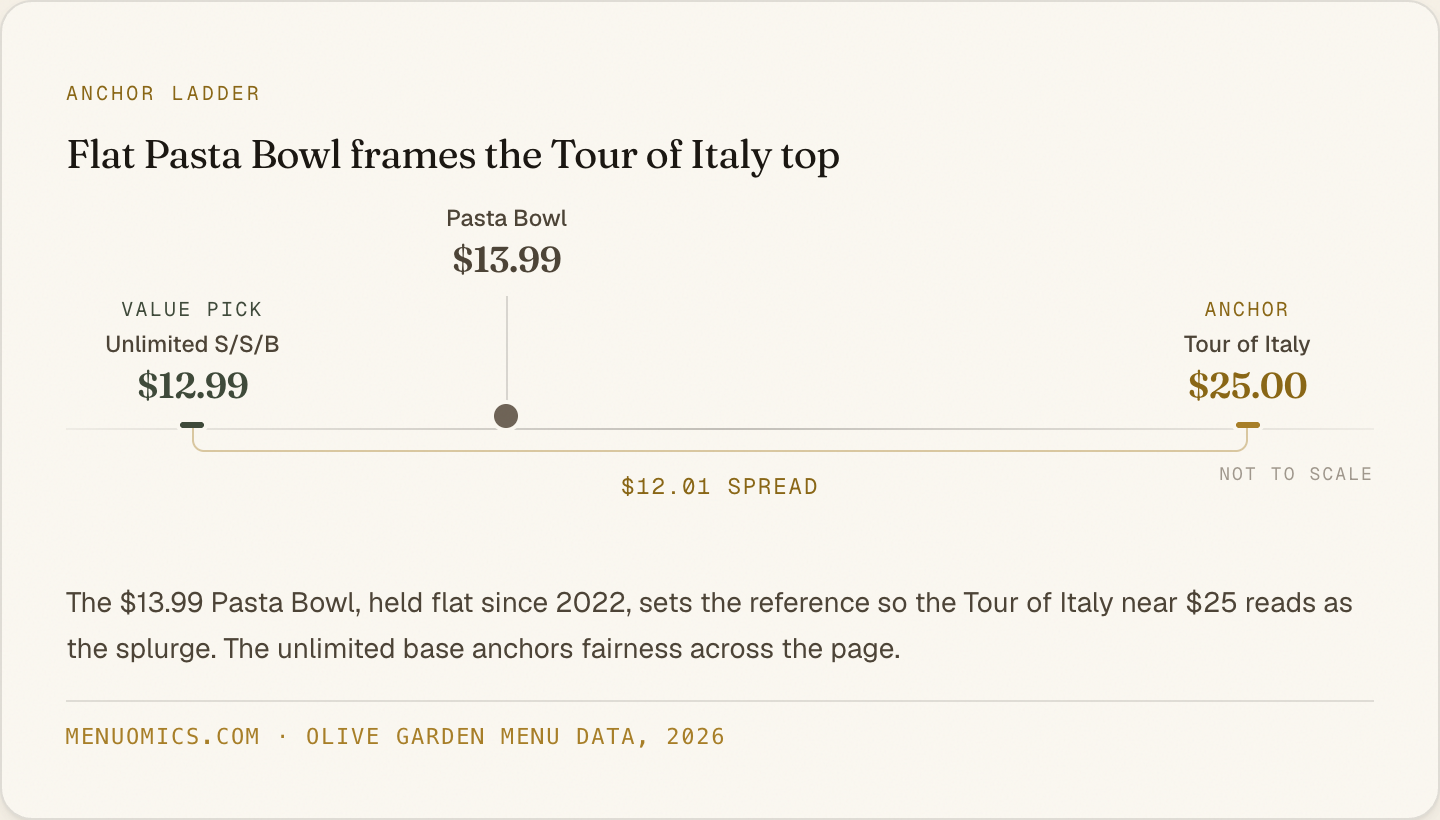
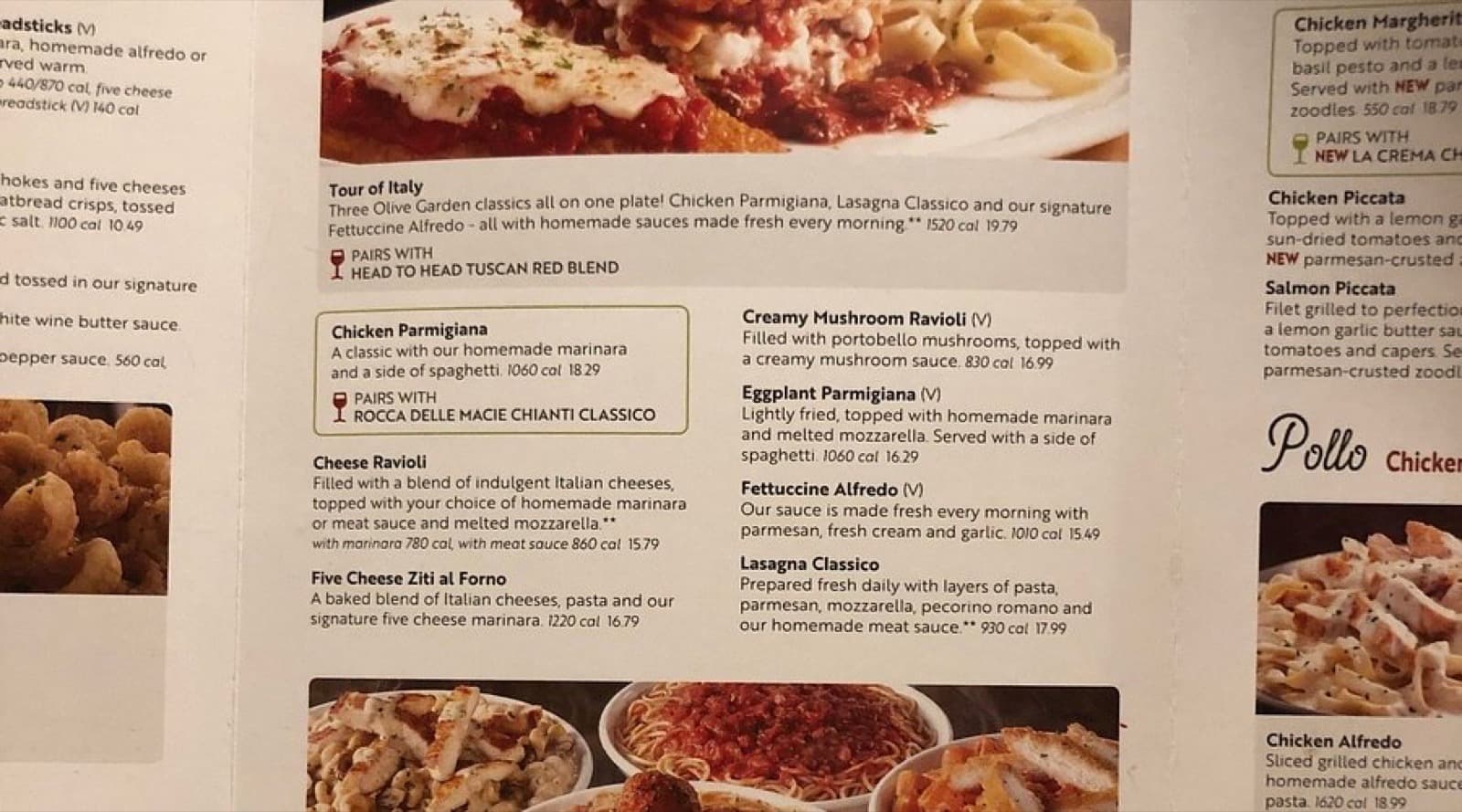
Flat Pasta Bowl frames the Tour of Italy top
The $13.99 Pasta Bowl, held flat since 2022, sets the reference so the Tour of Italy near $25 reads as the splurge. The unlimited base anchors fairness across the page.
Download this chart (PNG) · free to reuse with credit, see reuse terms.
The full ticket
What it actually rings up to.
The headline price is only the start. The real number is the journey from a base order to the check at the register, one easy yes at a time.
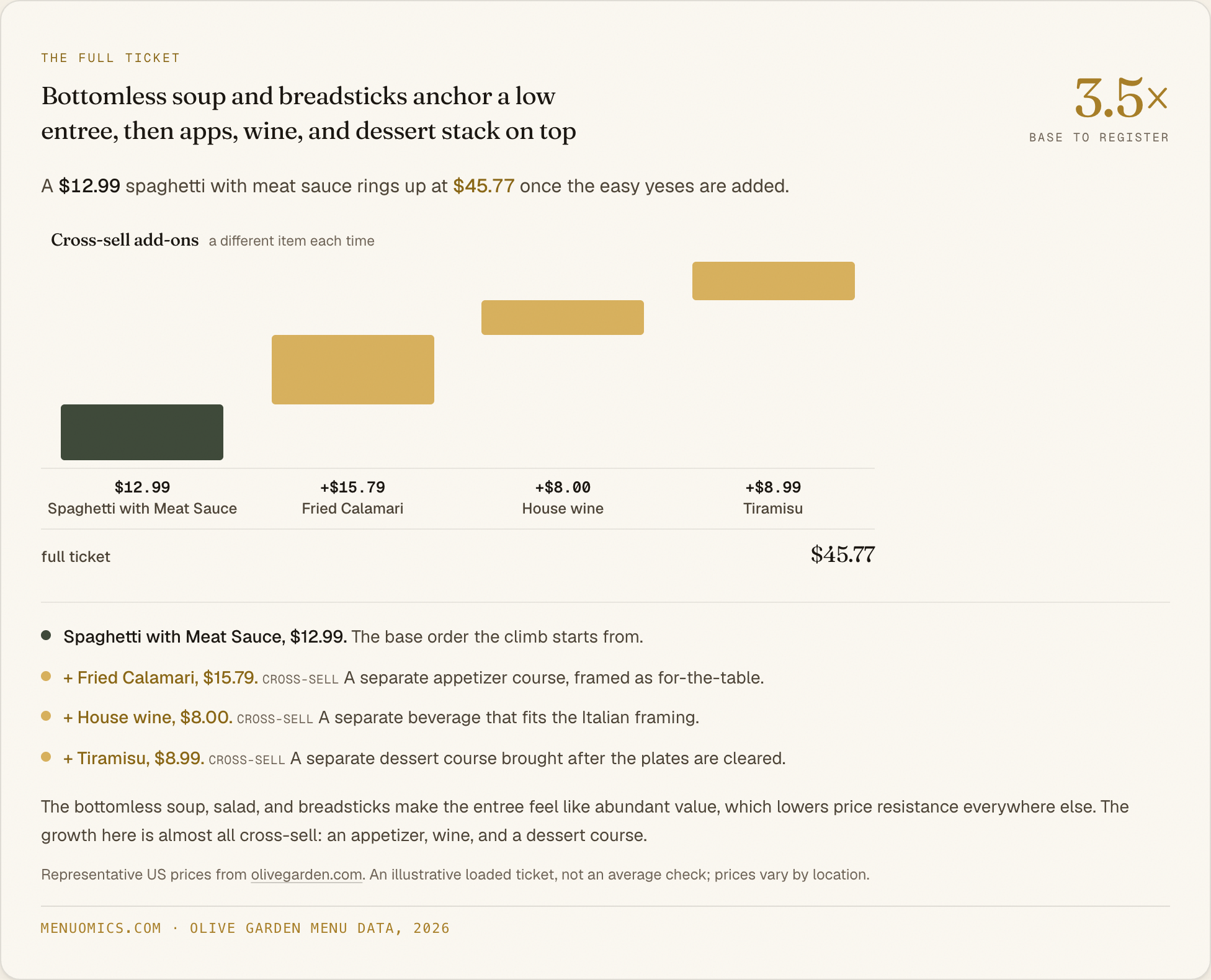
Bottomless soup and breadsticks anchor a low entree, then apps, wine, and dessert stack on top
A $12.99 spaghetti with meat sauce rings up at $45.77 once the easy yeses are added.
- Spaghetti with Meat Sauce, $12.99. The base order the climb starts from.
- + Fried Calamari, $15.79. cross-sell A separate appetizer course, framed as for-the-table.
- + House wine, $8.00. cross-sell A separate beverage that fits the Italian framing.
- + Tiramisu, $8.99. cross-sell A separate dessert course brought after the plates are cleared.
The bottomless soup, salad, and breadsticks make the entree feel like abundant value, which lowers price resistance everywhere else. The growth here is almost all cross-sell: an appetizer, wine, and a dessert course.
Representative US prices from olivegarden.com. An illustrative loaded ticket, not an average check; prices vary by location.
Download this chart (PNG) · free to reuse with credit, see reuse terms.
The setup
Olive Garden's most visible mechanics are all built around "unlimited": the bottomless breadsticks, the recurring Never Ending Pasta Bowl, and the $100 Pasta Pass that has sold out in about a second. It is easy to read this as a chain buying traffic with carbs. Look closer and it lines up with a stack of behavioral mechanisms most fine-dining rooms would never dare use. (The chain does not state these as intent; this is our reading of the observed design.)
The interesting part is not the free bread. It is what the free bread does to how a guest feels about paying.
What they get right
The behavioral economics already at work.
Unlimited decouples eating from paying
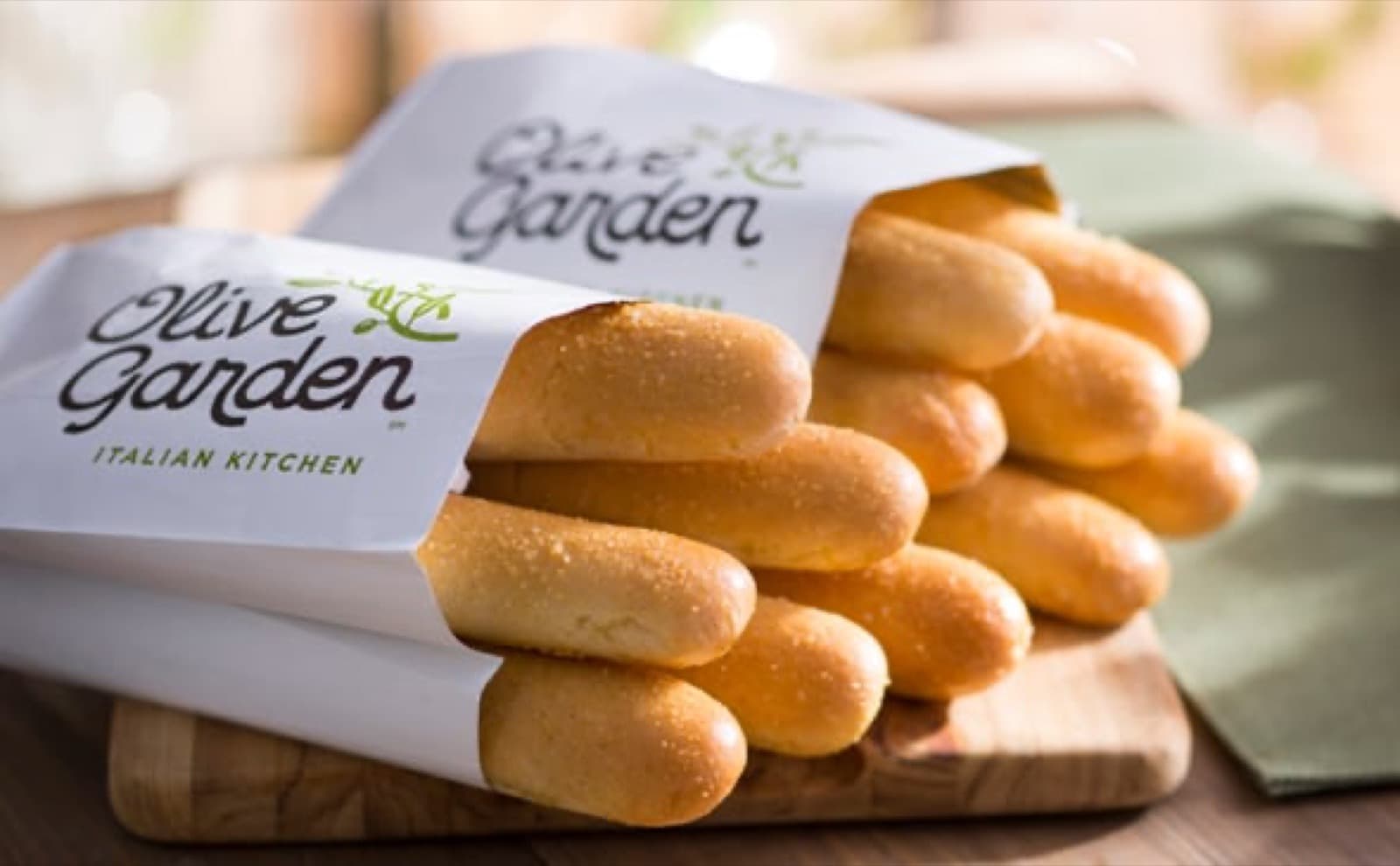
When the price is fixed and the refills are free, every breadstick feels free; the meter is off. Decoupling consumption from payment is one of the more reliable ways to make people both spend more and return. The breadsticks function as a loss-leader buying exactly that feeling.
Prelec & Loewenstein, "The Red and the Black," 1998
Bundles hide the bill
One combined price hurts less than a column of itemized charges. The Tour of Italy and the prix-fixe-style bowls fold three decisions into a single number.
Thaler, mental accounting, "segregate gains, integrate losses"
Price stability as a signal
The $13.99 Pasta Bowl has held flat since 2022, and the chain publicizes that fact. In an era of menu inflation, a flat price is a loud value signal, and it sets a reference point that makes everything else on the menu feel fair.
anchoring; Tversky & Kahneman 1974
The specials run on a calendar, the menu does not
The everyday menu is always there; the Never Ending Pasta Bowl runs only about late August to mid-November, and Buy One Take One comes and goes. Time-boxing the best deals turns them into events guests wait for, which spikes traffic in a way the permanent menu never could.
limited-time framing raises perceived value, Worchel et al. 1975 (scarcity)
The Pasta Pass reads as engineered scarcity
A limited run of $100 passes that has sold out in about one second generates waitlists, press and status, turning a pasta promo into a cultural event.
~22,000 passes, sold out in ~1 second, Worchel et al. 1975 (scarcity)
What we’d test
The rewrite, with the expected lift and the honest caveat.
Name the refills as "unlimited" on the page
On the menu itself, label the soup, salad and breadsticks explicitly as "unlimited" or "bottomless" wherever they appear, so the partitioned, decoupled pricing reads as truly endless on the page rather than as a single serving. The wording is what carries the meter-is-off feeling the bundle is built on.
Expect The bundle reads as endless at the point of choice, reinforcing the decoupling
Caveat A menu-copy change only; it does not alter portions, refills or service.
Keep surcharges small and clearly presented
The +$4.99 premium-topping add-on is smart: it keeps the $13.99 headline low and upsells on top. But partitioned pricing reverses the moment a surcharge feels large or sneaky (the drip-pricing backlash). Keep add-ons modest and visibly worth it on the page.
Caveat A pricing-presentation change; keep the add-on small and plainly shown.
Morwitz et al. 1998; Burman & Biswas 2007
Engineer the entree middle
Arrange the entrees as a clear good/better/best so the dish Olive Garden most wants to sell becomes the reasonable middle option.
Expect Mix shift toward the target tier
Caveat A layout and ordering change; works best when the top tier is plausible, not a stunt.
What diners actually say
Synthesized from public reviews, the reality check that grounds every recommendation.
They praise
- Genuine value
- The unlimited promise
- Familiar comfort food
- Family-friendly breadth
They criticize
- Quality and freshness can slip
- Refills can feel rationed
- Not "authentic" Italian
The verdict
Read as menu design, Olive Garden lines up with graduate-level behavioral pricing under a family-dinner frame: decoupled unlimited refills, loss-leader bread, integrated bundles, a flat-price value signal and a recurring scarcity event. The on-page work left is to name the unlimited as unlimited, present surcharges as small and honest, and engineer a clear good/better/best entree middle.
Common questions
- Is Olive Garden's Never-Ending Pasta Bowl worth it?
- The Never Ending Pasta Bowl is $13.99 and has held flat since 2022, which earns the menu a B+ as a genuine value signal. The unlimited refills decouple eating from paying so the meter feels off, which makes the deal feel even bigger than the flat price suggests.
- How much is a full dinner at Olive Garden?
- A $12.99 entree turns into a $45.77 check once you add calamari, house wine and tiramisu, about 3.5 times the base. The bottomless soup, salad and breadsticks make the entree feel like abundant value, which lowers price resistance on everything else.
- Are the unlimited breadsticks really free?
- Yes, the soup, salad and breadsticks are unlimited at no extra charge, but they function as a loss-leader, not a giveaway. With a fixed price and free refills, every breadstick feels free, and that decoupling reliably makes people spend more and return.
- What is the Olive Garden Pasta Pass?
- The Pasta Pass is a limited run of about 22,000 $100 passes that has sold out in roughly one second. That engineered scarcity generates waitlists, press and status, turning a pasta promo into a cultural event well beyond what the everyday menu could do.
- What is the most expensive item at Olive Garden?
- On the standard menu, the priciest single item is the Tour of Italy, about $22.00 in representative 2026 US pricing (it varies by location; group packs and combo deals can cost more). That top price also does quiet work as the menu's anchor: it is the number that makes everything below it read as reasonable.
Sources (6)
- CNN, Olive Garden's Never Ending Pasta Bowl (2025)
- Olive Garden, official menu
- Mental accounting & decoupling, Thaler (1999); Prelec & Loewenstein (1998)
- Partitioned pricing, Morwitz, Greenleaf & Johnson, 1998
- Scarcity raises perceived value, Worchel, Lee & Adewole, 1975
- Compromise / extremeness aversion, Simonson & Tversky, 1992
Head to head
More breakdowns
 Palmetto SuperfoodsB
A California acai chain whose menu leads with the one promise every acai shop gets accused of breaking: '100% Real Acai, every time.'
Read the Palmetto Superfoods breakdown → SweetgreenB+
The salad chain that names every bowl for its ingredients and farmers, then offers a handful of signature defaults so you don't have to build from scratch.
Read the Sweetgreen breakdown → Chipotle Mexican GrillA-
Chipotle's menu is a build-your-own assembly line with no prices on the rail, so you customize first and total up last, with guac quoted as a tidy little add-on.
Read the Chipotle Mexican Grill breakdown → StarbucksA-
Tall is the small. The names hide the ounces, the app hides the payment, and a pumpkin drink restarts the whole calendar every August. The most studied size menu in the world.
Read the Starbucks breakdown → CAVAB+
CAVA's menu is a build-your-own Mediterranean line that includes three scratch dips and unlimited toppings free, then concentrates the upsell on one flat premium-protein step and resells the dips as paid sides.
Read the CAVA breakdown → Shake ShackB+
A burger near $7.19 in a category where rivals sell at a dollar. Shake Shack does not discount; it sells provenance, refuses a value menu, and lets the sourcing copy justify every cent.
Read the Shake Shack breakdown →Your menu next
Get this for your own menu, free.
Send your menu and we’ll send back the same breakdown, what you get right, what we’d test, and why.
Restaurant Gary Danko
Tiered courses, round whole-dollar prices, a caviar anchor, build-your-own freedom and a tableside cheese cart. Danko is already doing what we'd recommend.
Read it →