
Sweetgreen menu, graded
Descriptive, sourced names plus a few named signature defaults turn an infinite build-your-own into an easy, health-haloed choice.
Sweetgreen's menu is a lesson in descriptive naming and the named default: a few signature bowls rescue you from an infinite build-your-own.
Menu-craft grade
Provenance-rich descriptive naming and a tight rack of named signature bowls give confident defaults over an infinite build-your-own, though the all-bowls-look-priced-alike rack mutes anchoring.
Graded on how well the menu uses behavioral economics, not the food.
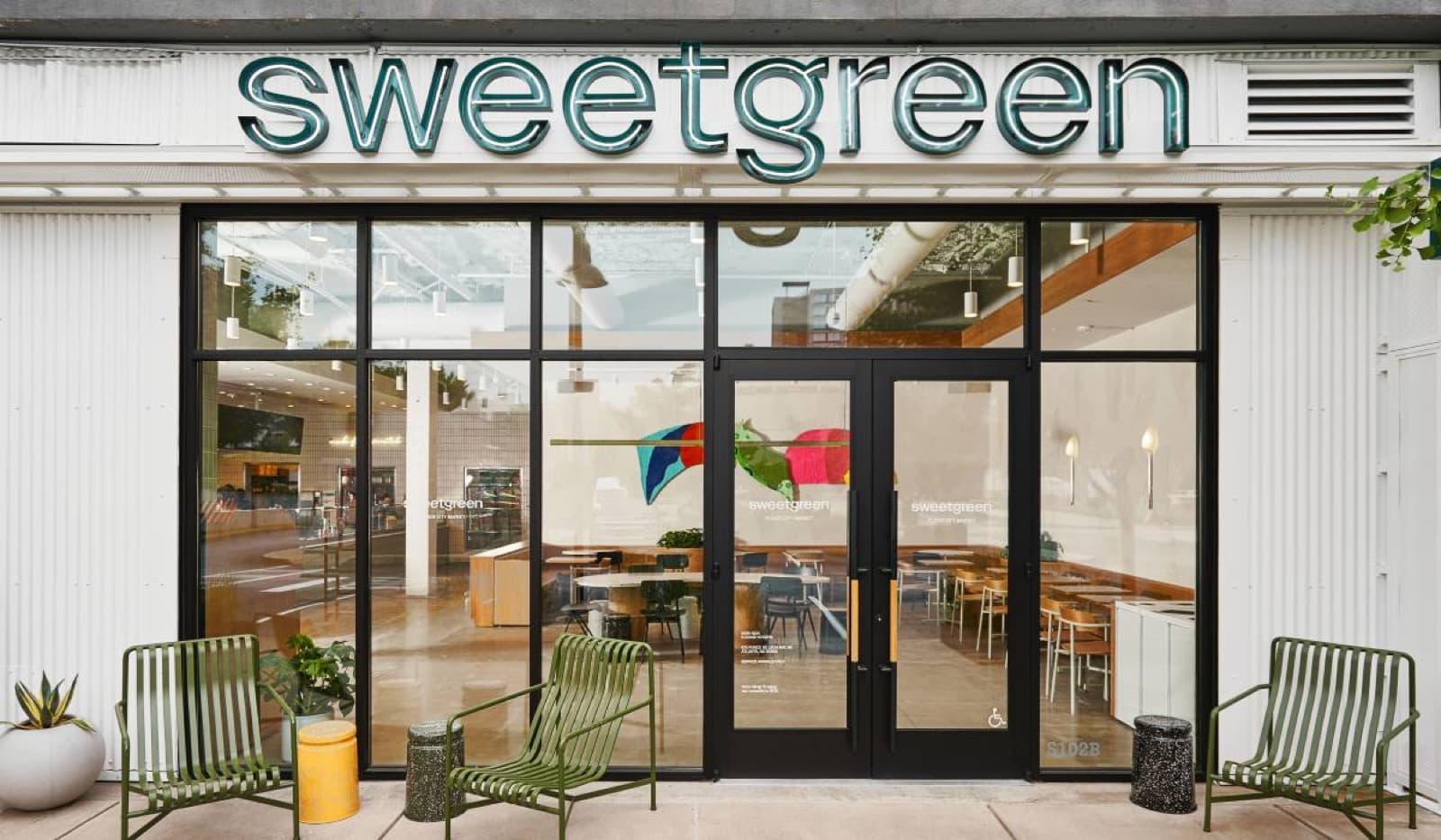
Menu and prices verified September 2026
A 3-minute audio read of the analysis
- Type
- Chain
- Where
- Los Angeles, CA (HQ); first store Georgetown, Washington, DC
- Cuisine
- Fast-casual salads and warm grain bowls
- Footprint
- 250+ locations
- Since
- 2007
- Ownership
- Sweetgreen, Inc. (NYSE: SG); founders Jonathan Neman, Nicolas Jammet, Nathaniel Ru
The mechanics, drawn
The same menu, mapped onto an axis, so the behavioral move is something you can see, not just read.
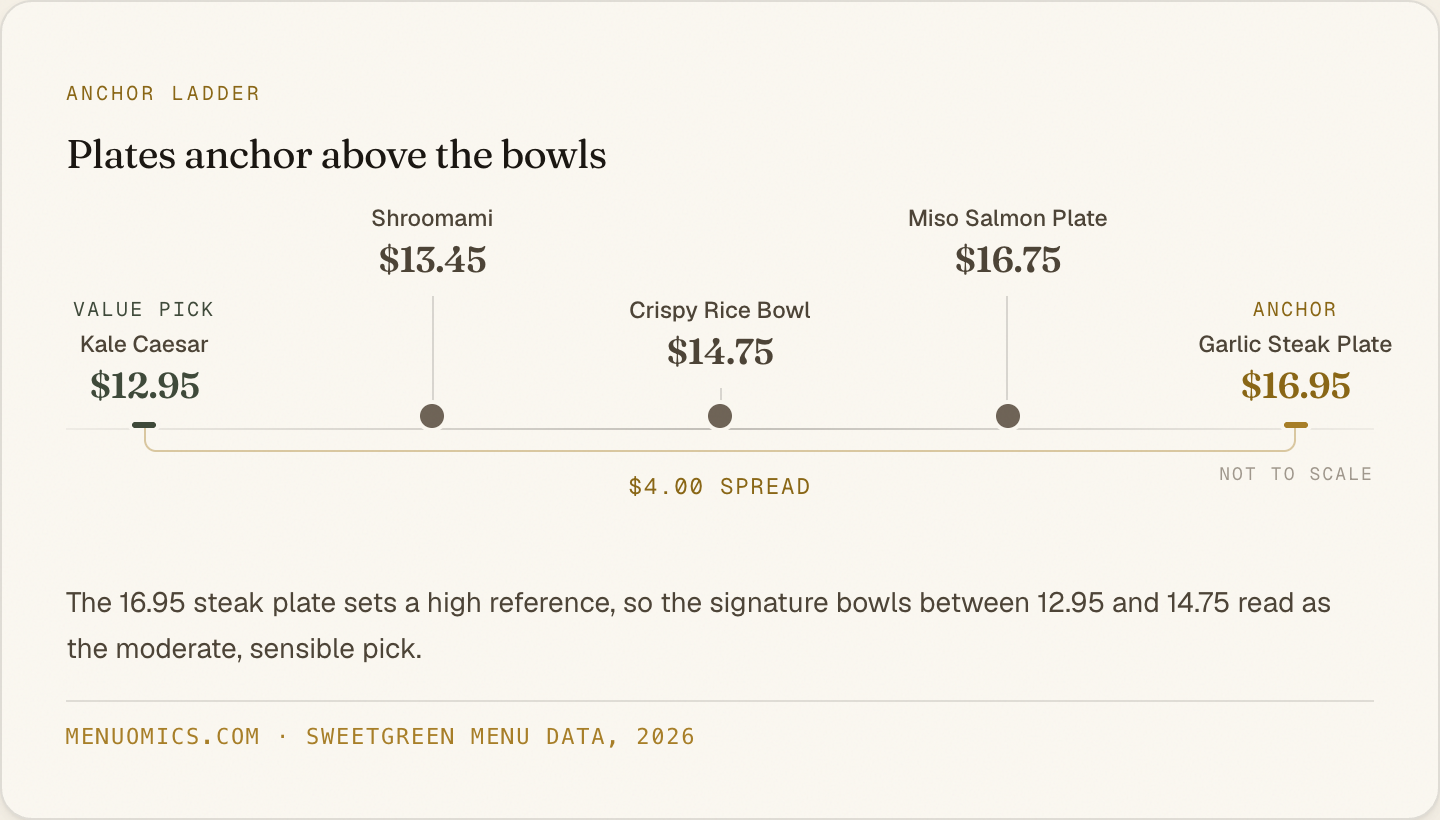
Plates anchor above the bowls
The 16.95 steak plate sets a high reference, so the signature bowls between 12.95 and 14.75 read as the moderate, sensible pick.
Download this chart (PNG) · free to reuse with credit, see reuse terms.
The full ticket
What it actually rings up to.
The headline price is only the start. The real number is the journey from a base order to the check at the register, one easy yes at a time.
Tiered build-your-own, premium proteins and toppings each upcharged
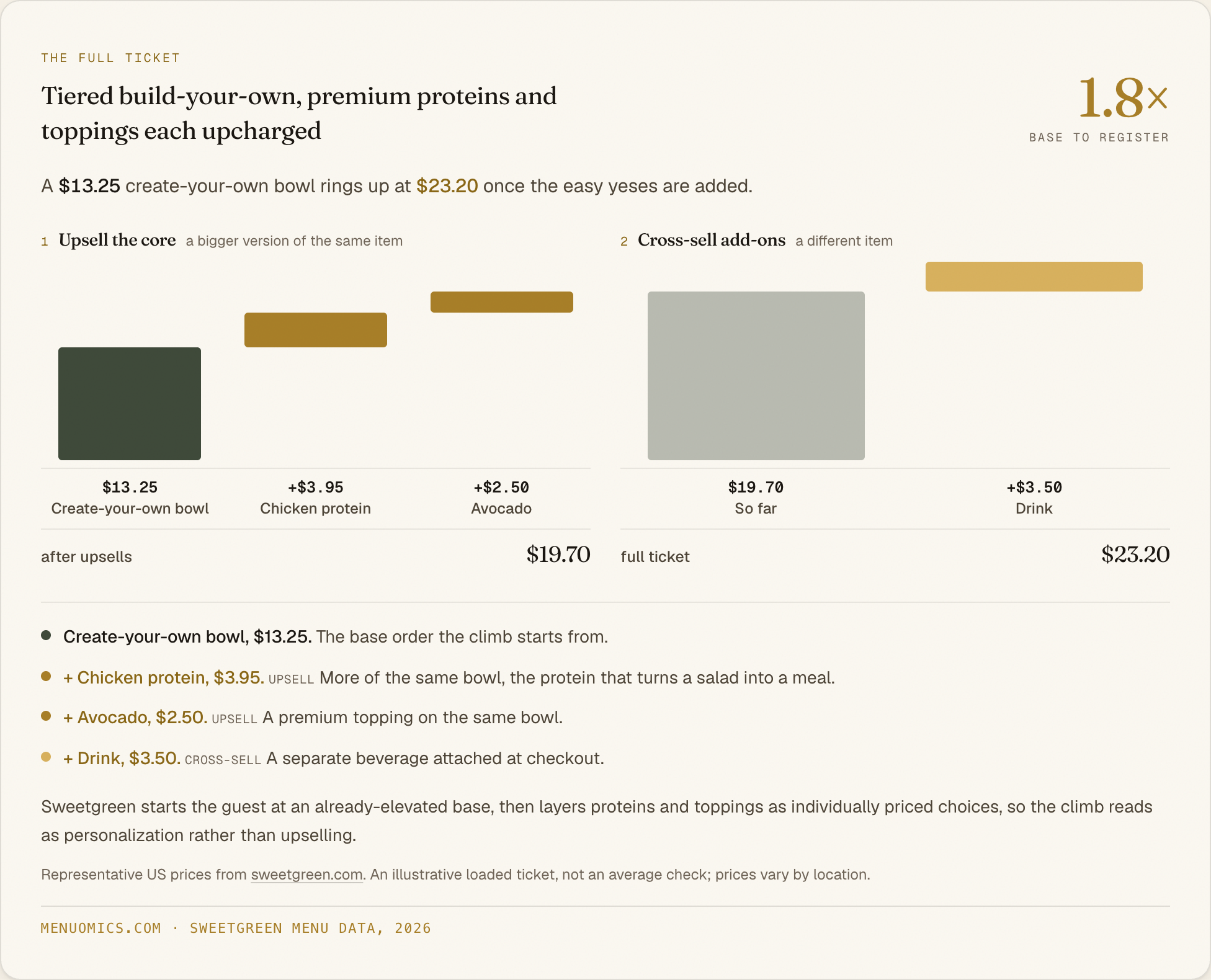
A $13.25 create-your-own bowl rings up at $23.20 once the easy yeses are added.
- Create-your-own bowl, $13.25. The base order the climb starts from.
- + Chicken protein, $3.95. upsell More of the same bowl, the protein that turns a salad into a meal.
- + Avocado, $2.50. upsell A premium topping on the same bowl.
- + Drink, $3.50. cross-sell A separate beverage attached at checkout.
Sweetgreen starts the guest at an already-elevated base, then layers proteins and toppings as individually priced choices, so the climb reads as personalization rather than upselling.
Representative US prices from sweetgreen.com. An illustrative loaded ticket, not an average check; prices vary by location.
Download this chart (PNG) · free to reuse with credit, see reuse terms.
The setup
Sweetgreen opened in Georgetown in 2007, founded by three Georgetown business-school grads, and now runs more than 250 fast-casual stores. In its own words it sources "the best ingredients from farmers we know" and prepares them fresh, a provenance story it carries straight into how items are named and described.
The behavioral setup: every Sweetgreen menu is really two menus stacked. On top sit named signature bowls and plates (Harvest Bowl, Crispy Rice Bowl, Shroomami) that act as confident, pre-composed defaults. Underneath sits an effectively infinite build-your-own. The named bowls exist so most guests never face the paralysis of the blank bowl.
What they get right
The behavioral economics already at work.
Descriptive names build a health halo
Sweetgreen names dishes for their actual ingredients and sourcing (Harvest Bowl, roasted sweet potatoes, goat cheese, wild rice) rather than abstract brand names. Descriptive, sensory labels measurably raise appeal and perceived quality; here they also reinforce the brand's farmer-sourced, fresh positioning so the name itself signals "healthy."
Descriptive labels lifted sales of named items by ~27% in Wansink's cafeteria study., Wansink, Painter and van Ittersum, 2001 (descriptive labels)
Named signatures are the meta-choice
Sitting a small rack of named signature bowls above an infinite build-your-own gives guests a confident default and a reason not to compose from scratch. The effect is fewer abandoned decisions: most people take the curated option rather than face the blank bowl.
Defaults dominate choice; opt-out organ-donation rates run ~90% vs single digits for opt-in., Scheibehenne et al., 2010 (choice-overload meta-analysis)
Build-your-own is the jam shelf
The custom path is effectively unbounded, the classic too-many-options trap. The signature bowls function as the escape hatch from that overload; the effect is that the curated few carry most orders while the infinite many sit in reserve.
24-jam display drew more lookers but ~10x fewer buyers than a 6-jam display., Iyengar and Lepper, 2000 (choice overload)
Provenance language as soft social proof
"Farmers we know," seed-oil-free, and ingredient-level sourcing copy borrow credibility from named growers. The effect is a trust transfer onto otherwise commodity salad ingredients, supporting a price the names alone could not.
Sweetgreen's average check (~$16) sits near Chipotle (~$17) and Cava (~$15) despite its "$20 salad" reputation., Restaurant Business: Sweetgreen value perception
The plates tier quietly anchors high
Protein "plates" like the Caramelized Garlic Steak ($16.95) and Miso Glazed Salmon ($16.75) sit above the bowl cluster and reframe Sweetgreen as a dinner option. The effect is a higher reference point that makes a ~$14 signature bowl read as the moderate, sensible pick.
Plates can climb past $20 in markets like NYC, widening the gap above the bowl cluster., Sweetgreen menu prices (June 2026)
What we’d test
The rewrite, with the expected lift and the honest caveat.
Make signature names even more provenance-rich
Where space allows, lead signature names or their one-line copy with the sourced or preparation cue (roasted, farm, wild, miso-glazed) rather than abstract names. A more descriptive label is associated with higher appeal and perceived quality in menu studies.
Expect Higher selection share of the relabeled signature items versus their prior naming.
Caveat This is a naming and wording change only; it does not change the recipe, ingredients, portion, or sourcing themselves.
Cap and order the build-your-own to a guided few
Present build-your-own as a short, ordered sequence with a small recommended set per step instead of a flat wall of options. Reducing the number of simultaneously presented options is associated with more completed choices in choice-overload research.
Expect Fewer abandoned custom orders and a higher completion rate on the build-your-own path.
Caveat This touches menu layout and option presentation only; it does not change which ingredients are offered or how they are prepared.
Visually separate the plates tier to sharpen the anchor
Give the higher-priced protein plates their own clearly labeled section above the bowls rather than interleaving them, so the top price is seen first as a reference point. A salient high anchor is associated with mid-tier items reading as more reasonable.
Expect A modest shift toward mid-priced signature bowls as the plates set a higher visible reference.
Caveat This touches sectioning and menu ordering only; it does not change prices, portions, or the food itself.
What diners actually say
Synthesized from public reviews, the reality check that grounds every recommendation.
They praise
- Fresh, high-quality produce and a seed-oil-free, farmer-sourced ingredient story
- Signature bowls like the Harvest Bowl are reliable, well-composed defaults
- Bowls feel genuinely healthy without feeling like a punishment
- Customization lets regulars dial in exactly what they want
They criticize
- "Pretty produce, skimpy protein, big price": value and protein-per-dollar complaints
- Reputation for the "$20 salad" even though the average check is near peers
- Portions can feel small for the price, hurting the price-to-protein ratio
The verdict
Sweetgreen's menu is a clean demonstration of descriptive, provenance-rich naming paired with a small rack of named signature bowls that rescue guests from an effectively infinite build-your-own. The names build a health halo and do most of the selling, while the curated defaults carry the orders the custom path would otherwise stall. The clearest menu-design upside is anchoring: separating and elevating the protein plates would give the ~$14 signatures a higher reference point and soften the "expensive salad" perception.
Common questions
- Is Sweetgreen worth it?
- A Sweetgreen signature bowl runs about $12.95 to $14.75 and the average check is near $16, so it sits close to peers like Chipotle and Cava rather than being a true outlier. The "$20 salad" reputation comes from a $13.25 build-your-own base that climbs to roughly $23.20, a 1.8x jump, once you add a protein, avocado, and drink as separate small choices.
- Why does a Sweetgreen bowl cost so much?
- The base bowl starts at an already-elevated $13.25, then a chicken protein adds $3.95, avocado adds $2.50, and a drink adds $3.50 as individually priced choices. Splitting the price into a base plus small add-ons makes each upgrade feel like personalization, so the loaded $23.20 total reads as your choices rather than an upsell.
- What is the most popular bowl at Sweetgreen?
- The Harvest Bowl at about $14.45 is the flagship named default, with roasted chicken, sweet potatoes, apples, goat cheese, almonds, wild rice, and kale. Sweetgreen names each bowl for its provenance-rich ingredients so the dish sells itself, and descriptive labels like these have been shown to lift sales of named items by about 27 percent.
- Why are Sweetgreen's protein plates more expensive than the bowls?
- The Caramelized Garlic Steak Plate at $16.95 and Miso Glazed Salmon Plate at $16.75 sit above the $12.95 to $14.75 bowl cluster and can climb past $20 in markets like NYC. The high plates act as an anchor, so a $14 signature bowl reads as the moderate, sensible pick by comparison.
- What is the most expensive item at Sweetgreen?
- On the standard menu, the priciest single item is the Caramelized Garlic Steak Plate, about $16.95 in representative 2026 US pricing (it varies by location; group packs and combo deals can cost more). That top price also does quiet work as the menu's anchor: it is the number that makes everything below it read as reasonable.
- How much is a meal at Sweetgreen?
- A meal at Sweetgreen starts around $13.25 for the base order and lands near $23.20 once the usual add-ons go on, roughly 1.8x the headline price (representative 2026 US figures; they vary by location). That gap between the price that gets you in and the total you pay is the multiplier this page grades.
Sources (7)
- Sweetgreen official menu
- Sweetgreen menu with prices (June 2026)
- Restaurant Business: Sweetgreen and the expensive-salad reputation
- Restaurant Business: Sweetgreen rethinking its menu and pricing (Aug 2026)
- Descriptive labels +27% sales, Wansink, Painter & van Ittersum, 2001
- Choice overload (jam study), Iyengar & Lepper, 2000
- Choice-overload meta-analysis (≈0 average effect), Scheibehenne et al., 2010
More breakdowns
 Olive GardenB+
Never-ending breadsticks read less like generosity than like decoupled pricing: a loss-leader and a recurring scarcity event working in concert.
Read the Olive Garden breakdown → Palmetto SuperfoodsB
A California acai chain whose menu leads with the one promise every acai shop gets accused of breaking: '100% Real Acai, every time.'
Read the Palmetto Superfoods breakdown → Chipotle Mexican GrillA-
Chipotle's menu is a build-your-own assembly line with no prices on the rail, so you customize first and total up last, with guac quoted as a tidy little add-on.
Read the Chipotle Mexican Grill breakdown → StarbucksA-
Tall is the small. The names hide the ounces, the app hides the payment, and a pumpkin drink restarts the whole calendar every August. The most studied size menu in the world.
Read the Starbucks breakdown → CAVAB+
CAVA's menu is a build-your-own Mediterranean line that includes three scratch dips and unlimited toppings free, then concentrates the upsell on one flat premium-protein step and resells the dips as paid sides.
Read the CAVA breakdown → Shake ShackB+
A burger near $7.19 in a category where rivals sell at a dollar. Shake Shack does not discount; it sells provenance, refuses a value menu, and lets the sourcing copy justify every cent.
Read the Shake Shack breakdown →Your menu next
Get this for your own menu, free.
Send your menu and we’ll send back the same breakdown, what you get right, what we’d test, and why.
Chipotle Mexican Grill
Chipotle's menu is a build-your-own assembly line with no prices on the rail, so you customize first and total up last, with guac quoted as a tidy little add-on.
Read it →