Five Guys menu, graded
Generosity as the premium: when the toppings are free and the fries overflow, a high base price reads as getting your money's worth, and the absence of any value menu keeps nothing cheap to compare it against
Most fast-food menus fight on price. Five Guys fights on generosity: free toppings, free peanuts, a double-patty default and an overflowing fry cup that make a premium burger feel like a deal you are getting, not a markup you are paying.
Menu-craft grade
An unusually complete generosity-and-omission playbook: every 'regular' burger is a double while the single is named 'Little,' all 15 toppings and the in-shell peanuts are free, the fries cup is overfilled and an extra scoop is dumped in the bag, there is no value menu or combo to anchor cheapness, and the founder openly ties prices to ingredient cost. Held back from an A by the value backlash those high a la carte prices create: Five Guys is named both the best-tasting and one of the most-overpriced fast-food burgers.
Graded on how well the menu uses behavioral economics, not the food.
Menu and prices verified September 2026
A 3-minute audio read of the analysis
- Type
- Chain
- Where
- Arlington, VA
- Cuisine
- Hand-formed burgers, fries and shakes
- Footprint
- ~1,500 US locations; ~1,900+ worldwide
- Since
- 1986 (Arlington, VA)
- Ownership
- Private; family-controlled by the Murrell family (never public)
The mechanics, drawn
The same menu, mapped onto an axis, so the behavioral move is something you can see, not just read.
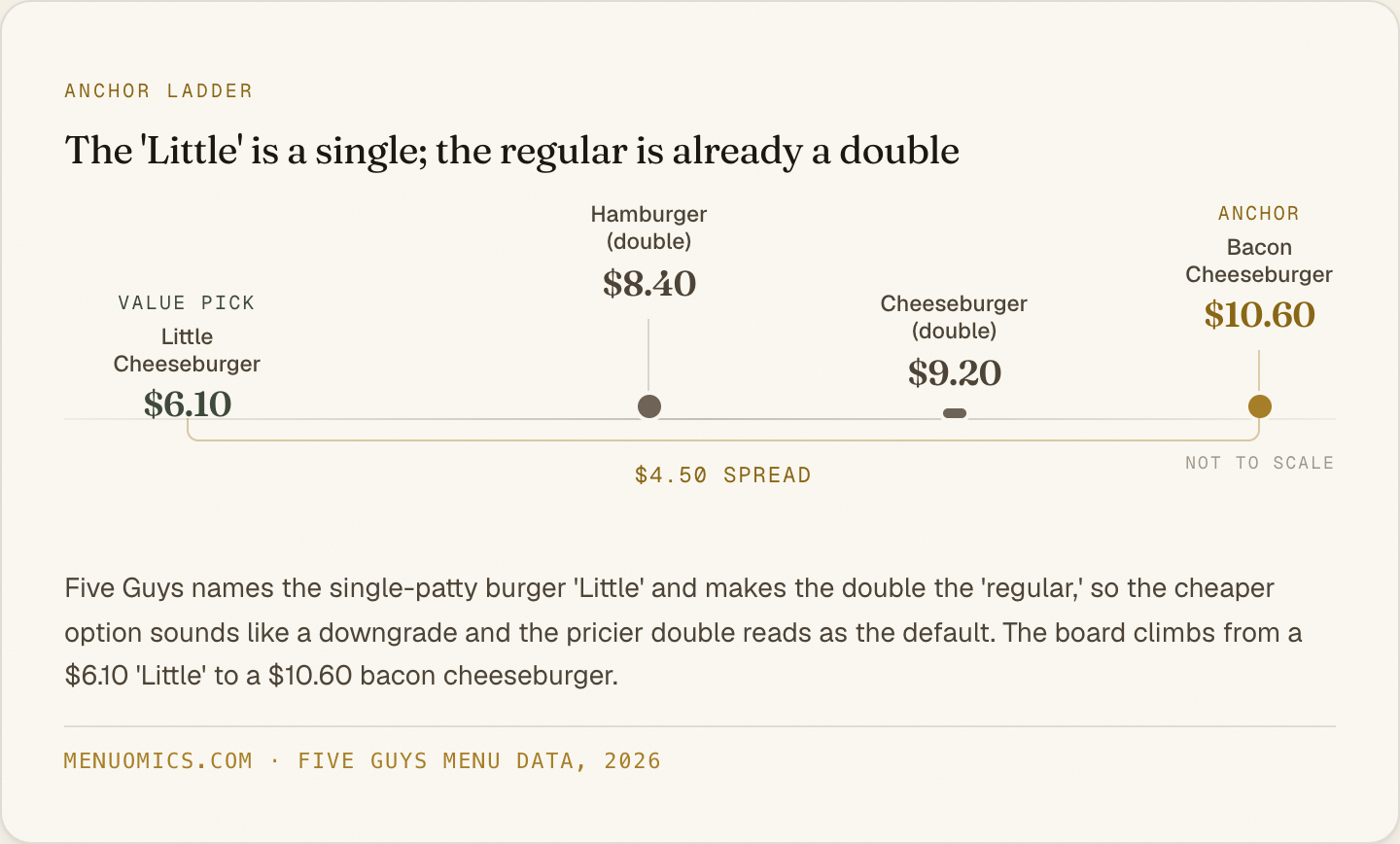
The 'Little' is a single; the regular is already a double
Five Guys names the single-patty burger 'Little' and makes the double the 'regular,' so the cheaper option sounds like a downgrade and the pricier double reads as the default. The board climbs from a $6.10 'Little' to a $10.60 bacon cheeseburger.
Download this chart (PNG) · free to reuse with credit, see reuse terms.
The full ticket
What it actually rings up to.
The headline price is only the start. The real number is the journey from a base order to the check at the register, one easy yes at a time.
A burger, fries and a drink, with no combo to soften it
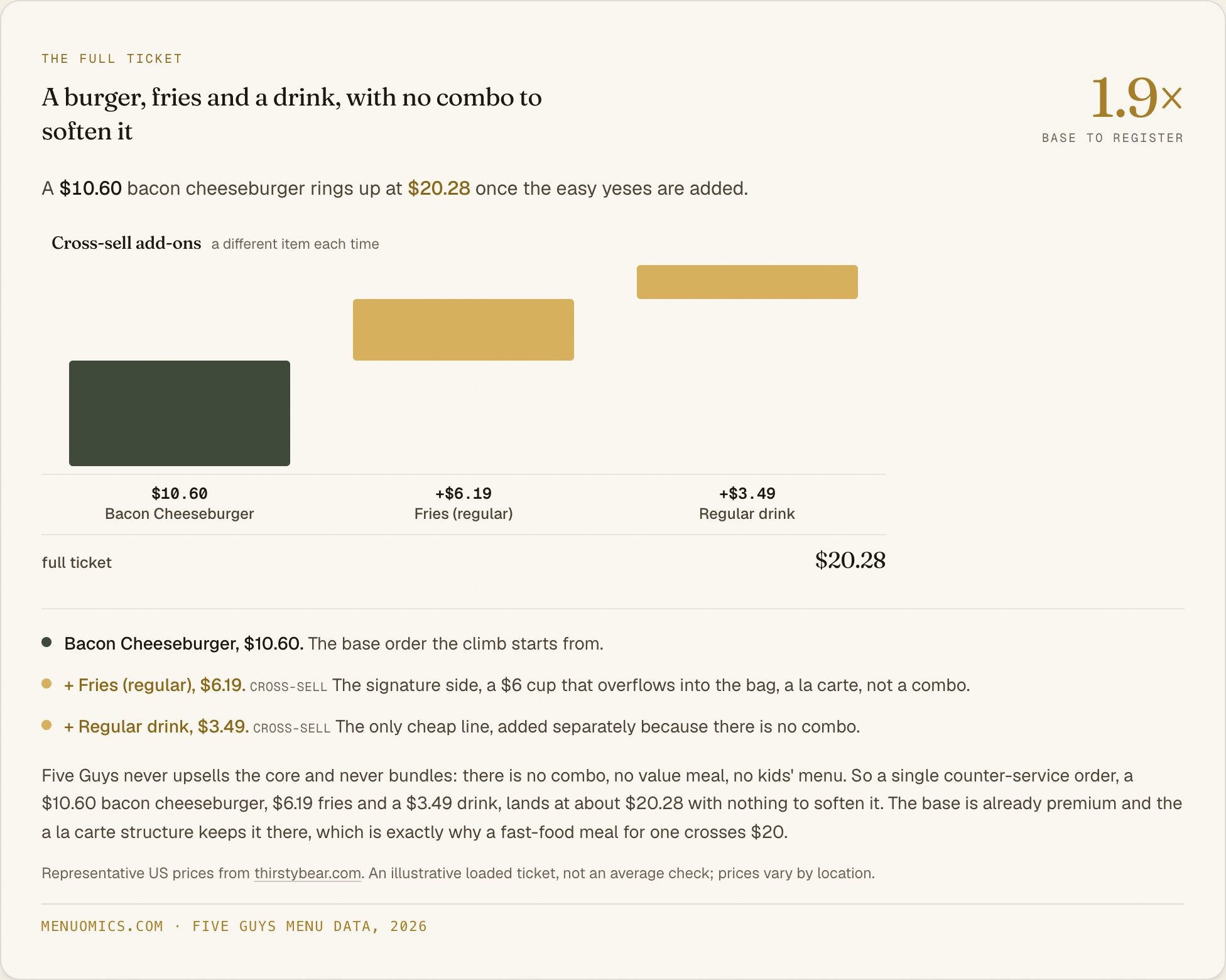
A $10.60 bacon cheeseburger rings up at $20.28 once the easy yeses are added.
- Bacon Cheeseburger, $10.60. The base order the climb starts from.
- + Fries (regular), $6.19. cross-sell The signature side, a $6 cup that overflows into the bag, a la carte, not a combo.
- + Regular drink, $3.49. cross-sell The only cheap line, added separately because there is no combo.
Five Guys never upsells the core and never bundles: there is no combo, no value meal, no kids' menu. So a single counter-service order, a $10.60 bacon cheeseburger, $6.19 fries and a $3.49 drink, lands at about $20.28 with nothing to soften it. The base is already premium and the a la carte structure keeps it there, which is exactly why a fast-food meal for one crosses $20.
Representative US prices from thirstybear.com. An illustrative loaded ticket, not an average check; prices vary by location.
Download this chart (PNG) · free to reuse with credit, see reuse terms.
The setup
Five Guys opened in 1986 in Arlington, Virginia, built by Jerry and Janie Murrell and their sons (the 'five guys'), and grew to roughly 1,500 US locations and 1,900 worldwide while staying private and family-controlled. It sells a deliberately short menu, hand-formed burgers, kosher-style dogs, fresh-cut fries and hand-spun shakes, with no value menu, no combos and no kids' menu. A 'regular' burger is a double patty; a bacon cheeseburger runs about $10.60, and a meal for one crosses $20.
What makes the board interesting is what it gives away. All 15 toppings are free, the in-shell peanuts by the door are free, the fries cup is overfilled and an extra scoop is dumped loose in the bag, and the founder openly explains the prices by ingredient cost. (Five Guys does not frame these as behavioral tactics; this is our reading of the observed design.)
What they get right
The behavioral economics already at work.
The free toppings buy reciprocity
All 15 toppings are free, and Five Guys markets it as generosity: 'we try to be as generous as we can with your order.' A gift creates a sense of obligation, so 'everything is included' reframes a $10 burger as a generous deal rather than an expensive one. The toppings cost pennies; the goodwill they buy is the point.
Cialdini on reciprocity; Five Guys' free-toppings positioning
The overfilled fry cup is abundance you can see
The fries are scooped into a cup, then an extra scoop is dumped loose into the bag, on purpose. A visible 'more than you ordered' overflow is a tangible signal that you are getting your money's worth, which is exactly what justifies a $6 side. The cup is the unit of price; the bag is the unit of value.
Five Guys' stated 'always give an extra scoop' policy; abundance signaling
The single is named 'Little,' so the double is the default
A 'regular' Five Guys burger is a double patty, and the single is branded 'Little.' The naming makes the smaller option sound like a downgrade while the double reads as the normal order, anchoring the mix toward the pricier build. 'Little' still delivers a full burger, but few people order down from the default.
Five Guys' regular-equals-double naming; anchoring (Tversky & Kahneman 1974)
No value menu keeps nothing cheap to compare against
There is no value menu, no combo and no kids' menu anywhere on the board. With nothing cheap to anchor against, the bacon cheeseburger becomes the entry to a premium experience rather than the expensive option on a value board. The absence is the design, the same move Shake Shack makes: print no low number and the whole frame reads as premium.
the deliberate absence of a value tier as a premium signal; compare Shake Shack
Radical price transparency is a trust lever
Jerry Murrell openly ties prices to ingredient cost: 'if the mayonnaise guy triples his price, we pay triple, and then we will increase the price.' Explaining the markup, rather than hiding it, turns a high price into a credibility signal and a defense when receipts go viral. The transparency itself is the reassurance that the price is honest, not greedy.
Rory Sutherland on reassurance; Murrell's ingredient-cost pricing logic
What we’d test
The rewrite, with the expected lift and the honest caveat.
State 'every regular is a double' on the board
Five Guys posts reminders online because customers do not realize a 'regular' is a double and the 'Little' is the single. Putting that fact on the menu board itself removes the confusion at the point of order and reframes the price: you are paying for two patties, not one. The value is already there; the board just has to say it.
Expect Fewer mis-orders and a stronger value read at the menu, with no change to the food
Caveat Menu-copy only: it states an existing fact on the board, it does not change pricing, portions, or the food.
Round the headline prices to whole dollars
The board prints charm-cent endings ('$10.60,' '$6.19,' '$8.25') that carry a faint value-signal, while the sourcing, the generosity and the no-value-menu positioning all signal premium. Rounding the headline items to whole dollars would align the price format with the experience, the way premium rooms drop the cents to read as quality rather than as a deal. This changes how the number is typeset, not what is charged.
Expect Prices read as consistent with the premium the food and generosity already earn
Caveat Pricing-presentation only: it changes the cents on the page, not the actual price, the portions, or the food.
Name the milkshake as the finish at the point of order
The hand-spun shake is the most on-brand add and the highest-margin line, but the a la carte board treats it as a separate afterthought. A prompt at the counter and in the app, 'finish with a hand-spun shake,' attaches the treat at the moment the meal feels complete. The shake already exists; the wording carries the cross-sell.
Expect A higher attach rate on the shake, the priciest and most on-brand line
Caveat Menu-flow and copy only: it surfaces an existing item at checkout, it does not change pricing, portions, or what is served.
What diners actually say
Synthesized from public reviews, the reality check that grounds every recommendation.
They praise
- Named the best-tasting fast-food burger in America in a 2026 YouGov survey, ahead of In-N-Out
- Genuinely generous: 15 free toppings, free peanuts, and an overfilled fry cup
- Fresh, never-frozen beef and hand-cut fries, with no freezers in the building
- Radical price transparency: the founder explains the markup by ingredient cost
- A short, confident menu with deep customization (the brand cites 250,000-plus combinations)
They criticize
- Expensive for the category: a meal for one routinely crosses $20
- The dominant complaint is value: a great burger, but not seen as worth sit-down money
- Prices have climbed steeply (a bacon cheeseburger near $5.79 in 2011, $11-plus by 2025)
- Prices swing sharply by location and spike in cities and airports
- No value menu or combo means no easy entry point for a price-sensitive visit
The verdict
Read as menu design, Five Guys is a master class in selling generosity instead of price: every regular burger is a double, all 15 toppings and the peanuts are free, the fry cup overflows on purpose, and there is no value menu to drag the frame down, all while the founder explains the prices openly enough that the markup reads as honest rather than greedy. The catch is the one every premium-by-omission brand faces: the loudest complaint is that a $20 counter-service meal is not worth it, so the generosity has to keep cashing a check the price keeps raising. The upside left on the table is small and honest: state on the board that a regular is a double so the value is legible, round the cents to match the premium the food already earns, and name the hand-spun shake as the meal's natural finish at checkout.
Common questions
- Why is Five Guys so expensive?
- Five Guys earns an A- for menu craft, with a bacon cheeseburger about $10.60 and a meal for one that crosses $20. The price is not hidden, it is reframed: every 'regular' burger is a double, all 15 toppings are free, the fries cup is overfilled and an extra scoop is dumped in the bag, and there is no value menu to compare against. The generosity does the work the price would otherwise lose.
- Is Five Guys worth it?
- It depends on whether you value abundance over price. A 2026 YouGov survey named Five Guys the best-tasting fast-food burger in America, ahead of In-N-Out, yet it is also one of the most-complained-about-expensive. The menu is built so the free toppings, the double-patty default and the overflowing fries make a $20 meal feel like getting your money's worth rather than a markup.
- What is the difference between a Little and a regular at Five Guys?
- A 'regular' Five Guys burger is a double patty; the 'Little' is the single-patty version, about $6.10 versus $9.20 for the regular cheeseburger. Five Guys even posts reminders because the naming confuses people: 'Little' still delivers a full burger, and the label quietly anchors you toward the larger, pricier double as the default.
- Are the toppings really free at Five Guys?
- Yes. All 15 toppings, lettuce, tomato, grilled onions and mushrooms, jalapenos, A1 and more, are free, as are the in-shell peanuts by the door. The company markets it as generosity, and that is the point: a gift triggers reciprocity, so 'everything is included' softens the sting of a $10 burger.
- How much is a Five Guys meal?
- A bacon cheeseburger, regular fries and a drink run about $20.28, with no combo discount to soften it. The base is already high and the a la carte structure keeps it there: Five Guys sells no value menu, no combos and no kids' menu, so a single counter-service meal lands north of $20.
- What is the most expensive item at Five Guys?
- On the standard menu, the priciest single item is the Bacon Cheeseburger (regular), about $10.60 in representative 2026 US pricing (it varies by location; group packs and combo deals can cost more). That top price also does quiet work as the menu's anchor: it is the number that makes everything below it read as reasonable.
Sources (6)
- Wikipedia, Five Guys (history, founders, ownership, locations)
- Five Guys, Our Story (official, 1986 Arlington founding)
- ScrapeHero, number of Five Guys locations in the USA (2026)
- thirstybear, Five Guys menu with prices (2026, representative)
- LADbible, Five Guys explains free toppings (founder quotes on generosity and pricing)
- FOX LA / YouGov, Five Guys voted best fast-food burger (2026)
Head to head
More breakdowns
 In-N-Out BurgerA
Three burgers, no seasonal items, and a famous off-menu modifier ('Animal Style') that turns customers into evangelists. Restraint as strategy.
Read the In-N-Out Burger breakdown → Chick-fil-AA
A famously simple chicken sandwich, an easy 'make it a meal' bundle, and free dipping sauces, wrapped in the most-praised service in fast food. The menu stays out of the way so the hospitality can do the selling.
Read the Chick-fil-A breakdown → Chili's Grill & BarA-
A $10.99 bundle dragged Chili's out of a slump and back to the top of casual-dining traffic. Read closely, '3 For Me' is one round number doing the work of three separate decisions.
Read the Chili's Grill & Bar breakdown → Domino'sB+
The $6.99 Mix & Match looks like a low price. Its real design is the words 'two or more': a self-bundle that turns one cheap pizza into a full cart.
Read the Domino's breakdown → Jersey Mike'sB+
Numbered subs in three sizes, a free signature modifier called 'Mike's Way,' and a Giant pitched as the smart-value pick. The size ladder, not the combo, is where the menu does its work.
Read the Jersey Mike's breakdown → Logan's RoadhouseB
A steakhouse that reviewers rank dead last still runs a value menu most casual chains would be proud of. The food is panned; the menu design is not. That gap is the whole point.
Read the Logan's Roadhouse breakdown →Your menu next
Get this for your own menu, free.
Send your menu and we’ll send back the same breakdown, what you get right, what we’d test, and why.
Taco Bell
A sub-$3 value menu sets the floor, $5/$7/$9 boxes name the deal after its own price, and a never-ending limited-time calendar keeps a reason to come back on the board. Taco Bell sells value loudly, and it works: it gained traffic while rivals shrank.
Read it →