Shake Shack menu, graded
Provenance as the premium: when sourcing copy is the differentiator, the menu's job is to name the quality and refuse a value tier so the higher price reads as worth it
Most fast-food menus fight on price. Shake Shack's menu fights on provenance, naming the beef, the eggs and the butcher so a premium burger reads as worth it rather than overpriced.
Menu-craft grade
A confident 'fine casual' board where provenance copy, not a pricing gimmick, carries a premium: 100% all-natural Angus with no hormones or antibiotics, cage-free eggs, a single-to-double trade-up, scarce regional and limited-time specials, and a deliberate refusal of any value menu. Held back by charm-cent endings that undersell the premium room and a shake-and-concrete cross-sell the board does not push hard enough.
Graded on how well the menu uses behavioral economics, not the food.
Menu and prices verified September 2026
A 3-minute audio read of the analysis
- Type
- Chain
- Where
- New York, NY
- Cuisine
- Fine-casual burgers, hot dogs and frozen custard
- Footprint
- ~400 US company-operated Shacks; ~700 systemwide worldwide (mid-2026)
- Since
- 2004 (Madison Square Park hot-dog cart, 2001)
- Ownership
- NYSE: SHAK; founded by Danny Meyer / Union Square Hospitality Group
The mechanics, drawn
The same menu, mapped onto an axis, so the behavioral move is something you can see, not just read.
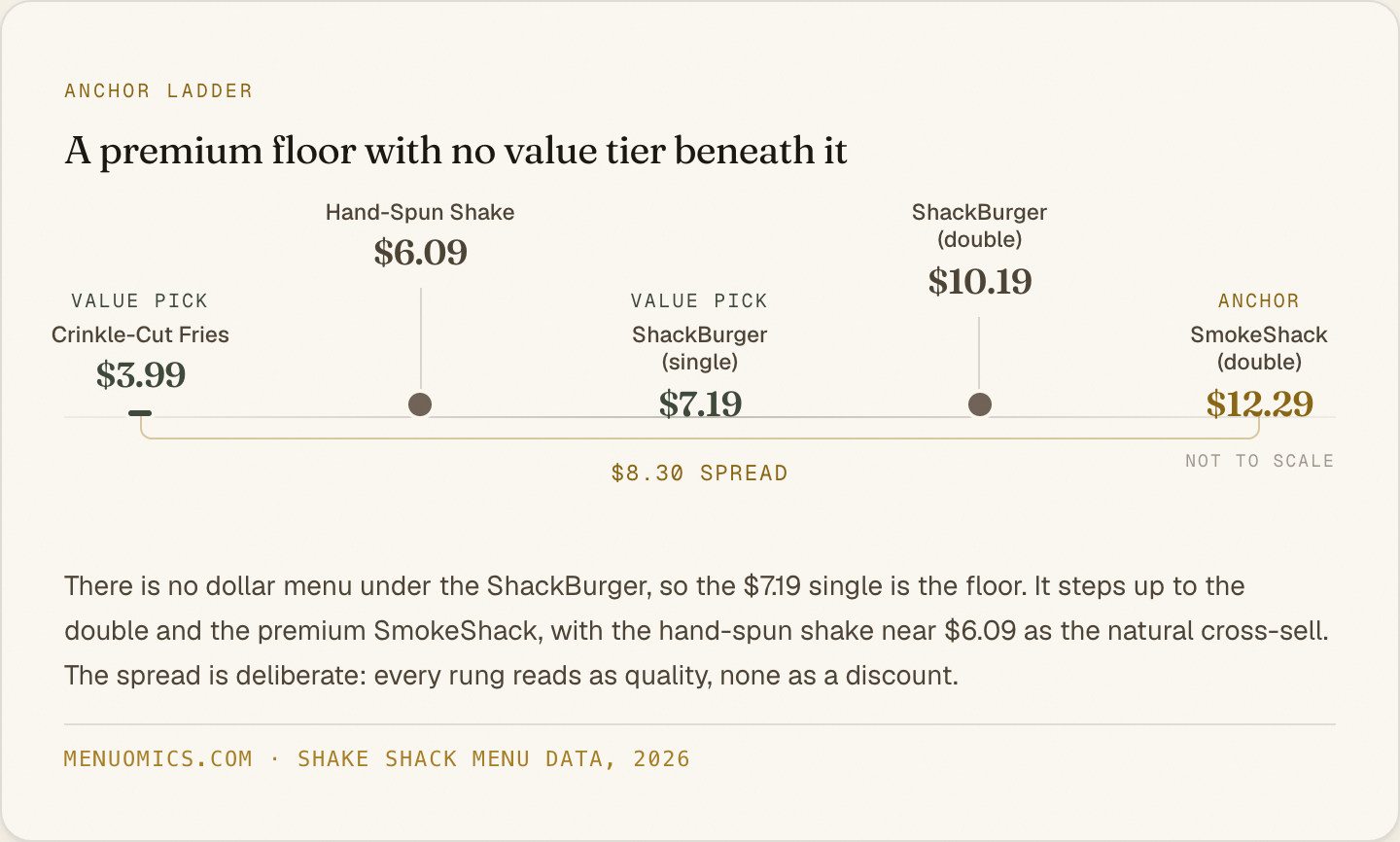
A premium floor with no value tier beneath it
There is no dollar menu under the ShackBurger, so the $7.19 single is the floor. It steps up to the double and the premium SmokeShack, with the hand-spun shake near $6.09 as the natural cross-sell. The spread is deliberate: every rung reads as quality, none as a discount.
Download this chart (PNG) · free to reuse with credit, see reuse terms.
The full ticket
What it actually rings up to.
The headline price is only the start. The real number is the journey from a base order to the check at the register, one easy yes at a time.
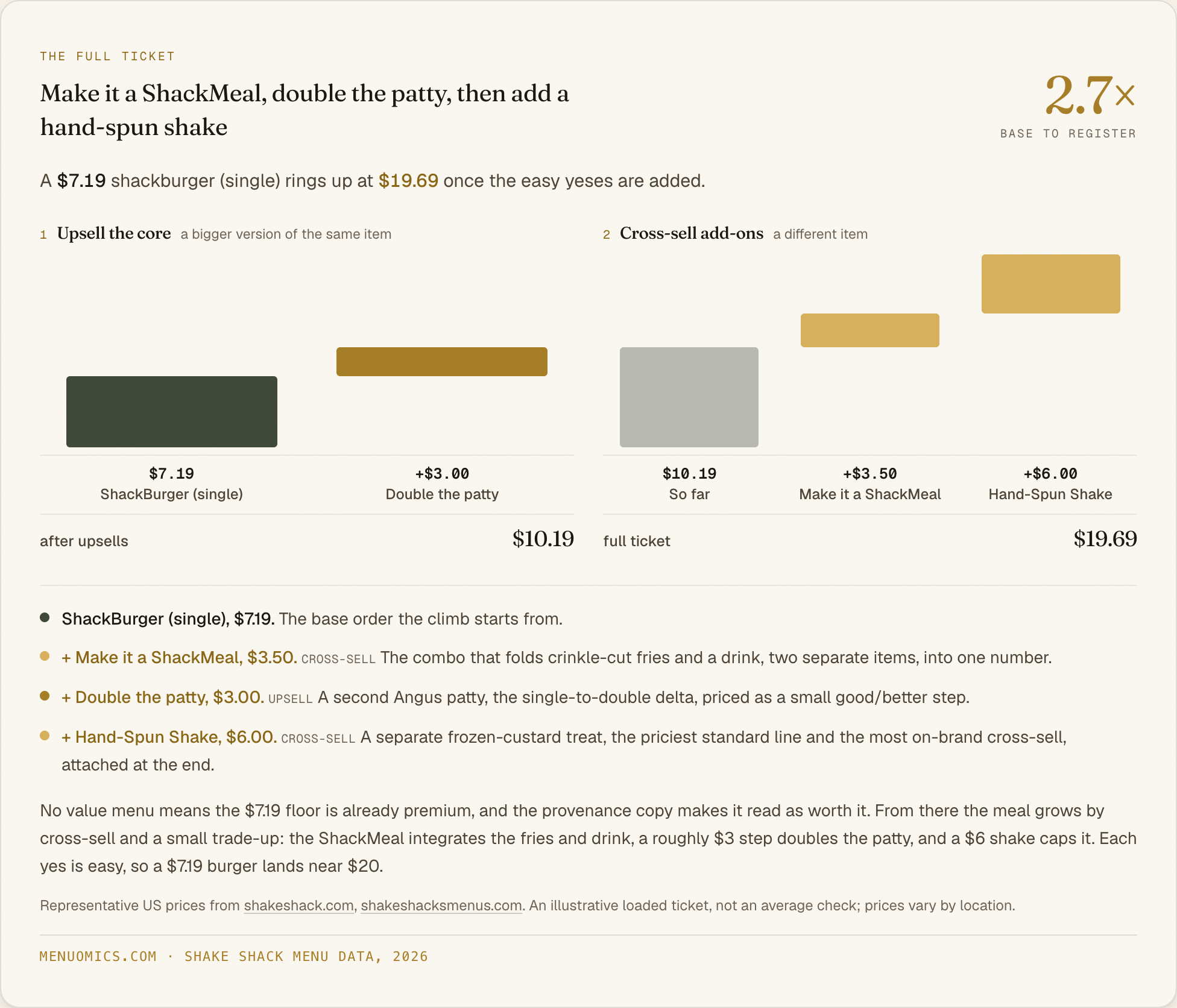
Make it a ShackMeal, double the patty, then add a hand-spun shake
A $7.19 shackburger (single) rings up at $19.69 once the easy yeses are added.
- ShackBurger (single), $7.19. The base order the climb starts from.
- + Make it a ShackMeal, $3.50. cross-sell The combo that folds crinkle-cut fries and a drink, two separate items, into one number.
- + Double the patty, $3.00. upsell A second Angus patty, the single-to-double delta, priced as a small good/better step.
- + Hand-Spun Shake, $6.00. cross-sell A separate frozen-custard treat, the priciest standard line and the most on-brand cross-sell, attached at the end.
No value menu means the $7.19 floor is already premium, and the provenance copy makes it read as worth it. From there the meal grows by cross-sell and a small trade-up: the ShackMeal integrates the fries and drink, a roughly $3 step doubles the patty, and a $6 shake caps it. Each yes is easy, so a $7.19 burger lands near $20.
Representative US prices from shakeshack.com, shakeshacksmenus.com. An illustrative loaded ticket, not an average check; prices vary by location.
Download this chart (PNG) · free to reuse with credit, see reuse terms.
The setup
Shake Shack began as a 2001 hot-dog cart in Madison Square Park and opened as a permanent kiosk in 2004, built by restaurateur Danny Meyer's Union Square Hospitality Group. Meyer coined the term 'fine casual' for it: counter-service speed and price points, but with sourcing, hospitality and ingredients borrowed from fine dining. The board names 100% all-natural Angus beef with no hormones or antibiotics, cage-free eggs, and Pat LaFrieda as the beef purveyor. A single ShackBurger runs about $7.19, roughly double a value-menu burger, and the menu never apologizes for it.
The interesting thing is what the menu refuses to do. There is no value menu, no dollar menu, no permanent discount tier. Instead the differentiator sits in the copy and the scarcity: provenance language on every patty, plus regional Shacks and limited-time specials that exist nowhere else. (Shake Shack does not state these as intent; this is our reading of the observed design.)
What they get right
The behavioral economics already at work.
Provenance copy is the product, so the price reads as quality
Shake Shack's edge is not a deal, it is provenance: the board names '100% all-natural Angus beef,' 'no hormones or antibiotics ever,' 'cage-free' eggs and Pat LaFrieda as the butcher. When sourcing is the differentiator, descriptive copy does the persuading, the way named, specified ingredients reliably lift perceived value. The effect is that a $7.19 burger reads as worth it, not overpriced.
descriptive labels +27% sales (Wansink, Painter & van Ittersum, 2001), Rory Sutherland on reassurance and costly signalling; Shake Shack sourcing copy
Refusing a value menu protects the premium frame
There is no dollar menu and no value tier anywhere on the board. With nothing cheap to compare against, the $7.19 ShackBurger becomes the entry point to a premium experience rather than the expensive option on a value menu. The absence is the design: a low anchor would drag the whole frame down, so Shake Shack simply does not print one.
anchoring (Tversky & Kahneman 1974); the deliberate absence of a value tier as a premium signal
The single-to-double step is the good/better trade-up
A single ShackBurger is about $7.19 and the double about $10.19, a roughly $3 gap for a second patty. That small visible step makes the single read as the sensible 'good' option and the double as the reasonable 'better' one, nudging the mix upward without an aggressive anchor. It is a gentle trade-up that quietly lifts the average check.
Simonson and Tversky 1992 (compromise effect); single-to-double priced at about a $3 delta
Regional Shacks and limited-time concretes manufacture scarcity
Many concretes and specials are regional or limited-time, tied to a specific Shack or a short window. Scarcity reliably raises how much people value a thing, so a flavor that exists only here, only now, feels more worth ordering than a permanent line. The rotating board also gives regulars a reason to return and try what is new before it is gone.
Worchel, Lee & Adewole 1975 (scarcity and perceived value); rotating regional and limited-time concretes
The app and kiosk cart make the add-ons frictionless
Ordering happens at a kiosk or in the app, where adding a shake or sizing up a side is a tap, not a spoken request to a cashier. Decoupling the choice from a face-to-face moment lowers the friction and the felt pain of each incremental yes, which is exactly where the shake, the cheese-fries upgrade and the double patty get added. The cart does the upselling the board is too restrained to do.
Prelec & Loewenstein 1998 (decoupling and the pain of paying); kiosk and app cart flow
What we’d test
The rewrite, with the expected lift and the honest caveat.
Move the core burgers to round whole-dollar prices
The board prints charm cents ('$7.19', '$10.19', '$3.99') that signal a deal, while the sourcing, the room and the 'fine casual' positioning all signal premium. Rounding the core burgers to whole dollars would align the price format with the experience, the way premium rooms drop the cents to read as quality rather than as a bargain. This is a pricing-presentation change to how the number is typeset, not a change to what is charged.
Expect Prices read as consistent with the premium provenance, with no loss of demand at a brand this trusted
Caveat Pricing-presentation only: it changes the cents on the page, not the actual price, the portions, or the food.
Name the shake and concrete as the included finish at the point of order
Frozen custard is the brand's signature and its highest-margin line, but the board treats the shake and concrete as a separate afterthought rather than the natural close to the meal. A prompt in the app and kiosk cart, 'finish with a hand-spun shake,' framed at checkout, attaches the treat at the moment the meal feels incomplete. The custard already exists; the wording and placement carry the cross-sell.
Expect A higher attach rate on shakes and concretes, the priciest and most on-brand lines
Caveat Menu-flow and copy only: it surfaces existing items at checkout, it does not change pricing, portions, or what is served.
Tag the regional and limited-time concretes as 'only here, only now'
The regional and limited-time concretes already exist, but the board does not state how scarce they are. Labeling them explicitly as local-only or available for a short window makes the scarcity legible at the point of choice, which is when it raises perceived value most. The wording carries the urgency; the limited flavors are already on the menu.
Expect A lift in trial of the limited concretes as the scarcity reads on the page
Caveat Menu-copy only: it names an existing limited item, it does not change pricing, portions, or availability.
What diners actually say
Synthesized from public reviews, the reality check that grounds every recommendation.
They praise
- Genuinely premium ingredients you can taste: all-natural Angus, no hormones or antibiotics
- Provenance copy that makes the price feel earned, not marked up
- Hand-spun shakes and rotating regional concretes that reward return visits
- A clean, confident board with no gimmicky value clutter
- Smooth app and kiosk ordering that makes customization easy
They criticize
- Expensive for the category: a burger near $7.19 where rivals start near a dollar
- Prices vary sharply and can spike 10-20% in airports, stadiums and high-rent cities
- Charm cents undersell the premium room the rest of the experience earns
- The board does not push the signature custard cross-sell hard enough
- No value tier means no easy entry point for price-sensitive visits
The verdict
Read as menu design, Shake Shack is a master class in selling provenance instead of price: the board names the Angus, the eggs and the butcher, refuses a value tier so nothing drags the frame down, steps the single up to a double for about $3, and uses regional and limited-time concretes to manufacture scarcity, all while the app and kiosk cart quietly handle the add-ons the restrained board will not. The upside left on the table is honest and small: round the cents to match the premium the sourcing already earns, surface the signature shake and concrete as the meal's natural finish at checkout, and tag the limited concretes as the scarce, only-here treats they actually are.
Common questions
- Is Shake Shack overpriced?
- Shake Shack earns a B+, with a single ShackBurger about $7.19, well above a fast-food burger but priced as 'fine casual,' not value. The menu is not a trick: provenance copy (100% all-natural Angus, no hormones or antibiotics, cage-free) does the heavy lifting, so the higher number reads as quality you can taste rather than a markup.
- How much does a full Shake Shack meal cost?
- A loaded order runs about $19.69, roughly 2.7x the $7.19 ShackBurger. A ShackMeal folds fries and a drink into one number, doubling the patty costs only the single-to-double delta of about $3, and a $6 hand-spun shake caps it, so each step is an easy separate yes.
- Why is Shake Shack so expensive compared to McDonald's?
- A ShackBurger near $7.19 costs roughly double a McDonald's hamburger because Shake Shack sells provenance, not price. The board names 100% all-natural Angus with no hormones or antibiotics, cage-free eggs and Pat LaFrieda beef, and the deliberate absence of any value menu keeps the premium frame intact.
- Does Shake Shack have a value menu or dollar menu?
- No, Shake Shack runs no value menu and no dollar menu by design. Refusing a low-price tier protects the 'fine casual' positioning: with nothing cheap to compare against, the $7.19 ShackBurger reads as the entry point to a premium experience rather than the expensive option on a value board.
- What is the difference between a single and double ShackBurger?
- A double ShackBurger costs about $10.19 versus $7.19 for the single, a roughly $3 step for a second patty. That small visible gap is the menu's good/better step: the single reads as the sensible start and the double as the reasonable trade-up, which quietly lifts the average check.
- What is the most expensive item at Shake Shack?
- On the standard menu, the priciest single item is the ShackBurger (double), about $10.19 in representative 2026 US pricing (it varies by location; group packs and combo deals can cost more). That top price also does quiet work as the menu's anchor: it is the number that makes everything below it read as reasonable.
Sources (6)
- Shake Shack, official menu and burgers
- Shake Shack, our food and sourcing (all-natural Angus, no hormones or antibiotics)
- Shake Shack, U.S. Animal Welfare Policy (cage-free eggs, sourcing standards)
- Wikipedia, Shake Shack (history, 'fine casual,' Danny Meyer, NYSE: SHAK)
- shakeshacksmenus.com, 2026 prices (as sampled)
- PureWow, the 2026 Shake Shack summer menu, reviewed (limited-time specials)
Head to head
More breakdowns
 Olive GardenB+
Never-ending breadsticks read less like generosity than like decoupled pricing: a loss-leader and a recurring scarcity event working in concert.
Read the Olive Garden breakdown → Palmetto SuperfoodsB
A California acai chain whose menu leads with the one promise every acai shop gets accused of breaking: '100% Real Acai, every time.'
Read the Palmetto Superfoods breakdown → SweetgreenB+
The salad chain that names every bowl for its ingredients and farmers, then offers a handful of signature defaults so you don't have to build from scratch.
Read the Sweetgreen breakdown → Chipotle Mexican GrillA-
Chipotle's menu is a build-your-own assembly line with no prices on the rail, so you customize first and total up last, with guac quoted as a tidy little add-on.
Read the Chipotle Mexican Grill breakdown → StarbucksA-
Tall is the small. The names hide the ounces, the app hides the payment, and a pumpkin drink restarts the whole calendar every August. The most studied size menu in the world.
Read the Starbucks breakdown → CAVAB+
CAVA's menu is a build-your-own Mediterranean line that includes three scratch dips and unlimited toppings free, then concentrates the upsell on one flat premium-protein step and resells the dips as paid sides.
Read the CAVA breakdown →Your menu next
Get this for your own menu, free.
Send your menu and we’ll send back the same breakdown, what you get right, what we’d test, and why.
Joe & The Juice
A green juice costs about $15.30 and a sandwich about $15.90, in a category whose inputs are pennies. Joe & The Juice does not hide the number; it surrounds it with names, music and lifestyle until the premium reads as the point.
Read it →