Jimmy John's menu, graded
The numbered menu: speed and simplicity as the product, with a tight lineup that strips decision friction out of the order.
How a tight numbered menu, a clean size ladder, and the Gargantuan anchor turn fast ordering into the actual product.
Menu-craft grade
The numbered grid, the deliberately capped lineup, and a clean size ladder make this one of the most friction-free ordering systems in fast food, and the Gargantuan anchors the whole board. Points come off because the Slim barely undercuts the Original (muddy value) and the menu rarely prompts the chips, drink, and cookie that would lift the ticket.
Graded on how well the menu uses behavioral economics, not the food.
Menu and prices verified September 2026
A 4-minute audio read of the analysis
- Type
- Chain
- Where
- Champaign, Illinois (headquarters)
- Cuisine
- Sandwiches and subs (quick service)
- Footprint
- ~2,600 US locations
- Since
- 1983, Charleston, Illinois (Jimmy John Liautaud)
- Ownership
- Inspire Brands (backed by Roark Capital), since 2019
The mechanics, drawn
The same menu, mapped onto an axis, so the behavioral move is something you can see, not just read.
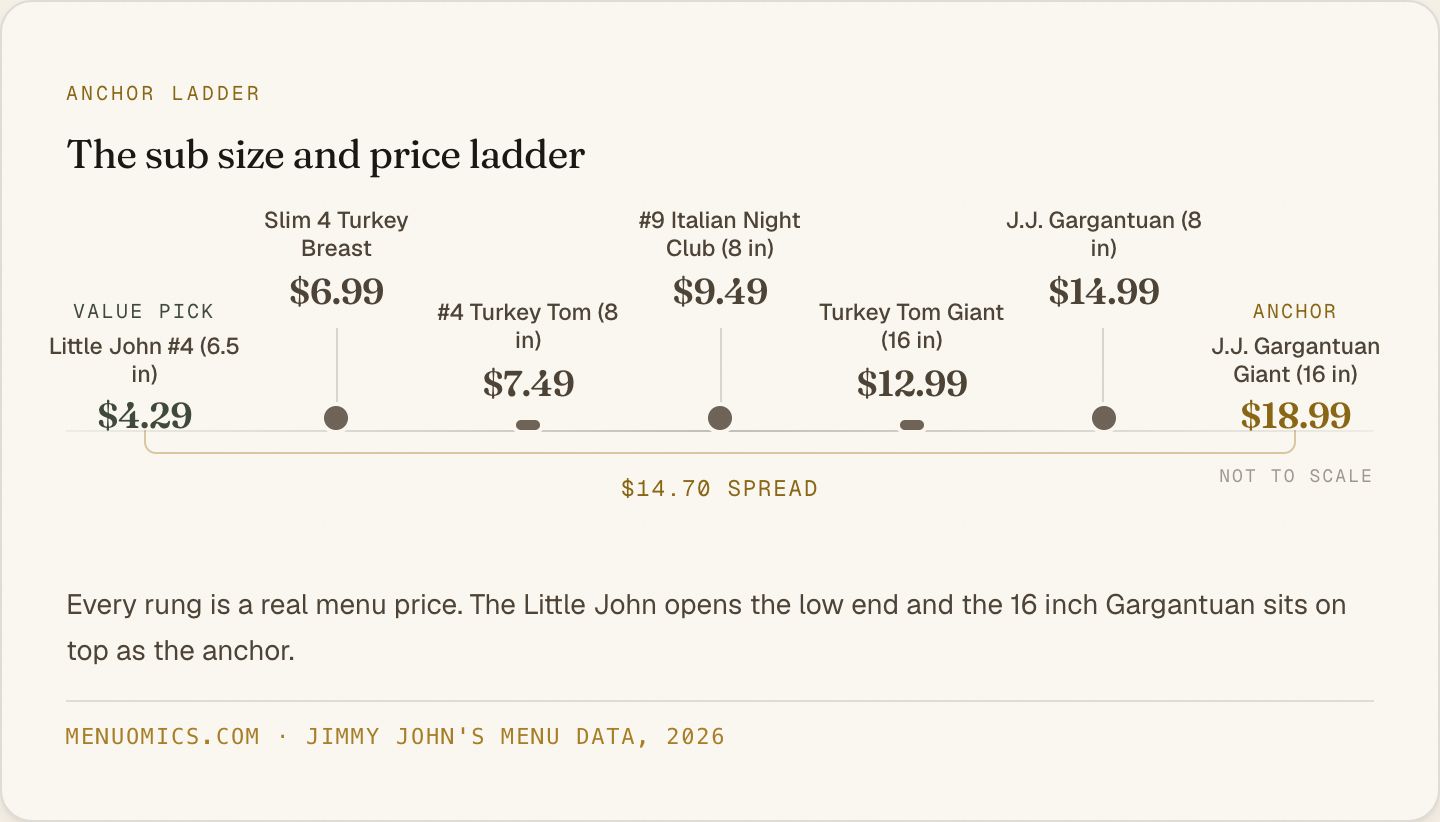
The sub size and price ladder
Every rung is a real menu price. The Little John opens the low end and the 16 inch Gargantuan sits on top as the anchor.
Download this chart (PNG) · free to reuse with credit, see reuse terms.
The full ticket
What it actually rings up to.
The headline price is only the start. The real number is the journey from a base order to the check at the register, one easy yes at a time.
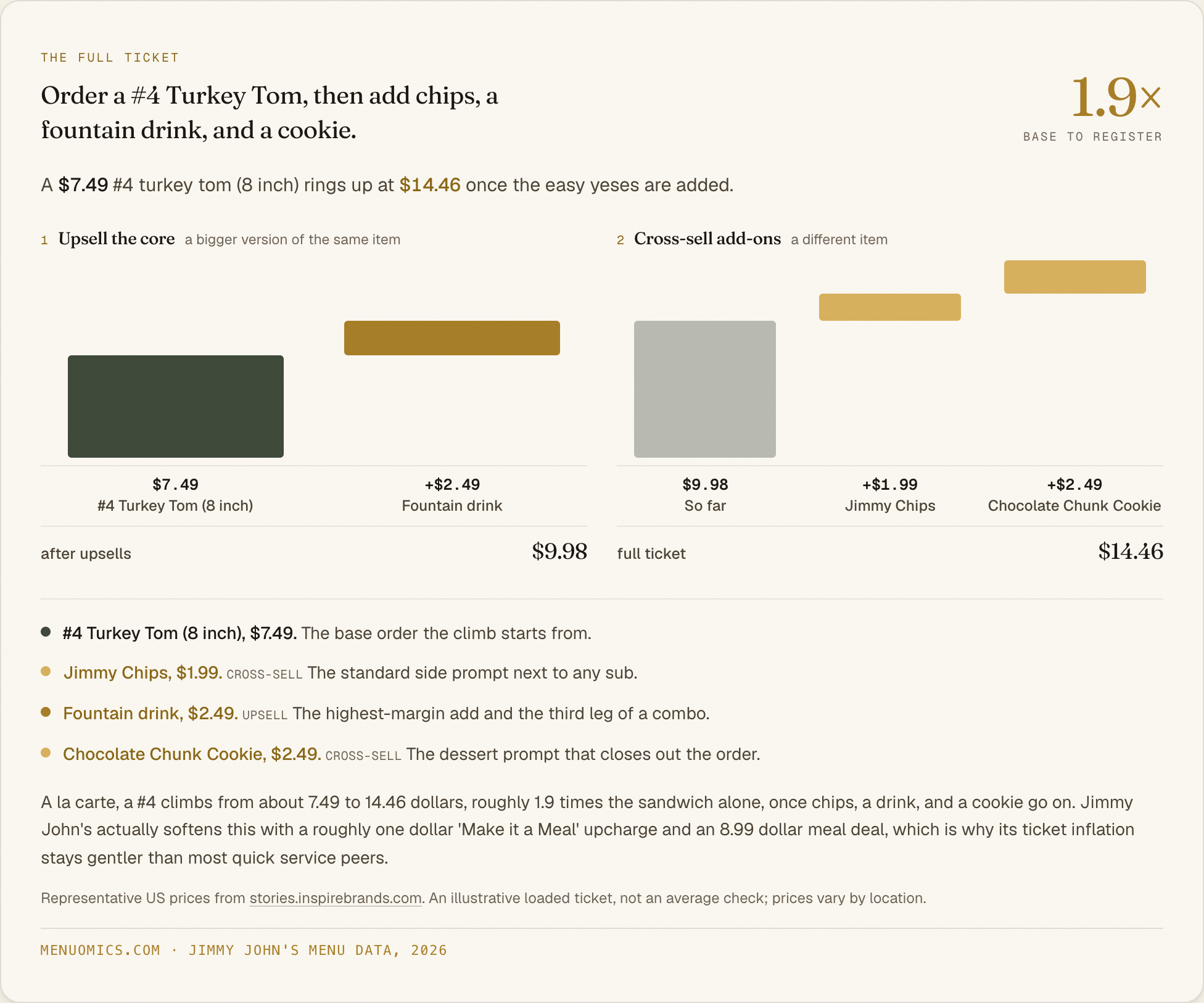
Order a #4 Turkey Tom, then add chips, a fountain drink, and a cookie.
A $7.49 #4 turkey tom (8 inch) rings up at $14.46 once the easy yeses are added.
- #4 Turkey Tom (8 inch), $7.49. The base order the climb starts from.
- Jimmy Chips, $1.99. cross-sell The standard side prompt next to any sub.
- Fountain drink, $2.49. upsell The highest-margin add and the third leg of a combo.
- Chocolate Chunk Cookie, $2.49. cross-sell The dessert prompt that closes out the order.
A la carte, a #4 climbs from about 7.49 to 14.46 dollars, roughly 1.9 times the sandwich alone, once chips, a drink, and a cookie go on. Jimmy John's actually softens this with a roughly one dollar 'Make it a Meal' upcharge and an 8.99 dollar meal deal, which is why its ticket inflation stays gentler than most quick service peers.
Representative US prices from stories.inspirebrands.com. An illustrative loaded ticket, not an average check; prices vary by location.
Download this chart (PNG) · free to reuse with credit, see reuse terms.
The setup
Jimmy John's has sold the same idea since a poorly located first store in 1983: get a good sandwich to you faster than anyone else. 'Freaky Fast' is not a tagline bolted on after the fact, it is the operating model. The menu is engineered to match it. Instead of an open-ended build wall, you get a short, numbered lineup of Originals, Slims, club sandwiches, the Little John, and the Gargantuan, each one a fixed recipe you can call out by number. The whole board is designed so a customer can decide quickly, an employee can build in about thirty seconds, and the line keeps moving.
Look closely and the menu reads like a set of behavioral moves. The numbers convert a paragraph of ingredients into a single digit, which lowers the cognitive cost of choosing. The Gargantuan sits at the top as a deliberately large, expensive anchor that makes the 7 to 9 dollar Originals feel moderate. And a clean ladder from the 6.5 inch Little John up to the 16 inch Giant gives people an obvious way to trade up. (Jimmy John's does not frame these as behavioral tactics; this is our reading of the observed design.)
What they get right
The behavioral economics already at work.
The number is the interface
Ordering 'a number nine' replaces reading a paragraph of meats, cheeses, and toppings with saying a single digit. Research on choice overload shows that more options and more parsing make people slower and less likely to decide at all. By collapsing each recipe into a number, Jimmy John's lowers the cognitive load at the exact moment a line forms, which is why a counter can quote a roughly thirty second build target and still keep the queue moving.
About 17 numbered sandwiches plus the Gargantuan, with a roughly 30 second in-store build target, Wikipedia: Jimmy John's
The Gargantuan is the anchor
The Gargantuan sits at the top of the board at about 14.99 dollars for the 8 inch and 18.99 for the 16 inch Giant. Most people will never buy it, and that is the point. A high anchor reframes everything beneath it, so a 7.49 dollar Turkey Tom or a 9.49 dollar club reads as the sensible, moderate choice rather than the expensive one. Shoppers also tend to avoid the extremes of a range, which steers them toward the comfortable middle the chain actually wants to sell.
Gargantuan ~$14.99 (8 inch) and ~$18.99 (16 inch Giant), the most expensive subs on the board, jimmyjohns.com J.J. Gargantuan menu page
A clean size ladder makes trading up obvious
The lineup runs from the 6.5 inch Little John at about 4.29 dollars up through the 8 inch Originals and into the 16 inch Giant near 12.99. Each rung is the same idea at a bigger size, so the upgrade is a single easy mental step rather than a new decision. Laddered sizes nudge the average order upward because the next size up always looks like only a small jump from where you already are.
Little John ~$4.29 to 8 inch Original ~$7.49 to 16 inch Giant ~$12.99, jimyjohnmenu.com 2026 menu pricing
Speed is the value, not a discount
Jimmy John's competes on time rather than price. The chain maps tight delivery zones meant to keep customers within about five minutes of a store and trains for a thirty second build. The menu design feeds that promise: fewer recipes, fixed builds, and numbers all reduce the variance that slows a kitchen down. The customer is effectively paying for certainty and speed, which is a softer and stickier value proposition than a coupon.
'Freaky Fast' delivery built on mapped five minute zones and a ~30 second build, Fast Casual: Jimmy John's Freaky Fast campaign
Low entry, gentle upsell
The Little John opens the door at about 4.29 dollars, but the Slim at 6.99 sits only about 50 cents under a full 7.49 Original, which quietly nudges thrifty customers up to the better sandwich. On the back end, an 8.99 dollar meal deal pairing an Original with chips and a drink, and a roughly one dollar 'Make it a Meal' upcharge, lower the friction of adding sides so the ticket climbs without feeling like an upsell.
$8.99 meal deal: an 8 inch Original Classic plus Jimmy Chips and a drink, Inspire Brands newsroom: Jimmy John's $8.99 meal deal
What we’d test
The rewrite, with the expected lift and the honest caveat.
Make the Slim's trade-off legible
Right now the Slim costs about 6.99 and the full Original about 7.49, a gap so small that the Slim looks like a worse deal rather than a deliberate choice. Label the Slim explicitly as the no-vegetable, no-spread option so the person who wants exactly that picks it on purpose, and so everyone else understands why the Original is worth the extra coins.
Expect Cleaner self-selection: customers who want simple pick the Slim deliberately, and the value of the Original becomes obvious to the rest.
Caveat If the gap is spelled out too plainly it could pull a few buyers down from the Original, so watch mix after the change.
Show the combo against the a la carte total
The 'Make it a Meal' upcharge is roughly a dollar, but the menu rarely puts the a la carte side and drink total next to it. Printing the two numbers together turns the combo into an obvious saving instead of a vague add-on, which is the classic decoy move: people buy the bundle once they can see what skipping it would cost.
Expect Higher combo attach rate as the one dollar upgrade reads as a clear discount rather than an upsell.
Caveat The one dollar price and the side and drink figures must hold true at the location, or the framing backfires when the register disagrees.
Lead with the number, keep a legend for newcomers
The number is the fastest unit of ordering, so make it the largest, first thing the eye and the menu hit, with the ingredient list as secondary detail. The risk is that ingredient-forward names still force first-time customers to decode the board, which slows exactly the moment the system is built to speed up. Pair the big number with a short, plain descriptor so regulars order by digit and newcomers are not stranded.
Expect Faster ordering and fewer mid-order reformulations as customers latch onto the number first.
Caveat Trimming the ingredient detail can frustrate diners with allergies or specific preferences, so keep the full list available somewhere.
What diners actually say
Synthesized from public reviews, the reality check that grounds every recommendation.
They praise
- The numbered grid is one of the cleanest decision-reduction systems in quick service: you can order in two words.
- A deliberately capped lineup keeps the line moving and order accuracy high, which is the whole speed promise.
- The size ladder from Little John to 8 inch to 16 inch Giant makes trading up an easy single step.
- The Gargantuan is a textbook top anchor that quietly flatters every cheaper sub on the board.
- Pricing is honest and legible, with little of the fake-urgency clutter that crowds most fast food menus.
They criticize
- The Slim costs only about 50 cents less than a full Original, so its value proposition is muddy.
- Cross-sell is restrained: the menu rarely prompts chips, a drink, or a cookie at the point of decision.
- Ingredient-heavy sandwich names still need a legend for newcomers, which blunts the speed the number is meant to deliver.
- Premium add-ons like extra meat or avocado spread quietly lift the ticket without much transparency on the board.
- Heavy franchising means prices and delivery zones vary by location, so the advertised value is inconsistent store to store.
The verdict
Judged on menu craft rather than food, Jimmy John's is close to the top of its class. The numbered menu is a genuine behavioral system, not decoration: it strips parsing out of the decision, lets the kitchen hit a thirty second build, and keeps the line moving, all in service of a speed promise the brand has sold since 1983. The Gargantuan anchors the board, the size ladder makes upgrades intuitive, and the pricing is refreshingly straight. What keeps it from an A is restraint that cuts both ways: the Slim's value gap is too thin to make sense, and the menu leaves money on the table by under-prompting the chips, drink, and cookie that would naturally finish the order. That restraint is on-brand for a chain that competes on time, but a few clearer value cues would let the menu work as hard as the kitchen does.
Common questions
- Why does Jimmy John's number its sandwiches?
- The numbers turn a long ingredient list into a single digit, which lowers the effort of choosing and lets customers order in seconds. That feeds the kitchen's roughly thirty second build target and keeps the line moving, which is the core of the Freaky Fast promise.
- What is the most expensive sandwich at Jimmy John's?
- The J.J. Gargantuan, a five-meat sub, is the priciest standard sandwich at about 14.99 dollars for the 8 inch and 18.99 for the 16 inch Giant. It works as a high anchor that makes the 7 to 9 dollar Originals look moderate by comparison.
- Is the Little John or the Slim the cheapest option?
- The Little John, a 6.5 inch mini sub at about 4.29 dollars, is the cheapest way onto the menu. The Slim runs about 6.99, only roughly 50 cents under a full 8 inch Original, so its value advantage is thin.
- How much is a meal at Jimmy John's?
- A meal at Jimmy John's starts around $7.49 for the base order and lands near $14.46 once the usual add-ons go on, roughly 1.9x the headline price (representative 2026 US figures; they vary by location). That gap between the price that gets you in and the total you pay is the multiplier this page grades.
Head to head
More breakdowns
 The Cheesecake FactoryB+
A 21-page, 250-item menu should be a behavioral disaster. It's a roughly $4-billion chain. Here's what all that abundance is quietly doing.
Read the The Cheesecake Factory breakdown → McDonald'sA-
The Extra Value Meal is one of the most-copied ideas in food: fold the whole order into a single number that hurts less than three. Then McValue and the app pile value on top, and the McRib drops in as an event.
Read the McDonald's breakdown → Taco BellA-
A sub-$3 value menu sets the floor, $5/$7/$9 boxes name the deal after its own price, and a never-ending limited-time calendar keeps a reason to come back on the board. Taco Bell sells value loudly, and it works: it gained traffic while rivals shrank.
Read the Taco Bell breakdown → Dunkin'A-
A premium latte anchors the cheap iced coffee as the obvious default, the $6 Meal Deal bundles the breakfast, and Dunkin' Rewards turns the morning run into a streak. The menu craft is textbook; the strain is price creep and an app that increasingly decides the real price.
Read the Dunkin' breakdown → Panda ExpressB+
The whole order comes down to one question, how many entrees. A Bowl is one, a Plate is two, a Bigger Plate is three, and the menu is built so the middle Plate wins. Orange Chicken is the anchor everyone orders, and a quiet $1.50 premium upcharge lifts the check while the headline price stays put.
Read the Panda Express breakdown → Raising Cane'sA-
The chicken-finger chain that built a billion-dollar machine by refusing to sell almost anything else.
Read the Raising Cane's breakdown →Your menu next
Get this for your own menu, free.
Send your menu and we’ll send back the same breakdown, what you get right, what we’d test, and why.
Super Duper Burgers
A tiny, premium Bay Area better-burger menu that sells with a free pickle bar, named suppliers, and no value tier in sight.
Read it →