
Joe & The Juice menu, graded
Premium as a lifestyle, not a discount: when the room, the names and the ritual are the product, the menu's job is to pull attention off cheap inputs so a $15 juice reads as an identity worth buying
Most menus describe what you are buying. Joe & The Juice names it instead, 'Green Mile,' 'Iron Man,' 'Tunacado,' so the choice becomes an identity rather than an ingredient-and-price comparison.
Menu-craft grade
An unusually complete premium-experience playbook: cryptic, identity-coded names ('Green Mile,' 'Iron Man') that defeat ingredient-and-price comparison, coffee priced cheap as an anchor beneath the $15 juices, a juice priced level with a sandwich so it reads as a meal, a viral signature in the Tunacado as the beacon, and a gamified loyalty ladder plus a paid subscription that lock in frequency. Held back from an A by the friction those nameless, description-free items create, and by a premium frame the product does not always cash: the dominant complaint is that the juices read as watered down and overpriced.
Graded on how well the menu uses behavioral economics, not the food.
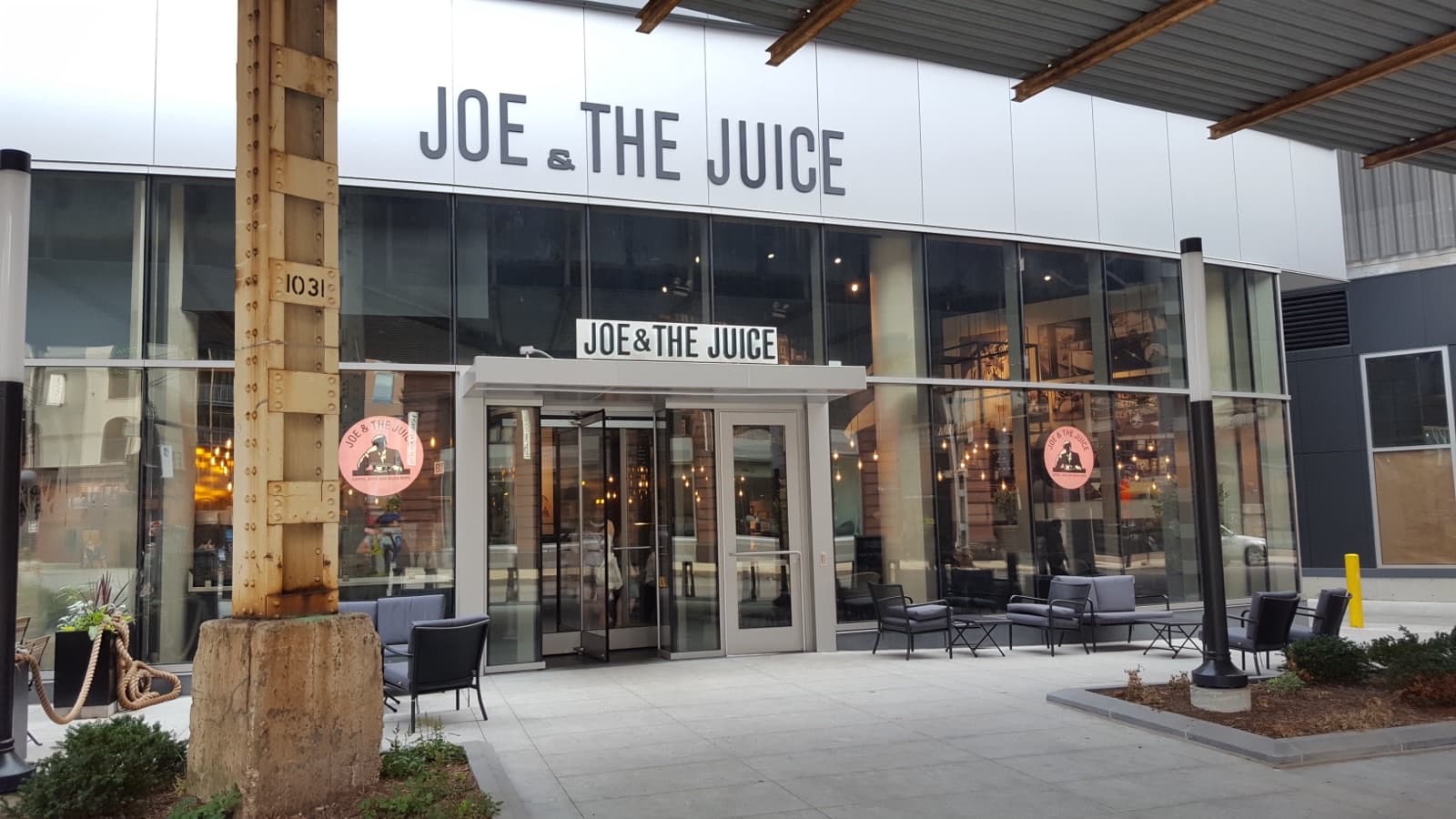
Menu and prices verified September 2026
A 4-minute audio read of the analysis
- Type
- Chain
- Where
- Copenhagen, Denmark
- Cuisine
- Juice, coffee and sandwiches
- Footprint
- ~71 US locations; ~500 worldwide
- Since
- 2002 (Copenhagen)
- Ownership
- Private; majority General Atlantic (control 2023), with Abu Dhabi's EIIC a minority holder (2026, ~$1.8B valuation)
The full ticket
What it actually rings up to.
The headline price is only the start. The real number is the journey from a base order to the check at the register, one easy yes at a time.
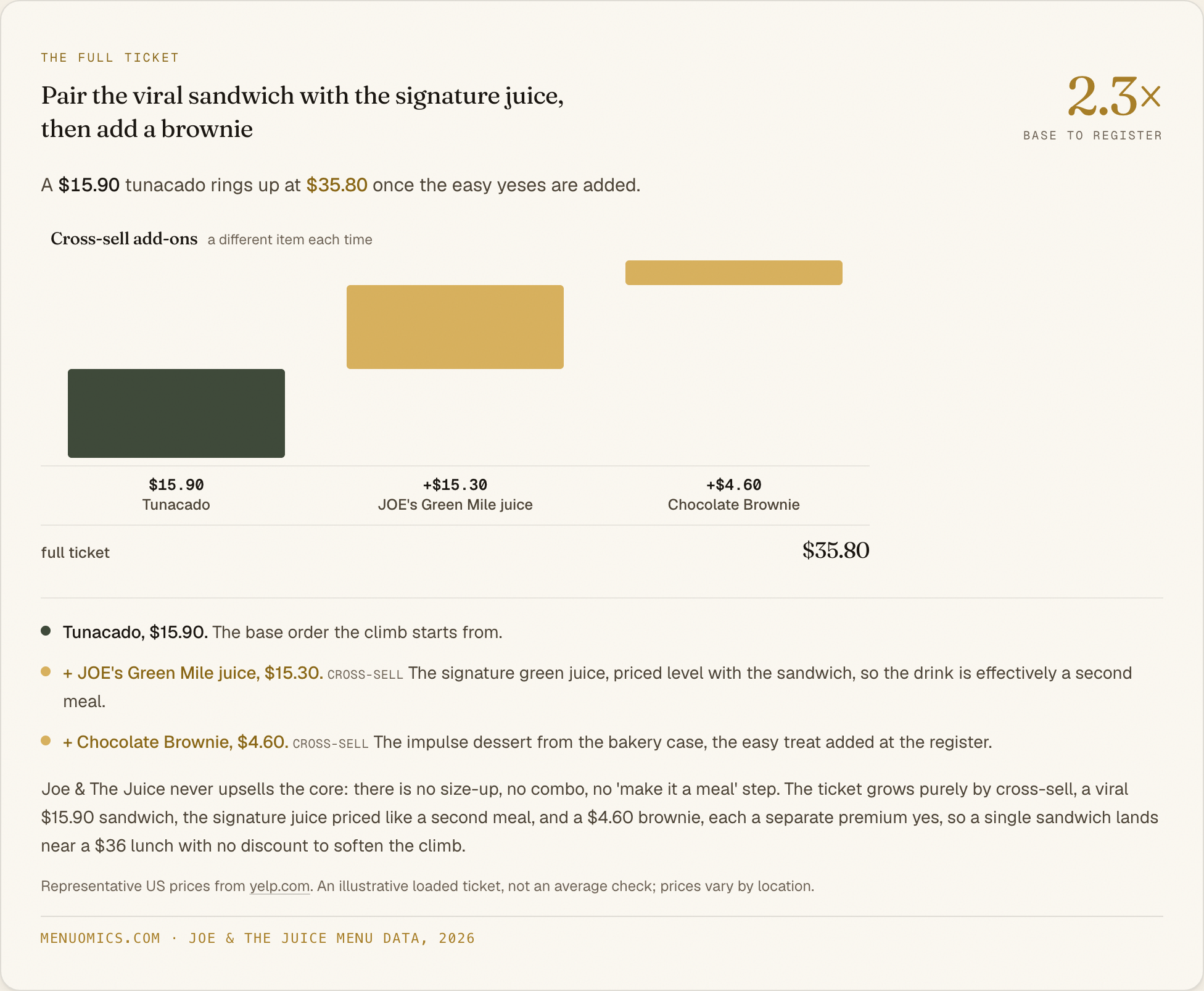
Pair the viral sandwich with the signature juice, then add a brownie
A $15.90 tunacado rings up at $35.80 once the easy yeses are added.
- Tunacado, $15.90. The base order the climb starts from.
- + JOE's Green Mile juice, $15.30. cross-sell The signature green juice, priced level with the sandwich, so the drink is effectively a second meal.
- + Chocolate Brownie, $4.60. cross-sell The impulse dessert from the bakery case, the easy treat added at the register.
Joe & The Juice never upsells the core: there is no size-up, no combo, no 'make it a meal' step. The ticket grows purely by cross-sell, a viral $15.90 sandwich, the signature juice priced like a second meal, and a $4.60 brownie, each a separate premium yes, so a single sandwich lands near a $36 lunch with no discount to soften the climb.
Representative US prices from yelp.com. An illustrative loaded ticket, not an average check; prices vary by location.
Download this chart (PNG) · free to reuse with credit, see reuse terms.
The setup
Joe & The Juice opened in Copenhagen in 2002, built by former competitive athlete Kaspar Basse, and has grown to roughly 500 stores across more than twenty countries, about seventy of them in the United States. It is now majority-owned by the US growth-equity firm General Atlantic, which took control in 2023, with Abu Dhabi's EIIC buying a minority stake in 2026 at a valuation near $1.8 billion. The product is freshly made juice, coffee and hot-pressed sandwiches, priced at a clear premium: a signature green juice runs about $15.30 and a sandwich about $15.90, numbers the menu never apologizes for.
What makes the board interesting is how little it describes. Items carry branded, identity-coded names ('Green Mile,' 'Iron Man,' 'Pick Me Up,' 'Tunacado') rather than ingredient lists, the coffee sits cheap beneath the juices, and the room, the music and the staff are staged as the experience you are paying for. (Joe & The Juice does not state this as intent; this is our reading of the observed design.)
What they get right
The behavioral economics already at work.
The names defeat price comparison
Juices are 'Green Mile,' 'Iron Man,' 'Pick Me Up,' not 'kale, apple and ginger.' A branded, benefit-coded name with no ingredient list gives the guest nothing to price-compare against the corner juice bar, so the choice shifts from cheap commodity inputs to identity and brand promise. The possessive 'JOE's' on signature items does the same work, turning a generic juice into a proprietary good with no reference price.
Rory Sutherland on making the comparison impossible; branded benefit-names over ingredient descriptions
The room is the product, so the price reads as the experience
The juice itself is cheap to make; what the $15 buys is the design, the music, the 'juicers' and the scene. By staging the store as a lifestyle rather than a counter, Joe & The Juice moves the value from the cup to the experience around it, where a premium price reads as the cost of the vibe, not a markup on fruit. The product is the theater; the juice is the ticket in.
Sutherland on the experience as the product; ambience, staff and music as the priced good
Cheap coffee anchors the $15 juice as the treat
A double espresso is about $5.50 and a latte about $7, a deliberately low floor beneath the $15 juices and $16 sandwiches. The cheap coffee does double duty: it makes the juice feel like the indulgent upgrade rather than the expensive option, and it gives a price-sensitive guest an easy, low-commitment entry that the premium board then pulls upward. The anchor is set low on purpose.
anchoring (Tversky & Kahneman 1974); coffee priced well below the juices and sandwiches
A juice priced like a sandwich becomes a meal
A green juice at about $15.30 costs essentially the same as a hot-pressed sandwich at $15.90. Pricing the drink level with the meal reframes the juice from a beverage into a meal-replacement and an experience, which is the only frame in which $15 for juice is defensible. The number is not just a price; it tells you which category to file the juice in.
price reliably signals quality when other cues are absent, price-quality inference; juice priced at parity with the sandwiches
A status ladder and a paid subscription buy frequency
A free tiered loyalty program (Grey to Yellow to Pink) gamifies visits with points and challenges, while a paid membership offers a fixed daily discount that turns a habit into a prepaid commitment. Both push ordering into the app, where the price is less salient at the moment of choice and the next visit is already half-decided. The subscription in particular is a sunk-cost device: once you have paid for the discount, skipping a day feels like waste.
Prelec & Loewenstein 1998 (decoupling and the pain of paying); tiered loyalty plus a paid daily-discount membership
What we’d test
The rewrite, with the expected lift and the honest caveat.
Add a one-line ingredient cue beneath each name
The identity names are an asset, but a guest who cannot tell 'Green Mile' from 'Iron Man' stalls or defaults to the familiar. A single quiet line of ingredients under each name keeps the branding that defeats comparison while removing the navigation friction that stalls a first-time order. The name still sells the identity; the cue just lets a newcomer commit.
Expect Faster first-time decisions and fewer defaults to coffee, with the premium names intact
Caveat Menu-copy only: it adds a description line, it does not change pricing, recipes, or the item names.
Name a signature juice-and-sandwich pairing at the point of order
The a la carte board leaves the natural lunch, a juice and a sandwich, for the guest to assemble, which many will not. Presenting one named pairing (the Tunacado with the Green Mile, say) as a suggested combination in the app and at the counter attaches the second premium item at the moment of decision, without a discount that would dent the hero prices. The items already exist; the prompt carries the attach.
Expect A higher attach rate of a second premium item, lifting the average ticket
Caveat Menu-flow only: it suggests existing items together, it does not bundle, discount, or change prices.
Round the headline juices and sandwiches to whole dollars
The board prints charm-ish cents ('$15.30,' '$15.90,' '$17.90') that carry a faint value-signal, while the room, the names and the positioning all signal premium. Rounding the headline juices and sandwiches to whole dollars would align the price format with the lifestyle the brand sells, the way premium rooms drop the cents to read as quality rather than as a deal. This changes how the number is typeset, not what is charged.
Expect Prices read as consistent with the premium experience, with no loss of demand at a brand bought for its identity
Caveat Pricing-presentation only: it changes the cents on the page, not the actual price, the recipes, or the food.
What diners actually say
Synthesized from public reviews, the reality check that grounds every recommendation.
They praise
- A genuinely enjoyable scene: design, music and energy that customers come back for
- Friendly, personalized service at its best, staff who remember regulars
- A distinctive, crave-worthy hero in the Tunacado and fresh, bold flavors
- A confident lifestyle identity that customers want to be seen buying into
- Smooth app ordering and a loyalty program that rewards frequency
They criticize
- Expensive for what it is: a green juice near $15.30 on pennies of produce
- The dominant complaint is poor value; some juices read as watered down and thin
- Cryptic, description-free names leave first-time guests guessing or defaulting
- Service and cleanliness are inconsistent across locations, undercutting the premium
- Prices swing sharply by market and spike on delivery apps and at flagships
The verdict
Read as menu design, Joe & The Juice runs one of the most complete premium-experience playbooks in the catalog: it names items by identity rather than ingredient so there is nothing to price-compare, sets the coffee cheap to anchor the $15 juices as the treat, prices a juice level with a sandwich so it reads as a meal, leans on a viral signature to pull traffic, and uses a gamified loyalty ladder and a paid subscription to buy frequency, all while the room itself does the persuading. The catch is that the frame is only as strong as the cup: the loudest complaint is that the juices are watered down and overpriced, so the premium the menu writes is not always the premium the product cashes. The upside left on the table is honest: add a quiet ingredient line beneath each name so newcomers can commit without losing the branding, suggest a signature juice-and-sandwich pairing at checkout to attach the second premium item, and round the headline prices to whole dollars so the format matches the lifestyle the brand is actually selling.
Common questions
- Why is Joe & The Juice so expensive?
- Joe & The Juice earns an A- for menu craft, with a signature green juice about $15.30 and a sandwich about $15.90 on pennies of produce. The premium is not hidden, it is justified: branded names like 'Green Mile' give you nothing to price-compare, the coffee sits cheap to make the juice feel like the treat, and the room, music and staff are staged as the experience you are paying for.
- Is Joe & The Juice worth it?
- It depends on whether you are buying juice or an experience. Priced as juice, the loudest complaint is that the drinks can read as watered down for a $15 price. Priced as a lifestyle, the scene, the service and the viral Tunacado are what regulars come back for. The menu is built so you file the juice as a meal and an identity, not a beverage.
- Why does a Joe & The Juice juice cost the same as a sandwich?
- A green juice at about $15.30 is priced almost level with a $15.90 sandwich on purpose. Pricing the drink like a meal reframes it from a beverage into a meal-replacement and an experience, which is the only frame in which $15 for juice reads as reasonable. The number tells you what category to file it in.
- What is the Tunacado at Joe & The Juice?
- The Tunacado is the chain's viral hero sandwich: tuna spread, avocado, tomato and vegan pesto on Joe's bread, hot-pressed, about $15.90. It went viral on TikTok and now works as a menu beacon, a single signature item that pulls traffic, with a deliberately mysterious 'proprietary' tuna-spread story to match.
- Does Joe & The Juice have a loyalty program?
- Yes. A free tiered loyalty program (Grey to Yellow to Pink) gamifies visits with points and challenges, and in some markets a paid membership offers a fixed daily discount on app orders. Both push ordering into the app, where the price is less salient and the next visit is already half-decided; the paid tier works like a prepaid commitment.
- What is the most expensive item at Joe & The Juice?
- On the standard menu, the priciest single item is The Steak, about $17.90 in representative 2026 US pricing (it varies by location; group packs and combo deals can cost more). That top price also does quiet work as the menu's anchor: it is the number that makes everything below it read as reasonable.
- How much is a meal at Joe & The Juice?
- A meal at Joe & The Juice starts around $15.90 for the base order and lands near $35.80 once the usual add-ons go on, roughly 2.3x the headline price (representative 2026 US figures; they vary by location). That gap between the price that gets you in and the total you pay is the multiplier this page grades.
Sources (6)
- Wikipedia, Joe & The Juice (founding, founder, HQ, ownership timeline)
- General Atlantic, becomes majority shareholder of Joe & The Juice (2023)
- Bloomberg, Abu Dhabi's EIIC buys a minority stake (April 2026, ~$1.8B valuation)
- Joe & The Juice, strong 2025 performance (485+ stores)
- Yelp, Joe & The Juice NYC menu with prices (as sampled, 2026)
- QSR Magazine, Joe & The Juice to open 100 US stores in 18 months
More breakdowns
 Olive GardenB+
Never-ending breadsticks read less like generosity than like decoupled pricing: a loss-leader and a recurring scarcity event working in concert.
Read the Olive Garden breakdown → Palmetto SuperfoodsB
A California acai chain whose menu leads with the one promise every acai shop gets accused of breaking: '100% Real Acai, every time.'
Read the Palmetto Superfoods breakdown → SweetgreenB+
The salad chain that names every bowl for its ingredients and farmers, then offers a handful of signature defaults so you don't have to build from scratch.
Read the Sweetgreen breakdown → Chipotle Mexican GrillA-
Chipotle's menu is a build-your-own assembly line with no prices on the rail, so you customize first and total up last, with guac quoted as a tidy little add-on.
Read the Chipotle Mexican Grill breakdown → StarbucksA-
Tall is the small. The names hide the ounces, the app hides the payment, and a pumpkin drink restarts the whole calendar every August. The most studied size menu in the world.
Read the Starbucks breakdown → CAVAB+
CAVA's menu is a build-your-own Mediterranean line that includes three scratch dips and unlimited toppings free, then concentrates the upsell on one flat premium-protein step and resells the dips as paid sides.
Read the CAVA breakdown →Your menu next
Get this for your own menu, free.
Send your menu and we’ll send back the same breakdown, what you get right, what we’d test, and why.
Five Guys
A bacon cheeseburger near $10.60 and a meal for one past $20, in a category where rivals sell at a dollar. Five Guys does not discount; it gives the toppings away, overfills the fries, and lets the abundance justify the bill.
Read it →