Tony's Pizza Napoletana menu, graded
Printed scarcity ('limit 73 per day') and a ladder of named styles turn a pizza list into a status climb.
Seven ovens, twelve styles, and a Margherita the menu literally limits to 73 a day. This is scarcity set in type.
Menu-craft grade
Seven ovens and a dozen named styles turn the menu into a connoisseur ladder, with hard daily caps that make the hero pizzas feel earned rather than ordered.
Graded on how well the menu uses behavioral economics, not the food.
Menu and prices verified September 2026
A 3-minute audio read of the analysis
- Type
- Independent
- Where
- North Beach, San Francisco
- Cuisine
- Pizza, Neapolitan and American regional styles
- Footprint
- 1 location
- Since
- 2009
- Ownership
- Tony Gemignani (independent)
The mechanics, drawn
The same menu, mapped onto an axis, so the behavioral move is something you can see, not just read.
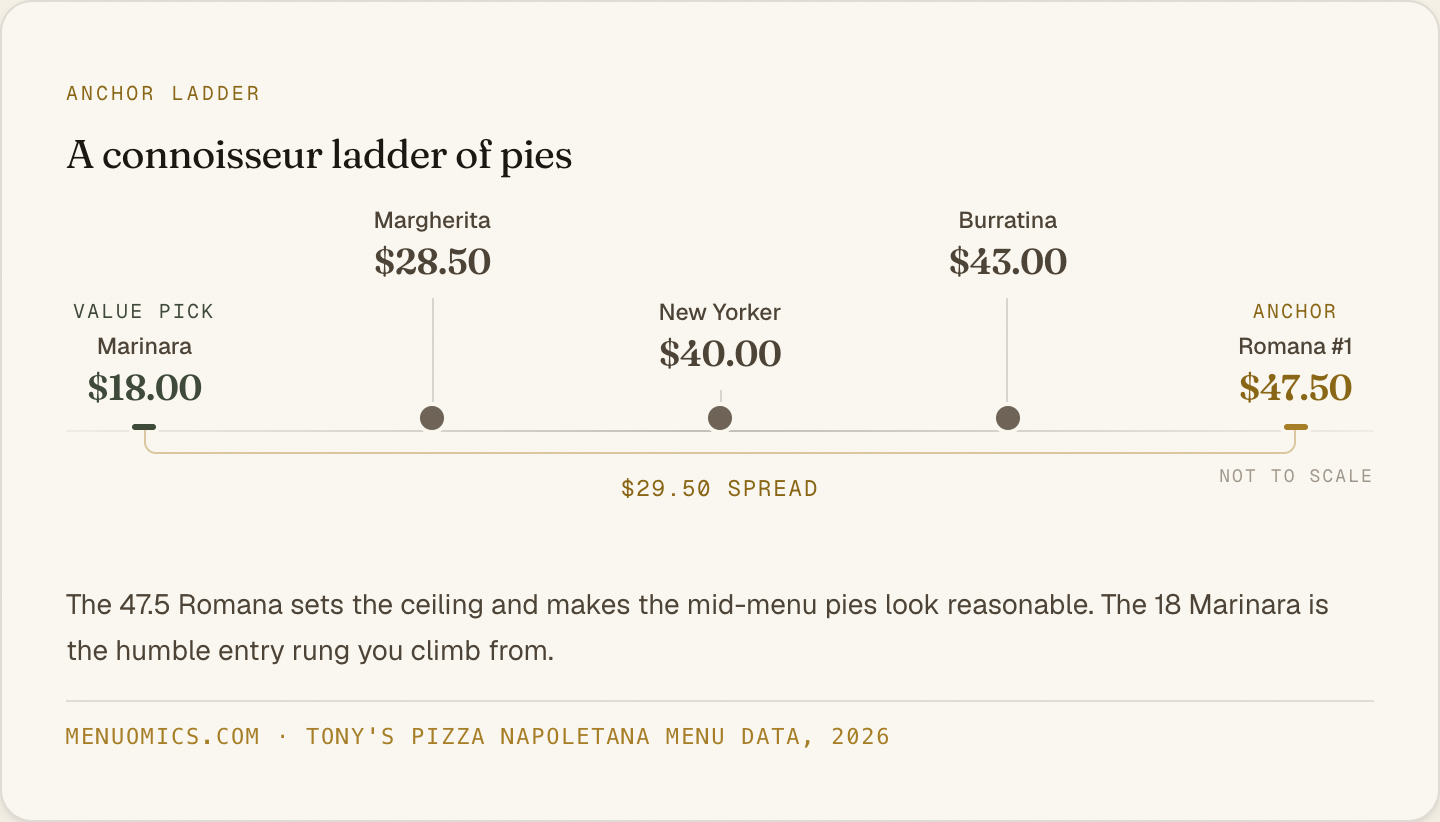
A connoisseur ladder of pies
The 47.5 Romana sets the ceiling and makes the mid-menu pies look reasonable. The 18 Marinara is the humble entry rung you climb from.
Download this chart (PNG) · free to reuse with credit, see reuse terms.
The setup
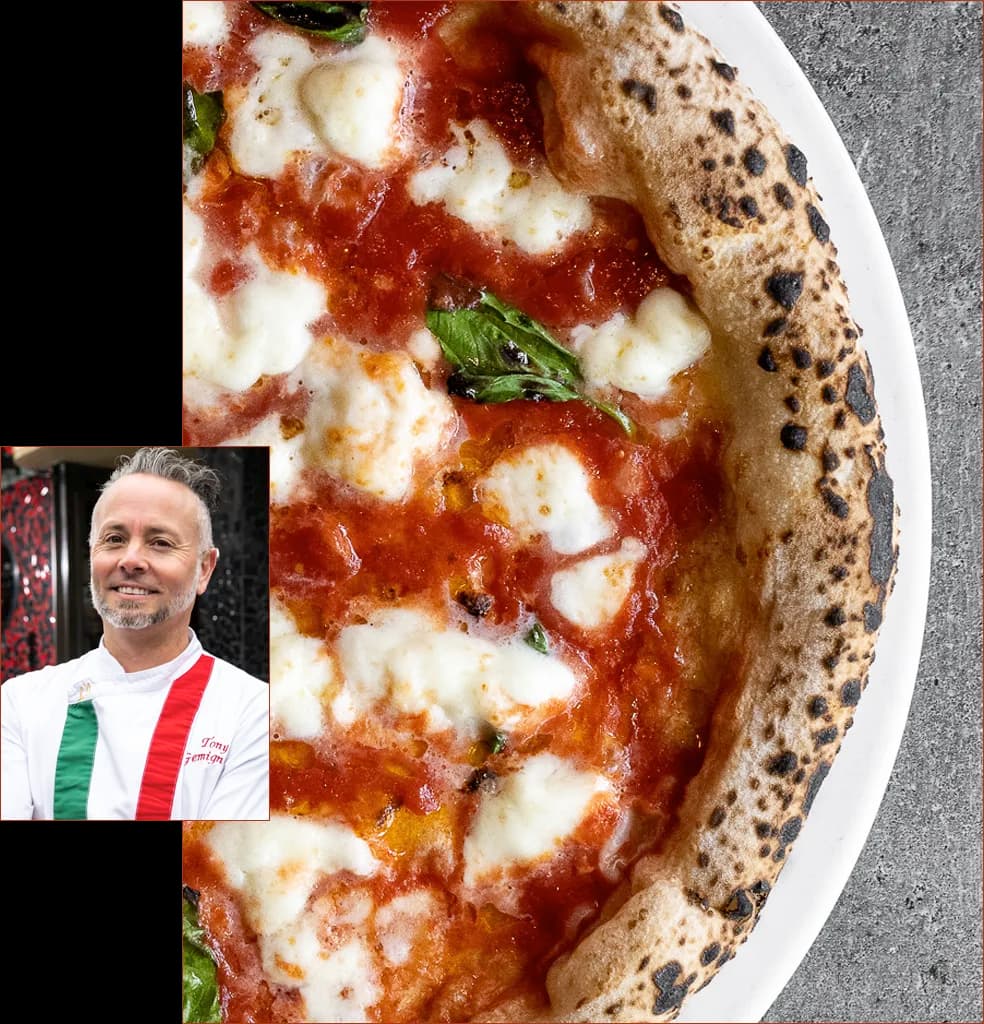
Tony's Pizza Napoletana opened in North Beach in 2009 under Tony Gemignani, who the restaurant bills as a '13-time World Pizza Champion' and 'the first American and non-Neapolitan to win' Best Pizza Margherita at the World Cup in Naples. The room 'displays seven different ovens' and the menu spans Neapolitan, California, Classic American and Italian, Sicilian, Romana, New York, Grandma, New Haven, Detroit, St. Louis and Gluten Free.
Most pizzerias sell one crust. Tony's sells a ladder of them, each tied to its own oven and temperature, and then does something rare: it prints scarcity directly on the menu. The signature Margherita reads 'limit 73 per day,' the Royal Margherita 'Limit 13 Per Day,' the Detroit 'LIMIT 20 PER DAY,' and others 10, 23, and 25. The number is part of the listing.
What they get right
The behavioral economics already at work.
Scarcity is printed, not just felt
Multiple pies carry an explicit daily cap on the menu itself: Margherita 'limit 73 per day,' Royal Margherita 13, Sausage and Stout 23, Detroit 20, plus 10 and 25 elsewhere. A stated limit raises perceived value and urgency more than an unstated one; here the number is in the listing, so the read is unavoidable.
6+ items carry a printed per-day limit, Worchel et al., 1975 (scarcity)
Twelve named styles build a connoisseur ladder
Neapolitan, California, Sicilian, Detroit, Romana, New York, Coal Fired and more, each tied to its own oven and temperature on the page. The breadth lets a guest climb from a $18 Marinara to a $47.5 Romana and feel they are leveling up in expertise, not just spending more.
12 pizza styles across 7 ovens, Tony's Pizza Napoletana, About
The credential travels with the dish
The Margherita line itself reads 'world pizza cup winner Naples, Italy,' attaching Gemignani's title to the specific item a guest is about to choose. The proof sits at the point of decision rather than only in the room's signage.
Award text printed inline on the item, Cai, Chen and Fang, AER 2009 (popularity tags)
Sectioning by oven, not by topping
The card groups pizzas under Napoletana, California, Detroit, Coal Fired, Sicilian, Romana, New York. Organizing by craft category frames each pizza as a distinct style decision and slows the scan into a tour, which supports trading up rather than defaulting to 'cheese.'
8+ oven/style sections, Wansink, Painter and van Ittersum, 2001 (descriptive labels)
Half-dollar pricing, not charm .99
Prices carry a dollar sign and land on .5 and .75 ($28.5, $29.5, $34.75, $36.75), a quieter register than .99 charm pricing. It reads closer to a specialty-shop convention than a value-chain one, consistent with the premium positioning.
Prices to the half/quarter dollar, no .99, Cornell, Yang and Kimes 2009 (drop the dollar sign)
What we’d test
The rewrite, with the expected lift and the honest caveat.
Pull the cap number off the Margherita line
Compare the current listing ('limit 73 per day') against a version that drops the number and keeps only the award text. Measure Margherita's share of pizza orders.
Expect Removing the stated cap softens urgency and likely lowers the Margherita's order share versus the numbered version.
Caveat This tests the wording of the scarcity cue on the menu, not the actual kitchen limit, the recipe, or the wait time.
Order the style sections high-to-low vs low-to-high
Test leading the pizza list with the $47.5 Romana and large-format Sicilians versus opening with the $18 Marinara. Track average pizza check.
Expect Leading with the higher-priced, large-format styles anchors upward and likely lifts average pizza spend.
Caveat This tests item ordering and anchoring on the page, not portion sizes, oven craft, or how dishes are described.
Pair the Royal Margherita beside the Margherita with both caps shown
Place the 'limit 13 per day' Royal Margherita directly adjacent to the 'limit 73 per day' Margherita so the scarcer, pricier twin is visible at the moment of choice. Compare against listing them in separate sections.
Expect Adjacency with both caps visible should make the standard Margherita feel like the sensible middle choice and may lift its take rate.
Caveat This tests menu adjacency and tier framing, not ingredient quality, plating, or which pizza actually tastes better.
What diners actually say
Synthesized from public reviews, the reality check that grounds every recommendation.
They praise
- Margherita called the standard others try to replicate, best some reviewers ever had
- Coal-fired New Yorker singled out for crust, crisp, sauce and spice
- Widely regarded as some of the best pizza in San Francisco
- The seven-oven, many-style range treated as a destination draw
They criticize
- Long waits for seating and pickup, hour-plus reported
- Prices seen as steep for the portion by some guests
- Margherita occasionally called soft or underdone, results vary
The verdict
Tony's runs the rare menu that puts its scarcity in writing: a Margherita capped at 73 a day, sibling pies capped lower, sectioned across seven ovens into a climbable ladder of named styles. As menu craft it is close to a masterclass in trading up, with the world-champion credential printed right on the line a guest is choosing. The design upside is a card that turns ordering pizza into picking a tier, and makes the hero feel earned.
Common questions
- Why does Tony's Pizza limit the Margherita to 73 per day?
- The $28.5 Napoletana Margherita carries an inline 'limit 73 per day' note, the clearest scarcity cue on a menu that earns an A-. A stated daily cap raises perceived value and urgency more than an unstated one, and here the number is printed right in the listing so the read is unavoidable.
- How much is pizza at Tony's Pizza Napoletana?
- Pizzas run from an $18 Marinara up to the $47.5 Romana #1, with the signature Margherita at $28.5 and the coal-fired New Yorker at $40. The high Romana ceiling makes the $28 to $40 pies look mid-menu rather than expensive.
- Why does Tony's Pizza have so many pizza styles?
- Tony's runs 12 named styles across 7 different ovens, from Neapolitan to Detroit to Romana, each tied to its own oven and temperature. The breadth lets a guest climb from an $18 Marinara to a $47.5 Romana and feel they are leveling up in expertise, not just spending more.
- What is the Royal Margherita at Tony's Pizza?
- The Royal Margherita is a multigrain twin of the signature pie at $34 with a stricter 'Limit 13 Per Day' cap. A lower cap reads as a higher tier, so the scarcer, pricier sibling makes the standard $28.5 Margherita feel like the sensible middle choice.
More breakdowns
 Zuni CafeA-
A 75.00 chicken that takes about 75 minutes, and the menu says so. A practical warning that also happens to reduce uncertainty, printed in the margin.
Read the Zuni Cafe breakdown →A 1988 supper club hidden down a Gold Street alley, where live jazz, $18 martinis and tableside theater are the product and the food only has to clear the bar the room has raised.
Read the Bix breakdown →An elegant, romantic neighborhood bistro in Lower Pacific Heights serving modern French cooking with a Californian accent, from chef JP Carmona and the B Patisserie team.
Read the Routier breakdown →The James Beard 'America's Classic' that builds its whole reputation on what it leaves out: no rice, six meats, one price, off-menu dorado.
Read the La Taqueria breakdown →A Tenderloin Creole institution where one cheap, famous beignet gets bundled into a four-way Flight that quietly triples the check.
Read the Brenda's French Soul Food breakdown → NopaA
NopaAA 2006 Divisadero gathering place whose daily wood-fired menu prints prices as plain numbers, no dollar signs, no cents, anchored by a 49 brisket.
Read the Nopa breakdown →Your menu next
Get this for your own menu, free.
Send your menu and we’ll send back the same breakdown, what you get right, what we’d test, and why.
4505 Burgers & BBQ
A 2014 Divisadero pit from butcher Ryan Farr where the burger is literally named the 'Best Damn,' barbecue is weighed by the half-pound, and a 149.95 Boss Platter sits at the top of the board.
Read it →