Popeyes menu, graded
Popeyes turned a stockout into a sales engine: the 2019 chicken sandwich sold out nationwide in about two weeks, the shortage itself became the advertising, and the relaunch proved that the most persuasive line on the menu is the one that reads sold out.
How a two-week stockout became the most valuable item on the menu.
Menu-craft grade
The standing menu does the boring things competently: a cheap hero sandwich as the doorway, a clean combo upsell, and a family-box anchor that can reach roughly forty-five dollars and makes everything beneath it look thrifty. But the famous scarcity magic was a one-time event, not a repeatable on-menu mechanic, and the day-to-day board leans on LTO churn, a busy layout, and franchise price swings that undercut the craft. Great marketing case study, merely solid menu engineering.
Graded on how well the menu uses behavioral economics, not the food.
Menu and prices verified September 2026
A 4-minute audio read of the analysis
- Type
- Chain
- Where
- New Orleans, Louisiana (Arabi)
- Cuisine
- Louisiana fried chicken
- Footprint
- 3,183 US locations (5,400+ worldwide)
- Since
- 1972 (Arabi, Louisiana)
- Ownership
- Restaurant Brands International (RBI; NYSE: QSR), since 2017
The mechanics, drawn
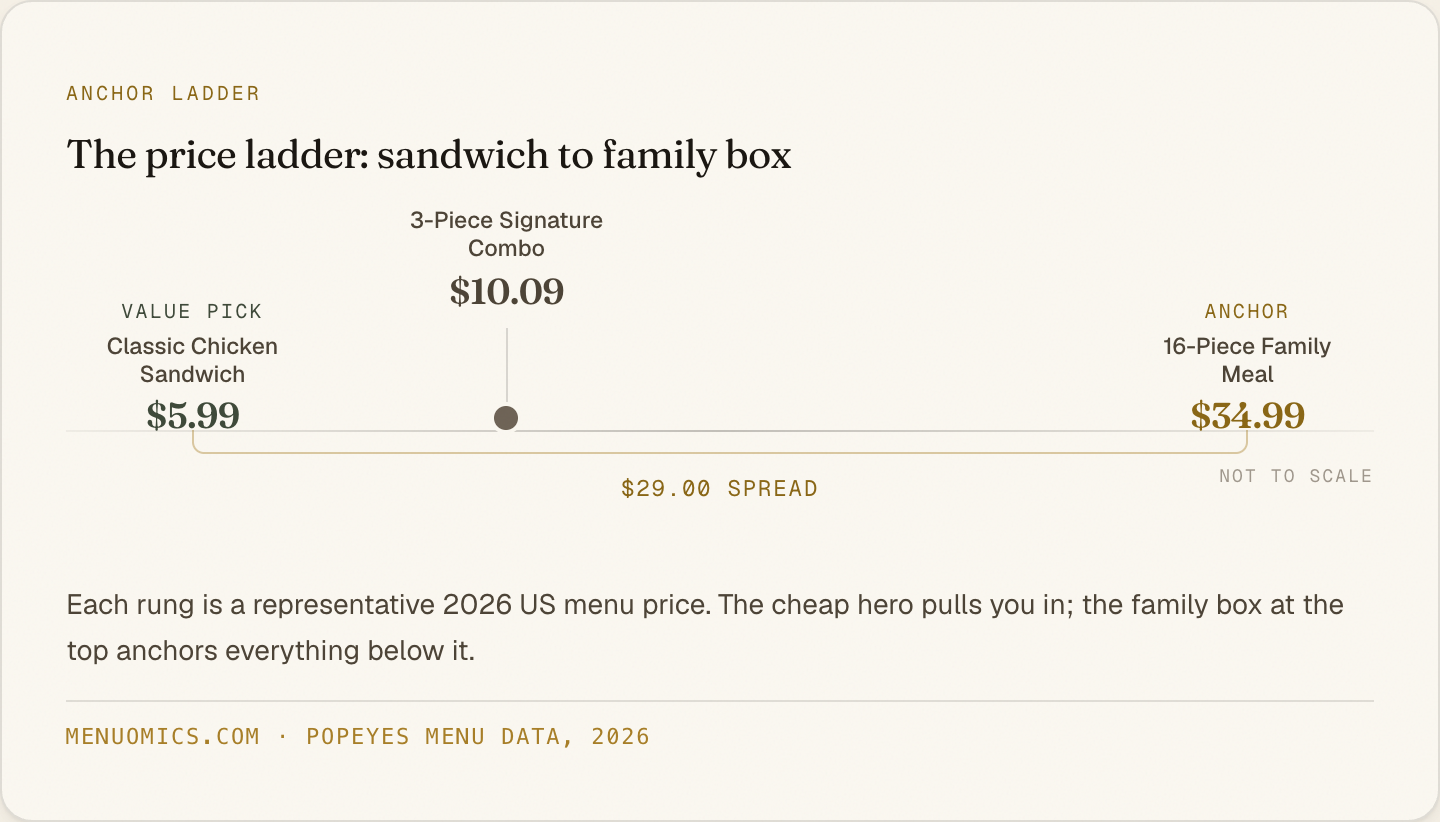
The same menu, mapped onto an axis, so the behavioral move is something you can see, not just read.
The price ladder: sandwich to family box
Each rung is a representative 2026 US menu price. The cheap hero pulls you in; the family box at the top anchors everything below it.
Download this chart (PNG) · free to reuse with credit, see reuse terms.
The full ticket
What it actually rings up to.
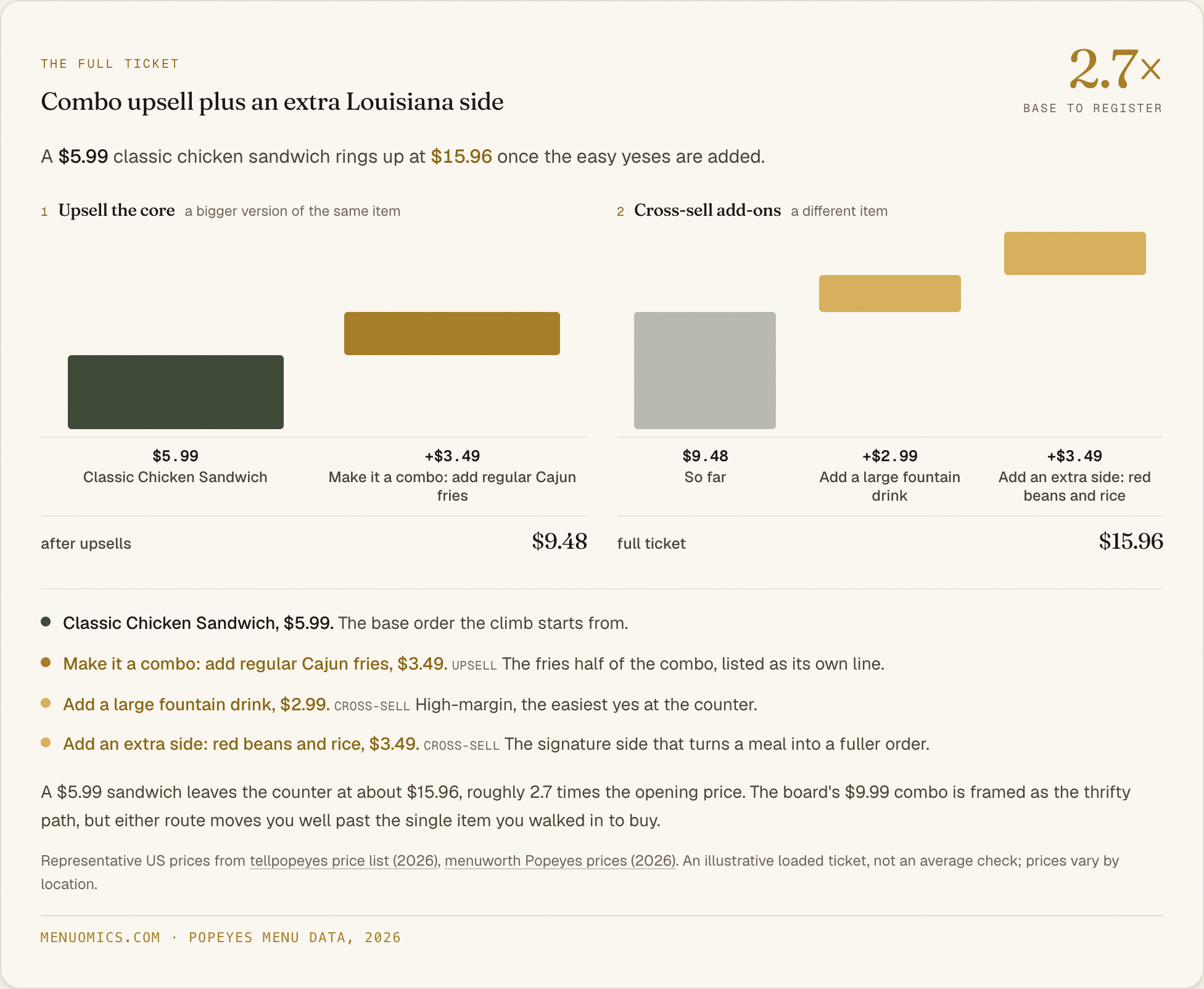
The headline price is only the start. The real number is the journey from a base order to the check at the register, one easy yes at a time.
Combo upsell plus an extra Louisiana side
A $5.99 classic chicken sandwich rings up at $15.96 once the easy yeses are added.
- Classic Chicken Sandwich, $5.99. The base order the climb starts from.
- Make it a combo: add regular Cajun fries, $3.49. upsell The fries half of the combo, listed as its own line.
- Add a large fountain drink, $2.99. cross-sell High-margin, the easiest yes at the counter.
- Add an extra side: red beans and rice, $3.49. cross-sell The signature side that turns a meal into a fuller order.
A $5.99 sandwich leaves the counter at about $15.96, roughly 2.7 times the opening price. The board's $9.99 combo is framed as the thrifty path, but either route moves you well past the single item you walked in to buy.
Representative US prices from tellpopeyes price list (2026), menuworth Popeyes prices (2026). An illustrative loaded ticket, not an average check; prices vary by location.
Download this chart (PNG) · free to reuse with credit, see reuse terms.
The setup
In August 2019 Popeyes launched a single buttermilk-battered chicken sandwich and accidentally wrote the modern playbook for manufactured scarcity. The chain planned for weeks of supply and burned through it in roughly two weeks, selling out nationwide by late August. Lines wrapped buildings, a Twitter feud with Chick-fil-A turned into free national coverage, and the absence of the product became a bigger story than its presence. When it returned that November, on a Sunday aimed squarely at a rival that closes on Sundays, the demand was already pre-built. The sandwich now sits on the board as a permanent value entry, but its origin story is the real asset.
Read as menu craft, Popeyes is a study in using a cheap, high-craving hero item as the front door, then letting a combo upsell, partitioned sides, and a large family box do the work of growing the ticket. The scarcity event taught the brand something most chains never learn firsthand: perceived value spikes when supply visibly runs out, and a shortage is the cheapest advertising there is. The standing menu cannot manufacture that shortage every day, so it relies on the more ordinary levers of anchoring and bundling instead. (Popeyes does not frame these as behavioral tactics; this is our reading of the observed design.)
What they get right
The behavioral economics already at work.
The sold-out sign was the ad
The 2019 launch is a near-perfect field test of the Worchel cookie-jar effect: identical product, but value spikes when supply visibly runs out. Popeyes planned for weeks of inventory, sold out nationwide in about two weeks, and the scarcity itself drove a reported 103% jump in traffic. The shortage was not a supply-chain failure that hurt the brand; it was the most persuasive thing the brand ever put in front of customers. People wanted the sandwich more precisely because they could no longer have it.
~2-week sellout; 103% traffic increase after launch, Worchel, Lee & Adewole (1975), Journal of Personality and Social Psychology; Wikipedia (Popeyes)
Everybody else wanting it is the menu copy you can't write
The lines, the Twitter war with Chick-fil-A, and the sold-out headlines did the persuasion that a menu board never can. An estimated $23 million in free publicity and weeks of news coverage told every undecided customer the same thing: this is the item people are fighting over. Social proof at that scale converts curiosity into a queue. The relaunch then cashed the demand the shortage had banked, with US same-store sales rising about 34% in the fourth quarter of 2019.
~$23M free publicity; Q4 2019 US same-store sales up ~34%, Restaurant Dive (2020); Wikipedia (Popeyes)
The family box makes the combo look like restraint
Drop a 16-piece family meal that can reach roughly $44.99 onto the board and every number under it recalibrates. Against that anchor a $9.99 combo and a $5.99 sandwich stop feeling like spending and start feeling like saving. The big bundle does not need to sell often to do its job; it just needs to be visible, resetting the customer's sense of what a normal order costs before they ever choose.
Anchor spread of roughly $5.99 to $44.99 on one board, menuworth Popeyes prices (2026); tellpopeyes price list (2026)
The combo is sold as the deal because the parts are priced apart
Fries at about $3.49 and a drink at about $2.99 are listed separately, so the combo at $9.99 can be framed as the smart bundle that saves you money. The trick is that either path moves you well past the $5.99 sandwich you walked in for. Splitting the components into their own line items makes each add feel small and makes the bundle feel generous, while the total quietly climbs.
Sandwich $5.99 vs combo $9.99; sides $3.49 and drink $2.99 a la carte, tellpopeyes price list (2026); menuworth Popeyes prices (2026)
A craving you can buy for six dollars is the perfect front door
The most famous item on the menu is also one of the cheapest, and that is by design. A roughly $5.99 sandwich is low enough to pull traffic in on impulse, then the combo, the extra side, and the drink do the margin work once the customer is already at the counter. The hero item is not where Popeyes makes its money; it is the bait that gets the ticket started.
Hero sandwich ~$5.99 anchors a ticket that loads to ~$15.96, Menuomics ticket analysis, 2026
What we’d test
The rewrite, with the expected lift and the honest caveat.
Put the scarcity back on the standing menu
The board treats every item as permanently available, which leaves the brand's single best lever sitting idle. A small, honest rotating callout (a limited seasonal flavor with a clear end date, or a weekly drop) reintroduces the urgency that made 2019 work, without faking a shortage.
Expect Higher conversion on the flagged item and more repeat visits timed to the window, as customers act before it disappears.
Caveat Scarcity has to be real. A countdown on something that never actually leaves trains regulars to ignore it and can read as manipulative.
Worchel, Lee & Adewole (1975)
Name the combo upgrade as a delta, not a new price
Listing the combo as its own $9.99 line makes the customer re-evaluate the whole purchase. Showing the upgrade as the small step up from the sandwich they already chose reframes it as a tiny add rather than a bigger decision.
Expect More sandwich buyers converting to combos, because the upgrade reads as a few dollars rather than a ten-dollar order.
Caveat The delta has to be genuinely modest. If the math reveals the bundle is barely a discount, transparent framing can backfire.
Menuomics ticket analysis, 2026
Lead the board with the family anchor
Anchors work hardest when seen first. Placing the 16-piece family meal at the top of the board, before the value items, sets a high reference price that every cheaper option is then judged against, instead of burying the anchor at the bottom where it does less work.
Expect A modest lift in average check as combos and 8-piece boxes look more reasonable beside the family meal seen first.
Caveat Push it too hard and budget-minded customers can feel priced out at a value brand. The cheap hero must stay obviously present.
tellpopeyes price list (2026)
What diners actually say
Synthesized from public reviews, the reality check that grounds every recommendation.
They praise
- The hero item is one of the cheapest on the board, a textbook low-friction front door that pulls traffic in on impulse.
- A clean three-rung ladder, from sandwich to combo to family box, gives the eye an obvious path upward.
- The 16-piece family meal is a genuine anchor that makes every combo beneath it feel like a sensible choice.
- Sides and drinks are partitioned into their own lines, so the combo can be sold as the bundle that saves money.
- The 2019 sellout remains one of the best real-world demonstrations of scarcity and social proof in fast food.
They criticize
- The standing menu can't reproduce the scarcity that made the brand famous, so its best lever sits unused most of the year.
- Franchise pricing swings widely (a sandwich from about $5.99 to $6.29, a family box from roughly $34.99 to $44.99), which muddies the anchor and erodes trust.
- The board is busy with overlapping combos and rotating LTOs, diluting the clarity that makes a ladder persuasive.
- Parallel combos priced identically (bone-in and tenders both near $10.09) add choices without adding a clear reason to trade up.
- ACSI satisfaction sits at 75, below the quick-service average, suggesting execution at the counter undercuts the menu's promise.
The verdict
Popeyes will be taught in marketing classes for a generation, but the lesson is about scarcity, not menu design. The 2019 sandwich proved that a visible stockout can outsell any discount, and the standing menu is built sensibly around the aftermath: a cheap, crave-heavy hero up front, a tidy combo upsell, partitioned sides, and a family box that anchors the whole board. The craft is real but ordinary, and it is held back by a cluttered layout and franchise pricing that drifts from market to market. The brand's single best behavioral move, manufactured scarcity, is the one thing the everyday menu cannot bottle, which is exactly why this lands at a solid B-minus rather than higher.
Common questions
- How fast did the Popeyes chicken sandwich sell out in 2019?
- Popeyes launched the sandwich on August 12, 2019, and sold out nationwide in about two weeks, by late August, after burning through inventory planned to last far longer.
- Why did selling out actually help Popeyes?
- The shortage became the marketing. It drove a reported 103% jump in traffic and an estimated $23 million in free publicity, and the November relaunch converted that pent-up demand into roughly a 34% rise in US same-store sales in Q4 2019.
- What is the most expensive standard item on the Popeyes menu?
- The 16-piece family meal is the standard anchor, running from about $34.99 to $44.99 depending on location, which makes the combos and the sandwich beneath it look like value.
- How much does a Popeyes chicken sandwich cost in 2026?
- Representative 2026 US pricing is about $5.99 for the Classic or Spicy sandwich and about $9.99 for the combo, though prices vary by franchise and market.
- How much is a meal at Popeyes?
- A meal at Popeyes starts around $5.99 for the base order and lands near $15.96 once the usual add-ons go on, roughly 2.7x the headline price (representative 2026 US figures; they vary by location). That gap between the price that gets you in and the total you pay is the multiplier this page grades.
Sources (6)
- Popeyes - Wikipedia
- ScrapeHero - Number of Popeyes locations in the US (2026)
- CNBC - Chicken sandwich wars: Popeyes and Chick-fil-A feud on Twitter
- Restaurant Dive - Popeyes chicken sandwich helped boost Q4 comp sales
- Marketing Dive - Popeyes dings Chick-fil-A with Sunday return of sold-out sandwich
- Menuworth - Popeyes menu prices (2026)
Head to head
More breakdowns
 The Cheesecake FactoryB+
A 21-page, 250-item menu should be a behavioral disaster. It's a roughly $4-billion chain. Here's what all that abundance is quietly doing.
Read the The Cheesecake Factory breakdown → McDonald'sA-
The Extra Value Meal is one of the most-copied ideas in food: fold the whole order into a single number that hurts less than three. Then McValue and the app pile value on top, and the McRib drops in as an event.
Read the McDonald's breakdown → Taco BellA-
A sub-$3 value menu sets the floor, $5/$7/$9 boxes name the deal after its own price, and a never-ending limited-time calendar keeps a reason to come back on the board. Taco Bell sells value loudly, and it works: it gained traffic while rivals shrank.
Read the Taco Bell breakdown → Dunkin'A-
A premium latte anchors the cheap iced coffee as the obvious default, the $6 Meal Deal bundles the breakfast, and Dunkin' Rewards turns the morning run into a streak. The menu craft is textbook; the strain is price creep and an app that increasingly decides the real price.
Read the Dunkin' breakdown → Panda ExpressB+
The whole order comes down to one question, how many entrees. A Bowl is one, a Plate is two, a Bigger Plate is three, and the menu is built so the middle Plate wins. Orange Chicken is the anchor everyone orders, and a quiet $1.50 premium upcharge lifts the check while the headline price stays put.
Read the Panda Express breakdown → Raising Cane'sA-
The chicken-finger chain that built a billion-dollar machine by refusing to sell almost anything else.
Read the Raising Cane's breakdown →Your menu next
Get this for your own menu, free.
Send your menu and we’ll send back the same breakdown, what you get right, what we’d test, and why.
Wingstop
How Wingstop turns roughly a dozen flavors into the real menu, then uses a by-count ladder and group packs to scale your ticket.
Read it →