Buffalo Wild Wings menu, graded
Buffalo Wild Wings sells wings on a count ladder (6, 10, 15, 20, 30) where the per-wing price falls at every step to pull you toward bigger orders, routes its weekly BOGO generosity through cheaper boneless breast meat, and wraps the whole menu in a 26-flavor sauce wall and wall-to-wall TVs so the visit runs long enough for the bar tab to do the real earning.
How a ~$49.99 order of 30 wings, a $2 boneless discount, and free-wings Thursday keep you climbing the ladder while the TVs and the bar tab quietly carry the ticket.
Menu-craft grade
The count ladder is genuine quantity discounting, per-wing price drops from about $2.25 at the 6-count to about $1.67 at the 30-count, and the Tuesday and Thursday BOGO rituals are legible habit builders. The flavor wall gives regulars a reason to return and the sports-bar format stretches dwell time into drink revenue. It loses ground on value legibility: the same order can differ by dollars between markets and channels, the famous Half-Price Wing Tuesday died in 2017 and came back in weaker clothing, and the best prices are gated behind a Rewards account.
Graded on how well the menu uses behavioral economics, not the food.
Menu and prices verified September 2026
A 4-minute audio read of the analysis
- Type
- Chain
- Where
- Sandy Springs, Georgia (headquarters)
- Cuisine
- Wings and sports-bar American
- Footprint
- ~1,300 locations across all 50 US states (2025), including Buffalo Wild Wings GO takeout units
- Since
- 1982 (Columbus, Ohio; founders Jim Disbrow and Scott Lowery)
- Ownership
- Inspire Brands (since February 2018), owned by Roark Capital
The mechanics, drawn
The same menu, mapped onto an axis, so the behavioral move is something you can see, not just read.
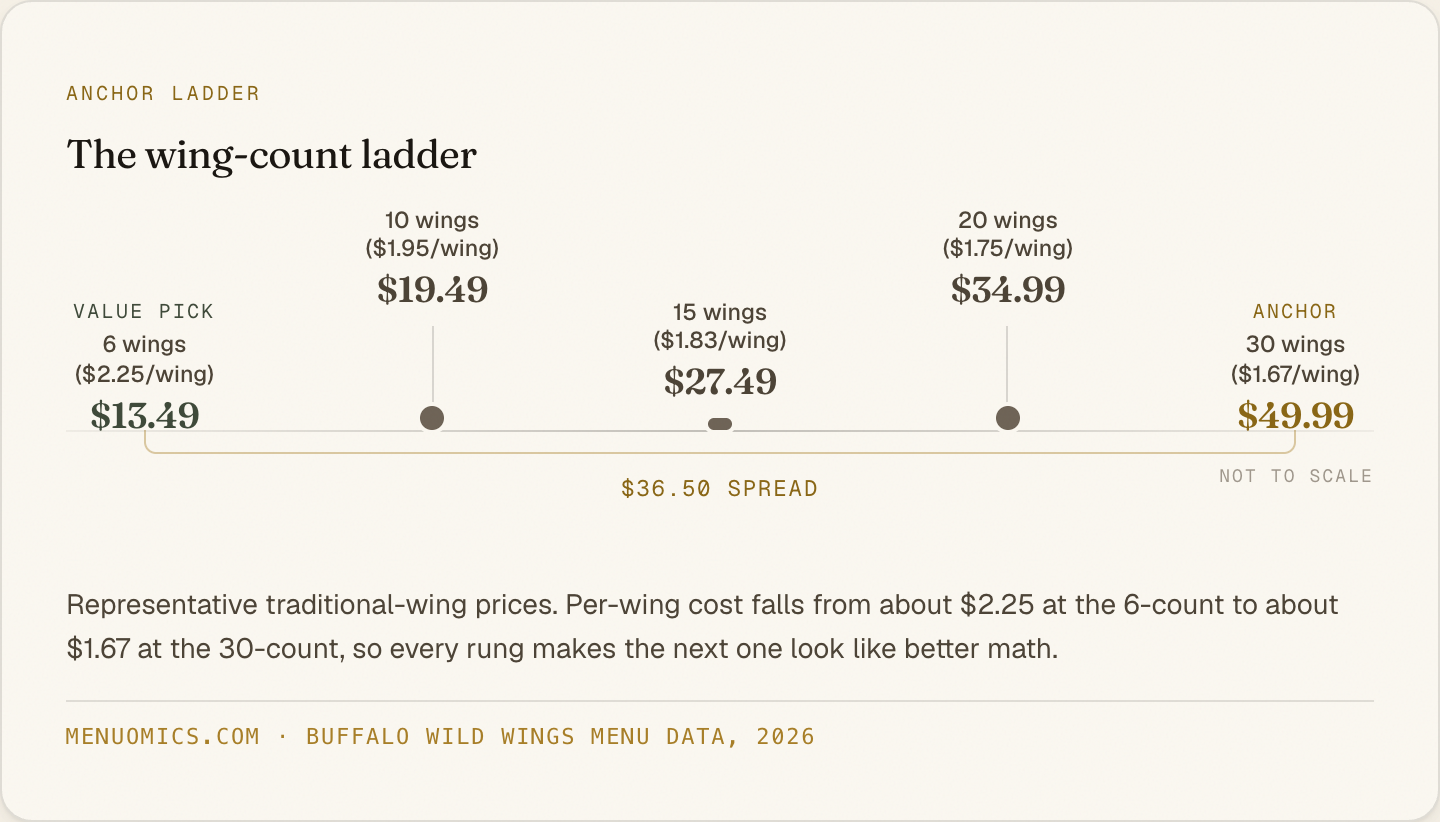
The wing-count ladder
Representative traditional-wing prices. Per-wing cost falls from about $2.25 at the 6-count to about $1.67 at the 30-count, so every rung makes the next one look like better math.
Download this chart (PNG) · free to reuse with credit, see reuse terms.
The full ticket
What it actually rings up to.
The headline price is only the start. The real number is the journey from a base order to the check at the register, one easy yes at a time.
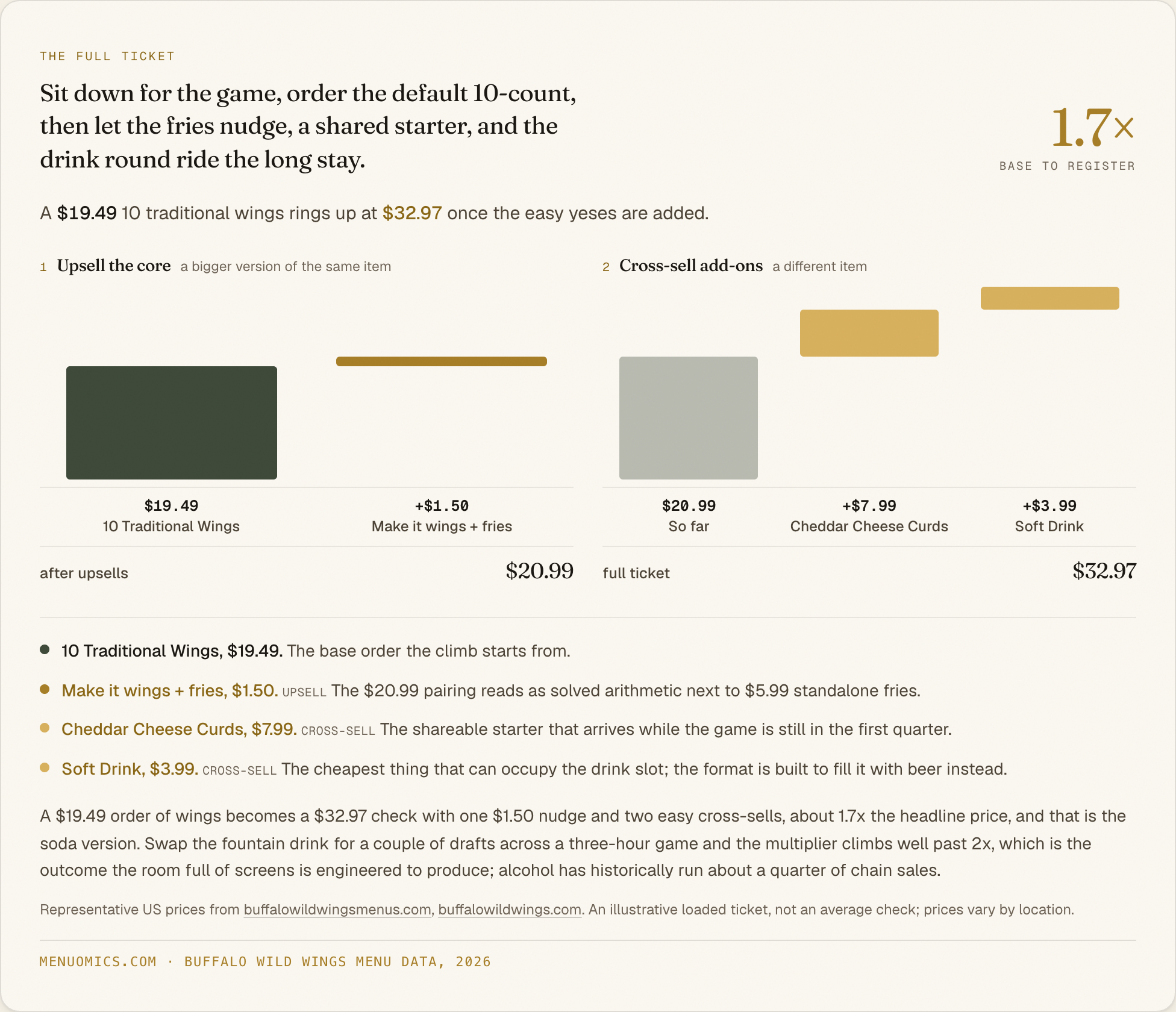
Sit down for the game, order the default 10-count, then let the fries nudge, a shared starter, and the drink round ride the long stay.
A $19.49 10 traditional wings rings up at $32.97 once the easy yeses are added.
- 10 Traditional Wings, $19.49. The base order the climb starts from.
- Make it wings + fries, $1.50. upsell The $20.99 pairing reads as solved arithmetic next to $5.99 standalone fries.
- Cheddar Cheese Curds, $7.99. cross-sell The shareable starter that arrives while the game is still in the first quarter.
- Soft Drink, $3.99. cross-sell The cheapest thing that can occupy the drink slot; the format is built to fill it with beer instead.
A $19.49 order of wings becomes a $32.97 check with one $1.50 nudge and two easy cross-sells, about 1.7x the headline price, and that is the soda version. Swap the fountain drink for a couple of drafts across a three-hour game and the multiplier climbs well past 2x, which is the outcome the room full of screens is engineered to produce; alcohol has historically run about a quarter of chain sales.
Representative US prices from buffalowildwingsmenus.com, buffalowildwings.com. An illustrative loaded ticket, not an average check; prices vary by location.
Download this chart (PNG) · free to reuse with credit, see reuse terms.
The setup
Buffalo Wild Wings started in 1982 near the Ohio State campus in Columbus, where founders Jim Disbrow and Scott Lowery could not find Buffalo-style wings and opened their own spot, originally Buffalo Wild Wings & Weck, BW3 to regulars. The chain went public in 2003, and in February 2018 Roark Capital bought it for about $2.9 billion and folded it into Inspire Brands alongside Arby's. Today it runs roughly 1,300 locations across all 50 states, and the format has always been the point: a room full of screens and a full bar, with wings as the reason you sat down.
The menu is built around one instrument, the count ladder. Traditional wings come in 6, 10, 15, 20, and 30 pieces, and the per-wing price falls at every rung, so trading up always looks like the smart move. Boneless wings shadow the ladder about two dollars cheaper per 10-count, and the weekly deals live disproportionately on that cheaper breast meat: Thursday's second boneless order is free, while Tuesday's second traditional order is only half off. Around the ladder sit 26 standing sauces and dry rubs, a limited-time all-you-can-eat weekday offer, and a rewards program that gates the dine-in deals. (Buffalo Wild Wings does not frame these as behavioral tactics; this is our reading of the observed design.)
What they get right
The behavioral economics already at work.
The ladder pays you to climb
Five counts, one falling curve: about $2.25 per wing at the 6-count, $1.95 at 10, $1.83 at 15, $1.75 at 20, and $1.67 at 30. Nobody prints the per-wing math, but diners sense it, and each rung makes the next one look like the smarter buy. The 30-count is doing anchor work too; a number near $50 at the top of the board makes a $19.49 order of 10 feel modest. The result is systematic upward drift in order size, sold as thrift.
6 wings ~$13.49 ($2.25 per wing) vs 30 wings ~$49.99 ($1.67 per wing), Aggregated BWW menu pricing, late 2025
The generosity flows through the cheap meat
Both weekly rituals say BOGO, but they are not the same deal. Thursday's second order of boneless wings is free; Tuesday's second order of traditional wings is only 50 percent off. Boneless pieces are cut from breast meat, a cheaper and more stable input than bone-in wings, so the loud generosity lands where the margin can absorb it. This is the direct descendant of 2017, when spiking wing costs killed Half-Price Wing Tuesday and the promotional weight shifted to boneless. The guest hears 'free wings'; the ledger hears 'discounted chicken breast.'
Thursday: second boneless order free; Tuesday: second traditional order 50% off, dine-in with a Rewards account, Buffalo Wild Wings BOGO Days page (official, 2026)
26 flavors is the engine, not the garnish
The sauce and dry-rub wall is the menu's variety machine: 26 standing flavors arranged along a heat spectrum, plus rotating limited editions, out of roughly 80 flavors released over the years. Large assortments attract and give regulars a reason to return and mix, and the classic worry, that too much choice stalls decisions, is managed by structure: the heat scale ranks the wall into an ordered path, and multi-flavor splits on bigger counts lower the cost of any single pick, which conveniently supports the ladder climb.
26 standing sauces and dry rubs; roughly 80 flavors released over the years, Cheapism and Tasting Table flavor coverage
The TVs sell the beer
A Buffalo Wild Wings is a room built to keep you in the seat: individual locations run 60 to 80 screens, games last hours, and orders arrive in waves on a running tab. Paying at the end, decoupled from each round, is exactly the condition under which spending feels lightest. The food menu is shaped for this, shareable fried starters and wings by the pile, but the economic payload is the bar: alcohol has run about a quarter of sales, with beer roughly three quarters of that, and the chain has sold more beer than soda.
Alcohol ~25% of sales, beer about three quarters of that; beer is the third best-seller after boneless and traditional wings, Nation's Restaurant News; CNBC
The deals live behind the login
The Tuesday traditional BOGO requires a valid Rewards account for dine-in, and the app is where the offers, points (10 per dollar, 12 at Blazin' Status), and limited drops live. Gating deals this way splits the customer base into deal-seekers who identify themselves and pay less, and walk-ins who pay the full posted price, while the point mechanics add a sunk-cost reason to route the next wing night through the same app.
Dine-in Tuesday BOGO requires a Rewards account; members earn 10 points per $1, 12 with Blazin' Status ($250/yr spend), BWW BOGO Days and Rewards pages (official)
What we’d test
The rewrite, with the expected lift and the honest caveat.
Print the per-wing price on every rung
The falling per-wing curve is the menu's best honest argument, and it is currently invisible. Printing the unit price next to each count turns the implicit feeling that bigger is smarter into explicit arithmetic, which should accelerate trade-up to the 20 and 30 counts.
Expect Higher average wing count per order, with the nudge doing the work the server currently has to.
Caveat It also makes the 6-count look openly bad, which can read as a penalty on solo diners and small appetites.
Badge the flavor wall's top three
Twenty-six flavors attract regulars but stall first-timers. A quiet 'most ordered' badge on the three best-selling sauces gives newcomers a default path through the wall without shrinking it, and published field evidence says popularity labels lift sales of the tagged items.
Expect Faster ordering for new guests and fewer disappointing first picks.
Caveat Choice-overload effects are inconsistent across studies, so treat this as a cheap test, not a sure thing.
Cai, Chen & Fang, AER 2009
Stop calling Tuesday a BOGO
The word BOGO anchors expectations at 'free,' so delivering 50 percent off the second order reads as a shrunken deal, and long-memory regulars still benchmark against the dead Half-Price Wing Tuesday. Presenting the same economics as a members' Tuesday price on traditional wings would move the reference point to the everyday menu, where the offer looks generous, instead of to 'free,' where it looks clipped.
Expect Identical discount cost with less deal-erosion grumbling and cleaner separation from the Thursday free offer.
Caveat BOGO is a proven traffic word; any rename needs a regional test before it touches the ritual.
What diners actually say
Synthesized from public reviews, the reality check that grounds every recommendation.
They praise
- The count ladder is a real quantity discount, not a decorative one; every step up genuinely lowers the per-wing price.
- The 26-flavor wall is a durable return-visit engine, and reviewers who have tried the full range rate its breadth favorably.
- Tuesday and Thursday BOGO days are simple, legible rituals that train weekly visit habits.
- The all-you-can-eat weekday offer puts one clear flat price on slow nights and fills seats that would otherwise sit empty.
- The menu is honest about its context: shareable starters, multi-flavor wing piles, and a deep drink list are all built for the long, social stay the format actually delivers.
They criticize
- Wing inflation has been brutal: a snack-size order that cost $5.99 in 2010 runs $11 to $13.49 today depending on market, roughly an 80 percent per-wing increase.
- Half-Price Wing Tuesday died in 2017 when wing costs spiked, and today's Tuesday offer wears the old ritual's name with materially weaker terms.
- Boneless 'wings' are breaded breast meat sold on wing branding, an irritation real enough that a 2023 class action (later dismissed) made national news.
- There is effectively no stable public price: the same count differs by dollars across markets, and third-party delivery menus run higher still.
- The best prices require an account and the app, so anonymous walk-ins systematically pay more for the identical food.
The verdict
As menu engineering, Buffalo Wild Wings is a well-built single-purpose machine. The count ladder does what a great ladder should, rewarding every step up with honestly better unit math while the 30-count anchors the top, and the flavor wall plus the BOGO calendar turns wings into a repeatable weekly habit rather than a one-off craving. The subtler craft is in what the menu does not say: the free-wing generosity is routed through cheaper boneless meat, and the room itself, screens and running tabs, converts food orders into bar revenue. What holds the grade at B+ is trust, not design. Prices float by market and channel, the headline Tuesday deal is a diminished heir to a better one, and the login gate between guests and the good prices trades a little goodwill for data every single week.
Common questions
- What days are the BOGO wing deals at Buffalo Wild Wings?
- Tuesdays: buy one order of traditional wings, get a second of equal or lesser value 50% off (dine-in requires a Rewards account; also available for takeout or delivery via the BWW app or site). Thursdays: buy one order of boneless wings, get a second of equal or lesser value free. Both are limited to participating locations and exclude third-party delivery.
- Why are Buffalo Wild Wings wings so expensive now?
- Chicken wing costs have risen sharply: a snack-size order that was $5.99 in 2010 runs roughly $11 to $13.49 today depending on market, about an 80 percent per-wing increase. Bone-in wings are a volatile commodity, which is also why the chain killed Half-Price Wing Tuesday in 2017 and shifted promotions toward cheaper boneless meat.
- Does Buffalo Wild Wings still have all-you-can-eat wings?
- The chain relaunched all-you-can-eat wings and fries in April 2025 as a limited-time dine-in offer, Monday through Thursday, at about $19.99 for boneless and $24.99 for traditional or mix-and-match, with all 26 sauces and dry rubs available. Check the app or your local store, since it comes and goes.
- Are Buffalo Wild Wings boneless wings real wings?
- No. Boneless wings are breaded chunks of all-white-meat chicken breast, not wing meat. A 2023 class action claimed the name was deceptive; a federal judge dismissed it, and the chain joked that its buffalo wings are 0% buffalo. Boneless orders typically run about $2 less per 10-count than traditional.
- What is the most expensive item at Buffalo Wild Wings?
- On the standard menu, the priciest single item is the 30 Traditional Wings, about $49.99 in representative 2026 US pricing (it varies by location; group packs and combo deals can cost more). That top price also does quiet work as the menu's anchor: it is the number that makes everything below it read as reasonable.
- How much is a meal at Buffalo Wild Wings?
- A meal at Buffalo Wild Wings starts around $19.49 for the base order and lands near $32.97 once the usual add-ons go on, roughly 1.7x the headline price (representative 2026 US figures; they vary by location). That gap between the price that gets you in and the total you pay is the multiplier this page grades.
Sources (8)
- Buffalo Wild Wings BOGO Days (official, 2026)
- Buffalo Wild Wings Rewards (official)
- Brand Eating: All-You-Can-Eat wings return (April 2025)
- Chowhound: BWW wing prices, 2010 vs 2025
- FSR: Chicken wing prices continue to clip Buffalo Wild Wings (2017)
- NPR: A lawsuit picks a bone with Buffalo Wild Wings (2023)
- Nation's Restaurant News: How Buffalo Wild Wings builds its bar business
- Inspire Brands launches with Arby's and Buffalo Wild Wings (2018)
Head to head
More breakdowns
 In-N-Out BurgerA
Three burgers, no seasonal items, and a famous off-menu modifier ('Animal Style') that turns customers into evangelists. Restraint as strategy.
Read the In-N-Out Burger breakdown → Chick-fil-AA
A famously simple chicken sandwich, an easy 'make it a meal' bundle, and free dipping sauces, wrapped in the most-praised service in fast food. The menu stays out of the way so the hospitality can do the selling.
Read the Chick-fil-A breakdown → Chili's Grill & BarA-
A $10.99 bundle dragged Chili's out of a slump and back to the top of casual-dining traffic. Read closely, '3 For Me' is one round number doing the work of three separate decisions.
Read the Chili's Grill & Bar breakdown → Domino'sB+
The $6.99 Mix & Match looks like a low price. Its real design is the words 'two or more': a self-bundle that turns one cheap pizza into a full cart.
Read the Domino's breakdown → Jersey Mike'sB+
Numbered subs in three sizes, a free signature modifier called 'Mike's Way,' and a Giant pitched as the smart-value pick. The size ladder, not the combo, is where the menu does its work.
Read the Jersey Mike's breakdown → Logan's RoadhouseB
A steakhouse that reviewers rank dead last still runs a value menu most casual chains would be proud of. The food is panned; the menu design is not. That gap is the whole point.
Read the Logan's Roadhouse breakdown →Your menu next
Get this for your own menu, free.
Send your menu and we’ll send back the same breakdown, what you get right, what we’d test, and why.
Baskin-Robbins
An ice cream chain built on engineered variety: 31 flavors defused by free pink-spoon sampling, a scoop ladder with a steep quantity discount, and a cake case that quietly anchors the whole shop.
Read it →