Arby's menu, graded
Arby's hangs its board from one famous anchor, the off-menu Meat Mountain, a customer-invented stack of every meat in the building, then sells restraint beneath it through a roast beef size ladder and a rotating 2 for $7 mix-and-match frame, while curly fries and a Jamocha shake quietly triple the ticket.
How an off-menu Meat Mountain, a $7.99 half pound, and a rotating 2 for $7 window frame the order, then curly fries and a Jamocha shake take a $5.49 sandwich to $19.55.
Menu-craft grade
The anchor work is elite. The Meat Mountain is a decade-old, customer-invented price ceiling that cost the brand a poster, and the roast beef half-pound ladder gives the trade-up a built-in unit-price logic. What holds the grade down is everyday discipline: the value frame toggles between 2 for $6 and 2 for $7 at participating locations only, many offers hide in the app, and two portion lawsuits (2020 on advertised meat, 2025 on relabeled sizes) attack the honesty of the very size claims the ladder depends on.
Graded on how well the menu uses behavioral economics, not the food.
Menu and prices verified September 2026
A 4-minute audio read of the analysis
- Type
- Chain
- Where
- Sandy Springs, Georgia (headquarters)
- Cuisine
- Fast-food roast beef and deli-style sandwiches
- Footprint
- ~3,350 US restaurants (2025)
- Since
- 1964 (Boardman, Ohio; founders Forrest and Leroy Raffel)
- Ownership
- Inspire Brands (its founding flagship), majority-owned by private-equity firm Roark Capital
The mechanics, drawn
The same menu, mapped onto an axis, so the behavioral move is something you can see, not just read.
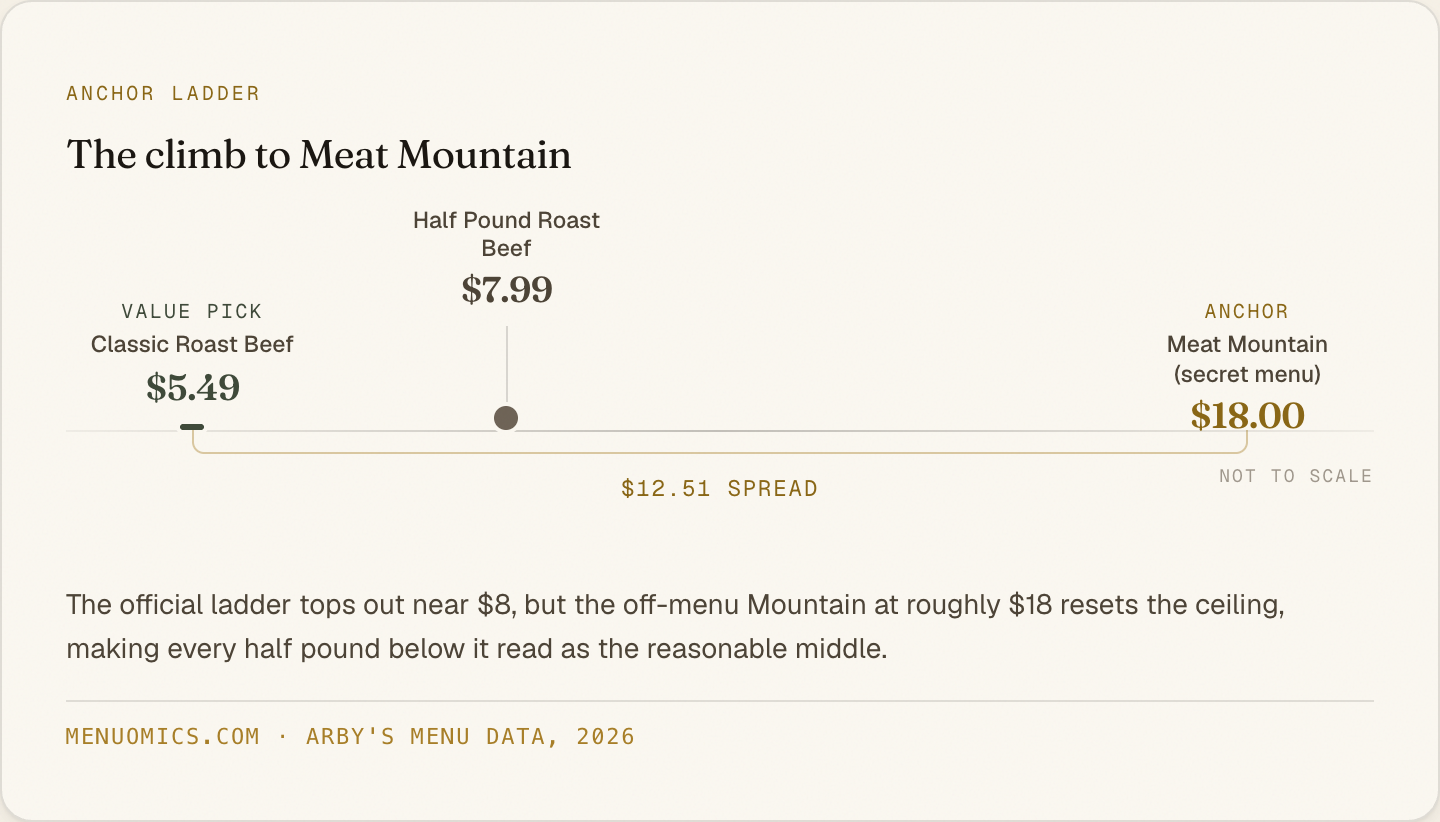
The climb to Meat Mountain
The official ladder tops out near $8, but the off-menu Mountain at roughly $18 resets the ceiling, making every half pound below it read as the reasonable middle.
Download this chart (PNG) · free to reuse with credit, see reuse terms.
The full ticket
What it actually rings up to.
The headline price is only the start. The real number is the journey from a base order to the check at the register, one easy yes at a time.
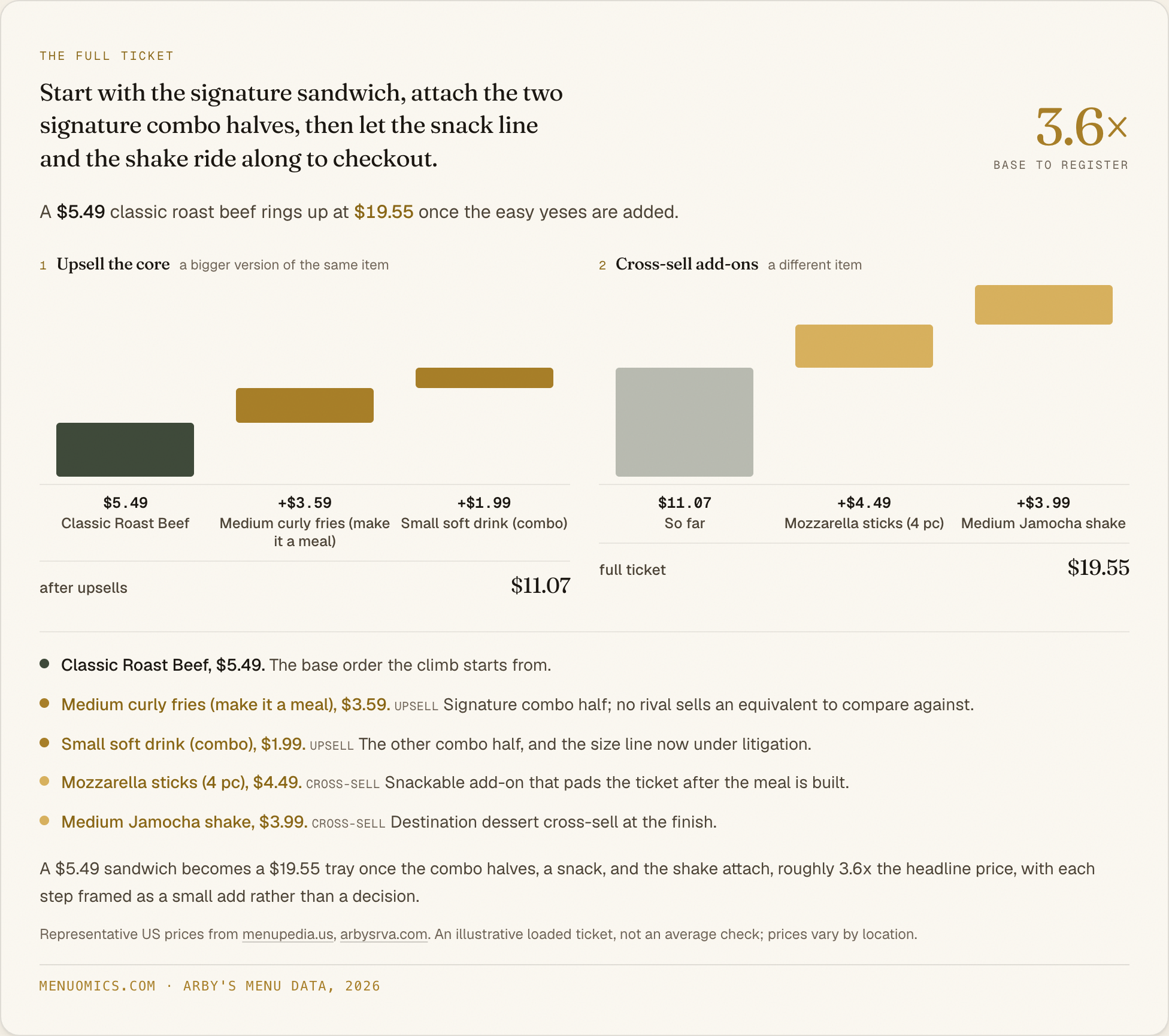
Start with the signature sandwich, attach the two signature combo halves, then let the snack line and the shake ride along to checkout.
A $5.49 classic roast beef rings up at $19.55 once the easy yeses are added.
- Classic Roast Beef, $5.49. The base order the climb starts from.
- Medium curly fries (make it a meal), $3.59. upsell Signature combo half; no rival sells an equivalent to compare against.
- Small soft drink (combo), $1.99. upsell The other combo half, and the size line now under litigation.
- Mozzarella sticks (4 pc), $4.49. cross-sell Snackable add-on that pads the ticket after the meal is built.
- Medium Jamocha shake, $3.99. cross-sell Destination dessert cross-sell at the finish.
A $5.49 sandwich becomes a $19.55 tray once the combo halves, a snack, and the shake attach, roughly 3.6x the headline price, with each step framed as a small add rather than a decision.
Representative US prices from menupedia.us, arbysrva.com. An illustrative loaded ticket, not an average check; prices vary by location.
Download this chart (PNG) · free to reuse with credit, see reuse terms.
The setup
Arby's has priced against nobody since day one. When the Raffel brothers (R.B., hence the name) opened in Boardman, Ohio in 1964, they sold a 69-cent roast beef sandwich in a market where hamburger stands charged 15 cents, and the chain has occupied that category-of-one position ever since. The modern identity arrived in 2014 with the Ving Rhames-voiced 'We Have the Meats' campaign, and with it came an accident of menu engineering: Arby's hung a promotional poster showing every meat it sells stacked into one tower, customers started walking in and asking to order the poster, and the chain obliged. The Meat Mountain was born as a $10 secret item and now runs roughly $18 depending on the franchise.
The board underneath that mountain is a size ladder. The Classic Roast Beef sits around $5.49, the Beef 'n Cheddar a half step above it, and half-pound versions of both top the official menu near $8 and $9, so the names themselves do the unit-price math for the trade-up. Around the ladder sit a rotating Everyday Value window (2 for $6 in some quarters, 2 for $7 in others), premium limited runs like the Wagyu Steakhouse Burger, and two cross-sells no competitor can match item for item, curly fries and the Jamocha shake. (Arby's does not frame these as behavioral tactics; this is our reading of the observed design.)
What they get right
The behavioral economics already at work.
The Meat Mountain is an accidental anchor
In 2014 Arby's hung a poster of every meat it sells stacked into one tower, and customers started ordering the poster. The chain turned it into a $10 secret item, and by 2026 it runs roughly $18. Whether or not anyone buys it, the Mountain does the anchor's job: against an $18 tower of eight meats, an $8.99 half pound reads as the sane middle and a $5.49 Classic reads as restraint. Most chains pay to build a ceiling; Arby's customers built this one for free.
Launched as a $10 secret item in August 2014; commonly quoted around $18 in 2026, Time (2014); 2026 secret-menu price trackers
One number buys two sandwiches
The Everyday Value frame sells a single memorable number, 2 for $6 in some windows and 2 for $7 in others, for any mix of qualifying sandwiches. Because the guest assembles the pair, the deal feels like their own bargain rather than the house's markdown, and the round number becomes the reference price the rest of the board gets judged against. The cost of that flexibility is instability: the number itself keeps changing between windows and markets.
Franchisee promotions show 2 for $7 through Jan 2024, 2 for $6 from Jul to Sep 2024, and 2 for $7 again in 2026, Arby's Richmond franchisee promos; 2026 menu trackers
The size ladder does its own math
The roast beef line climbs from a $5.49 Classic to a $7.99 Half Pound, and the Beef 'n Cheddar from $5.99 to $8.99. Naming the big size by weight makes the trade-up look like arithmetic, roughly double the beef for two and a half dollars more, so choosing the bigger sandwich feels like the smart unit-price buy rather than an indulgence. With the Meat Mountain looming above, the half pound also becomes the compromise choice instead of the extreme one.
Classic Roast Beef ~$5.49 vs Half Pound ~$7.99; Beef 'n Cheddar ~$5.99 vs half pound ~$8.99, Menupedia Arby's 2026 US menu pricing
Premium LTOs borrow the steakhouse
The 2022 Wagyu Steakhouse Burger ran for a ten-week window at $5.99, was pitched as 50 percent larger than a McDonald's Quarter Pounder, and returned in 2023 at $6.99. The limited window manufactures urgency, the Wagyu label imports a steakhouse quality signal into a sub-$7 price, and the explicit Quarter Pounder comparison hands guests a flattering reference point. It is the rare fast-food LTO that anchors on both size and pedigree at once.
Wagyu Steakhouse Burger: May 23 to Jul 31, 2022, from $5.99; billed as 50% larger than a Quarter Pounder, Axios (2022); Brand Eating (2023 return)
A category of one resists comparison shopping
From the first store, which sold a 69-cent roast beef sandwich while burger stands charged 15 cents, Arby's has sold products with no direct rival. Nobody can check the Beef 'n Cheddar or the Greek Gyro against a McDonald's equivalent, so there is no external reference price to make the board feel expensive. The chain effectively sets its own comparison set, which is why its everyday prices can sit a tier above burger rivals without an item-level price war.
1964 launch price: 69 cents for roast beef when hamburgers sold for about 15 cents, Arby's history (Wikipedia; The Vindicator)
What we’d test
The rewrite, with the expected lift and the honest caveat.
Put the Mountain on the board
The Meat Mountain currently anchors only for guests who already know the lore. Listing it on kiosks and app menus with a posted price would put the $18 ceiling in front of every guest, strengthening the compromise pull toward the $8 to $9 half pounds that are the board's likely margin sweet spot.
Expect Higher half-pound and brisket mix as the visible ceiling reframes the upper-middle of the menu.
Caveat Part of the item's earned-media value is the secrecy; making it official could trade a decade of free word of mouth for a one-time anchoring gain.
Pick one value number and hold it
Toggling between 2 for $6 and 2 for $7 across quarters and markets spends the frame's biggest asset, memorability. Committing to a single year-round number, even the higher one, would let the deal function like Wendy's Biggie tiers: a stable named price guests can plan around and judge the rest of the board against.
Expect Stronger value perception and less checking-the-app hesitation before visits.
Caveat Roast beef input costs are volatile, and a fixed promise is expensive to keep in a commodity spike.
Make the Jamocha a one-tap finish
The Jamocha shake is a destination item with no equivalent at rival chains, but it competes with the drink slot mid-order. Surfacing a single 'Add a Jamocha for ~$3.99?' prompt at the final app and kiosk checkout step, after the meal is built, would catch guests when the marginal add feels smallest.
Expect Higher shake attach rate without discounting.
Caveat One dismissible prompt only; stacked upsell screens raise abandonment.
What diners actually say
Synthesized from public reviews, the reality check that grounds every recommendation.
They praise
- The Meat Mountain may be the cheapest anchor in fast food: customers invented it from a poster in 2014 and have marketed it by word of mouth ever since.
- Curly fries and the Jamocha shake are genuinely differentiated cross-sells, so the combo upsell attaches items no competitor can undercut item for item.
- The 2-for mix-and-match frame is a clean, memorable value mechanic that spans beef, chicken, and fish without redesigning the board.
- A category-of-one product line, roast beef to brisket to gyro, that resists direct price comparison, a structural pricing advantage most chains lack.
- The Wagyu Steakhouse Burger showed real premium-LTO craft, earning coverage for arriving 50 percent larger than a Quarter Pounder at a $5.99 starting price.
They criticize
- A January 2025 New York lawsuit alleges deceptive size relabeling: kid drinks and fries became the small, the small became the medium, and the medium became the large, at unchanged prices.
- A 2020 suit claimed advertising shows sandwiches piled far higher with roast beef than what is actually served, striking at the size ladder's credibility.
- The Meat Mountain has roughly doubled from $10 at its 2014 debut to a commonly quoted $18 in 2026.
- Full-price checks read high for the category, with half-pound singles near $9 before sides, and 'overpriced' is a recurring theme in customer complaints and press coverage.
- The value message is not landing where it counts: sales fell 6.3 percent in 2024, the worst of Inspire's six brands, with dozens of net US closures in 2024 and 2025.
The verdict
Arby's owns one of the great artifacts of accidental menu engineering. The Meat Mountain is a customer-built anchor that has framed the board from above for a decade at essentially zero cost, and beneath it the half-pound ladder, the category-of-one lineup, and two signature cross-sells form a coherent trade-up machine. The craft problem is everything the guest is asked to trust: a value number that changes by quarter and market, offers migrating into the app, and two lawsuits aimed directly at whether the sizes and portions are what the names claim. The anchor is A work. The everyday architecture underneath it needs the discipline, and the honesty, to match.
Common questions
- What is on the Arby's Meat Mountain and how much does it cost?
- The Meat Mountain stacks every meat Arby's carries, roast beef, brisket, corned beef, ham, turkey, chicken tenders, and bacon, plus cheddar and Swiss, on one bun. It is a secret-menu item you have to ask for, launched at $10 in 2014 and commonly quoted around $18 in 2026, with local prices ranging roughly $15 to $20 since it is built from a la carte ingredients.
- Does Arby's still have the 2 for $7 deal in 2026?
- At participating locations, yes. The Everyday Value frame lets you mix and match two qualifying sandwiches, such as the Classic Roast Beef or Crispy Chicken, for one price. The number has toggled between 2 for $6 and 2 for $7 in different promotional windows, so check the Arby's app or your local restaurant for the current version.
- Why is Arby's more expensive than other fast food?
- Partly by design. Arby's has positioned itself above burger stands since 1964, when it sold a 69-cent roast beef sandwich against 15-cent hamburgers, and its category-of-one menu means there is no direct rival item to compare prices against. Franchisees also set their own prices, so the same sandwich can vary by a dollar or more between markets.
- Who owns Arby's?
- Arby's is the founding flagship brand of Inspire Brands, the Atlanta-based restaurant group that also owns Buffalo Wild Wings, Sonic, Jimmy John's, Dunkin', and Baskin-Robbins. Inspire is majority-owned by the private-equity firm Roark Capital. Arby's itself was founded in 1964 in Boardman, Ohio by brothers Forrest and Leroy Raffel.
- What is the most expensive item at Arby's?
- On the standard menu, the priciest single item is the Meat Mountain, about $18.00 in representative 2026 US pricing (it varies by location; group packs and combo deals can cost more). That top price also does quiet work as the menu's anchor: it is the number that makes everything below it read as reasonable.
- How much is a meal at Arby's?
- A meal at Arby's starts around $5.49 for the base order and lands near $19.55 once the usual add-ons go on, roughly 3.6x the headline price (representative 2026 US figures; they vary by location). That gap between the price that gets you in and the total you pay is the multiplier this page grades.
Sources (8)
- Time: There's a $10 secret menu item at Arby's called the Meat Mountain (2014)
- Menupedia: Arby's menu prices (2026)
- Axios: Arby's Wagyu beef burger 50% larger than McDonald's Quarter Pounder (2022)
- Baltimore Sun: Arby's faces lawsuit accusing it of shrinking portion sizes without dropping prices (Jan 2025)
- Newsweek: Map shows where Arby's has shut down restaurants in 2025
- Wikipedia: Arby's (founding, ownership, history)
- Arby's Richmond franchisee: 2 for $7 Everyday Value windows
- Food Republic: Inside Arby's controversies, including the 2020 roast beef ad lawsuit
Head to head
More breakdowns
 The Cheesecake FactoryB+
A 21-page, 250-item menu should be a behavioral disaster. It's a roughly $4-billion chain. Here's what all that abundance is quietly doing.
Read the The Cheesecake Factory breakdown → McDonald'sA-
The Extra Value Meal is one of the most-copied ideas in food: fold the whole order into a single number that hurts less than three. Then McValue and the app pile value on top, and the McRib drops in as an event.
Read the McDonald's breakdown → Taco BellA-
A sub-$3 value menu sets the floor, $5/$7/$9 boxes name the deal after its own price, and a never-ending limited-time calendar keeps a reason to come back on the board. Taco Bell sells value loudly, and it works: it gained traffic while rivals shrank.
Read the Taco Bell breakdown → Dunkin'A-
A premium latte anchors the cheap iced coffee as the obvious default, the $6 Meal Deal bundles the breakfast, and Dunkin' Rewards turns the morning run into a streak. The menu craft is textbook; the strain is price creep and an app that increasingly decides the real price.
Read the Dunkin' breakdown → Panda ExpressB+
The whole order comes down to one question, how many entrees. A Bowl is one, a Plate is two, a Bigger Plate is three, and the menu is built so the middle Plate wins. Orange Chicken is the anchor everyone orders, and a quiet $1.50 premium upcharge lifts the check while the headline price stays put.
Read the Panda Express breakdown → Raising Cane'sA-
The chicken-finger chain that built a billion-dollar machine by refusing to sell almost anything else.
Read the Raising Cane's breakdown →Your menu next
Get this for your own menu, free.
Send your menu and we’ll send back the same breakdown, what you get right, what we’d test, and why.
Sonic Drive-In
A drive-in chain where you park under a canopy, browse an enormous board with nobody behind you, and order drinks from a combination space the company measures in the millions, half price every afternoon.
Read it →