Burger King menu, graded
Anchor with the Whopper, name the value tiers after their price, and gate the real price behind the app, so every guest sees a number that already feels like a deal
Burger King prices from the top down: a premium burger ceiling makes the Whopper read as mainstream, value tiers named after their price collapse the decision into one number, and the app quietly decides what you actually pay.
Menu-craft grade
A textbook anchoring board (the Whopper sits between a $3.49 floor and a $10.49 Bacon King), value tiers named after their price ($5 Duo, $7 Trio), 'Your Way' ownership framing, and app-gated price salience through Royal Perks. Held short of an A because heavy coupon dependence trains guests to wait for a deal and the value perception still trails McDonald's, which undercuts the full-price Whopper the brand is trying to elevate.
Graded on how well the menu uses behavioral economics, not the food.
Menu and prices verified September 2026
A 4-minute audio read of the analysis
- Type
- Chain
- Where
- Miami, FL
- Cuisine
- American fast food, flame-grilled burgers
- Footprint
- ~6,600 US locations; ~18,700 worldwide
- Since
- 1953 (Jacksonville, FL); renamed Burger King 1959
- Ownership
- NYSE: QSR (Restaurant Brands International)
The mechanics, drawn
The same menu, mapped onto an axis, so the behavioral move is something you can see, not just read.
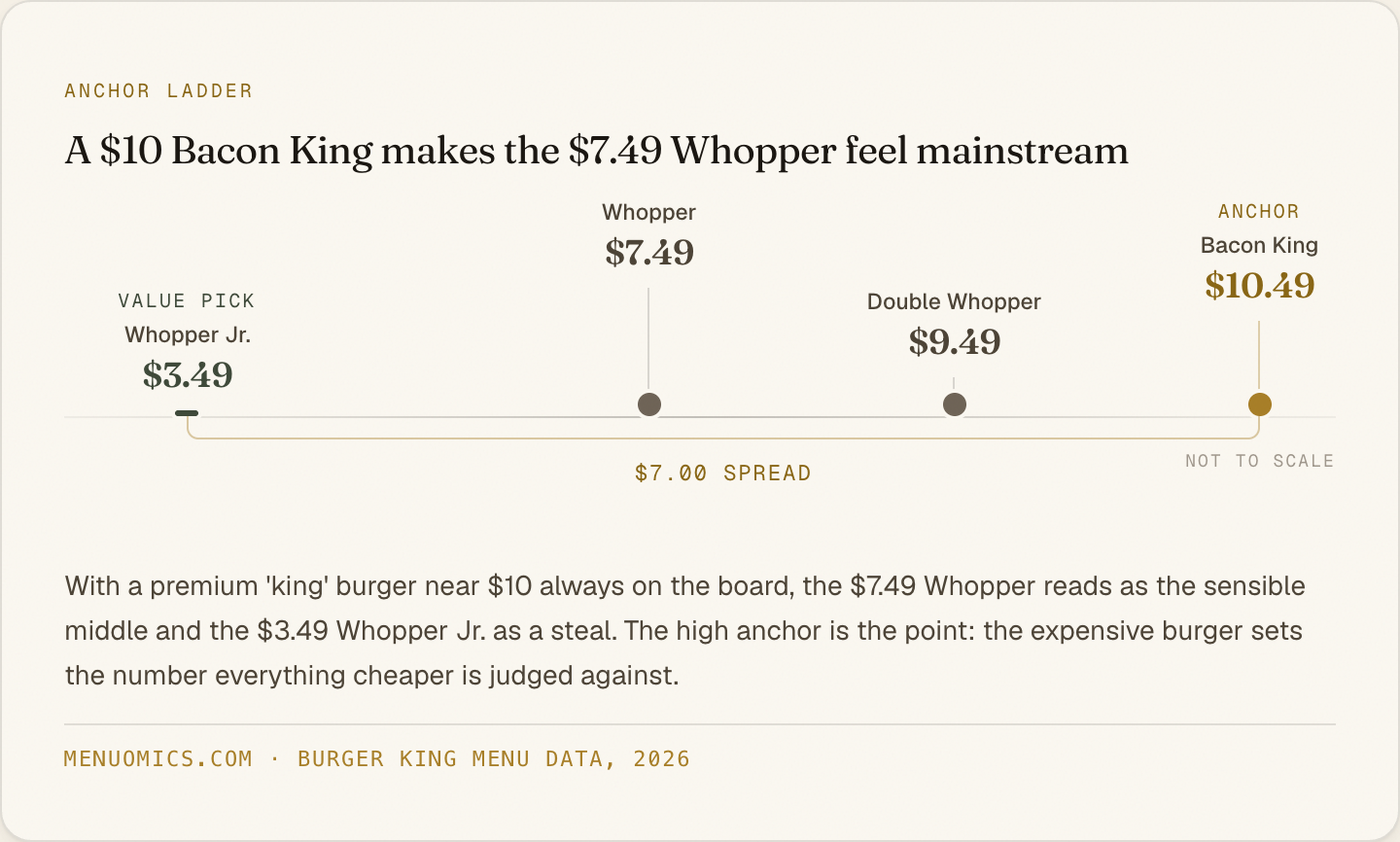
A $10 Bacon King makes the $7.49 Whopper feel mainstream
With a premium 'king' burger near $10 always on the board, the $7.49 Whopper reads as the sensible middle and the $3.49 Whopper Jr. as a steal. The high anchor is the point: the expensive burger sets the number everything cheaper is judged against.
Download this chart (PNG) · free to reuse with credit, see reuse terms.
The full ticket
What it actually rings up to.
The headline price is only the start. The real number is the journey from a base order to the check at the register, one easy yes at a time.
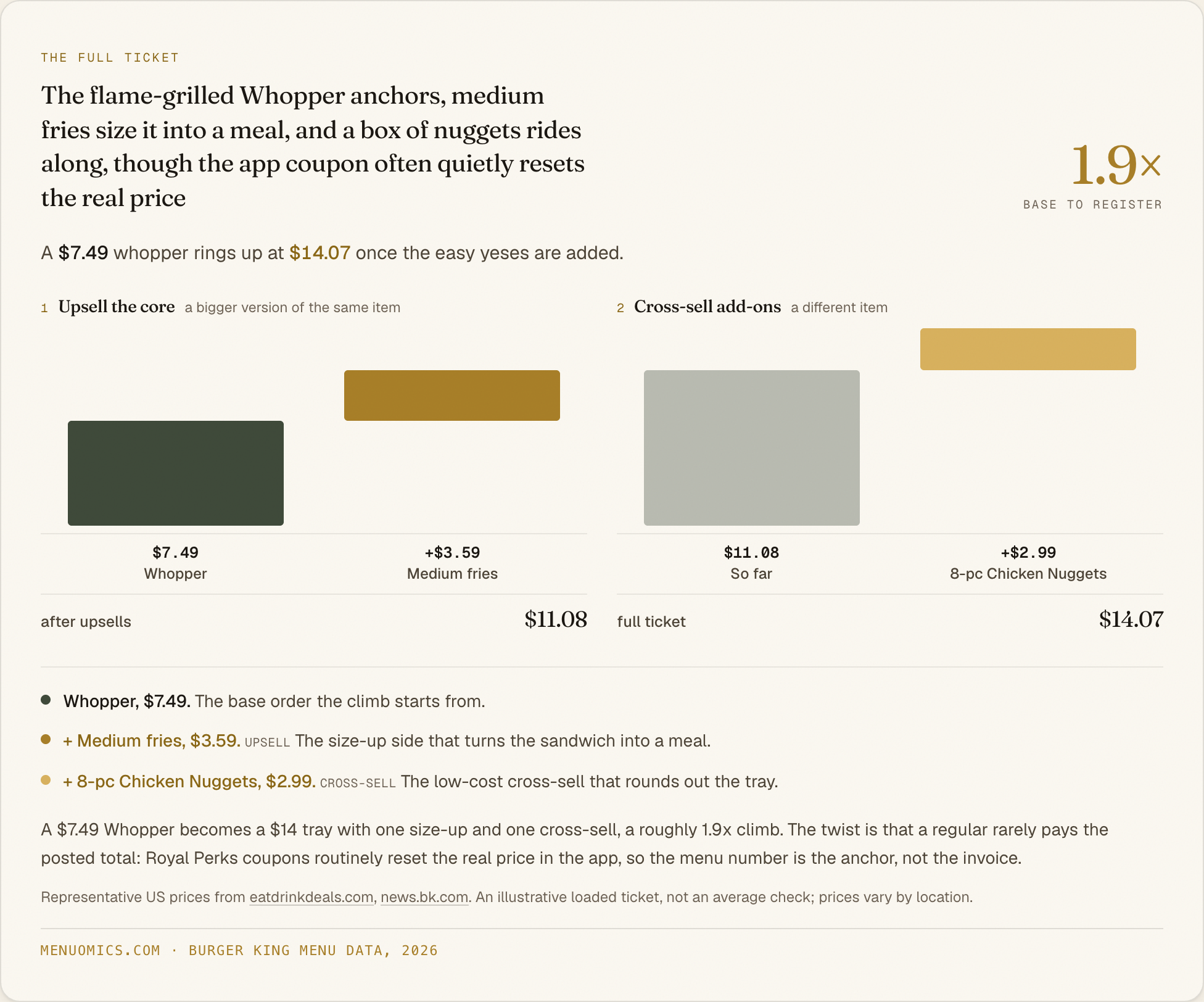
The flame-grilled Whopper anchors, medium fries size it into a meal, and a box of nuggets rides along, though the app coupon often quietly resets the real price
A $7.49 whopper rings up at $14.07 once the easy yeses are added.
- Whopper, $7.49. The base order the climb starts from.
- + Medium fries, $3.59. upsell The size-up side that turns the sandwich into a meal.
- + 8-pc Chicken Nuggets, $2.99. cross-sell The low-cost cross-sell that rounds out the tray.
A $7.49 Whopper becomes a $14 tray with one size-up and one cross-sell, a roughly 1.9x climb. The twist is that a regular rarely pays the posted total: Royal Perks coupons routinely reset the real price in the app, so the menu number is the anchor, not the invoice.
Representative US prices from eatdrinkdeals.com, news.bk.com. An illustrative loaded ticket, not an average check; prices vary by location.
Download this chart (PNG) · free to reuse with credit, see reuse terms.
The setup
Burger King opened as Insta-Burger King in 1953 in Jacksonville, Florida, was bought and renamed by James McLamore and David Edgerton in 1959, and is now an independently run subsidiary of Restaurant Brands International (NYSE: QSR), alongside Tim Hortons, Popeyes and Firehouse Subs. It runs roughly 6,600 US locations and more than 18,700 worldwide, the second-largest burger chain behind McDonald's, and it is in the middle of a 'Reclaim the Flame' turnaround of remodels, a reformulated Whopper and a new brand platform.
What makes the board worth reading is how deliberately it anchors. The flame-grilled Whopper is the named flagship, premium 'king' burgers sit above it as high anchors, and the value architecture is coded straight into the price labels: the $5 Duo, the $7 Trio, the $5 Your Way Meal. (Burger King does not frame these as behavioral tactics; this is our reading of the observed design.)
What they get right
The behavioral economics already at work.
Premium 'king' burgers anchor the Whopper as mainstream
The Bacon King (~$10.49) and Double Whopper (~$9.49) sit at the top of the board, so a guest who registers a $10 burger as the ceiling reads the $7.49 Whopper as the sensible middle and the $3.49 Whopper Jr. as a steal. The expensive burgers rarely need to sell in volume; they exist to set the reference price every cheaper item is judged against.
anchoring (Tversky & Kahneman 1974); the Bacon King and Double Whopper priced above the Whopper
The value tiers are named after their price
The $5 Duo (pick two) and $7 Trio (pick three) code the value architecture straight into the price label, collapsing the decision into a single number. The Trio is a textbook decoy: it makes the Duo feel restrained while nudging a third item for two more dollars, and the mix-and-match format adds a feeling of control while still steering the check above a lone a la carte sandwich.
the $5 Duo and $7 Trio mix-and-match tiers; bundling and the compromise effect
The app gates the real price
Royal Perks awards 10 Crowns per dollar and pushes constant app-only coupons, with the first redemption tier lowered to 200 Crowns so rewards feel reachable. Routing discounts through the app means the menu price is rarely the price paid: the regular sees a coupon-adjusted number, which blunts price salience, builds a points-and-streaks habit loop, and lets Burger King discount selectively without lowering the posted anchor.
Royal Perks (10 Crowns per dollar; app-exclusive coupons; lowered first-redemption tier)
Limited drops and a 2026 reset manufacture a reason to return
Rotating 'Whopper by You' limited-time burgers (the 2026 Peppercorn BLT, past Steakhouse and BBQ Brisket builds) create urgency and novelty, while the March 2026 'There's a New King and It's You' repositioning retired the King mascot and had the brand publicly take complaint calls. Scarcity raises perceived value, and the reinvention itself reads as a freshness signal and a reason to revisit.
Worchel, Lee & Adewole 1975; the 'Whopper by You' LTOs and the 2026 'new King is you' campaign
'Your Way' frames the burger as the customer's own
Burger King's six-decade 'Have It Your Way' promise became 'You Rule' in 2022 and 'the new King is you' in 2026, all casting the guest as the decision-maker. A build-your-own burger feels more 'mine,' which raises willingness to pay even when the product is standard, and the '$5 Your Way Meal' name deliberately ports that ownership language onto the value tier so the cheapest option still feels chosen.
'Have It Your Way' / 'You Rule' / the $5 Your Way Meal; the endowment effect
What we’d test
The rewrite, with the expected lift and the honest caveat.
Show the Duo and Trio savings on the deal itself
The bundles are cheaper than building the order a la carte, but the saving is not stated where the choice is made. Printing 'about $9 of food for $7' on the Trio makes the discount concrete and anchors the deal as a win, which is when a stated saving lifts perceived value most. The math already favors the bundle; the board just has to show it.
Expect A higher bundle attach rate as the saving reads on the page, lifting the average check
Caveat Menu-copy only: it states the existing bundle saving, it does not change pricing, portions or the food.
Lead the Whopper with its flame-grilled cue
Flame-grilling is Burger King's one genuine product differentiator, but the board states it flatly. Naming it in sensory, provenance terms ('flame-grilled over an open flame') raises perceived quality and taste expectations at no cost, the way descriptive menu labels reliably lift both appeal and willingness to pay. The attribute already exists; the wording carries it.
Expect A lift in Whopper preference and perceived quality as the flame-grilled cue reads at the point of choice
Caveat Menu-copy only: it describes an existing cooking method, it does not change the recipe or the price.
Surface the make-it-a-meal upgrade inline on the Whopper
The combo upgrade exists, but the board rarely shows the small upcharge next to the sandwich. Placing 'add medium fries and a drink for a few dollars' inline makes the good/better step legible at the moment of decision, the way a visible trade-up nudges the mix up without a hard push. The upgrade already exists; the layout carries it.
Expect A higher combo attach rate as the meal upgrade reads as the easy next step
Caveat Menu-layout only: it surfaces an existing upgrade, it does not change pricing or portions.
What diners actually say
Synthesized from public reviews, the reality check that grounds every recommendation.
They praise
- The turnaround is landing: 'Reclaim the Flame' remodels have driven double-digit sales lifts and growth that outpaced the market in most recent quarters
- A disciplined value menu: the $5 Duo, $7 Trio and $5 Your Way Meal drive traffic while protecting franchisee margins
- A genuinely upgraded core product: the reformulated Whopper, with a premium bun and new packaging, drew strong consumer reaction
- Sharp, attention-getting brand work: the 'You Rule' and 'new King is you' campaigns went viral, and the president's public complaint line drew tens of thousands of calls
They criticize
- Value perception still trails McDonald's, which has out-messaged Burger King and Wendy's on the deal-seeker's reference point
- Severe franchisee distress: major operators closed or filed for bankruptcy and the US footprint shrank again to roughly 6,600
- Discount and app-coupon dependence historically suppressed margins and starved remodels, the very problem the turnaround set out to fix
- Quality and consistency gripes: Burger King admitted stores did not follow consistent Whopper prep, and the 2026 apology campaign acknowledged it
- Pricing by name trains guests to wait for the next $5 or $7 deal, which can erode the worth of the full-price Whopper the brand is trying to elevate
The verdict
Read as menu design, Burger King runs a smart top-down board: premium 'king' burgers anchor the Whopper as the sensible middle, the $5 Duo and $7 Trio code the value straight into the price label, 'Your Way' frames the burger as the guest's own, and Royal Perks quietly decides what a regular actually pays. It is sophisticated enough to be working: the 'Reclaim the Flame' turnaround has produced real sales lifts. The catch is the one the No. 2 chain can least afford. Value perception still trails McDonald's, franchisees have struggled, and constant '$5/$7' and app-coupon framing trains guests to wait for a deal, which undercuts the upgraded full-price Whopper the brand is trying to elevate. The upside left on the table is honest and cheap: show the bundle saving on the bundle, lead the Whopper with its flame-grilled cue, and surface the meal upgrade inline, so the value and the quality the menu already has are legible at the moment of choice.
Common questions
- Why is the Burger King menu built around the Whopper?
- The Whopper is the named, advertised flagship at about $7.49, and the whole board is priced around it. Premium burgers like the Double Whopper (~$9.49) and Bacon King (~$10.49) sit above it as high anchors, which makes the Whopper read as mainstream and the $3.49 Whopper Jr. read as a steal. The reference price is engineered from the top down.
- Is the Burger King $5 Duo or $7 Trio worth it?
- The $5 Duo (pick two) and $7 Trio (pick three) let you mix and match from items like the Whopper Jr., Bacon Cheeseburger, nuggets and fries. Naming each tier after its price collapses the decision into one number, and the $7 Trio makes the $5 Duo feel restrained while nudging a third item for two more dollars. It is usually cheaper than building the same order a la carte.
- What is the '$5 Your Way Meal' at Burger King?
- The $5 Your Way Meal bundles one entree (a Whopper Jr., Chicken Jr. or Bacon Cheeseburger) with 4-piece nuggets, small fries and a small drink for a flat $5. The 'Your Way' name ports Burger King's decades-old 'Have It Your Way' ownership language onto the value tier, so the cheapest option still feels chosen rather than settled for.
- What is Burger King's 2026 'new King is you' campaign?
- In March 2026 Burger King evolved its 2022 'You Rule' platform into 'There's a New King and It's You,' retiring the King mascot and putting the customer at the center. Its president even took customer-complaint calls publicly, a credibility-through-humility move borrowed from Domino's 2010 turnaround. The reinvention itself doubles as a freshness signal and a reason to revisit.
- What is the most expensive item at Burger King?
- On the standard menu, the priciest single item is the Bacon King, about $10.49 in representative 2026 US pricing (it varies by location; group packs and combo deals can cost more). That top price also does quiet work as the menu's anchor: it is the number that makes everything below it read as reasonable.
- How much is a meal at Burger King?
- A meal at Burger King starts around $7.49 for the base order and lands near $14.07 once the usual add-ons go on, roughly 1.9x the headline price (representative 2026 US figures; they vary by location). That gap between the price that gets you in and the total you pay is the multiplier this page grades.
Sources (6)
- Burger King, Wikipedia (founding, ownership, scale)
- Burger King Newsroom, the 'You Rule' brand platform
- EatDrinkDeals, Burger King menu, the $5 Duo and $7 Trio (2026, representative)
- Brand Eating, Burger King's $7 Trio and updated $5 Duo (run dates)
- Tasting Table, Burger King's 2026 comeback and Whopper upgrade
- Restaurant Business, Burger King proves heavy discounts are not always necessary
Head to head
More breakdowns
 In-N-Out BurgerA
Three burgers, no seasonal items, and a famous off-menu modifier ('Animal Style') that turns customers into evangelists. Restraint as strategy.
Read the In-N-Out Burger breakdown → Chick-fil-AA
A famously simple chicken sandwich, an easy 'make it a meal' bundle, and free dipping sauces, wrapped in the most-praised service in fast food. The menu stays out of the way so the hospitality can do the selling.
Read the Chick-fil-A breakdown → Chili's Grill & BarA-
A $10.99 bundle dragged Chili's out of a slump and back to the top of casual-dining traffic. Read closely, '3 For Me' is one round number doing the work of three separate decisions.
Read the Chili's Grill & Bar breakdown → Domino'sB+
The $6.99 Mix & Match looks like a low price. Its real design is the words 'two or more': a self-bundle that turns one cheap pizza into a full cart.
Read the Domino's breakdown → Jersey Mike'sB+
Numbered subs in three sizes, a free signature modifier called 'Mike's Way,' and a Giant pitched as the smart-value pick. The size ladder, not the combo, is where the menu does its work.
Read the Jersey Mike's breakdown → Logan's RoadhouseB
A steakhouse that reviewers rank dead last still runs a value menu most casual chains would be proud of. The food is panned; the menu design is not. That gap is the whole point.
Read the Logan's Roadhouse breakdown →Your menu next
Get this for your own menu, free.
Send your menu and we’ll send back the same breakdown, what you get right, what we’d test, and why.
Dunkin'
A premium latte anchors the cheap iced coffee as the obvious default, the $6 Meal Deal bundles the breakfast, and Dunkin' Rewards turns the morning run into a streak. The menu craft is textbook; the strain is price creep and an app that increasingly decides the real price.
Read it →