
Carvel menu, graded
Carvel runs two menus from one counter: a short, cheap soft-serve board that builds a weekly habit around buy-one-get-one Wednesday sundaes, and a nostalgic cake case where a whale-shaped mold from 1977 anchors prices near $55, so the everyday cone visit quietly frames and funds the high-margin occasion cake.
How a $1.99 kids cone, a buy-one-get-one Wednesday, and a ~$54.99 whale-shaped cake turn a shrinking chain's menu into an anchoring machine.
Menu-craft grade
The cake anchor is all-time great menu craft: Fudgie the Whale is a nostalgic character item that still sells close to 100,000 units a year at roughly eleven times the price of a large cone, and Wednesday is Sundae is one of the oldest day-of-week habit promotions in food service. It stays out of the A range because the price communication is muddy. Character cakes are published open-ended ($54.99 and up), shoppe-to-shoppe spreads are wide, a cheaper supermarket cake line trains a lower reference price for the same brand, and the soft-serve size ladder is erratic rather than engineered.
Graded on how well the menu uses behavioral economics, not the food.
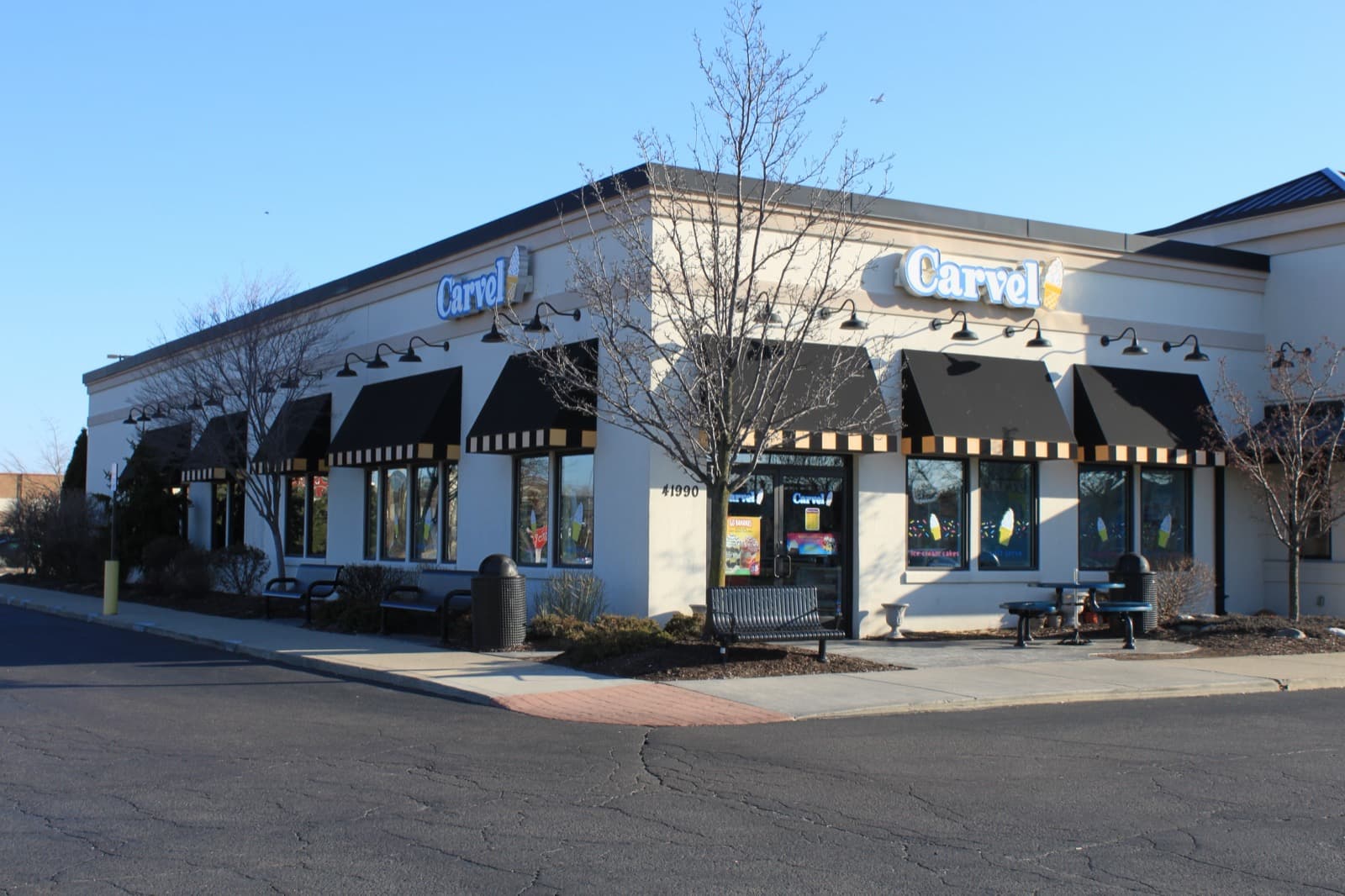
Menu and prices verified September 2026
A 4-minute audio read of the analysis
- Type
- Chain
- Where
- Atlanta, Georgia (headquarters)
- Cuisine
- Soft serve, sundaes, and ice cream cakes
- Footprint
- ~326 shoppes across 16 states and 8 countries (2025), down from ~865 at the 1985 peak
- Since
- 1934 (Hartsdale, New York; founder Tom Carvel)
- Ownership
- GoTo Foods (formerly Focus Brands), a Roark Capital portfolio company since 2001; shoppes are franchised
The mechanics, drawn
The same menu, mapped onto an axis, so the behavioral move is something you can see, not just read.
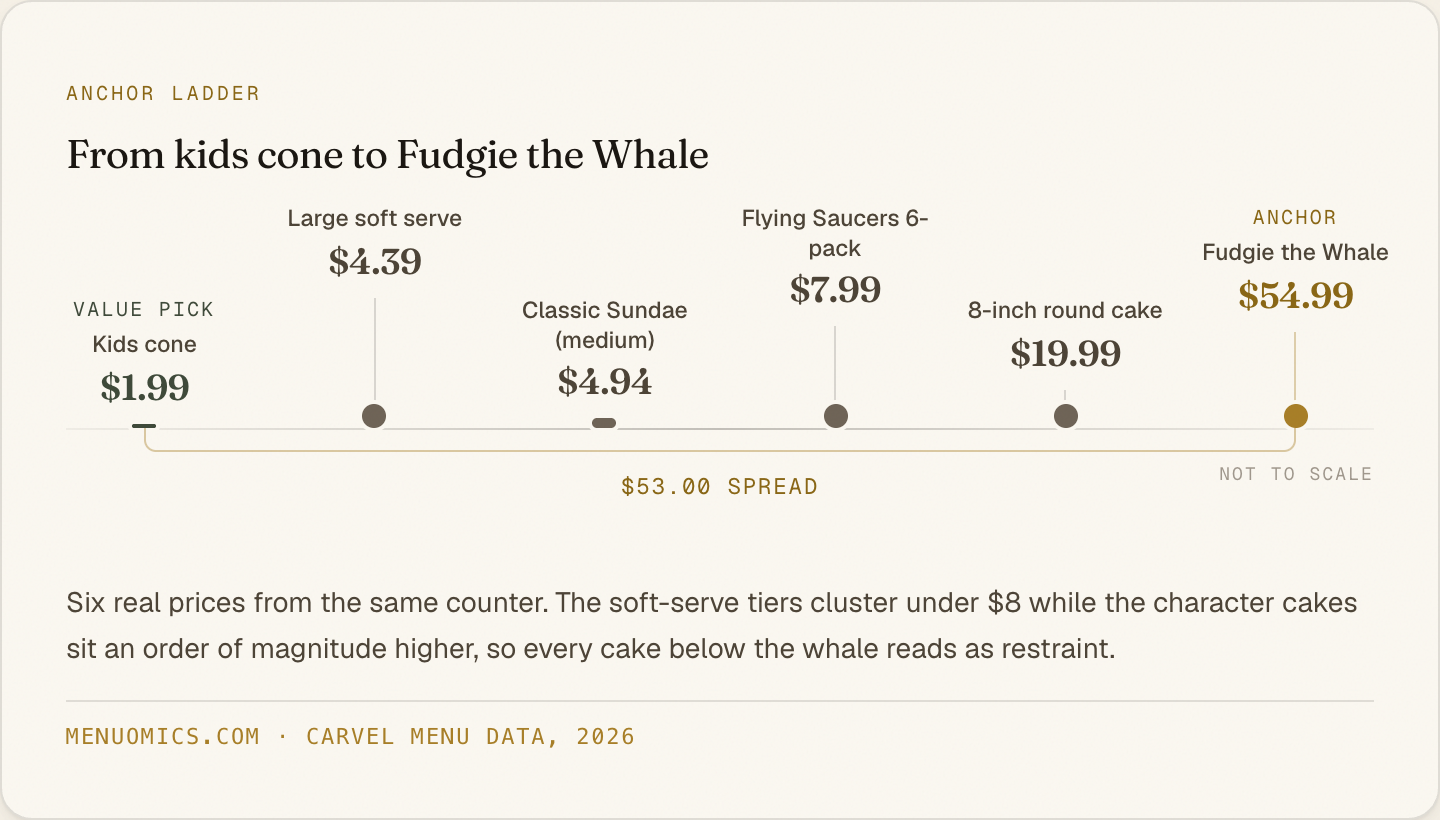
From kids cone to Fudgie the Whale
Six real prices from the same counter. The soft-serve tiers cluster under $8 while the character cakes sit an order of magnitude higher, so every cake below the whale reads as restraint.
Download this chart (PNG) · free to reuse with credit, see reuse terms.
The full ticket
What it actually rings up to.
The headline price is only the start. The real number is the journey from a base order to the check at the register, one easy yes at a time.
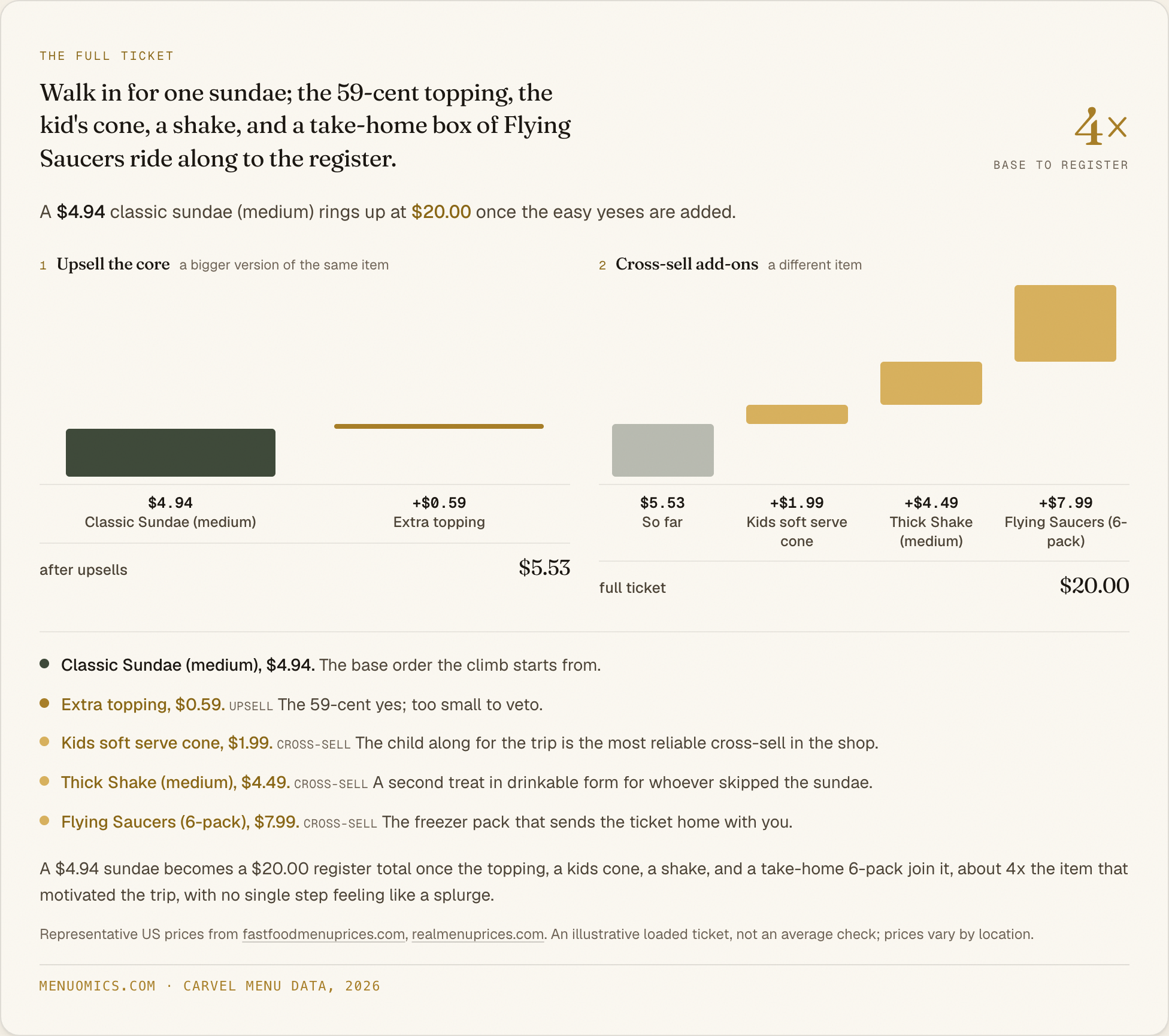
Walk in for one sundae; the 59-cent topping, the kid's cone, a shake, and a take-home box of Flying Saucers ride along to the register.
A $4.94 classic sundae (medium) rings up at $20.00 once the easy yeses are added.
- Classic Sundae (medium), $4.94. The base order the climb starts from.
- Extra topping, $0.59. upsell The 59-cent yes; too small to veto.
- Kids soft serve cone, $1.99. cross-sell The child along for the trip is the most reliable cross-sell in the shop.
- Thick Shake (medium), $4.49. cross-sell A second treat in drinkable form for whoever skipped the sundae.
- Flying Saucers (6-pack), $7.99. cross-sell The freezer pack that sends the ticket home with you.
A $4.94 sundae becomes a $20.00 register total once the topping, a kids cone, a shake, and a take-home 6-pack join it, about 4x the item that motivated the trip, with no single step feeling like a splurge.
Representative US prices from fastfoodmenuprices.com, realmenuprices.com. An illustrative loaded ticket, not an average check; prices vary by location.
Download this chart (PNG) · free to reuse with credit, see reuse terms.
The setup
Carvel is the oldest name in American soft serve. Tom Carvel borrowed $15 from his future wife in 1929 to run an ice cream truck, got a flat tire in Hartsdale, New York over Memorial Day weekend 1934, sold his softening stock to passing drivers in two days, and concluded that semi-melted ice cream at a fixed spot was the better business. The company says it was the first to franchise a retail ice cream shop in the United States (1947 by its own telling; Wikipedia dates formal franchising to 1949 under the Carvel Dari-Freez name). The chain peaked around 865 shoppes in 1985 and has contracted to roughly 326 locations across 16 states and 8 countries, run today from Atlanta by GoTo Foods, the Roark Capital platform formerly called Focus Brands.
What survives is a menu with two distinct jobs. The walk-up board sells cones, sundaes, Carvelanches, and shakes at neighborhood prices, with a buy-one-get-one sundae deal every Wednesday that has run for decades. The cake case sells occasions: round and sheet cakes sitting beneath the two most famous shaped desserts in the country, Cookie Puss, the original character cake built in the early 1970s around Flying Saucer cookies, and Fudgie the Whale, a 1977 Father's Day pun ('a whale of a dad') that still moves close to 100,000 units a year. The cheap board builds the visit habit while the whale collects the celebration margin. (Carvel does not frame any of this as behavioral tactics; this is our reading of the observed design.)
What they get right
The behavioral economics already at work.
A 1977 whale is one of the most durable anchors in food retail
Fudgie the Whale was invented for Father's Day 1977 as a pun on 'a whale of a dad,' and the same molded design still sells close to 100,000 cakes a year. At roughly $54.99 it sits at the top of the printed menu, about eleven large cones' worth, and its job up there is to reset what a Carvel purchase can cost, which makes the $19.99 round cake and the $29.99 sheet feel like the sensible middle. Nostalgia does the second half of the work: Lasaleta, Sedikides and Vohs (2014) found that nostalgic feelings weaken people's desire to hold onto money, and a Fudgie buyer is almost by definition in that state.
Close to 100,000 Fudgie the Whale cakes sold per year on a design unchanged since 1977, CNN Business (June 2024)
Wednesday is Sundae is a habit loop older than most chains
A fixed weekday plus a reliable reward is the basic recipe for a habit: cue, routine, payoff. Carvel has run 'Wednesday is Sundae' for decades, and the current form gives a free sundae with one bought at full price, in-store, every single Wednesday. The 2026 version adds a gate: the deal requires membership in the Fudgie Fanatics rewards program, which converts an anonymous weekly ritual into an identified, trackable one and hands Carvel the contact data of exactly its most habitual guests.
Buy one sundae, get one free, every Wednesday in-store; rewards membership required (2026), Carvel offers page via EatDrinkDeals (June 2026)
Two menus, two mental accounts
The same counter sells a $3.87 cone and a $54.99 cake, and nobody blinks at the 14x gap because the two purchases live in different mental budgets. The cone is judged in the snack account against McDonald's soft serve; the whale is judged in the celebration account against a bakery cake, party supplies, and the cost of disappointing your dad. By housing an occasion business inside a treat shop, Carvel collects celebration-budget margins on soft serve it is already spinning, and the walk-in traffic doubles as a standing ad for the cake case.
Large soft serve ~$4.39 vs Fudgie the Whale ~$54.99 on the same menu, FastFoodMenuPrices; MenuPriceGuide (2025-26 price lists)
The 39-cent upsize
Soft serve runs five sizes: $1.99, $2.77, $3.48, $3.87, $4.39. The step from small to medium is 39 cents and medium to large is 52 cents, so at the register each next size feels close to free even though the large costs more than double the kids cone. Five tiers also give the ladder a long top and bottom, and extremeness aversion pushes most guests off both ends into the middle sizes, where the per-step margin is best.
Small $3.48, medium $3.87, large $4.39; going small to large costs 91 cents, FastFoodMenuPrices Carvel price list (2026)
The supermarket case resets your reference price
Carvel cakes sit in the freezer aisles of more than 8,500 supermarkets while only about 326 shoppes remain, so most Americans now meet the brand at grocery prices. That keeps Carvel alive far beyond its shrunken footprint, and it feeds the occasion business year-round, but it also trains a much lower reference price for a branded ice cream cake than the one the shoppe charges. A shopper who has seen the packaged cakes all year feels the gap the moment a shoppe quotes the made-to-order number.
Cakes in more than 8,500 supermarkets vs ~326 shoppes (2025), Wikipedia; Carvel via PR Newswire
What we’d test
The rewrite, with the expected lift and the honest caveat.
Post a committed price on the whale
Published lists show the character cakes as '$54.99+', an open-ended number that forces guests to call or visit to learn what a Fudgie actually costs. Every cake page online should pull the real committed price from the local shoppe's ordering system, the same number the order flow already uses, so the occasion buyer can budget before they are standing at the counter.
Expect More completed online cake orders and fewer abandoned price-check calls.
Caveat Franchisees guard pricing autonomy; the fix is displaying each shoppe's own number, not standardizing it.
Bridge the Wednesday habit to the cake case
The rewards gate on Wednesday sundaes identifies Carvel's most habitual weekly guests, but the habit currently lives entirely in the snack account. Let Wednesday visits accrue visible progress toward a cake credit (for example, a counter in the app that fills toward money off any character cake) so the weekly ritual points at the high-margin occasion purchase it currently never touches.
Expect Higher cake attach rate among rewards members and more birthdays captured before guests price a grocery cake.
Caveat The credit must be meaningful; a token discount on a $55 cake will read as an ad, not a reward.
Make the cheap upsize explicit
The small-to-medium step on soft serve is 39 cents, but the board presents three flat prices and leaves the math to the guest. Flagging the step cost at the point of choice ('medium: 39 cents more') makes the near-free upgrade visible and moves the default order up a size with no price change at all.
Expect A higher share of medium and large cups at identical menu prices.
Caveat Works only while the steps stay small; if the gap creeps past a dollar the callout starts hurting.
What diners actually say
Synthesized from public reviews, the reality check that grounds every recommendation.
They praise
- Fudgie the Whale is a 49-year-old premium anchor that still sells close to 100,000 units a year, a brand asset almost no chain menu can match.
- Wednesday is Sundae is one of the longest-running day-of-week habit promotions in American food service, and it now doubles as a rewards-signup engine.
- The core soft-serve board stays short and legible: a handful of formats on one base product, with little of the choice overload that bloats competitors.
- The Flying Saucers 6-pack is a clean freezer cross-sell that extends the ticket beyond the visit and into the guest's home.
- Distribution in 8,500+ supermarkets keeps the brand present in weekly shopping trips even in the many regions where the shoppes themselves have vanished.
They criticize
- The footprint has collapsed from roughly 865 shoppes at the 1985 peak to about 326 today, and the menu's habit loops only work where a store still exists.
- Character cake pricing is published open-ended ('$54.99+'), so occasion buyers often discover the real number only at the counter or on the phone.
- Shoppe-to-shoppe spreads on identical items are wide even by franchise standards, which erodes trust in any posted price.
- The cheaper packaged cakes in supermarket freezers train shoppers on a lower reference price that the shoppe-made cakes then have to fight.
- Gating the once-simple Wednesday BOGO behind rewards membership trades a beloved no-strings deal for data capture, adding friction to the chain's best habit.
The verdict
On menu craft, Carvel is a study in how much work two old ideas can still do. Fudgie the Whale is close to a perfect anchor: a high, memorable, emotionally loaded price at the top of the board that makes every cake under it look reasonable, renewed each year by Father's Day nostalgia. Wednesday is Sundae is a habit loop that predates the modern loyalty industry and now feeds it. The weaknesses are all in the plumbing: open-ended cake pricing, erratic size-ladder steps, and a supermarket line that quietly undercuts the shoppe frame. The architecture deserves its B+; a chain a third of its former size cannot afford to make its best customers guess what the whale costs.
Common questions
- How much does a Fudgie the Whale cake cost in 2026?
- Published shoppe price lists show Fudgie the Whale at about $54.99 and up, but Carvel shoppes are franchised and set prices locally, so the real number varies widely by location and delivery app. Packaged Carvel cakes sold in supermarket freezers are a separate, cheaper product line.
- What is Carvel's Wednesday is Sundae deal?
- Every Wednesday, participating Carvel shoppes give you a free sundae when you buy one at regular price, in-store. As of 2026 the deal requires free membership in Carvel's Fudgie Fanatics rewards program, and new members also get a BOGO sundae coupon at signup.
- Who owns Carvel?
- Carvel is owned by GoTo Foods, the Atlanta-based franchise platform formerly known as Focus Brands, which has been controlled by private equity firm Roark Capital since 2001. Individual shoppes are franchised, and Carvel-branded cakes are also sold in more than 8,500 supermarkets.
- Was Carvel really the first ice cream franchise?
- Carvel says it was the first company to franchise a retail ice cream shop in the United States, dating the claim to 1947; Wikipedia records formal franchising beginning in 1949 under the Carvel Dari-Freez name. The business itself began when Tom Carvel's ice cream truck got a flat tire in Hartsdale, New York in 1934 and he sold his melting stock on the spot.
- What is the most expensive item at Carvel?
- On the standard menu, the priciest single item is the Cookie Puss Cake, about $54.99 in representative 2026 US pricing (it varies by location; group packs and combo deals can cost more). That top price also does quiet work as the menu's anchor: it is the number that makes everything below it read as reasonable.
- How much is a meal at Carvel?
- A meal at Carvel starts around $4.94 for the base order and lands near $20.00 once the usual add-ons go on, roughly 4x the headline price (representative 2026 US figures; they vary by location). That gap between the price that gets you in and the total you pay is the multiplier this page grades.
Sources (8)
- Carvel: About Us (official history)
- Wikipedia: Carvel (franchise)
- CNN Business: How Fudgie the Whale became a Father's Day icon (2024)
- FastFoodMenuPrices: Carvel menu prices (2026)
- MenuPriceGuide: Carvel menu with character cake prices
- EatDrinkDeals: Carvel Wednesday BOGO sundae details (June 2026)
- PR Newswire: Carvel Crunchie cakes at grocery retailers
- WPDH: Hudson Valley loses another Carvel (Feb 2026)
Head to head
More breakdowns
 The Cheesecake FactoryB+
A 21-page, 250-item menu should be a behavioral disaster. It's a roughly $4-billion chain. Here's what all that abundance is quietly doing.
Read the The Cheesecake Factory breakdown → McDonald'sA-
The Extra Value Meal is one of the most-copied ideas in food: fold the whole order into a single number that hurts less than three. Then McValue and the app pile value on top, and the McRib drops in as an event.
Read the McDonald's breakdown → Taco BellA-
A sub-$3 value menu sets the floor, $5/$7/$9 boxes name the deal after its own price, and a never-ending limited-time calendar keeps a reason to come back on the board. Taco Bell sells value loudly, and it works: it gained traffic while rivals shrank.
Read the Taco Bell breakdown → Dunkin'A-
A premium latte anchors the cheap iced coffee as the obvious default, the $6 Meal Deal bundles the breakfast, and Dunkin' Rewards turns the morning run into a streak. The menu craft is textbook; the strain is price creep and an app that increasingly decides the real price.
Read the Dunkin' breakdown → Panda ExpressB+
The whole order comes down to one question, how many entrees. A Bowl is one, a Plate is two, a Bigger Plate is three, and the menu is built so the middle Plate wins. Orange Chicken is the anchor everyone orders, and a quiet $1.50 premium upcharge lifts the check while the headline price stays put.
Read the Panda Express breakdown → Raising Cane'sA-
The chicken-finger chain that built a billion-dollar machine by refusing to sell almost anything else.
Read the Raising Cane's breakdown →Your menu next
Get this for your own menu, free.
Send your menu and we’ll send back the same breakdown, what you get right, what we’d test, and why.
Schlotzsky's
An Austin-born deli chain still anchored by its 1971 one-sandwich origin, a muffuletta-style Original on a round sourdough bun, now wrapped in a three-size price ladder, a pizza-and-calzone sprawl, and a Cinnabon counter at the register.
Read it →