Schlotzsky's menu, graded
Schlotzsky's runs The Original as a three-rung size ladder where the step from small to medium costs about $1.50 but the step to large costs nearly seven dollars, so the medium reads as the automatic compromise, while a sourdough bun baked from scratch in every store supplies the quality story that lets the whole board price above the sub-chain floor.
How a $1.50 upsize step, a $15.79 large, and a cinnamon roll at checkout grow a one-sandwich heritage menu into an $18 lunch.
Menu-craft grade
The Original's size ladder is real craft, a $1.50 step that makes the medium feel automatic and a ~$15.79 large that anchors the board, and the 2021 cut from 27 sandwiches to 12 showed genuine choice discipline. It loses ground because the board has sprawled back out into pizzas, flatbreads, calzones, salads, and soups that dilute the one-bun story, franchisee pricing varies so much that no reference price ever forms, and the deal structure is a scatter of local BOGOs and app offers instead of one number anyone can remember.
Graded on how well the menu uses behavioral economics, not the food.
Menu and prices verified September 2026
A 4-minute audio read of the analysis
- Type
- Chain
- Where
- Atlanta, Georgia (headquarters); founded in Austin, Texas
- Cuisine
- Fast-casual deli sandwiches, pizzas, and soups
- Footprint
- ~300 US restaurants (2026), down from a 759-store peak in 2001; more than 180 in Texas
- Since
- 1971 (Austin, Texas; founders Don and Dolores Dissman)
- Ownership
- GoTo Foods (formerly Focus Brands), a Roark Capital portfolio company; acquired out of bankruptcy in 2006, franchised system
The mechanics, drawn
The same menu, mapped onto an axis, so the behavioral move is something you can see, not just read.
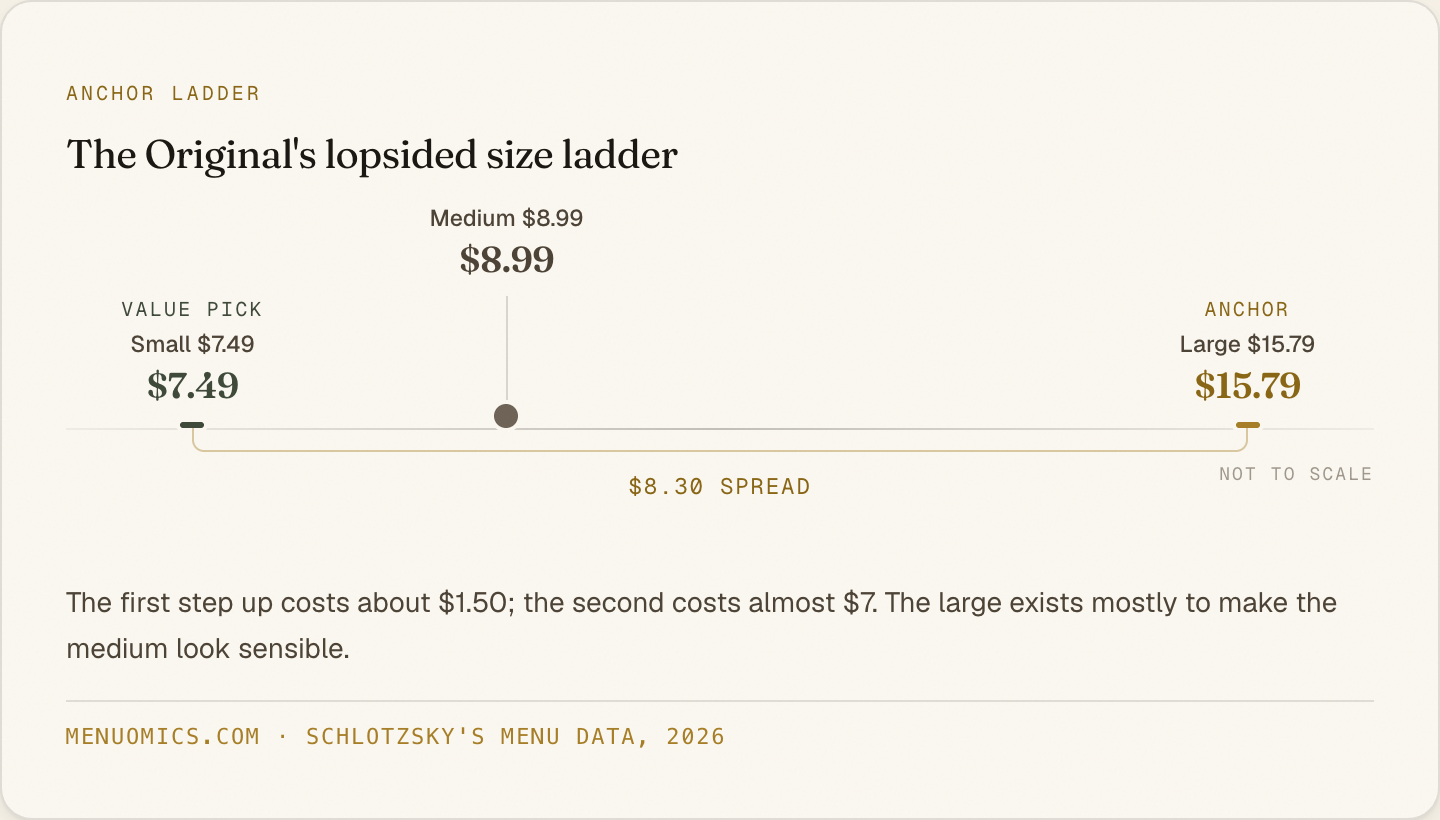
The Original's lopsided size ladder
The first step up costs about $1.50; the second costs almost $7. The large exists mostly to make the medium look sensible.
Download this chart (PNG) · free to reuse with credit, see reuse terms.
The full ticket
What it actually rings up to.
The headline price is only the start. The real number is the journey from a base order to the check at the register, one easy yes at a time.
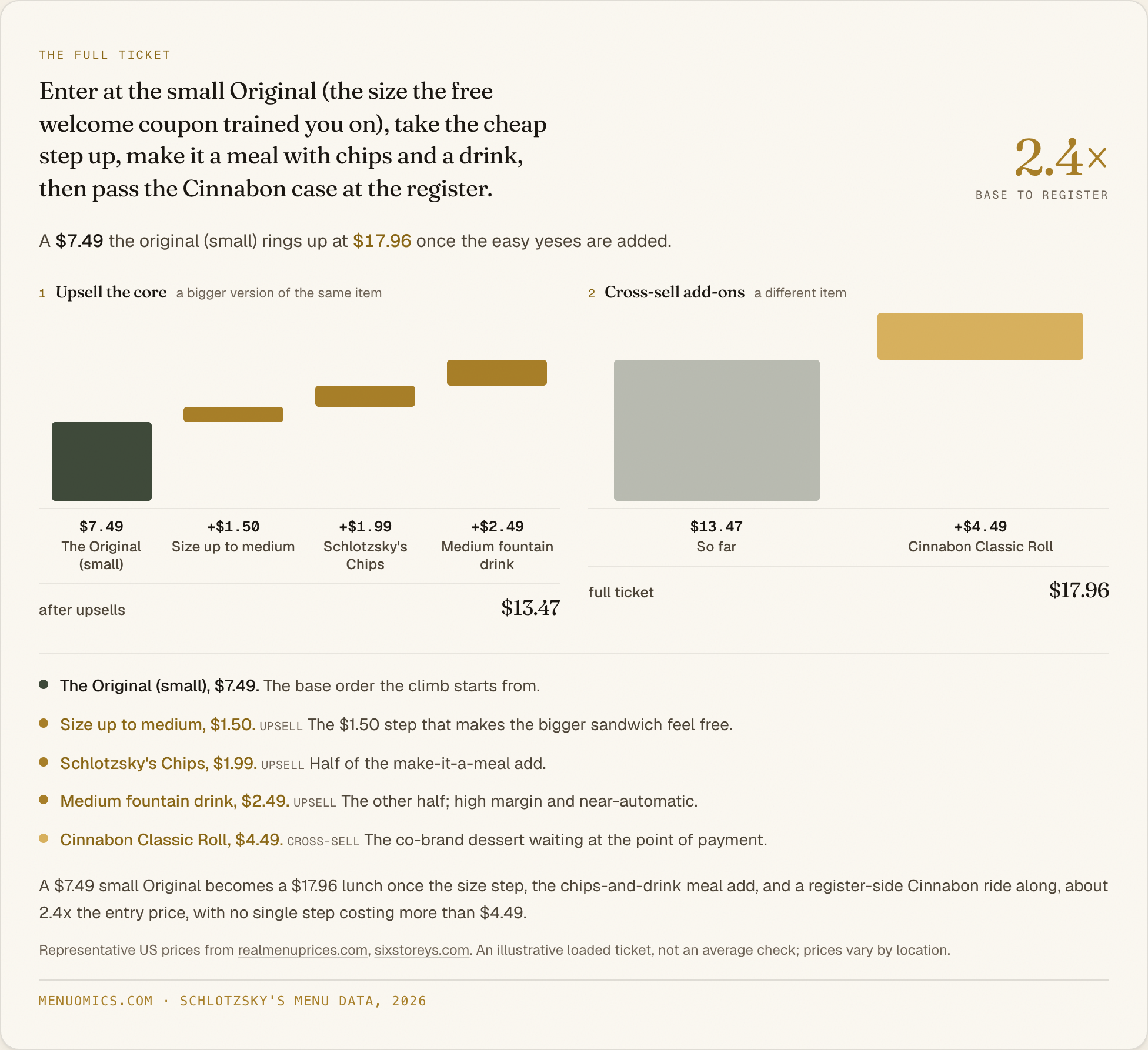
Enter at the small Original (the size the free welcome coupon trained you on), take the cheap step up, make it a meal with chips and a drink, then pass the Cinnabon case at the register.
A $7.49 the original (small) rings up at $17.96 once the easy yeses are added.
- The Original (small), $7.49. The base order the climb starts from.
- Size up to medium, $1.50. upsell The $1.50 step that makes the bigger sandwich feel free.
- Schlotzsky's Chips, $1.99. upsell Half of the make-it-a-meal add.
- Medium fountain drink, $2.49. upsell The other half; high margin and near-automatic.
- Cinnabon Classic Roll, $4.49. cross-sell The co-brand dessert waiting at the point of payment.
A $7.49 small Original becomes a $17.96 lunch once the size step, the chips-and-drink meal add, and a register-side Cinnabon ride along, about 2.4x the entry price, with no single step costing more than $4.49.
Representative US prices from realmenuprices.com, sixstoreys.com. An illustrative loaded ticket, not an average check; prices vary by location.
Download this chart (PNG) · free to reuse with credit, see reuse terms.
The setup
Schlotzsky's opened in 1971 in a small shop on South Congress in Austin, Texas, selling exactly one thing: The Original, founders Don and Dolores Dissman's take on the New Orleans muffuletta, with smoked ham, Genoa salami, three cheeses, black olives, and a signature sauce on a round sourdough bun baked in the store. The one-item menu became a 759-store chain by 2001, then collapsed into Chapter 11 bankruptcy in 2004 after years of over-leveraged expansion. Focus Brands, a Roark Capital affiliate now called GoTo Foods, bought it in 2006, and today roughly 300 US locations remain, more than half of them in Texas. In May 2021 the chain cut its sandwich menu from 27 options to 12 and added 15 to 30 percent more meat by size, an unusually disciplined edit for a brand that had spent decades adding.
The modern board runs on three mechanisms. Nearly every sandwich comes in small, medium, and large, and on The Original the first step up costs about $1.50 while the second costs almost seven dollars, which makes the medium the path of least resistance and the large a ceiling that flatters everything below it. Around that ladder sits the sprawl: specialty pizzas, flatbreads, calzones, salads, and soups, plus Cinnabon bakeries built into most stores since the two sister brands began co-branding. And the app does the price-setting work, with a free small Original for signing up, 2 points per dollar, and a redemption ladder that mirrors the sandwich sizes. (Schlotzsky's does not frame these as behavioral tactics; this is our reading of the observed design.)
What they get right
The behavioral economics already at work.
A $1.50 step and a seven-dollar cliff
The Original's ladder is not evenly spaced, and that is the point. Moving from small to medium costs about $1.50, small enough that refusing it feels cheap, while moving from medium to large costs nearly $7, large enough that almost nobody does it. When options are ranked, people avoid extremes and settle in the middle, and this ladder is engineered so the middle is exactly one painless step above the entry price. The large's real job is to stand at $15.79 and make $8.99 look like restraint.
The Original: small ~$7.49, medium ~$8.99, large ~$15.79 in 2026 aggregator averages, Real Menu Prices; Six Storeys; TheFoodXP, 2025-2026
The bun is the brand
Every Schlotzsky's bakes its round sourdough buns from scratch daily, an operational expense most sandwich chains refuse to carry, and every menu description leans on it: toasted, sourdough, since 1971. Against rectangular rolls at Subway, Jimmy John's, and Jersey Mike's, the round bun is instantly recognizable, and the baked-in-this-building claim is the quality story that justifies a $9 medium. Descriptive, provenance-heavy menu language measurably lifts sales, and Schlotzsky's has a rare version of it that happens to be true.
310+ restaurants serve sandwiches on sourdough buns baked from scratch each day, GoTo Foods brand materials, 2024
The 27-to-12 diet
In May 2021 Schlotzsky's cut its sandwich lineup from 27 options to 12, killing slow sellers like the Caprese and consolidating near-duplicates into single items with a protein choice, while adding 15 to 30 percent more meat depending on size. That is the textbook response to an over-assorted menu: fewer, better-defined choices reduce decision friction for guests and errors for staff, and concentrating volume onto fewer SKUs funded the bigger portions. It was the strongest single piece of menu discipline in the brand's modern history.
Sandwich menu cut from 27 to 12 in May 2021, with 15-30% more meat by size, Nation's Restaurant News, May 2021
A cinnamon roll at the register
After Roark's Focus Brands bought Schlotzsky's in 2006, it began installing sister-brand Cinnabon bakeries inside the restaurants, and by 2010 the plan was for essentially all future units to open co-branded. The effect is a dessert case with its own national brand equity sitting at the point of payment, where a warm $4.49 roll attaches to the lunch mental account instead of requiring a separate treat decision. It is the same slot Wendy's gives the Frosty, filled with a borrowed brand instead of a house item.
50+ co-branded Cinnabon bakeries by 2010, with all future units planned as co-brands, QSR Magazine, 2010
The free sandwich that signs you up
Joining Schlotzsky's Rewards earns a coupon for a free small Original, which is both a gift that invites reciprocation and a trial of the exact heritage item the brand needs you to crave. Members then earn 2 points per dollar, and the redemption ladder mirrors the menu's own size logic: roughly 100 points for a small sandwich, 150 for a medium, 200 for a large. Earned rewards expire 14 days after issue, a deadline that manufactures a return visit on the chain's timetable.
2 points per $1; free small Original at signup; rewards expire 14 days after issue, Schlotzsky's Rewards; SoLoyal loyalty guide; EatDrinkDeals
What we’d test
The rewrite, with the expected lift and the honest caveat.
Print the step, not just the price
On boards, kiosks, and the app, show the medium as an increment rather than a fresh number, so the cheapest step in the ladder does its own selling. The $1.50 delta is the single best number on the menu and it is currently invisible unless a guest does the subtraction.
Expect Higher small-to-medium upsize rate at no discount cost.
Caveat Making deltas salient also exposes the near-$7 jump to large; keep the large presented as a whole price, not a step.
One famous deal instead of many local ones
Consolidate the scattered promotions (BOGO pizza Wednesdays at select stores, $5 weekend personal pizzas, rotating app offers) into a single named, nationally consistent price event. A decade of Wendy's 4 for $4 shows that one memorable number builds a reference price that outlasts any individual discount.
Expect A durable value anchor and improved deal recall in a system that currently has neither.
Caveat Franchisee pricing autonomy makes national price points genuinely hard; this needs operator buy-in, not just marketing.
Make the Cinnabon a one-tap finish
Surface a single add-a-Cinnabon prompt at the final app and kiosk checkout step, after the meal is built, when the marginal $4.49 feels smallest against a $13 ticket. The bakery is already in the building; the attach point should be in the payment flow, not just in the pastry case's sightline.
Expect Higher dessert attach on digital orders, which are the orders that never walk past the case.
Caveat One dismissible prompt only; stacked upsell screens raise abandonment.
What diners actually say
Synthesized from public reviews, the reality check that grounds every recommendation.
They praise
- Sourdough buns baked from scratch in every store, every day, a genuine product differentiator that most national sandwich chains cannot match.
- The 2021 menu streamline was real discipline: 27 sandwiches cut to 12, with the savings reinvested in more meat rather than more SKUs.
- The Original is an authentic signature with a true origin story, a one-item menu from 1971 that still leads the board.
- The free small Original welcome offer puts the heritage product itself in new hands, a smart trial mechanic rather than a generic percent-off coupon.
- The rewards redemption ladder (small at 100 points, medium at 150, large at 200) mirrors the menu's own size logic, a coherent piece of loyalty design.
They criticize
- Menu sprawl: pizzas, flatbreads, calzones, salads, and soups on a brand whose entire story is one sandwich on one bun.
- Price opacity: franchisee pricing varies so widely that 2026 menu trackers disagree by more than a dollar on the same sandwich.
- The nearly seven-dollar jump from medium to large reads as a penalty to value-minded guests rather than a treat tier.
- No memorable national value anchor; the deal calendar is a patchwork of select-store BOGO pizza days and $5 nights.
- The footprint tells its own story: 759 stores in 2001, about 300 today, more than half in Texas, so in much of the country the brand survives mainly as nostalgia.
The verdict
Schlotzsky's has the raw materials of a great menu: a signature item nobody else sells, a bun baked in the building, and a size ladder whose $1.50 first step is quietly one of the better upsize mechanics in the sandwich business. The 2021 streamline proved the brand can edit itself, and the Cinnabon counter is a smarter dessert slot than most chains manage. What is missing is system-level discipline. The board keeps re-sprawling into pizzas and calzones, franchise pricing noise prevents any reference price from forming, and the discounting is local trivia instead of a national anchor. It grades B-: an excellent core mechanism surrounded by drift.
Common questions
- What is on Schlotzsky's Original sandwich?
- The Original is a muffuletta-inspired sandwich with smoked ham, Genoa salami, melted cheddar, mozzarella, and parmesan, plus black olives, red onion, lettuce, tomato, mustard, and signature sauce on a toasted round sourdough bun. It comes in small (~$7.49), medium (~$8.99), and large (~$15.79) sizes, with prices varying by location.
- Who owns Schlotzsky's?
- Schlotzsky's is owned by GoTo Foods (formerly Focus Brands), the Atlanta-based platform company controlled by private equity firm Roark Capital, alongside sister brands Cinnabon, Auntie Anne's, Carvel, Jamba, Moe's, and McAlister's Deli. Focus Brands bought Schlotzsky's in 2006, two years after its 2004 bankruptcy.
- How do you get a free sandwich at Schlotzsky's?
- Sign up for Schlotzsky's Rewards in the app or online and you receive a coupon for a free small Original. After that you earn 2 points per dollar, with redemptions at roughly 100 points for a small sandwich, 150 for a medium, and 200 for a large. Earned rewards expire 14 days after they are issued.
- What is the most expensive item at Schlotzsky's?
- On the standard menu, the priciest single item is The Original (large), about $15.79 in representative 2026 US pricing (it varies by location; group packs and combo deals can cost more). That top price also does quiet work as the menu's anchor: it is the number that makes everything below it read as reasonable.
- How much is a meal at Schlotzsky's?
- A meal at Schlotzsky's starts around $7.49 for the base order and lands near $17.96 once the usual add-ons go on, roughly 2.4x the headline price (representative 2026 US figures; they vary by location). That gap between the price that gets you in and the total you pay is the multiplier this page grades.
Sources (8)
- Schlotzsky's (Wikipedia): founding, bankruptcy, GoTo Foods ownership
- Tasting Table: how Schlotzsky's went from '90s fame to almost closing
- Nation's Restaurant News: Schlotzsky's streamlines menu to 12 sandwiches (2021)
- Real Menu Prices: Schlotzsky's menu prices (updated July 2026)
- Six Storeys: Schlotzsky's menu and prices (2026)
- EatDrinkDeals: Schlotzsky's specials, meal deals, and rewards signup offer
- Schlotzsky's Rewards (official)
- QSR Magazine: Schlotzsky's goes all in with Cinnabon (co-branding)
More breakdowns
 The Cheesecake FactoryB+
A 21-page, 250-item menu should be a behavioral disaster. It's a roughly $4-billion chain. Here's what all that abundance is quietly doing.
Read the The Cheesecake Factory breakdown → McDonald'sA-
The Extra Value Meal is one of the most-copied ideas in food: fold the whole order into a single number that hurts less than three. Then McValue and the app pile value on top, and the McRib drops in as an event.
Read the McDonald's breakdown → Taco BellA-
A sub-$3 value menu sets the floor, $5/$7/$9 boxes name the deal after its own price, and a never-ending limited-time calendar keeps a reason to come back on the board. Taco Bell sells value loudly, and it works: it gained traffic while rivals shrank.
Read the Taco Bell breakdown → Dunkin'A-
A premium latte anchors the cheap iced coffee as the obvious default, the $6 Meal Deal bundles the breakfast, and Dunkin' Rewards turns the morning run into a streak. The menu craft is textbook; the strain is price creep and an app that increasingly decides the real price.
Read the Dunkin' breakdown → Panda ExpressB+
The whole order comes down to one question, how many entrees. A Bowl is one, a Plate is two, a Bigger Plate is three, and the menu is built so the middle Plate wins. Orange Chicken is the anchor everyone orders, and a quiet $1.50 premium upcharge lifts the check while the headline price stays put.
Read the Panda Express breakdown → Raising Cane'sA-
The chicken-finger chain that built a billion-dollar machine by refusing to sell almost anything else.
Read the Raising Cane's breakdown →Your menu next
Get this for your own menu, free.
Send your menu and we’ll send back the same breakdown, what you get right, what we’d test, and why.
McAlister's Deli
A Southern fast-casual deli built around a $2.99 sweet tea with free refills, a one-pound baked potato nobody can price-compare, and a no-tip table-service model that makes $11 sandwiches feel reasonable.
Read it →