
Cinnabon menu, graded
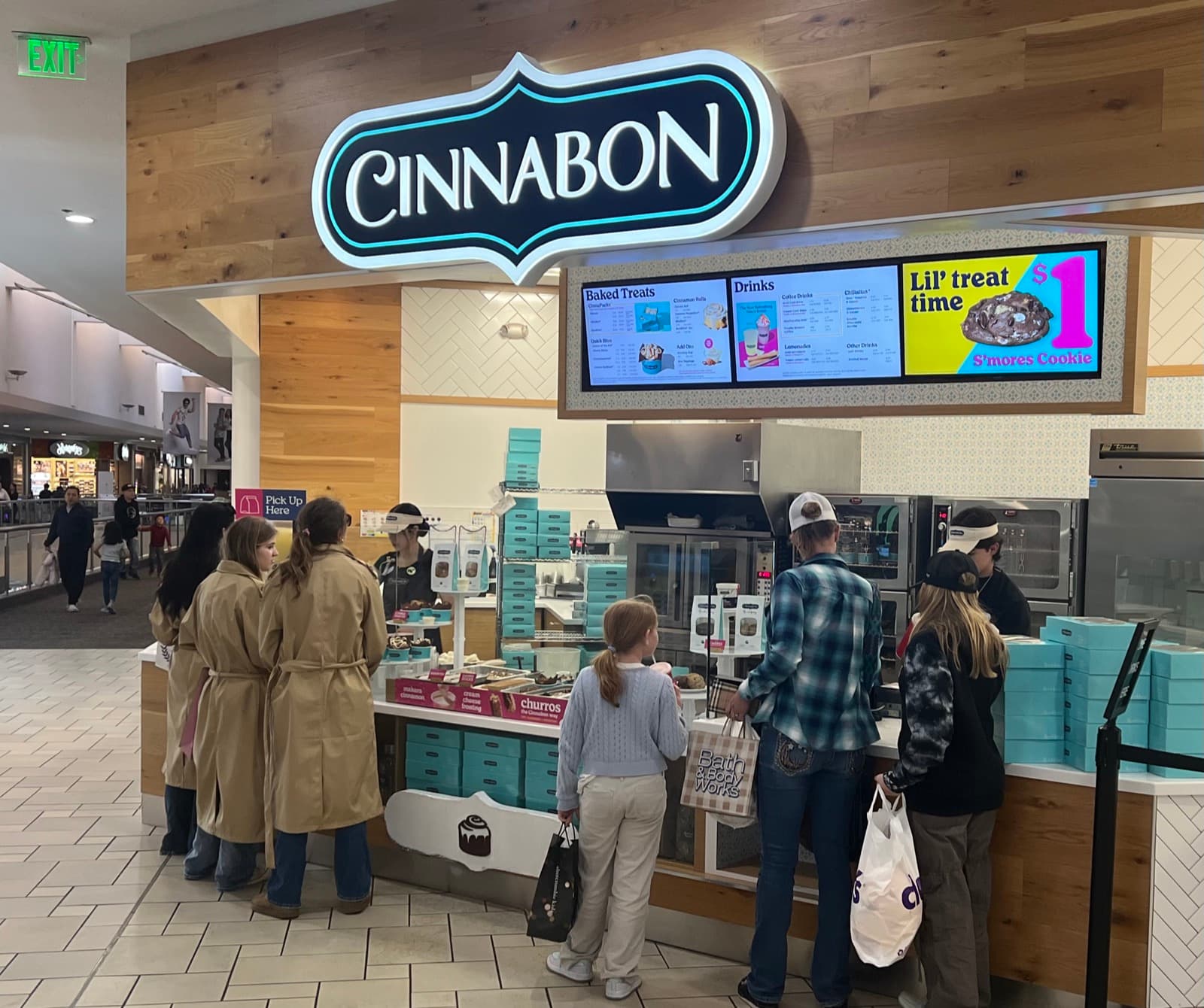
Cinnabon's real menu is the air: ovens parked at the front of the store, the weakest legal exhaust hoods, and fresh bakes timed so the cinnamon smell never stops selling, and by the time you reach the counter a narrow ladder of roll sizes, a premium Pecanbon anchor, and a take-home CinnaPack are waiting to turn one impulse into a multi-item ticket.
How a $6.39 Classic Roll, a $5.49 cup of roll centers, and a box of nine MiniBons at $1.89 each turn one whiff of cinnamon into a $35 ticket.
Menu-craft grade
As impulse architecture this is close to perfect. The aroma strategy (front-placed ovens, weak hoods, constant bakes) is the cheapest and most effective ad in retail, and leadership has openly described it as core to the business. The SKU ladder is tight, the Center of the Roll is genuinely clever productization, and the CinnaPack quantity discount is real. It loses ground on price transparency: Cinnabon publishes no national price list, aggregators disagree by dollars on the same item, and captive airport locations quietly charge more for the identical roll.
Graded on how well the menu uses behavioral economics, not the food.
Menu and prices verified September 2026
A 5-minute audio read of the analysis
- Type
- Chain
- Where
- Atlanta, Georgia (headquarters)
- Cuisine
- Cinnamon rolls and sweet baked goods
- Footprint
- ~1,030 US bakeries, ~2,070 worldwide (2025)
- Since
- 1985 (SeaTac Mall, Federal Way, Washington; Rich Komen with baker Jerilyn Brusseau)
- Ownership
- GoTo Foods (renamed from Focus Brands in 2024), an affiliate of Roark Capital; 99% franchised
The mechanics, drawn
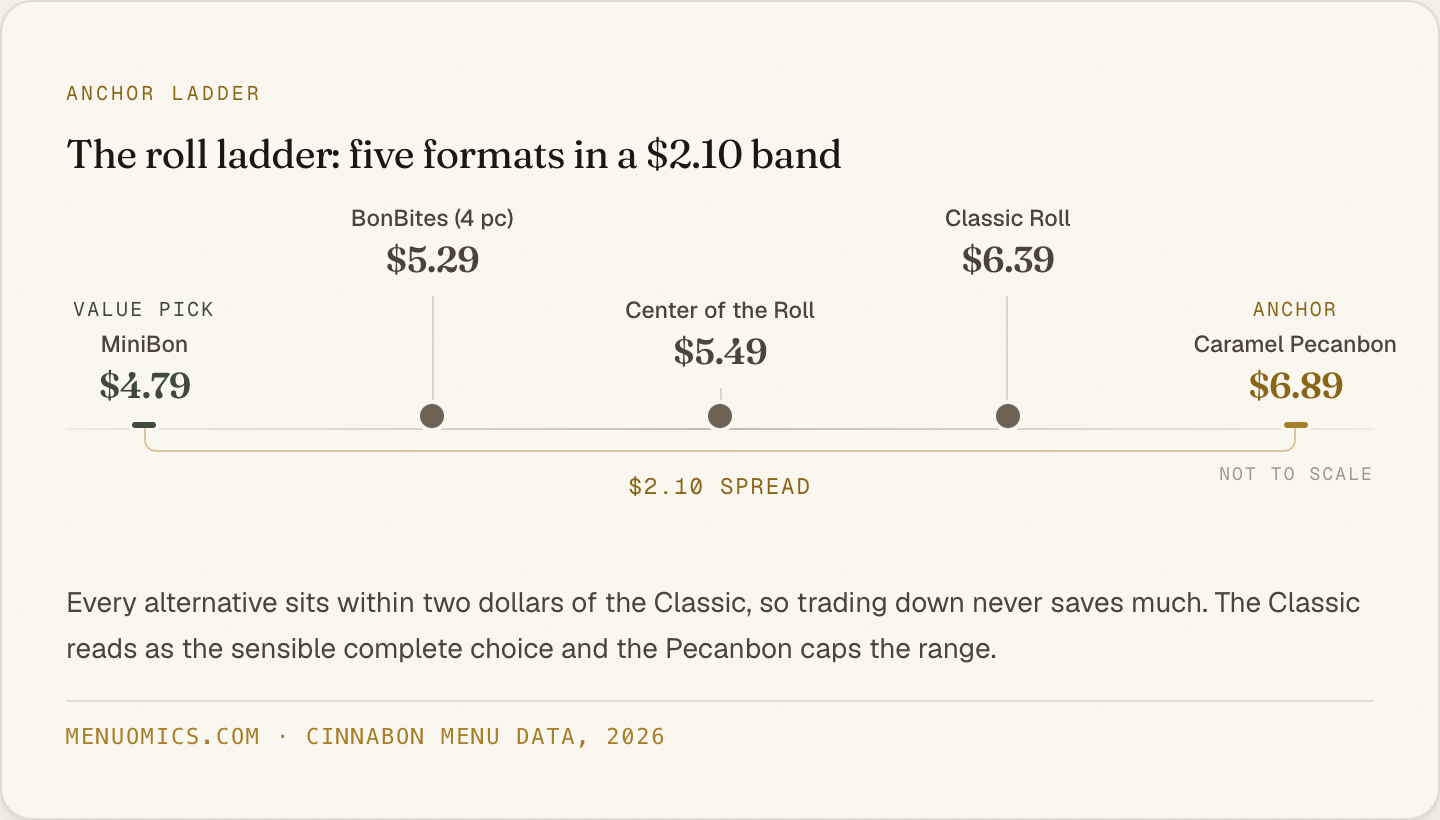
The same menu, mapped onto an axis, so the behavioral move is something you can see, not just read.
The roll ladder: five formats in a $2.10 band
Every alternative sits within two dollars of the Classic, so trading down never saves much. The Classic reads as the sensible complete choice and the Pecanbon caps the range.
Download this chart (PNG) · free to reuse with credit, see reuse terms.
The full ticket
What it actually rings up to.
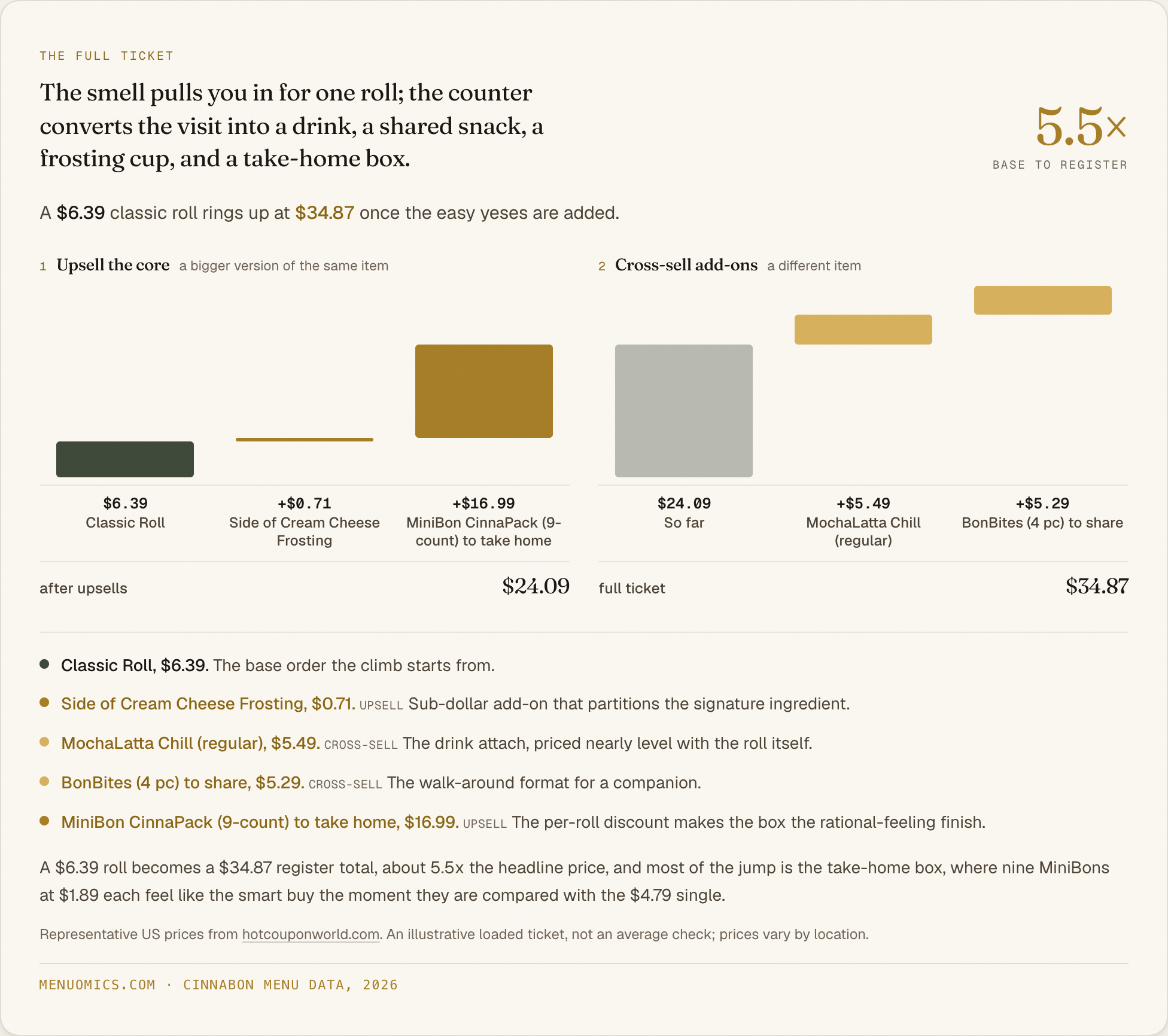
The headline price is only the start. The real number is the journey from a base order to the check at the register, one easy yes at a time.
The smell pulls you in for one roll; the counter converts the visit into a drink, a shared snack, a frosting cup, and a take-home box.
A $6.39 classic roll rings up at $34.87 once the easy yeses are added.
- Classic Roll, $6.39. The base order the climb starts from.
- Side of Cream Cheese Frosting, $0.71. upsell Sub-dollar add-on that partitions the signature ingredient.
- MochaLatta Chill (regular), $5.49. cross-sell The drink attach, priced nearly level with the roll itself.
- BonBites (4 pc) to share, $5.29. cross-sell The walk-around format for a companion.
- MiniBon CinnaPack (9-count) to take home, $16.99. upsell The per-roll discount makes the box the rational-feeling finish.
A $6.39 roll becomes a $34.87 register total, about 5.5x the headline price, and most of the jump is the take-home box, where nine MiniBons at $1.89 each feel like the smart buy the moment they are compared with the $4.79 single.
Representative US prices from hotcouponworld.com. An illustrative loaded ticket, not an average check; prices vary by location.
Download this chart (PNG) · free to reuse with credit, see reuse terms.
The setup
The first Cinnabon opened in December 1985 in the SeaTac Mall south of Seattle, and the chain has stayed loyal to enclosed, high-traffic venues ever since: malls, airports, travel plazas. That is not an accident of real estate. In a 2014 Wall Street Journal interview, then-president Kat Cole described the smell of baking rolls as central to how the company does business. Ovens are placed at the front of stores, franchisees are reportedly steered toward the weakest exhaust hoods local codes allow, rolls are baked frequently enough that the aroma never dies, and some locations have heated sheets of cinnamon and brown sugar just to keep the scent in the air. When a test store baked in the back instead, sales dropped significantly. The menu board is almost a formality; the pitch happened forty feet before you saw it.
Once the smell has you at the counter, the printed menu takes over with a compact ladder built around a single hero product. The MiniBon, BonBites, and Center of the Roll all sit within about $1.60 of the Classic Roll, so trading down never saves much, while the Caramel Pecanbon caps the range as the premium anchor. CinnaPacks then reframe the whole transaction, dropping the per-roll price so steeply that walking out with a box feels like the rational move. The aroma strategy is publicly acknowledged by the company; the pricing ladder is not framed that way by Cinnabon, and that part is our reading of the observed design.
What they get right
The behavioral economics already at work.
The smell is the advertisement
Cinnabon places its ovens at the front of stores, reportedly specifies the weakest exhaust hoods local codes allow, and keeps bakes frequent so the cinnamon aroma never fades; some franchises have heated sheets of brown sugar and cinnamon between bakes to keep the scent going. Scent reaches the emotional brain before any price does, and controlled research shows ambient scent improves store evaluations and intent to return (Spangenberg, Crowley & Henderson, 1996). This is the rare behavioral tactic a company has confirmed on the record: when a test store baked in the back, sales dropped significantly.
Test store moved baking to the back and sales dropped significantly, per then-president Kat Cole (2014), Wall Street Journal interview, via Fast Company
A size ladder where downsizing barely saves
The MiniBon costs $4.79 against the Classic's $6.39, a 25% saving for a roll with 60% fewer calories (350 versus 880). BonBites and the Center of the Roll fill the space between at $5.29 and $5.49. With every alternative packed inside a two-dollar band under the Classic, the smaller options do less work as products than as context: they make the full roll look like the sensible, complete choice, and the Pecanbon at $6.89 caps the ladder so the Classic never sits at the top.
MiniBon $4.79 vs Classic Roll $6.39; 350 vs 880 calories, HotCouponWorld 2026 price list; Cinnabon nutrition guide
Selling the best bite by itself
Everyone eats a cinnamon roll toward the middle, where the dough is softest and the frosting pools. In 2010 Cinnabon turned that peak into a product, the Center of the Roll, a cup of just the gooey middles with extra frosting. Memory research shows experiences are judged largely by their peak moments rather than their duration, so extracting the peak and pricing it at $5.49, nearly the cost of the whole roll it came from, is a remarkably direct piece of menu engineering.
Introduced September 2010; now a standing quick-bites item at ~$5.49, Cinnabon newsroom (2010); 2026 price lists
The CinnaPack reframes the whole transaction
Sold alone, a MiniBon is $4.79. In the 9-count CinnaPack it is about $1.89. The 6-count Classic box works out to roughly $3.83 per roll against $6.39 single. Discounts that steep do two things: they anchor the buyer on a larger quantity than they came in for, and they make the single roll feel mildly irrational at the register. Research on purchase-quantity decisions shows shoppers anchor on the quantities a promotion suggests and adjust upward (Wansink, Kent & Hoch, 1998). The counter script naturally ends with the box.
MiniBon 9-count CinnaPack ~$1.89 per roll vs $4.79 sold singly, HotCouponWorld 2026 price list
Captive venues, quiet premiums
Cinnabon barely exists on the street; it lives in malls, airports, and travel plazas where foot traffic is guaranteed, alternatives are few, and the customer's mental budget has already shifted into travel-treat mode. Airport and travel-center locations typically charge $1 to $2 more than mall bakeries for identical items. Spending sorted into a vacation or travel account is policed far less strictly than everyday food spending, and the venue premium harvests exactly that slack.
Airport and travel-center locations typically run $1 to $2 higher than mall locations, Menupedia price survey, May 2026
What we’d test
The rewrite, with the expected lift and the honest caveat.
Print the per-roll math on the CinnaPack case
The multipack discount is real and steep, yet the signage leaves the arithmetic to the customer. Showing the per-roll price next to each box makes the discount legible in one glance and lets the quantity anchor do its work honestly.
Expect Higher conversion from single rolls to take-home boxes.
Caveat Displaying $3.83 a roll next to a $6.39 single can make the single feel overpriced; the two figures may need physical separation on the board.
Wansink, Kent & Hoch, Journal of Marketing Research, 1998
Name the roll-and-drink pairing on the board
The MochaLatta Chill and the cold brew sit in a separate beverage list, leaving the attach to the cashier's improvisation. Placing the drink photo directly beside the Classic Roll and giving the pairing a consistent spoken script turns the drink from an afterthought into the default second item, with no new pricing required.
Expect Higher beverage attach rate on single-roll orders.
Caveat Keep it to one suggestion per order; pushing a second add-on at a captive airport line reads as squeezing.
Move the Center of the Roll to the register
The product that best matches a last-second impulse is the cup of roll centers, yet it lives on the main board with everything else. Merchandising it at the point of payment, where the order is already committed and the marginal add feels small, puts the highest-craving SKU at the moment of least resistance.
Expect Higher Center of the Roll attach on existing tickets.
Caveat Watch for cannibalization of Classic Roll sales among solo customers trading down to the cup.
What diners actually say
Synthesized from public reviews, the reality check that grounds every recommendation.
They praise
- The aroma strategy is the cheapest and most honest ad in retail: the product itself is the marketing, and the company has openly said so on the record.
- A ruthlessly focused menu built on one hero product with a handful of formats; there is no choice overload anywhere on the board.
- The Center of the Roll is a genuinely clever piece of productization, extracting the bite people actually crave and giving it its own price.
- CinnaPack discounts are real quantity discounts, with per-roll prices falling by half or more, rather than the cosmetic bundle savings many chains offer.
- The product is consistent enough across roughly 2,070 bakeries that the brand licensed itself into more than 70 grocery products (Pillsbury, Green Mountain and others), a program reported at around $1 billion in annual retail sales by the mid-2010s.
They criticize
- The Classic Roll carries 880 calories, 37 grams of fat, and 61 grams of sugar; the Caramel Pecanbon reaches 1,090 calories, and dietitians routinely flag both as sugar bombs.
- No published national price list, and aggregator menus disagree by dollars on the same item, which keeps customers from forming any stable reference price.
- Airport and travel-plaza locations charge $1 to $2 more for the identical roll, a premium extracted from customers with nowhere else to go.
- The entire model monetizes impulse at low-willpower moments, targeting tired travelers and shoppers with a scent that acts before deliberation does.
- The format is chained to enclosed-venue foot traffic, and declining mall traffic has pushed the brand toward cobranding and licensing to compensate.
The verdict
Cinnabon is the clearest case in the catalog of a menu that starts working before you can read it. The ovens at the front, the weak hoods, and the constant bakes are the real menu engineering, publicly acknowledged and almost free to run, and by the time the printed board matters the ladder does quiet, competent work: small sizes that barely save money, a Pecanbon capping the range, the best bite sold separately, and a take-home box whose per-roll math makes the single feel like the mistake. The craft earns an A. What holds the grade to an A- is the opacity around price, the captive-venue premium, and the fact that the whole machine points customers toward an 880-calorie impulse they were engineered into wanting. It is brilliant design; it is not neutral design.
Common questions
- Why does Cinnabon smell so strong in malls and airports?
- It is deliberate. Then-president Kat Cole told the Wall Street Journal in 2014 that the smell of baking rolls is central to the business: ovens sit at the front of stores, franchisees are reportedly steered toward the weakest exhaust hoods local codes allow, rolls are baked frequently so the aroma never fades, and some locations have heated sheets of cinnamon and brown sugar between bakes. When a test store baked in the back, sales dropped significantly.
- How much does a Cinnabon cost in 2026?
- Representative US prices run about $6.39 for a Classic Roll, $6.89 for a Caramel Pecanbon, $4.79 for a MiniBon, and $5.49 for the Center of the Roll. Cinnabon publishes no national price list, franchisees set their own prices, and airport and travel-center locations typically charge $1 to $2 more than mall bakeries.
- How many calories are in a Cinnabon Classic Roll?
- A Classic Roll has 880 calories, 37 grams of fat, and 61 grams of sugar. The Caramel Pecanbon reaches 1,090 calories. The MiniBon is the lighter option at 350 calories.
- What is Cinnabon's Center of the Roll?
- It is a cup containing just the soft, gooey centers of the cinnamon roll, the bite most people consider the best part, served with extra frosting. Cinnabon introduced it in September 2010 and it now sells for around $5.49, nearly the price of the full roll the centers come from.
- What is the most expensive item at Cinnabon?
- On the standard menu, the priciest single item is the Classic CinnaPack (4-count), about $19.99 in representative 2026 US pricing (it varies by location; group packs and combo deals can cost more). Formats like that are priced to move the decision to per-unit math: the big number buys a lower cost per piece, and that falling per-piece price is where the persuasion happens.
- How much is a meal at Cinnabon?
- A meal at Cinnabon starts around $6.39 for the base order and lands near $34.87 once the usual add-ons go on, roughly 5.5x the headline price (representative 2026 US figures; they vary by location). That gap between the price that gets you in and the total you pay is the multiplier this page grades.
Sources (8)
- Fast Company: How Cinnabon strategically seduces shoppers with smells (2014)
- Mashed: The sneaky way Cinnabon attracts customers
- HotCouponWorld: Cinnabon menu with prices (2026)
- Franchise Times Top 400 (2025): Cinnabon, No. 144
- Wikipedia: Cinnabon (founding, ownership)
- CNBC: Cinnabon president Kat Cole on strategy and licensing (2014)
- Eat This, Not That: Best and worst Cinnabon menu items, per a dietitian
- Spangenberg, Crowley & Henderson: ambient scent and store evaluations (Journal of Marketing, 1996)
Head to head
More breakdowns
 The Cheesecake FactoryB+
A 21-page, 250-item menu should be a behavioral disaster. It's a roughly $4-billion chain. Here's what all that abundance is quietly doing.
Read the The Cheesecake Factory breakdown → McDonald'sA-
The Extra Value Meal is one of the most-copied ideas in food: fold the whole order into a single number that hurts less than three. Then McValue and the app pile value on top, and the McRib drops in as an event.
Read the McDonald's breakdown → Taco BellA-
A sub-$3 value menu sets the floor, $5/$7/$9 boxes name the deal after its own price, and a never-ending limited-time calendar keeps a reason to come back on the board. Taco Bell sells value loudly, and it works: it gained traffic while rivals shrank.
Read the Taco Bell breakdown → Dunkin'A-
A premium latte anchors the cheap iced coffee as the obvious default, the $6 Meal Deal bundles the breakfast, and Dunkin' Rewards turns the morning run into a streak. The menu craft is textbook; the strain is price creep and an app that increasingly decides the real price.
Read the Dunkin' breakdown → Panda ExpressB+
The whole order comes down to one question, how many entrees. A Bowl is one, a Plate is two, a Bigger Plate is three, and the menu is built so the middle Plate wins. Orange Chicken is the anchor everyone orders, and a quiet $1.50 premium upcharge lifts the check while the headline price stays put.
Read the Panda Express breakdown → Raising Cane'sA-
The chicken-finger chain that built a billion-dollar machine by refusing to sell almost anything else.
Read the Raising Cane's breakdown →Your menu next
Get this for your own menu, free.
Send your menu and we’ll send back the same breakdown, what you get right, what we’d test, and why.
Dave's Hot Chicken
A hot-chicken chain that reduced the food decision to tenders or sliders and moved all the choosing into a seven-rung heat ladder, with a waiver-gated Reaper on top doing the advertising.
Read it →