Dave's Hot Chicken menu, graded
Dave's strips the food decision down to almost nothing (tenders or sliders, in counts of one to three) and reinstalls all of the choosing as a seven-rung heat ladder from No Spice to the waiver-gated Reaper, so the menu's real product is the ladder itself: an entry point for everyone, a dare at the top doing the marketing, and a next rung waiting on every return visit.
How a $900 parking-lot pop-up turned one question (how hot?) into a $1 billion menu, and what the Reaper waiver is actually for.
Menu-craft grade
The focus is the craft: one protein in two formats, four numbered combos, and a seven-level heat ladder that gives every guest a rung and a reason to come back. The Reaper waiver converts the top rung into earned media, and the 2026 drop cadence (Hot Mozz sold out nationwide in under a week) shows real scarcity discipline. It loses ground on the value floor: no numbered combo includes a drink, so the board price is never the register price, a la carte pieces are priced to push you into the tiers, and with no posted national pricing the same combo varies by dollars across markets.
Graded on how well the menu uses behavioral economics, not the food.
Menu and prices verified September 2026
A 4-minute audio read of the analysis
- Type
- Chain
- Where
- Pasadena, California (headquarters)
- Cuisine
- Nashville-style hot chicken (fast casual)
- Footprint
- 400+ locations worldwide (April 2026), across most US states plus Canada, the UK, and the Middle East
- Since
- 2017 (parking-lot pop-up, East Hollywood, Los Angeles)
- Ownership
- Roark Capital (majority stake, June 2025, deal valued around $1 billion); Jim Bitticks became CEO in January 2026, Bill Phelps now executive chairman
The mechanics, drawn
The same menu, mapped onto an axis, so the behavioral move is something you can see, not just read.
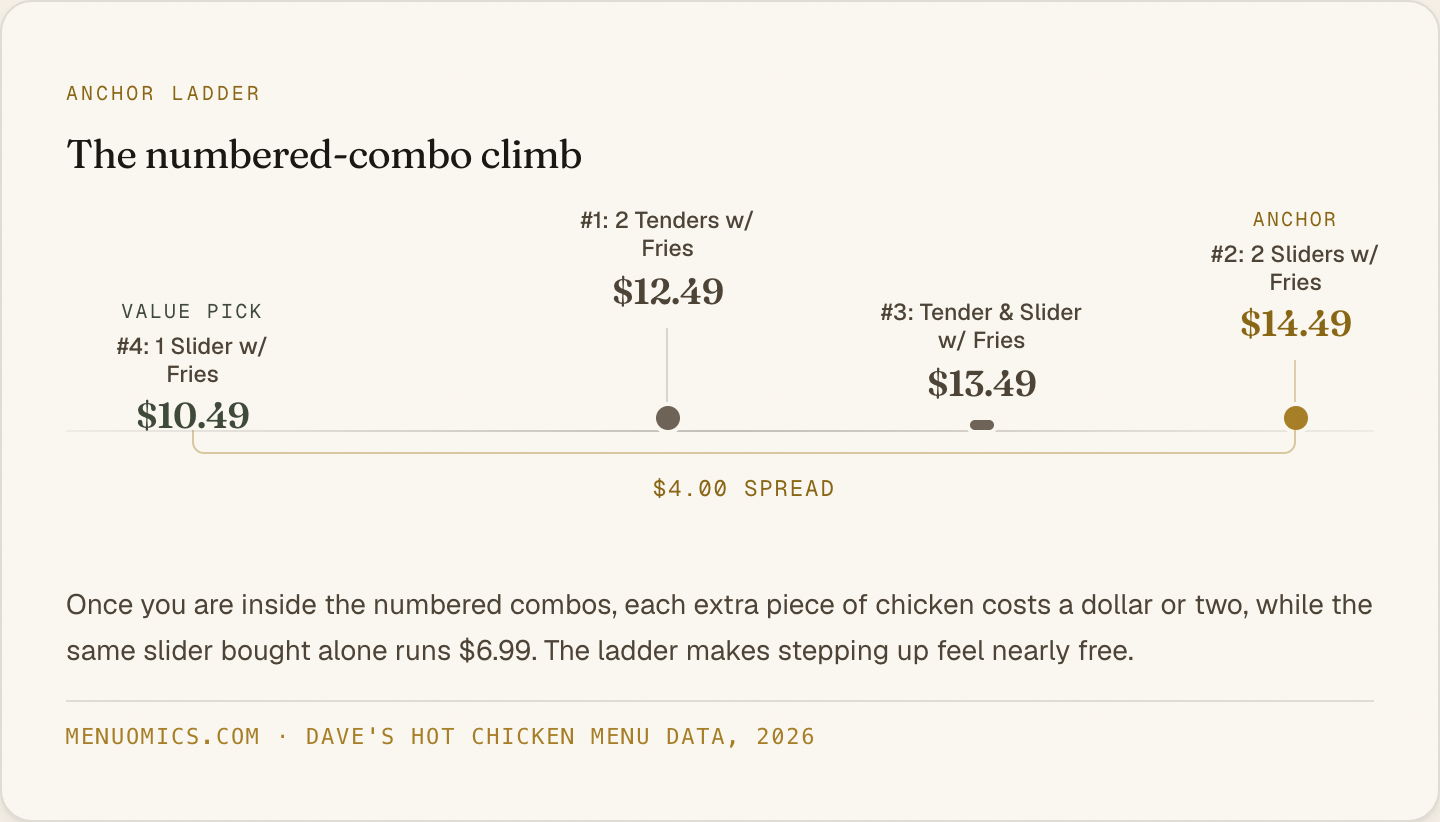
The numbered-combo climb
Once you are inside the numbered combos, each extra piece of chicken costs a dollar or two, while the same slider bought alone runs $6.99. The ladder makes stepping up feel nearly free.
Download this chart (PNG) · free to reuse with credit, see reuse terms.
The full ticket
What it actually rings up to.
The headline price is only the start. The real number is the journey from a base order to the check at the register, one easy yes at a time.
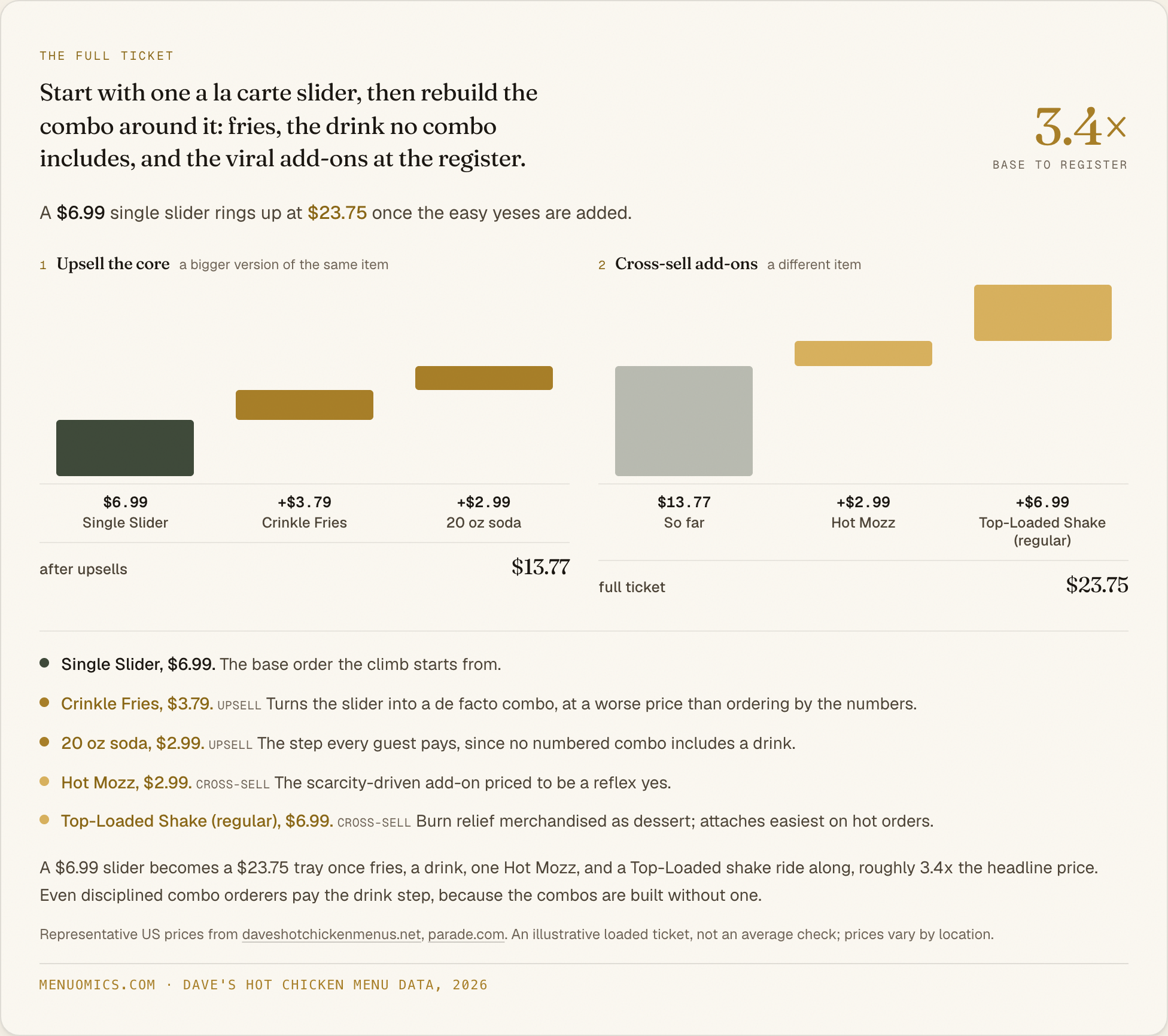
Start with one a la carte slider, then rebuild the combo around it: fries, the drink no combo includes, and the viral add-ons at the register.
A $6.99 single slider rings up at $23.75 once the easy yeses are added.
- Single Slider, $6.99. The base order the climb starts from.
- Crinkle Fries, $3.79. upsell Turns the slider into a de facto combo, at a worse price than ordering by the numbers.
- 20 oz soda, $2.99. upsell The step every guest pays, since no numbered combo includes a drink.
- Hot Mozz, $2.99. cross-sell The scarcity-driven add-on priced to be a reflex yes.
- Top-Loaded Shake (regular), $6.99. cross-sell Burn relief merchandised as dessert; attaches easiest on hot orders.
A $6.99 slider becomes a $23.75 tray once fries, a drink, one Hot Mozz, and a Top-Loaded shake ride along, roughly 3.4x the headline price. Even disciplined combo orderers pay the drink step, because the combos are built without one.
Representative US prices from daveshotchickenmenus.net, parade.com. An illustrative loaded ticket, not an average check; prices vary by location.
Download this chart (PNG) · free to reuse with credit, see reuse terms.
The setup
Dave's Hot Chicken opened in May 2017 as a pop-up in an East Hollywood parking lot: chef Dave Kopushyan and three childhood friends (Arman Oganesyan and brothers Tommy and Gary Rubenyan) scraped together about $900 for a portable fryer and some folding tables. Five days in, Eater LA showed up and ran the headline 'East Hollywood's Late Night Chicken Stand Might Blow Your Mind'; within two months roughly 80 people were waiting in the lot each night. Wetzel's Pretzels co-founder Bill Phelps came aboard to franchise it, celebrity investors followed (Drake in 2021, along with Samuel L. Jackson, Maria Shriver, Michael Strahan, and Tom Werner), and in June 2025 Roark Capital, the private-equity owner behind Subway, Arby's, and Dunkin', bought a majority stake in a deal valued around $1 billion. By April 2026 the chain had passed 400 locations.
The menu the empire runs on is startlingly small. There is one protein, chicken tenders, served straight or on a slider bun, sold in counts of one to three through four numbered combos, with crinkle fries, kale slaw, mac and cheese, and shakes around the edges. The real decision is heat: seven named levels running No Spice, Lite Mild, Mild, Medium, Hot, Extra Hot, and Reaper, the last made with Carolina Reaper peppers and gated behind a signed waiver. The ladder is the menu, the waiver is the billboard, and periodic drops like the Hot Mozz keep the small board feeling like an event. (Dave's does not frame these as behavioral tactics; this is our reading of the observed design.)
What they get right
The behavioral economics already at work.
Seven rungs of heat, one real decision
Dave's removes almost every food decision (one protein, two formats, counts of one to three) and reinstalls choice as a ranked ladder: No Spice, Lite Mild, Mild, Medium, Hot, Extra Hot, Reaper. Ranked ladders push people away from the ends, and menu guides report Medium as the most-ordered level, right in the middle where extremeness aversion predicts. The ladder also builds a return visit into the first one: whatever you ordered, there is a named next rung waiting, a progression mechanic that costs the kitchen nothing.
Seven named levels from No Spice to Reaper; Medium reported as the most-ordered, Dave's Hot Chicken menu; davemenu.com heat-level guide (2026)
The Reaper waiver is commitment theater
Ordering the top rung requires signing a form that reads, in part, 'I acknowledge that eating the REAPER can cause me harm, including, but not limited to, bodily injury, property damage, emotional distress, or even death.' The paperwork converts a menu item into a public dare, which makes it a story people retell and film. Tellingly, Mashed's reviewers found the actual heat underwhelming for experienced chiliheads. The waiver is not protecting the customer from the chicken; it is advertising the ladder below it.
Waiver text warns of 'bodily injury, property damage, emotional distress, or even death', Food Republic (2025)
A menu small enough to signal focus
The core board is tenders and sliders through four numbered combos, and that is roughly it. Iyengar and Lepper's jam study found that fewer options can raise purchase rates, and while later meta-analysis shows the effect is not universal, a radically short menu does something subtler here: it signals specialization. A shop that sells one thing is implicitly claiming to be good at it, and the operational simplicity (one fry station, one protein) is what let a $900 pop-up scale past 400 stores without the menu drifting.
Core menu is one protein in two formats, sold through four numbered combos, Dave's Hot Chicken menu (2026)
The line was the ad, then Drake was
Dave's never needed launch advertising: five days after opening, an Eater LA writeup turned a parking lot into a destination, and within two months roughly 80 people were queuing each night. The visible line is the oldest social proof there is, and the chain then layered on the celebrity version, with Drake investing in 2021 alongside Samuel L. Jackson, Maria Shriver, Michael Strahan, and Tom Werner. Popularity cues measurably lift demand, and Dave's whole origin story functions as one long popularity cue.
~80 people in line two months after the 2017 pop-up opened; Drake invested in 2021, Restaurant Business; CNBC
Drops engineered to sell out
Because the permanent board is tiny, novelty arrives as drops, and the drops are run like sneaker releases. The Hot Mozz, a thick fried mozzarella plank dusted at any spice level, launched March 10, 2026, sold out nationwide in under a week on tens of millions of social views, then returned April 15 to a waiting audience. Slushers with Pop Rocks and an X-Men '97 collab meal sat on the same 2026 board. Scarcity raises perceived value, and a sellout is the cheapest scarcity there is: the shortage itself becomes the marketing for the re-release.
Hot Mozz sold out nationwide in under a week (March 2026) and returned April 15, Parade; Dave's Hot Chicken homepage (2026)
What we’d test
The rewrite, with the expected lift and the honest caveat.
Badge Medium as the most-ordered rung
The seven levels are presented as an undifferentiated row, which leaves first-timers guessing and occasionally overreaching into a bad first visit. A small 'Most Ordered' badge on Medium would give newcomers a defensible default and formalize where the crowd already lands.
Expect More first-timers land mid-ladder, fewer regretted Hot-and-above first orders, better first-visit repeat rates.
Caveat The badge has to be true; if ordering data says otherwise at a given store, badge that store's real mode instead.
Cai, Chen & Fang, AER 2009
Key the shake prompt to the spice level
Shakes at Dave's are functionally burn relief, but they are merchandised like any dessert. When an order contains Hot, Extra Hot, or Reaper, a single checkout prompt ('Cool it down: add a shake, ~$4.99') reframes the shake from indulgence to remedy, a different mental account that is much easier to say yes to mid-commitment.
Expect Higher shake attach on high-heat orders, which are exactly the orders already primed for it.
Caveat One dismissible prompt only; nagging at checkout costs more in abandonment than it earns in attach.
Show the combo math once
The numbered combos are genuinely cheaper than rebuilding them from a la carte parts, but the menu never says so. Printing the computed saving next to each numbered combo turns the tiers from a default into a visible deal, and it inoculates against the sticker resentment that mid-teens chicken prices invite.
Expect Higher combo conversion and less price grumbling, since the a la carte prices start doing anchor work instead of just looking expensive.
Caveat Only show the line where the delta is meaningful; a 29-cent saving reads as a joke and undermines the frame.
What diners actually say
Synthesized from public reviews, the reality check that grounds every recommendation.
They praise
- One of the most focused menus in fast casual: one protein, two formats, and the consistency that focus buys (Mashed found the chicken juicy and the crust crunchy across every spice level).
- The heat ladder is genuinely inclusive choice architecture: No Spice makes the brand orderable for kids and the heat-averse while the Reaper markets to daredevils, all on one board.
- The Reaper waiver is honest, costless theater that generates earned media no ad budget could buy.
- The origin story ($900, a parking lot, an Eater LA writeup) is real and verifiable, and the chain has resisted menu bloat while scaling past 400 stores.
- Drop discipline: Hot Mozz earned its way toward the permanent board through a demonstrated nationwide sellout rather than a marketing hunch.
They criticize
- Fast-food format at fast-casual prices: two sliders and fries runs about $14.49 and past $17 in some markets, and a $6.99 a la carte slider is a lot for one tender on a bun.
- No numbered combo includes a drink, so the board price is never the register price; the near-universal $2.99 drink is a partitioned step the menu quietly banks on.
- The few sides are the weakest work: Mashed called the sliders 'not worth it' against the tenders, the kale slaw bland, and the mac and cheese 'boring, mushy'.
- The Reaper underdelivers for actual chiliheads per reviewers, so the waiver can read as stunt rather than warning on a second visit, and stunts age.
- With no posted national pricing, trackers disagree by dollars on the same combo across markets, an opacity that gets riskier as a private-equity owner scales the footprint.
The verdict
As menu craft, Dave's is a lesson in subtraction. By shrinking the food decision to tenders or sliders and pouring all of the choice into a seven-rung heat ladder, the menu turns ordering into a game with a built-in reason to return, and the Reaper waiver at the top is one of the best free marketing devices in the category. The drop cadence keeps a tiny board feeling alive. What holds it to a B+ is the money side of the design: combos that never include the drink, a la carte prices set mostly to herd you into the tiers, and market-to-market variance with no posted national pricing. The ladder earns trust; the register fine print spends some of it back.
Common questions
- Do you have to sign a waiver to order the Reaper at Dave's Hot Chicken?
- Yes. The Reaper, the top of the seven-level heat ladder, is made with Carolina Reaper peppers, and locations have guests sign a waiver before the order is made. The form acknowledges that eating it 'can cause me harm, including, but not limited to, bodily injury, property damage, emotional distress, or even death.' It is generally treated as an adults-only order, and it cannot be applied to Dave's Bites.
- What are Dave's Hot Chicken's spice levels?
- Seven, in order: No Spice, Lite Mild, Mild, Medium, Hot, Extra Hot, and Reaper. Medium is widely reported as the most-ordered level, and the Reaper requires a signed waiver.
- Who owns Dave's Hot Chicken now?
- Roark Capital, the private-equity firm behind Subway, Arby's, and Dunkin', acquired a majority stake in June 2025 in a deal valued around $1 billion. The founding team and CEO Bill Phelps stayed on, and the chain passed 400 locations worldwide in April 2026.
- Do Dave's Hot Chicken combos come with a drink?
- No. The numbered combos include fries, pickles, bread, and Dave's sauce, but drinks are separate (a 20 oz soda runs about $2.99), so expect the register total to land roughly $3 above the board price. Combo prices vary by location, from about $10.49 for one slider with fries to $14.49 and up for two sliders with fries.
- What is the most expensive item at Dave's Hot Chicken?
- On the standard menu, the priciest single item is the Top Loaded Fries (large), about $15.99 in representative 2026 US pricing (it varies by location; group packs and combo deals can cost more). That top price also does quiet work as the menu's anchor: it is the number that makes everything below it read as reasonable.
- How much is a meal at Dave's Hot Chicken?
- A meal at Dave's Hot Chicken starts around $6.99 for the base order and lands near $23.75 once the usual add-ons go on, roughly 3.4x the headline price (representative 2026 US figures; they vary by location). That gap between the price that gets you in and the total you pay is the multiplier this page grades.
Sources (8)
- CNBC: Roark Capital invests in Dave's Hot Chicken (June 2025)
- Restaurant Business: Roark acquires Dave's Hot Chicken for $1B
- Restaurant Business: the ultimate parking lot success story
- Food Republic: the Reaper waiver, quoted
- Mashed: We Tried Dave's Hot Chicken (full-menu review, 2025)
- Parade: Hot Mozz sellout and return (2026)
- International Franchise Association: 400+ locations, eight openings in one day (April 2026)
- Dave's Hot Chicken menu prices, 2026 (tracker)
Head to head
More breakdowns
 The Cheesecake FactoryB+
A 21-page, 250-item menu should be a behavioral disaster. It's a roughly $4-billion chain. Here's what all that abundance is quietly doing.
Read the The Cheesecake Factory breakdown → McDonald'sA-
The Extra Value Meal is one of the most-copied ideas in food: fold the whole order into a single number that hurts less than three. Then McValue and the app pile value on top, and the McRib drops in as an event.
Read the McDonald's breakdown → Taco BellA-
A sub-$3 value menu sets the floor, $5/$7/$9 boxes name the deal after its own price, and a never-ending limited-time calendar keeps a reason to come back on the board. Taco Bell sells value loudly, and it works: it gained traffic while rivals shrank.
Read the Taco Bell breakdown → Dunkin'A-
A premium latte anchors the cheap iced coffee as the obvious default, the $6 Meal Deal bundles the breakfast, and Dunkin' Rewards turns the morning run into a streak. The menu craft is textbook; the strain is price creep and an app that increasingly decides the real price.
Read the Dunkin' breakdown → Panda ExpressB+
The whole order comes down to one question, how many entrees. A Bowl is one, a Plate is two, a Bigger Plate is three, and the menu is built so the middle Plate wins. Orange Chicken is the anchor everyone orders, and a quiet $1.50 premium upcharge lifts the check while the headline price stays put.
Read the Panda Express breakdown → Raising Cane'sA-
The chicken-finger chain that built a billion-dollar machine by refusing to sell almost anything else.
Read the Raising Cane's breakdown →Your menu next
Get this for your own menu, free.
Send your menu and we’ll send back the same breakdown, what you get right, what we’d test, and why.
Qdoba
The burrito chain that turned its rival's most famous surcharge into its own advertisement: queso and guacamole free on every entree, one flat price for the whole build.
Read it →