KFC menu, graded
KFC organizes its menu around the bucket, a shareable anchor whose per-piece math makes eight or twelve pieces of chicken read as a bargain, then wraps the whole brand in a secret recipe of 11 herbs and spices so the product sells a mystery you cannot price-check anywhere else.
How the bucket's per-piece math, the $20 Fill Up boxes, and a vault-guarded recipe of 11 herbs and spices steer your order and defend the price.
Menu-craft grade
The core mechanics are strong and old: the bucket is one of the best per-unit value anchors in fast food, the 11-herbs-and-spices secrecy is a durable quality-and-mystery signal no rival can copy, and the Fill Up boxes bundle a full meal at a memorable round price. What keeps the grade at a plain B rather than higher is execution and discipline. US same-store sales have fallen for multiple quarters since 2022, roughly 80 percent of customer complaints center on food quality and service, the board is cluttered with rotating limited-time offers, and the best prices are increasingly locked behind the app, so two guests rarely pay the same for the same food.
Graded on how well the menu uses behavioral economics, not the food.
Menu and prices verified September 2026
A 4-minute audio read of the analysis
- Type
- Chain
- Where
- Plano, Texas (US headquarters, relocated from Louisville, Kentucky)
- Cuisine
- Fried chicken
- Footprint
- ~3,700-3,800 US restaurants (2026); over 31,000 worldwide
- Since
- 1930 (Corbin, Kentucky; founder Harland 'Colonel' Sanders); first franchise 1952
- Ownership
- Yum! Brands (NYSE: YUM), which also owns Taco Bell and The Habit Burger & Grill; Yum sold sister brand Pizza Hut in a deal completed September 2026
The mechanics, drawn
The same menu, mapped onto an axis, so the behavioral move is something you can see, not just read.
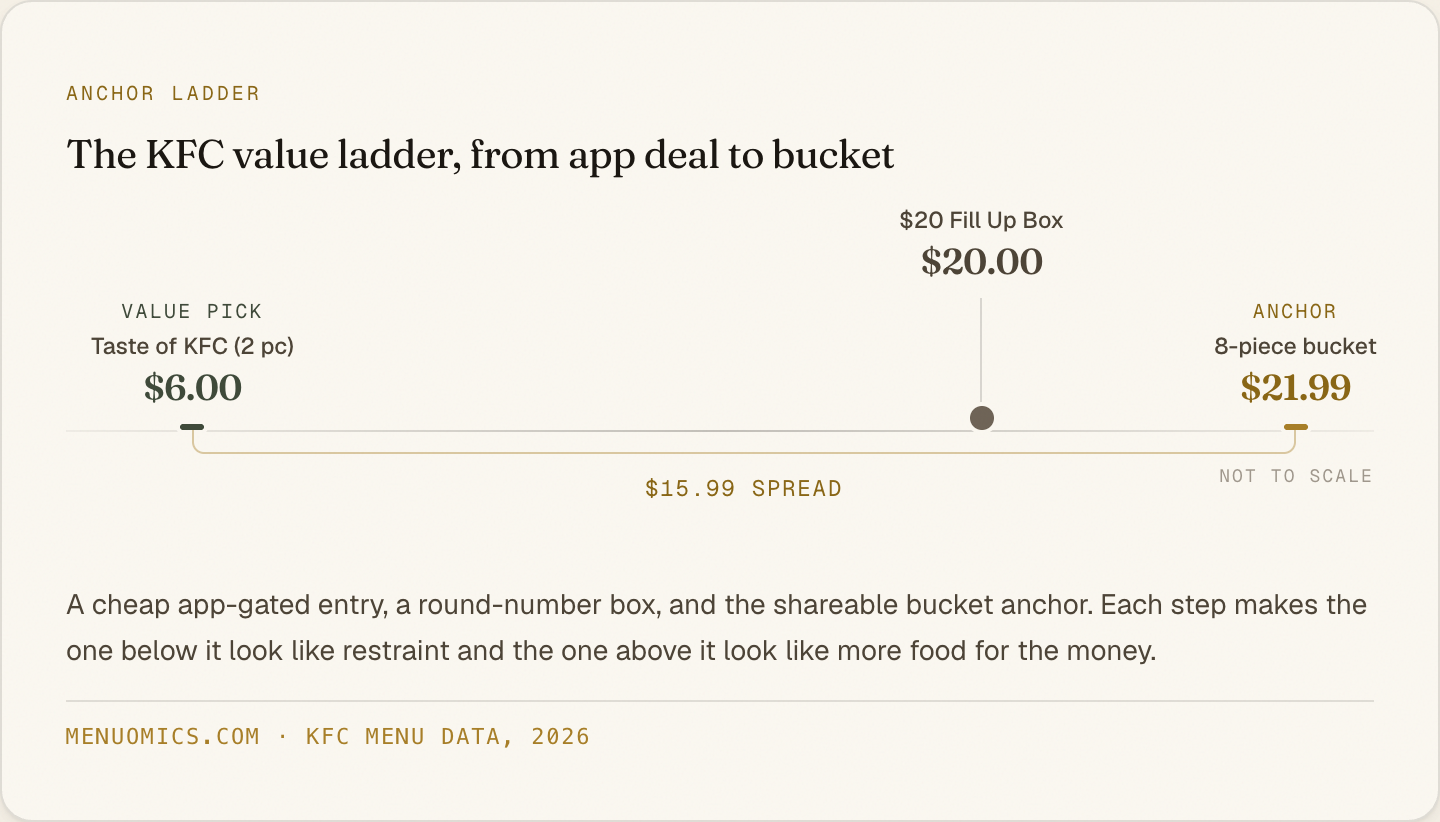
The KFC value ladder, from app deal to bucket
A cheap app-gated entry, a round-number box, and the shareable bucket anchor. Each step makes the one below it look like restraint and the one above it look like more food for the money.
Download this chart (PNG) · free to reuse with credit, see reuse terms.
The full ticket
What it actually rings up to.
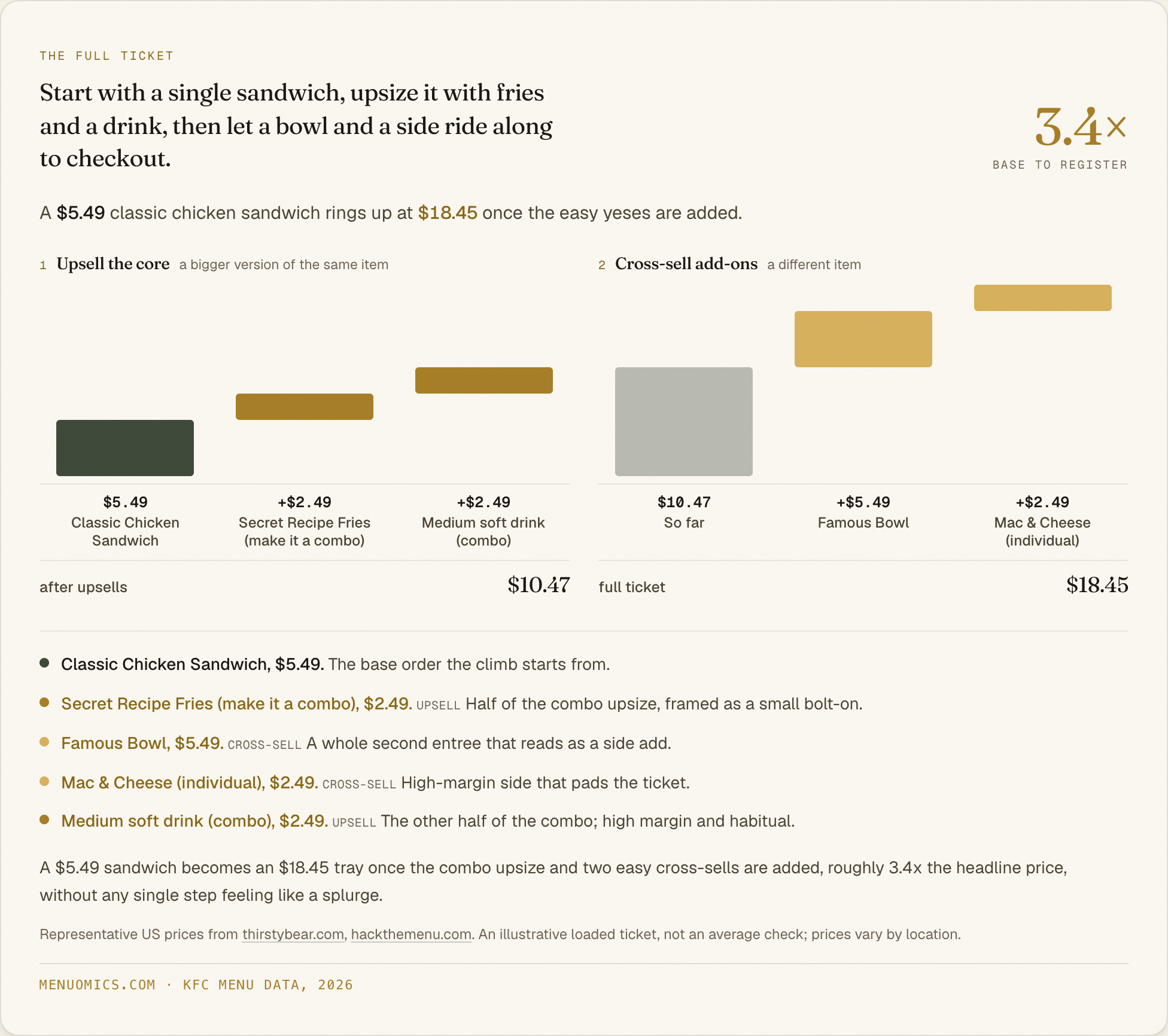
The headline price is only the start. The real number is the journey from a base order to the check at the register, one easy yes at a time.
Start with a single sandwich, upsize it with fries and a drink, then let a bowl and a side ride along to checkout.
A $5.49 classic chicken sandwich rings up at $18.45 once the easy yeses are added.
- Classic Chicken Sandwich, $5.49. The base order the climb starts from.
- Secret Recipe Fries (make it a combo), $2.49. upsell Half of the combo upsize, framed as a small bolt-on.
- Famous Bowl, $5.49. cross-sell A whole second entree that reads as a side add.
- Mac & Cheese (individual), $2.49. cross-sell High-margin side that pads the ticket.
- Medium soft drink (combo), $2.49. upsell The other half of the combo; high margin and habitual.
A $5.49 sandwich becomes an $18.45 tray once the combo upsize and two easy cross-sells are added, roughly 3.4x the headline price, without any single step feeling like a splurge.
Representative US prices from thirstybear.com, hackthemenu.com. An illustrative loaded ticket, not an average check; prices vary by location.
Download this chart (PNG) · free to reuse with credit, see reuse terms.
The setup
KFC has sold the same organizing idea since Harland Sanders started frying chicken at a Corbin, Kentucky gas station in 1930: put the food in a bucket and let the container do the selling. A bucket is a portion you are meant to share, and its price is quoted as one number for eight, twelve, or sixteen pieces rather than as a per-piece rate, so the buyer does the flattering division themselves. Eight pieces for about twenty-two dollars feels like a lot of chicken for the money in a way that a single piece never could. On top of that sits the brand's oldest asset, the Original Recipe of 11 herbs and spices, a formula KFC keeps in a literal guarded vault and splits across suppliers so no one party knows the whole blend.
Layered over the bucket are the round-number value boxes, descended from the 2009 $5 Fill Up and now sold as the $20 Fill Up and smaller Taste of KFC deals, plus a chicken sandwich the chain rushed onto the board in 2021 to answer Popeyes. The result is a menu where a shareable anchor pulls the family ticket up, the value boxes give the solo diner a memorable round price to reach for, and a recipe nobody can copy defends the whole thing against cheaper fried chicken. (KFC does not frame these as behavioral tactics; this is our reading of the observed design.)
What they get right
The behavioral economics already at work.
The bucket does the math for you
A bucket is quoted as a single price for eight, twelve, or sixteen pieces, never as a per-piece rate. The buyer performs the division themselves, which flatters the number: about twenty-two dollars for eight pieces reads as a generous haul of food rather than roughly $2.75 a piece. Sizing the buckets in even steps also rewards trading up, because the twelve- and sixteen-piece each drop the per-piece cost, so the guest who does the arithmetic talks themselves into the bigger container.
8 pc ~$21.99, 12 pc ~$29.99, 16 pc ~$35.00; per-piece cost falls as size rises, KFC 2026 US bucket pricing (kf-menu, thirstybear)
A recipe you cannot price-check
The Original Recipe of 11 herbs and spices is kept in a guarded vault and split across suppliers so no single party knows the full blend. This is a marketing asset, not a food-safety measure. A secret you are told exists but can never see makes the product feel proprietary and premium, and it removes any basis for comparison shopping, because no rival can sell the same thing. Even the founder's own nephew reportedly leaking a version has not dented the mystique, which is the point.
Recipe vaulted since 1970; a 2019 stunt sent an encrypted copy to a Stockholm nuclear bunker, KFC Original Recipe (Wikipedia); KFC press release, RoboCop vault stunt
Round-number boxes that name the price
From the 2009 $5 Fill Up to today's $20 Fill Up, KFC trains one tidy round number into the customer's head and lets it become the reference point the rest of the board is measured against. A named round price is a more durable anchor than any individual sticker, and it converts a scattered order into a single easy yes. When the $5 Fill Up buoyed same-store sales in 2015, the mechanic proved it could move traffic on the strength of the number alone.
$5 Fill Up launched 2009; credited with 7% and 3% same-store sales growth in H1 2015, Mashed, 'The Truth About KFC's $5 Fill Up' (Citi Research figures)
Tenders widen the door the bucket cannot
KFC's heritage is on-the-bone chicken, but bone-in is a barrier for a large share of diners who dislike bones or eating with their hands. The boneless tenders and nuggets exist to capture that demand without diluting the Original Recipe story, giving the menu a parallel boneless track that starts around $5.49 for three tenders and climbs to about $12.99 for twelve. It broadens who will walk in while keeping the bucket as the headline for the group occasion.
Tenders ~$5.49 (3 pc) to ~$12.99 (12 pc); nuggets sold in app-only 24-count promos, KFC 2026 US menu pricing (hackthemenu, thirstybear)
The best prices hide in the app
The deepest discounts, the Taste of KFC, $10 Tuesday, BOGO buckets, and bonus-point events, run through the KFC app and KFC Rewards rather than the posted board. Gating deals behind an app lets KFC offer a low price to the price-sensitive who will do the work of downloading and ordering, while charging full board price to everyone else. It is textbook price discrimination, and it means the number two guests pay for the same bucket can differ by several dollars.
Taste of KFC, $10 Tuesday, $5 Bowls, and 24 Nuggets are app-exclusive or app-easiest in 2026, The Krazy Coupon Lady; thirstybear KFC deals (2026)
What we’d test
The rewrite, with the expected lift and the honest caveat.
Print the per-piece price on the bucket
The bucket already wins on per-piece math when the guest does the division. Making that division explicit on the board (for example, showing the effective per-piece cost beside each bucket size) hands the value argument to the customer instead of leaving it implicit, and makes the step up from eight to twelve pieces read as an obvious saving rather than a bigger spend.
Expect More guests trade up to the 12- and 16-piece buckets once the falling per-piece cost is shown, not just implied.
Caveat Only works while KFC's per-piece price stays competitive; printing it invites direct comparison with rivals and with grocery rotisserie chicken.
Give the Fill Up boxes a visible middle
The Taste of KFC and $20 Fill Up currently read as two unrelated deals. Presenting the value boxes as a clean three-step ladder, a small solo box, a mid box, and the $20 group box, would let the compromise effect pull most solo and pair diners toward a defined middle tier rather than defaulting to the cheapest option or leaving without a box at all.
Expect A higher share of guests select a defined mid-tier box instead of trading down to the cheapest single item.
Caveat Too many box SKUs revives the cluttered-board problem KFC already struggles with; three tiers is the ceiling.
Frame app deals as savings, never as a members-only wall
App-gating deepens the sense that non-app guests are being overcharged, which erodes the value-brand trust KFC depends on. Framing every app offer purely as a discount off a stable posted price, and keeping a visible in-store version of the headline Fill Up, protects the fairness perception while preserving the app's data and traffic upside.
Expect App adoption keeps rising without the resentment that comes from feeling the board price is a penalty.
Caveat If the in-store price drifts far above the app price, the savings frame collapses and the fairness gain is lost.
What diners actually say
Synthesized from public reviews, the reality check that grounds every recommendation.
They praise
- The bucket is one of the strongest shareable value anchors in fast food: a single price that flatters the per-piece math and owns the family occasion.
- The 11-herbs-and-spices secrecy is a rare, durable moat: a quality-and-mystery signal no competitor can legally reverse-engineer.
- The round-number Fill Up boxes give solo and small-group diners a memorable price to reach for, a mechanic proven to move traffic.
- A genuinely differentiated heritage in on-the-bone chicken that most rivals abandoned for boneless, giving KFC a distinct occasion to own.
- The tenders-and-nuggets boneless track widens who will walk in without diluting the Original Recipe story that defines the brand.
They criticize
- US same-store sales have fallen for multiple quarters since 2022, with monthly traffic declines through 2024 and 2025 while rivals grew.
- Roughly 80 percent of customer complaints center on food quality and service, undercutting the premium the secret recipe is meant to signal.
- The board is cluttered with rotating limited-time offers that bury the core value story and slow decisions.
- Heavy app-gating means two guests can pay several dollars apart for the same bucket, muddying the everyday-value promise.
- Franchisee price swings are large enough that a bucket's 'representative' price can be off by several dollars store to store, weakening the value anchor.
The verdict
As menu engineering, KFC is built on two genuinely great ideas: the bucket, which is among the best shareable value anchors in the category, and the 11-herbs-and-spices secret, which is a moat no rival can copy. The round-number Fill Up boxes and the boneless tender track are competent supporting moves. What holds the grade to a plain B is not the design but the state of the business behind it. Sliding US sales, a quality-and-service complaint problem, a cluttered board, and deals disappearing into the app have all started to hollow out the very value trust the bucket depends on. The architecture still works; the discipline carrying it is the thing to watch.
Common questions
- How much is an 8-piece KFC bucket in 2026?
- An 8-piece chicken-only KFC bucket runs about $21.99 at most US locations as a representative 2026 price, with the 12-piece near $29.99 and the 16-piece near $35.00. Prices are set by franchisees and swing several dollars by market. The single quoted price is the whole trick: you divide it into a flattering per-piece cost yourself.
- Why does KFC keep its 11 herbs and spices a secret?
- The Original Recipe is kept secret as a marketing asset, not for food safety. KFC vaults the formula and splits it across suppliers so no single party knows the full blend. A recipe you know exists but can never see makes the chicken feel proprietary and removes any basis for comparison shopping, which is exactly why no rival can sell the same thing.
- What is the KFC $20 Fill Up box?
- The $20 Fill Up is a round-number value box with 4 pieces of bone-in chicken, 12 nuggets, large fries, 4 biscuits, and dipping sauces as a representative 2026 offer. It descends from the 2009 $5 Fill Up. The memorable round price is the anchor doing the work, turning a scattered group order into one easy yes.
- Are KFC's best deals only in the app?
- Many of them, yes. The Taste of KFC, $10 Tuesday, BOGO buckets, and bonus-point events run through the KFC app and KFC Rewards rather than the posted board in 2026. Gating deals behind the app lets KFC quietly charge app users less than everyone else for the same bucket, which is price discrimination dressed as a loyalty program.
- What is the most expensive item at KFC?
- On the standard menu, the priciest single item is the 16-piece bucket (chicken only), about $35.00 in representative 2026 US pricing (it varies by location; group packs and combo deals can cost more). Formats like that are priced to move the decision to per-unit math: the big number buys a lower cost per piece, and that falling per-piece price is where the persuasion happens.
- How much is a meal at KFC?
- A meal at KFC starts around $5.49 for the base order and lands near $18.45 once the usual add-ons go on, roughly 3.4x the headline price (representative 2026 US figures; they vary by location). That gap between the price that gets you in and the total you pay is the multiplier this page grades.
Sources (7)
- KFC (Wikipedia): founding, parent Yum! Brands, HQ, scale
- KFC Original Recipe (Wikipedia): 11 herbs and spices, the vault
- CNBC: KFC moves US headquarters from Kentucky to Texas (2025)
- CNBC: KFC to enter chicken sandwich wars with new premium version (2021)
- Mashed: The Truth About KFC's $5 Fill Up (history, 2015 sales)
- The Takeout: 12 Signs KFC Is Struggling (sales, complaints)
- ScrapeHero: Number of KFC locations in the USA (2026)
Head to head
More breakdowns
 In-N-Out BurgerA
Three burgers, no seasonal items, and a famous off-menu modifier ('Animal Style') that turns customers into evangelists. Restraint as strategy.
Read the In-N-Out Burger breakdown → Chick-fil-AA
A famously simple chicken sandwich, an easy 'make it a meal' bundle, and free dipping sauces, wrapped in the most-praised service in fast food. The menu stays out of the way so the hospitality can do the selling.
Read the Chick-fil-A breakdown → Chili's Grill & BarA-
A $10.99 bundle dragged Chili's out of a slump and back to the top of casual-dining traffic. Read closely, '3 For Me' is one round number doing the work of three separate decisions.
Read the Chili's Grill & Bar breakdown → Domino'sB+
The $6.99 Mix & Match looks like a low price. Its real design is the words 'two or more': a self-bundle that turns one cheap pizza into a full cart.
Read the Domino's breakdown → Jersey Mike'sB+
Numbered subs in three sizes, a free signature modifier called 'Mike's Way,' and a Giant pitched as the smart-value pick. The size ladder, not the combo, is where the menu does its work.
Read the Jersey Mike's breakdown → Logan's RoadhouseB
A steakhouse that reviewers rank dead last still runs a value menu most casual chains would be proud of. The food is panned; the menu design is not. That gap is the whole point.
Read the Logan's Roadhouse breakdown →Your menu next
Get this for your own menu, free.
Send your menu and we’ll send back the same breakdown, what you get right, what we’d test, and why.
Little Caesars
A hot pizza already made, sold at one famous low price for so long the number became the brand. The menu's whole job is to keep that price memorable and the decision small.
Read it →