Little Caesars menu, graded
Hold one round, low price so long that the number itself becomes the brand: a pizza already made, sold for about the cost of a coffee, with almost nothing to decide
How a ~$5.99 pizza you don't wait for, a menu you barely have to read, and a slogan from 1979 add up to the purest value-anchor play in fast food.
Menu-craft grade
One of the cleanest value-anchor stories in fast food: a hot pizza already made (no wait), a deliberately tiny menu that removes choice friction, and a single low HOT-N-READY price that held at a flat $5 for roughly 25 years until it became the brand's whole positioning. Held back because the anchor is now drifting (a first-ever hike to $5.55 in 2022, ~$5.99 today), the best pricing is sliding behind the app, and quality-and-execution complaints undercut the deal at the counter.
Graded on how well the menu uses behavioral economics, not the food.
Menu and prices verified September 2026
A 3-minute audio read of the analysis
- Type
- Chain
- Where
- Detroit, Michigan (headquarters)
- Cuisine
- Carryout pizza
- Footprint
- ~4,374 US locations (end of 2025); 3rd-largest US pizza chain
- Since
- 1959 (Detroit; founders Mike and Marian Ilitch)
- Ownership
- Private; Ilitch Holdings (the Ilitch family)
The mechanics, drawn
The same menu, mapped onto an axis, so the behavioral move is something you can see, not just read.
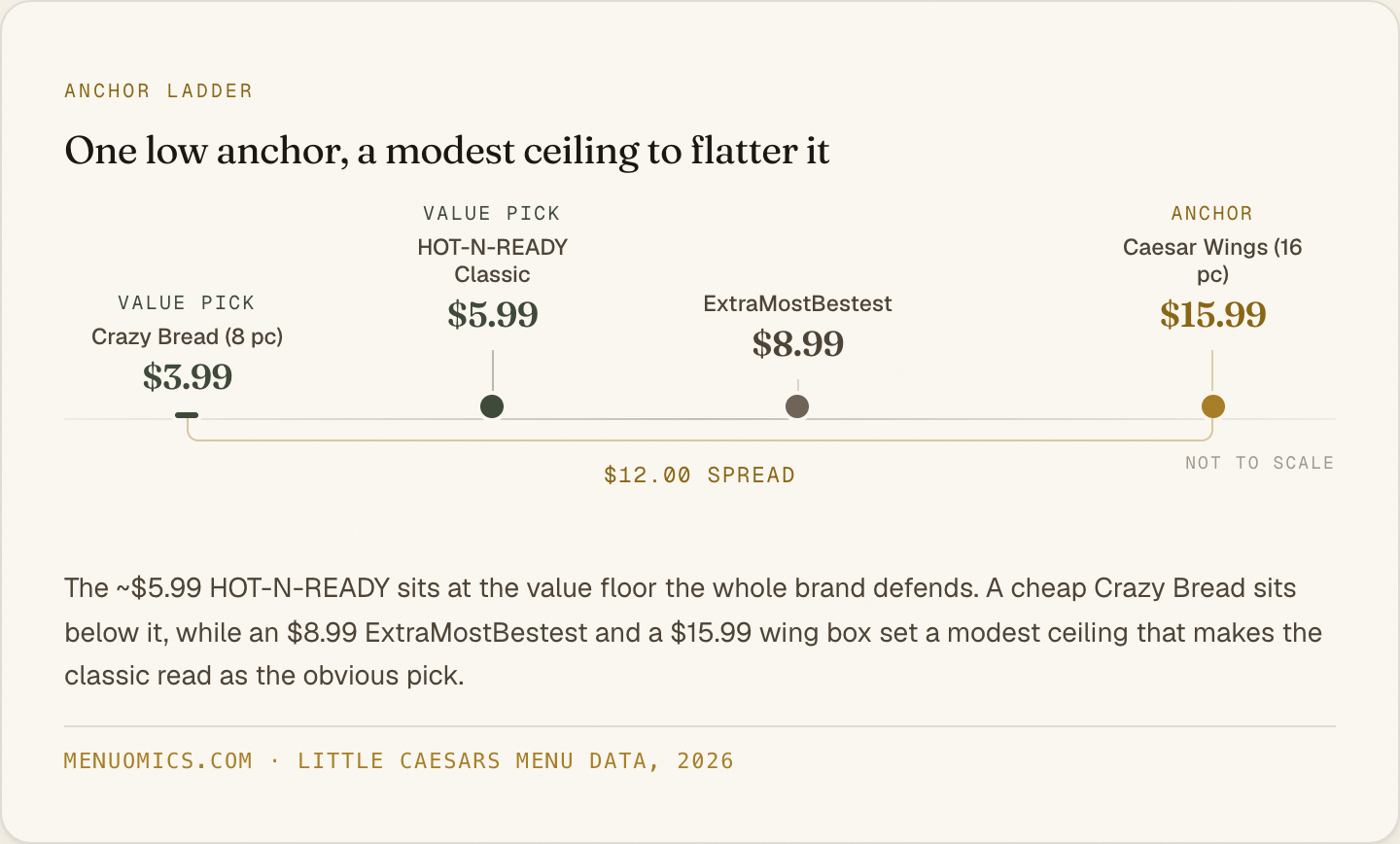
One low anchor, a modest ceiling to flatter it
The ~$5.99 HOT-N-READY sits at the value floor the whole brand defends. A cheap Crazy Bread sits below it, while an $8.99 ExtraMostBestest and a $15.99 wing box set a modest ceiling that makes the classic read as the obvious pick.
Download this chart (PNG) · free to reuse with credit, see reuse terms.
The full ticket
What it actually rings up to.
The headline price is only the start. The real number is the journey from a base order to the check at the register, one easy yes at a time.
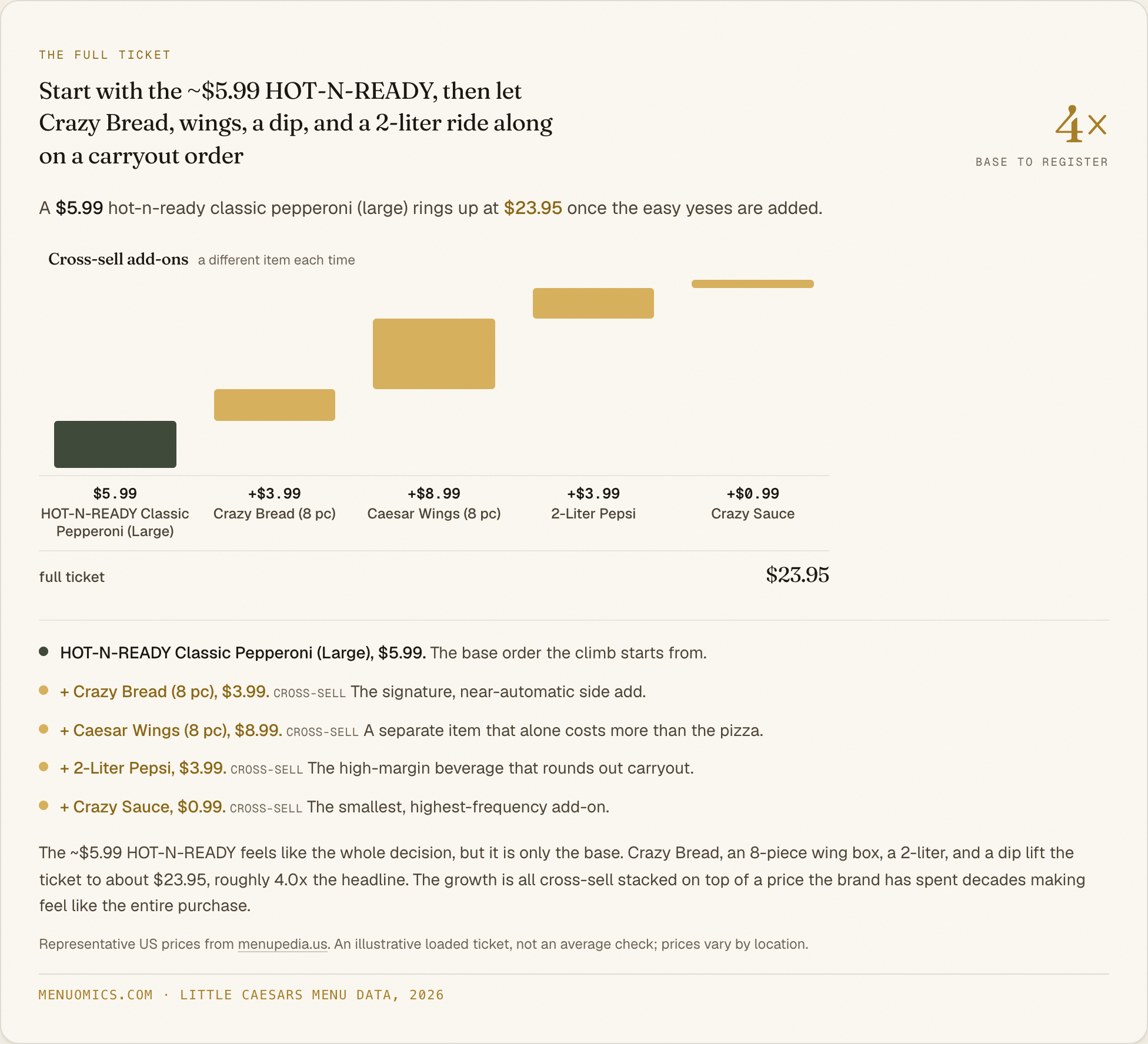
Start with the ~$5.99 HOT-N-READY, then let Crazy Bread, wings, a dip, and a 2-liter ride along on a carryout order
A $5.99 hot-n-ready classic pepperoni (large) rings up at $23.95 once the easy yeses are added.
- HOT-N-READY Classic Pepperoni (Large), $5.99. The base order the climb starts from.
- + Crazy Bread (8 pc), $3.99. cross-sell The signature, near-automatic side add.
- + Caesar Wings (8 pc), $8.99. cross-sell A separate item that alone costs more than the pizza.
- + 2-Liter Pepsi, $3.99. cross-sell The high-margin beverage that rounds out carryout.
- + Crazy Sauce, $0.99. cross-sell The smallest, highest-frequency add-on.
The ~$5.99 HOT-N-READY feels like the whole decision, but it is only the base. Crazy Bread, an 8-piece wing box, a 2-liter, and a dip lift the ticket to about $23.95, roughly 4.0x the headline. The growth is all cross-sell stacked on top of a price the brand has spent decades making feel like the entire purchase.
Representative US prices from menupedia.us. An illustrative loaded ticket, not an average check; prices vary by location.
Download this chart (PNG) · free to reuse with credit, see reuse terms.
The setup
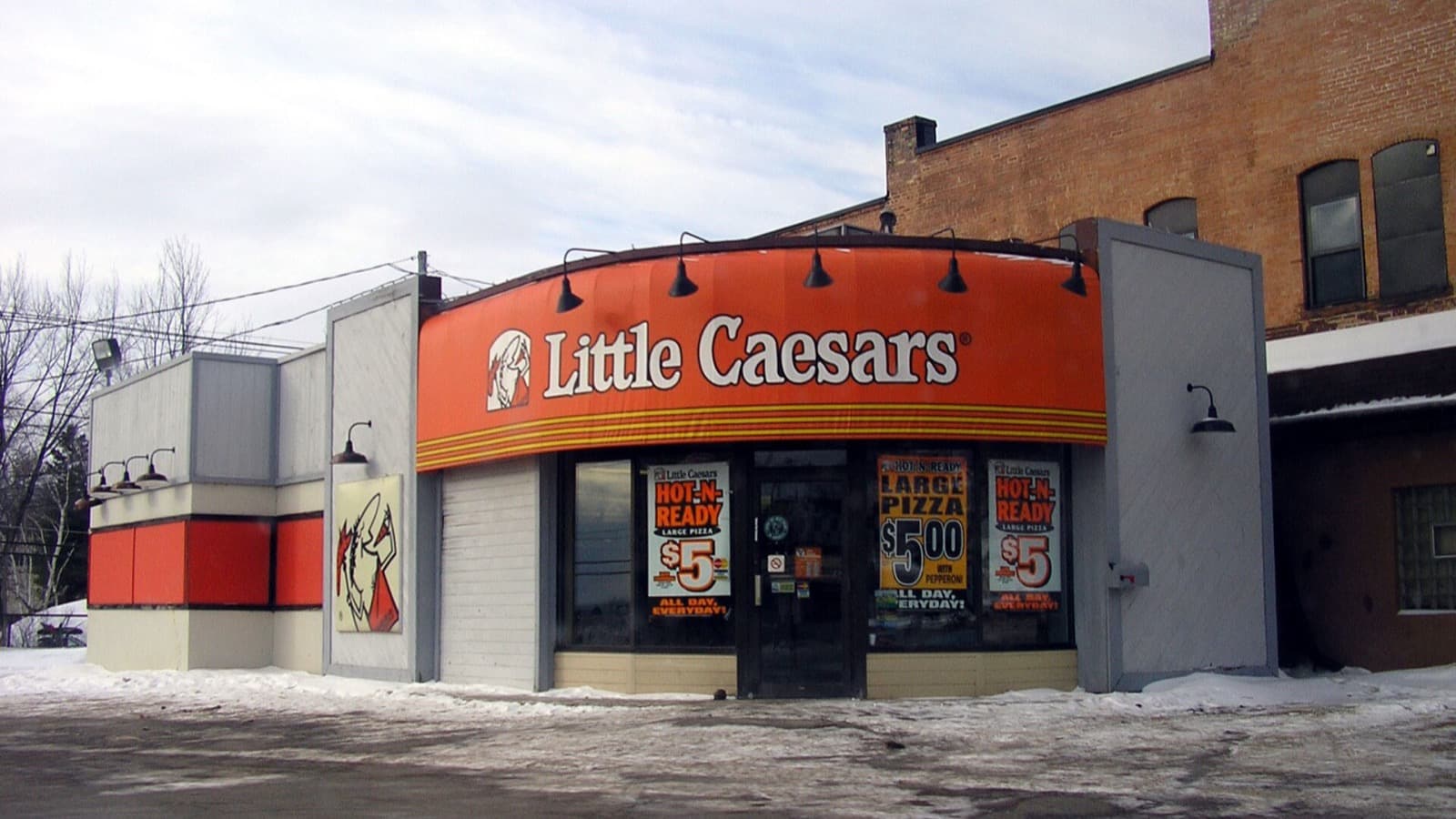
Little Caesars sells the HOT-N-READY: a classic pepperoni or cheese pizza already baked and waiting when you walk in, no order, no wait, for about $5.99. That is the entire pitch. The number is the point. The chain held a flat $5 HOT-N-READY price for roughly 25 years, from its 2001 launch until the first-ever increase to $5.55 in January 2022, long enough that the price stopped being a promotion and became the thing people know about the brand. Behind it sits a heritage of the same idea: the 1979 'Pizza! Pizza!' slogan, which sold two pizzas for the price of one competitor's single pie.
The menu is deliberately tiny. A handful of round pizzas, Crazy Bread, wings, a drink, and you are done, which keeps the decision small and the line moving. Above the classic sits the ExtraMostBestest at about $8.99, framed as more pepperoni and more cheese at the nation's best price, and the Pizza Portal app locker removes even the counter interaction for people who order ahead. Every piece points at the same thing: one low, round, memorable price, defended by a menu that gives you almost nothing to weigh it against. (Little Caesars does not frame these as behavioral tactics; this is our reading of the observed design.)
What they get right
The behavioral economics already at work.
One round number, held for 25 years, is the brand
Little Caesars held the HOT-N-READY at a flat $5 for roughly 25 years, from 2001 to the first increase in 2022. Repeating one round figure that long turns it into a stored reference price customers carry in their heads, so every other pizza is judged against '$5 gets you a whole pizza' rather than against ingredient cost. A round, stable, memorable number is a far more durable anchor than a rotating discount, and here it is the entire positioning.
Flat $5 HOT-N-READY held ~25 years (2001 to 2022) before its first hike to $5.55, Tversky & Kahneman 1974 (anchoring); ClickOnDetroit / Deseret News on the 2022 price increase
A pizza already made removes the wait entirely
The HOT-N-READY is baked before you arrive, so the transaction is walk in, grab, pay, leave. Removing the wait is not a side benefit; it is the product. Waiting is a real cost customers weigh against price, and a hot pizza sitting ready collapses that cost to zero, which lets a low sticker price feel even lower because nothing else is being spent, not time, not attention.
friction / pain-of-paying and waiting research; Sutherland on perceived cost of waiting
The tiny menu is a feature, not a limitation
Where a build-your-own chain hands you crusts, sizes, and toppings to weigh, Little Caesars offers a short list of finished pizzas and a couple of sides. Fewer options means a faster decision, a faster line, and less second-guessing about whether you got the deal. A pared-back board also keeps attention on the one thing the brand wants judged: the price of the pizza in front of you.
Iyengar & Lepper 2000 (choice overload); the effect is context-dependent, Scheibehenne et al. 2010
'Pizza! Pizza!' sold more-for-less before the HOT-N-READY existed
The 1979 'Pizza! Pizza!' campaign offered two pizzas for the price of one competitor's single pie, and the doubled word was the offer. It trained the brand's core promise, more pizza for less money, decades before the HOT-N-READY delivered the same idea as one round-priced item. Framing value as extra quantity rather than a percentage off reads as a gift rather than a markdown, and it is stickier in memory.
'Pizza! Pizza!' introduced 1979 for a two-for-one deal; dropped ~1998, revived 2012, Wikipedia (Little Caesars); The Takeout on the catchphrase
ExtraMostBestest and wings set the ceiling that flatters $5.99
An $8.99 ExtraMostBestest and a $15.99 16-piece wing box are the priciest things on an otherwise cheap board. Their job is less to sell in volume than to make the $5.99 classic read as the obvious, thrifty default. Keep a visible top rung and every cheaper choice feels like restraint; the ExtraMostBestest also gives trade-up buyers somewhere to go without ever leaving the value story.
ExtraMostBestest ~$8.99; 16-pc Caesar Wings ~$15.99 vs the ~$5.99 classic, Simonson & Tversky 1992 (extremeness aversion); Menupedia Little Caesars 2026 prices
What we’d test
The rewrite, with the expected lift and the honest caveat.
Print the held-price history next to the HOT-N-READY
The strongest asset is that the price barely moved for 25 years, and almost nobody sees that on the menu. A small honest line ('one price, held since 2001') on the HOT-N-READY turns an abstract low number into a visible promise of stability, which is exactly what makes the anchor persuasive. It costs nothing and reinforces the one thing the brand already owns.
Expect Higher perceived value on the classic and a stronger 'they've always been the cheap one' association.
Caveat A menu-copy change only; it does not change the price or the pizza, and the claim must stay truthful as prices drift.
Show the classic and ExtraMostBestest as a two-rung ladder
Place the $5.99 classic and the $8.99 ExtraMostBestest side by side as a plain 'good / loaded' pair rather than separate listings, so the trade-up reads as a small step within the value story instead of a jump to a pricier product. Letting extremeness aversion do the work moves mix toward the higher-margin pizza without a hard upsell.
Expect A modest shift toward the ExtraMostBestest while the classic still holds the value floor.
Caveat A layout and presentation change only; no change to portions, recipes, or prices.
Surface a one-tap Crazy Bread add at Pizza Portal checkout
In the app, after the pizza is chosen and before payment, offer a single 'Add Crazy Bread for ~$3.99?' prompt, the moment the marginal cost feels smallest against a committed order. The Portal already removes counter friction; a quiet, dismissible add at the finish captures the cross-sell a cashier would otherwise have to ask for.
Expect Higher Crazy Bread attach rate on app orders with no added counter friction.
Caveat Keep it to one dismissible prompt; repeated nags raise cart abandonment.
What diners actually say
Synthesized from public reviews, the reality check that grounds every recommendation.
They praise
- One of the clearest value anchors in fast food: a round low price held so long the number itself became the brand.
- The made-in-advance HOT-N-READY genuinely removes the wait, a real benefit priced into a low sticker.
- A deliberately tiny menu that makes ordering fast and keeps the line moving.
- Crazy Bread is a beloved, cheap, near-automatic cross-sell that lifts tickets without feeling like an upsell.
- The Pizza Portal app locker is a smart, low-friction pickup mechanic that fits the no-wait model perfectly.
They criticize
- The anchor is drifting: a flat $5 for ~25 years, then a first-ever hike to $5.55 in 2022 and roughly $5.99 today.
- The best pricing is sliding behind the app and Pizza Portal, so two customers can pay very different prices.
- Franchise pricing swings widely (roughly $5.55 to $6.99 for the same HOT-N-READY), which muddies the famous number.
- Quality complaints are common: reviews flag undercooked or cold pizza and thin toppings when the pie has sat.
- Execution and service reviews run low, so the counter experience can undercut the value the menu promises.
The verdict
Read as menu design, Little Caesars is the purest value-anchor play in the catalog. It holds one round, low HOT-N-READY price so long it becomes the brand, removes the wait by baking in advance, keeps the menu tiny so there is almost nothing to weigh the price against, and lets an $8.99 ExtraMostBestest and a $15.99 wing box flatter the ~$5.99 classic as the obvious pick. Where Domino's builds a self-assembled cart around a $6.99 deal, Little Caesars sells one finished thing at one memorable number and defends it. The B-plus, not higher, reflects the cracks in that number: the anchor is creeping up, the sharpest deals are moving into the app, and quality-and-service complaints keep threatening to undo at the counter what the price promises on the sign.
Common questions
- Why is Little Caesars so cheap?
- Little Caesars sells a hot pizza already made and waiting, so it skips the wait and the build-your-own labor that other chains price for. The classic HOT-N-READY pepperoni runs about $5.99 (varies by location, 2026). The whole menu is engineered around holding one memorable low price as the brand's anchor rather than discounting off a high one.
- How much is a Little Caesars HOT-N-READY pizza in 2026?
- The classic HOT-N-READY pepperoni or cheese is about $5.99, and the ExtraMostBestest with extra toppings runs about $8.99 (both vary by location, 2026). The price held at a flat $5 for roughly 25 years, which is what made the number a value anchor before its first increase in 2022.
- What does 'Pizza! Pizza!' mean at Little Caesars?
- 'Pizza! Pizza!' dates to a 1979 deal offering two pizzas for the price of one competitor's single pie. The doubled word was the offer, said twice. It seeded the brand's whole identity: more pizza for less money, which the HOT-N-READY later delivered as a single round-priced item.
- What is the Little Caesars Pizza Portal?
- The Pizza Portal is a heated self-service locker for app orders, launched nationwide in 2018. You pre-pay in the app, skip the counter, and open a compartment with a PIN or QR code. It removes the last friction from an already no-wait model and moves the best pricing behind the app.
- What is the most expensive item at Little Caesars?
- On the standard menu, the priciest single item is the Caesar Wings (16 pc), about $15.99 in representative 2026 US pricing (it varies by location; group packs and combo deals can cost more). Formats like that are priced to move the decision to per-unit math: the big number buys a lower cost per piece, and that falling per-piece price is where the persuasion happens.
- How much is a meal at Little Caesars?
- A meal at Little Caesars starts around $5.99 for the base order and lands near $23.95 once the usual add-ons go on, roughly 4x the headline price (representative 2026 US figures; they vary by location). That gap between the price that gets you in and the total you pay is the multiplier this page grades.
Sources (7)
- Little Caesars, our history (official)
- Wikipedia, Little Caesars
- ClickOnDetroit: HOT-N-READY price increase, first in 25-year history (2022)
- PR Newswire: Little Caesars reveals ExtraMostBestest at nation's best price (2017)
- PR Newswire: Pizza Portal pickup and mobile app available nationwide (2018)
- Menupedia: Little Caesars menu prices (2026)
- The Takeout: the rise, fall, and comeback of 'Pizza! Pizza!'
Head to head
More breakdowns
 The Cheesecake FactoryB+
A 21-page, 250-item menu should be a behavioral disaster. It's a roughly $4-billion chain. Here's what all that abundance is quietly doing.
Read the The Cheesecake Factory breakdown → McDonald'sA-
The Extra Value Meal is one of the most-copied ideas in food: fold the whole order into a single number that hurts less than three. Then McValue and the app pile value on top, and the McRib drops in as an event.
Read the McDonald's breakdown → Taco BellA-
A sub-$3 value menu sets the floor, $5/$7/$9 boxes name the deal after its own price, and a never-ending limited-time calendar keeps a reason to come back on the board. Taco Bell sells value loudly, and it works: it gained traffic while rivals shrank.
Read the Taco Bell breakdown → Dunkin'A-
A premium latte anchors the cheap iced coffee as the obvious default, the $6 Meal Deal bundles the breakfast, and Dunkin' Rewards turns the morning run into a streak. The menu craft is textbook; the strain is price creep and an app that increasingly decides the real price.
Read the Dunkin' breakdown → Panda ExpressB+
The whole order comes down to one question, how many entrees. A Bowl is one, a Plate is two, a Bigger Plate is three, and the menu is built so the middle Plate wins. Orange Chicken is the anchor everyone orders, and a quiet $1.50 premium upcharge lifts the check while the headline price stays put.
Read the Panda Express breakdown → Raising Cane'sA-
The chicken-finger chain that built a billion-dollar machine by refusing to sell almost anything else.
Read the Raising Cane's breakdown →Your menu next
Get this for your own menu, free.
Send your menu and we’ll send back the same breakdown, what you get right, what we’d test, and why.
Pizza Hut
The chain that invented stuffed crust and the sit-down pizza night is now running a flat $7 value menu. The design is sound; the question is whether it can arrest a real decline.
Read it →