McAlister's Deli menu, graded
McAlister's uses a $2.99 sweet tea with free refills (plus a $7.99 Tea Pass and an annual Free Tea Day) as the habit that drives visit frequency, then a one-pound giant spud with no reference price and a mix-and-match Choose 2 combo to move the check past $10, with no-tip table delivery making the premium feel earned.
How a $7.99 Tea Pass, a $12.49 giant spud, and free refills brought to your table turn a sandwich shop into a habit.
Menu-craft grade
The tea program is one of the best habit loops in fast casual, the giant spud is a genuinely differentiated anchor with no competitive reference price, and Choose 2 is a flexible compromise engine. The craft loses points for a Choose 2 floor that quietly rises with premium picks, a national menu site that shows no prices until you pick a store, and a 35-cent service fee on digital Tea Pass redemptions, small frictions that work against an otherwise elegant design.
Graded on how well the menu uses behavioral economics, not the food.
Menu and prices verified September 2026
A 4-minute audio read of the analysis
- Type
- Chain
- Where
- Atlanta, Georgia (GoTo Foods headquarters)
- Cuisine
- Fast-casual deli sandwiches, giant spuds, and sweet tea
- Footprint
- ~550 US locations in about 30 states (2025)
- Since
- 1989 (Oxford, Mississippi; founder Don Newcomb, a retired dentist)
- Ownership
- GoTo Foods (formerly Focus Brands), a Roark Capital portfolio company since 2005; nearly all locations franchised
The mechanics, drawn
The same menu, mapped onto an axis, so the behavioral move is something you can see, not just read.
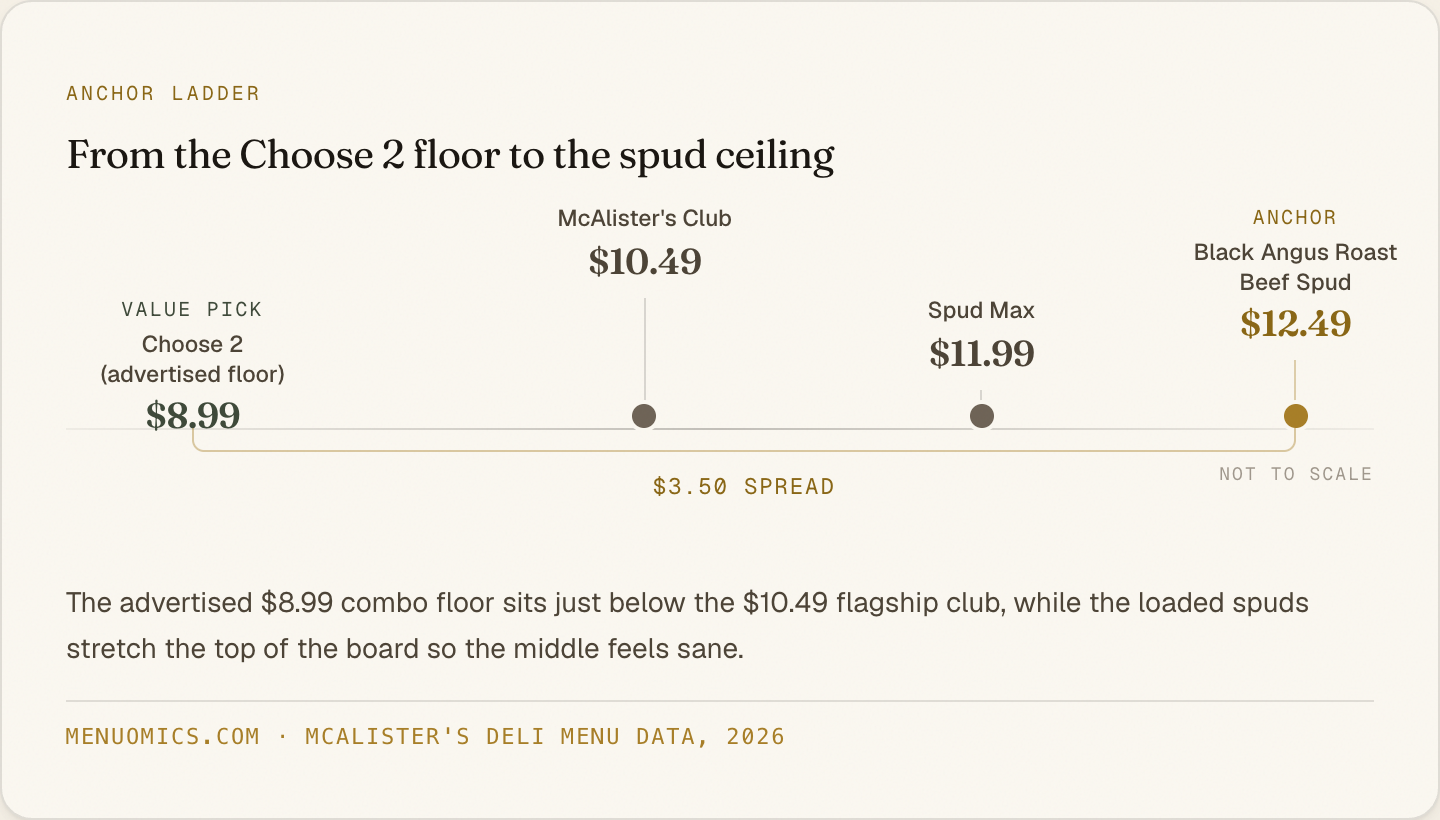
From the Choose 2 floor to the spud ceiling
The advertised $8.99 combo floor sits just below the $10.49 flagship club, while the loaded spuds stretch the top of the board so the middle feels sane.
Download this chart (PNG) · free to reuse with credit, see reuse terms.
The full ticket
What it actually rings up to.
The headline price is only the start. The real number is the journey from a base order to the check at the register, one easy yes at a time.
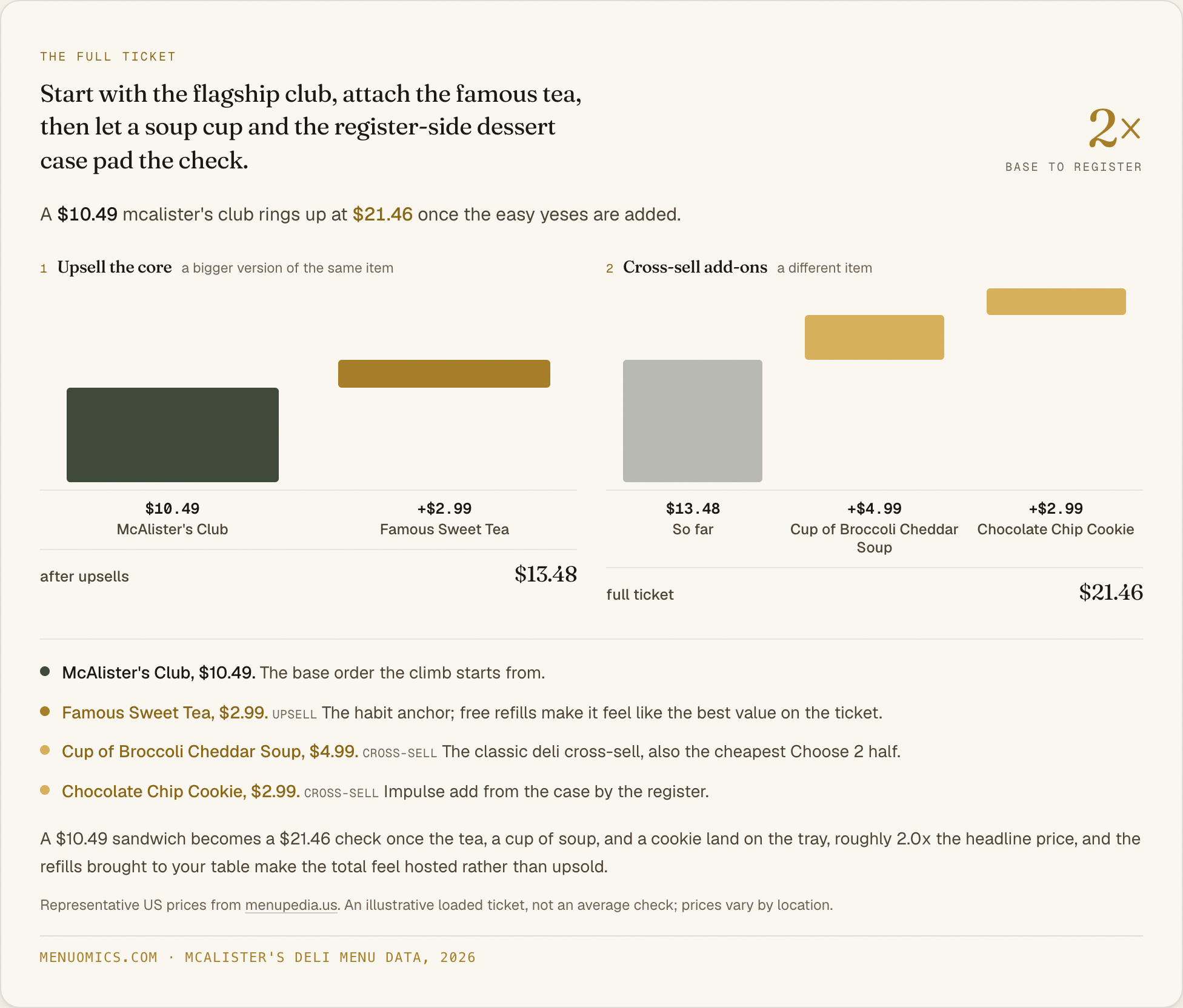
Start with the flagship club, attach the famous tea, then let a soup cup and the register-side dessert case pad the check.
A $10.49 mcalister's club rings up at $21.46 once the easy yeses are added.
- McAlister's Club, $10.49. The base order the climb starts from.
- Famous Sweet Tea, $2.99. upsell The habit anchor; free refills make it feel like the best value on the ticket.
- Cup of Broccoli Cheddar Soup, $4.99. cross-sell The classic deli cross-sell, also the cheapest Choose 2 half.
- Chocolate Chip Cookie, $2.99. cross-sell Impulse add from the case by the register.
A $10.49 sandwich becomes a $21.46 check once the tea, a cup of soup, and a cookie land on the tray, roughly 2.0x the headline price, and the refills brought to your table make the total feel hosted rather than upsold.
Representative US prices from menupedia.us. An illustrative loaded ticket, not an average check; prices vary by location.
Download this chart (PNG) · free to reuse with credit, see reuse terms.
The setup
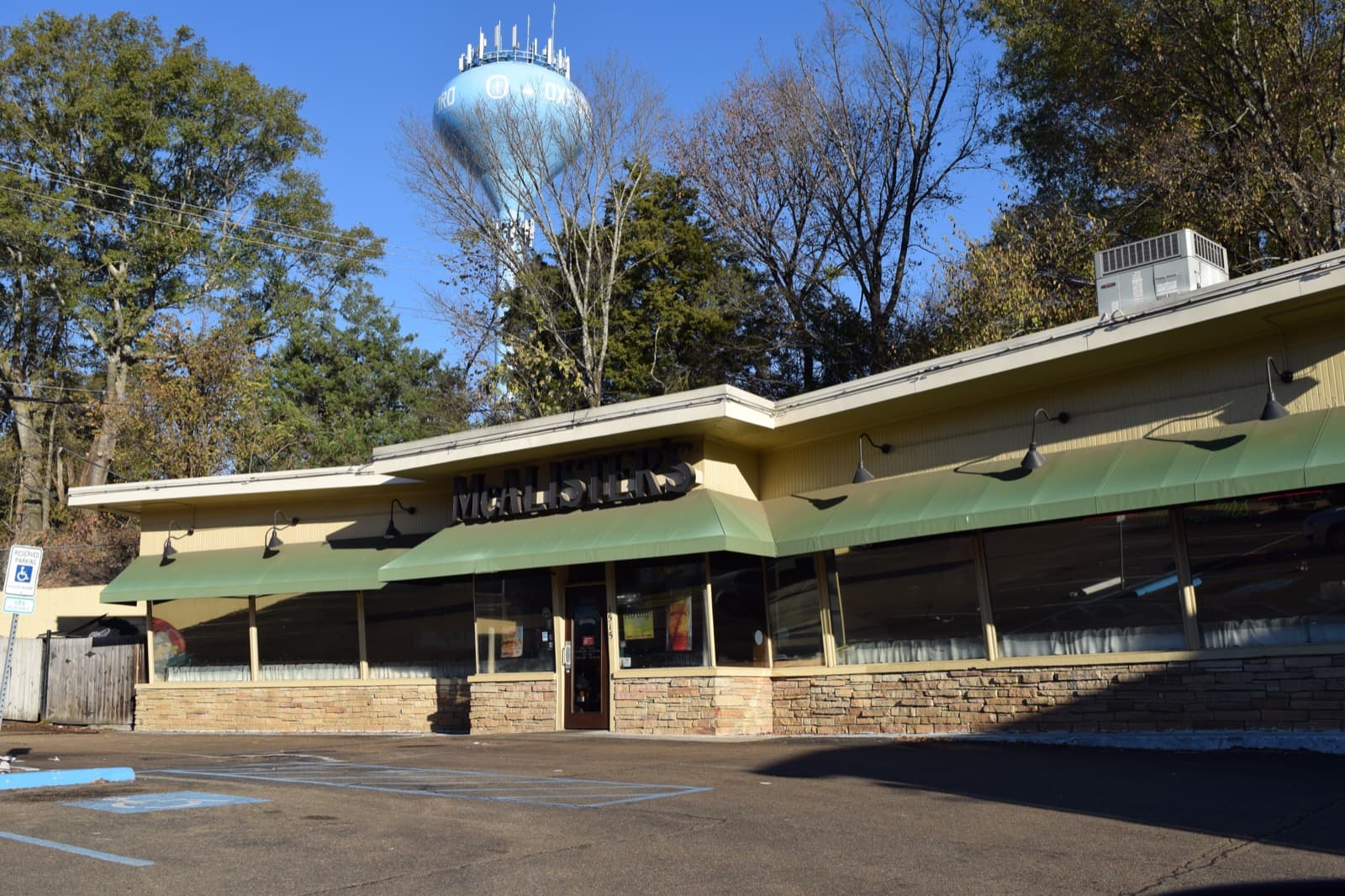
McAlister's Deli started in 1989 in Oxford, Mississippi, when Don Newcomb, a retired dentist, bought a former gas station that a film crew had dressed up as a 1950s diner for the movie 'Heart of Dixie' and opened a sandwich shop inside the set. The shop was briefly called Chequers, then renamed after the surname of his wife's parents. From that one converted movie set the chain grew to roughly 550 locations in about 30 states, was acquired by Roark Capital in 2005, sits today inside the GoTo Foods portfolio alongside Cinnabon and Auntie Anne's, and in 2024 became the first brand in that portfolio to pass $1 billion in systemwide sales.
The engine under that growth is not the sandwiches. It is a $2.99 glass of sweet tea with free refills, backed by a $7.99 Tea Pass that dispenses a free tea every day for a month, a free tea for joining the rewards program, and an annual Free Tea Day each July that hands out more than 200,000 glasses. Around the tea sit a one-pound baked potato that no other national chain sells at this scale, a Choose 2 menu that lets guests pair any two half portions, and a no-tip table-delivery model the company calls Fast Casual Plus. Each piece nudges the same direction: visit often and feel hosted, without noticing that lunch at a deli now clears fifteen dollars. (McAlister's does not frame these as behavioral tactics; this is our reading of the observed design.)
What they get right
The behavioral economics already at work.
A $2.99 tea engineered into a daily habit
The tea is the cheapest thing McAlister's sells and the hardest working. Refills are free in the dining room, joining the rewards program earns a free glass, and the $7.99 Tea Pass gives rewards members a free tea every day for 30 days, which pays for itself by the third visit. Once the pass is prepaid, each visit's drink feels free, the trip feels justified, and the food carries the check. Prepaying separates the pain of paying from the pleasure of consuming, which is exactly what a pass does.
Tea Pass: $7.99 for 30 days of daily tea; 20+ million glasses sold a year, McAlister's Tea Pass terms; Men's Journal (2025)
Free Tea Day is reciprocity at industrial scale
Every July since 2010, McAlister's gives a free 32 oz tea to anyone who walks in, no purchase required, more than 200,000 glasses in a day. A free gift creates a mild obligation to reciprocate, and most people reciprocate by buying lunch to go with the free drink or by coming back. The giveaway costs pennies per glass and manufactures a store-traffic holiday the brand now owns.
Free Tea Day 2026: July 16; 200,000+ free teas given away annually, Hey It's Free (2026); Men's Journal (2025)
The giant spud has no reference price
Each giant spud is two roughly 10-ounce russets pressed together and baked as one, then loaded. No other national chain sells a one-pound loaded baked potato, so guests have no mental price for one, and $11.99 to $12.49 reads as novelty rather than markup, even though potatoes are among the cheapest inputs in food service. An item nobody can comparison-shop is an item whose price the seller controls.
Two russets per spud; 5.8 million Giant Spuds sold in a year, Chowhound; Restaurant Business
Choose 2 is a compromise machine with a soft floor
Choose 2 advertises a starting price around $8.99 and lets guests pair any two half portions across sandwiches, spuds, salads, and soups. The 'from' price anchors low, then premium picks add small upcharges one at a time, so most real pairings land near $10.49 without any single step feeling like a decision. The format also flatters the guest as a customizer while steering everyone to the same mid-priced outcome.
Choose 2 advertised from ~$8.99; tracked soup-and-half-sandwich pairings at ~$10.49, McAlister's Choose 2 menu; Menupedia 2026 pricing
Table service without the tip line
You order at the counter and pay fast-casual style, then staff bring the food, refill your tea at the table, and bus your plates, and the chain has been explicitly no-tip since 1989 (it now brands the model Fast Casual Plus). The guest books the meal in the fast-casual mental account while receiving casual-dining treatment, so an $11 sandwich is judged against Panera rather than against a sit-down deli where the same service would add 20 percent. The absent tip works like an invisible discount that justifies the premium menu.
No-tip counter-plus-table model since 1989; systemwide sales passed $1B in 2024, Restaurant Hospitality; GoTo Foods
What we’d test
The rewrite, with the expected lift and the honest caveat.
Rank the spud board so the Max is the compromise
Wherever the spud line appears (board, app, kiosk), list the Black Angus Roast Beef Spud first at the top, place the Spud Max in the middle, and end with Justaspud, so the $11.99 Max reads as the sensible middle between a $12.49 ceiling and an $8.49 floor.
Expect More guests trade up from Justaspud to the loaded spuds without any price change.
Caveat The gap between floor and ceiling is only $4; if loaded-spud prices creep further the floor starts to look like the smart buy instead.
Drop the 35-cent Tea Pass redemption fee
Charging 35 cents to redeem a prepaid free-tea pass through the app or website puts a visible surcharge on the brand's own loyalty flagship. Small itemized fees attract attention out of proportion to their size and recode a gift as a transaction, which is the opposite of what a habit product should do.
Expect Higher Tea Pass renewal rates and more digital orders attached to daily redemptions.
Caveat The fee presumably offsets platform costs; folding it into the pass price ($8.49 instead of $7.99) keeps the economics without the sting.
Say the quiet perk out loud
The refill service already exists and is already paid for, but the menu board just says the tea price. Printing the true service fact next to the price converts an operating cost into perceived value at zero marginal cost, the kind of reframing Rory Sutherland argues is cheaper than any product change.
Expect Higher tea attach rate and more dine-in visits, where tickets run larger.
Caveat Works only where staffing actually delivers the promise; a slow refill turns the printed claim into an irritant.
What diners actually say
Synthesized from public reviews, the reality check that grounds every recommendation.
They praise
- The tea program is the best beverage habit loop in fast casual: a $7.99 pass that pays for itself in three glasses, free refills, and a 16-year-old free-tea holiday.
- The giant spud is real differentiation, a category of one that sold 5.8 million units in a year with no rival item to price-compare against.
- Choose 2 lets guests mix half portions across all four menu categories, more flexible than the rigid pick-two formats at competing bakery-cafe chains.
- No-tip table service since 1989 delivers casual-dining hospitality at counter-service prices, and the company held that line for decades before branding it Fast Casual Plus.
- The catering arm (box lunches, hot spud bars, gallons of tea) gives the brand a high-ticket second business and helped make it the first GoTo Foods brand past $1 billion in systemwide sales.
They criticize
- Price creep has pushed a deli lunch into casual-dining territory: a club, a tea, and a cookie clear $16 before tax in many markets.
- Documented portion complaints (thin French Dip beef, skimpy chicken-salad halves) recur on consumer review sites, where the chain holds a 2.4 of 5 rating across 147 PissedConsumer reviews.
- The Choose 2 floor is hard to hit: premium picks and upcharges move most advertised $8.99 pairings past $10.
- Charging a 35-cent service fee to redeem the Tea Pass digitally is penny friction on the loyalty program's own flagship product.
- The national menu site shows no prices until you select a store, and franchise variance means the same order can differ by two dollars a town away.
The verdict
McAlister's is proof that a menu's strongest hook does not have to be food. The tea is a near-zero-marginal-cost product that buys visit frequency and a brand identity (the company calls its fans Tea Freaks), the giant spud is the rare anchor with no competitive reference price, and Choose 2 gives the middle of the menu a flexible, safe-feeling default while no-tip table service quietly justifies the premium over other counter chains. What holds the grade at B+ is discipline rather than design: the Choose 2 floor drifts upward with premium picks, national pricing hides behind a store selector, and a 35-cent fee on redeeming a prepaid free-tea pass is exactly the kind of small self-inflicted friction the rest of this system is too smart for.
Common questions
- Are refills free at McAlister's Deli?
- Yes. Tea and fountain drinks are refilled free when you dine in, and staff bring refills to your table as part of the chain's no-tip table-service model, in place since 1989.
- Is the McAlister's Tea Pass worth it?
- Yes, quickly: the Tea Pass costs $7.99 for a free tea every day for 30 days, so at roughly $2.99 a glass it pays for itself by the third visit. That speed is the design. Once the pass is prepaid, each visit's drink feels free, skipping a week feels like waste, and the food carries the check, which is the habit loop this whole menu is built around.
- How does McAlister's Choose 2 work?
- You pick any two half portions: a half sandwich, half spud, half salad, or a cup of soup. Advertised pricing starts around $8.99, but premium picks carry upcharges, so most real-world pairings land closer to $10 or $11 depending on location.
- When is McAlister's Free Tea Day 2026?
- July 16, 2026. McAlister's has held Free Tea Day every July since 2010, giving anyone a free 32 oz tea with no purchase required, limited to one per person in store or four per order through the app or website.
- What is the most expensive item at McAlister's Deli?
- On the standard menu, the priciest single item is the Black Angus Roast Beef Spud, about $12.49 in representative 2026 US pricing (it varies by location; group packs and combo deals can cost more). That top price also does quiet work as the menu's anchor: it is the number that makes everything below it read as reasonable.
- How much is a meal at McAlister's Deli?
- A meal at McAlister's Deli starts around $10.49 for the base order and lands near $21.46 once the usual add-ons go on, roughly 2x the headline price (representative 2026 US figures; they vary by location). That gap between the price that gets you in and the total you pay is the multiplier this page grades.
Sources (8)
- Menupedia: McAlister's Deli 2026 US menu pricing
- The Krazy Coupon Lady: McAlister's Free Tea Day and Tea Pass details
- Hey It's Free: McAlister's Free Tea Day, July 16, 2026
- GoTo Foods: McAlister's Deli surpasses $1 billion in systemwide sales (2024)
- Fast Casual: McAlister's Deli expanding via 'Fast Casual Plus' model
- Restaurant Business: McAlister's loads potatoes with bold toppings
- Chowhound: Why McAlister's baked potatoes are bigger than a typical spud
- Wikipedia: McAlister's Deli (founding and ownership history)
Head to head
More breakdowns
 Olive GardenB+
Never-ending breadsticks read less like generosity than like decoupled pricing: a loss-leader and a recurring scarcity event working in concert.
Read the Olive Garden breakdown → Palmetto SuperfoodsB
A California acai chain whose menu leads with the one promise every acai shop gets accused of breaking: '100% Real Acai, every time.'
Read the Palmetto Superfoods breakdown → SweetgreenB+
The salad chain that names every bowl for its ingredients and farmers, then offers a handful of signature defaults so you don't have to build from scratch.
Read the Sweetgreen breakdown → Chipotle Mexican GrillA-
Chipotle's menu is a build-your-own assembly line with no prices on the rail, so you customize first and total up last, with guac quoted as a tidy little add-on.
Read the Chipotle Mexican Grill breakdown → StarbucksA-
Tall is the small. The names hide the ounces, the app hides the payment, and a pumpkin drink restarts the whole calendar every August. The most studied size menu in the world.
Read the Starbucks breakdown → CAVAB+
CAVA's menu is a build-your-own Mediterranean line that includes three scratch dips and unlimited toppings free, then concentrates the upsell on one flat premium-protein step and resells the dips as paid sides.
Read the CAVA breakdown →Your menu next
Get this for your own menu, free.
Send your menu and we’ll send back the same breakdown, what you get right, what we’d test, and why.
Cinnabon
A mall and airport bakery whose most important menu decision is invisible: the ovens sit at the front so the cinnamon smell does the selling, and the counter is built to convert that impulse into a drink, a frosting cup, and a take-home box.
Read it →