Pinkberry menu, graded
Pinkberry sells a tart, nonfat swirl as the healthier dessert, then partitions the toppings so the fruit and candy each read as a small, virtuous add rather than the thing that doubles the ticket, turning a permission-to-indulge health halo into a rising check.
How a 20-calorie-per-ounce tart swirl and a partitioned wall of fruit and candy toppings turn a healthy-feeling snack into an eleven-dollar cup.
Menu-craft grade
The core mechanic is genuinely clever. A tart, nonfat base at roughly 20 calories per ounce gives guests permission to treat dessert as health food, and the toppings are partitioned so each fresh-fruit or candy add lands as a tiny yes while the total climbs toward eleven dollars. The Original swirl is a real anchor flavor and the size ladder is clean. It loses ground because the board is thin next to the by-weight self-serve rivals that undercut it, the health framing collided with a real 'is this even yogurt' lawsuit, and the fixed-tier pricing hides how fast toppings inflate the check.
Graded on how well the menu uses behavioral economics, not the food.
Menu and prices verified September 2026
A 4-minute audio read of the analysis
- Type
- Chain
- Where
- West Hollywood, California (first store); Kahala Brands HQ in Scottsdale, Arizona
- Cuisine
- Tart frozen yogurt and toppings
- Footprint
- 72 US locations (2026), down from a late-2000s peak near 260 worldwide
- Since
- 2005 (West Hollywood, California; founders Shelly Hwang and Young Lee)
- Ownership
- Kahala Brands (acquired Pinkberry December 2015), a subsidiary of Canada's MTY Food Group since 2016
The mechanics, drawn
The same menu, mapped onto an axis, so the behavioral move is something you can see, not just read.
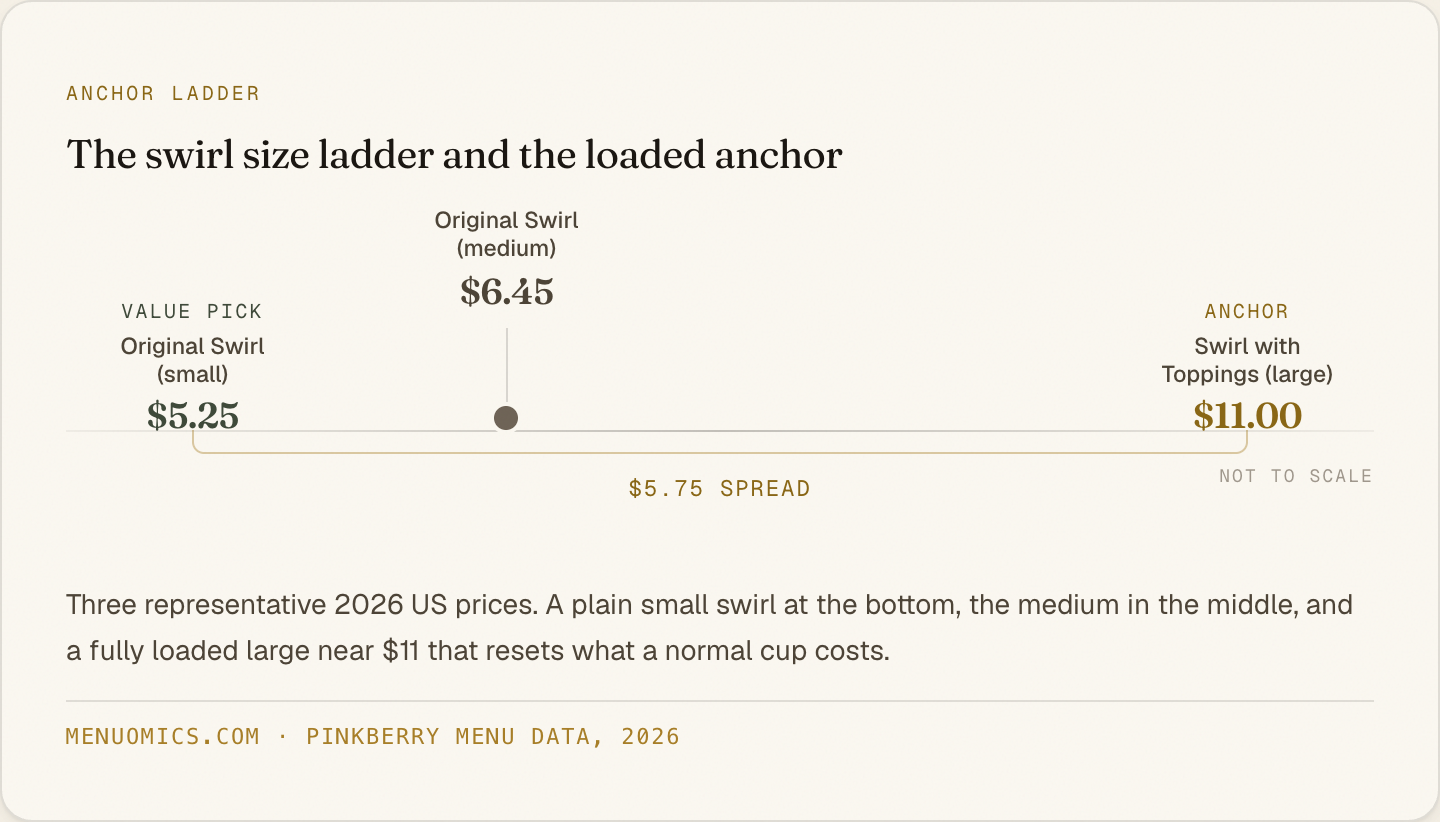
The swirl size ladder and the loaded anchor
Three representative 2026 US prices. A plain small swirl at the bottom, the medium in the middle, and a fully loaded large near $11 that resets what a normal cup costs.
Download this chart (PNG) · free to reuse with credit, see reuse terms.
The full ticket
What it actually rings up to.
The headline price is only the start. The real number is the journey from a base order to the check at the register, one easy yes at a time.
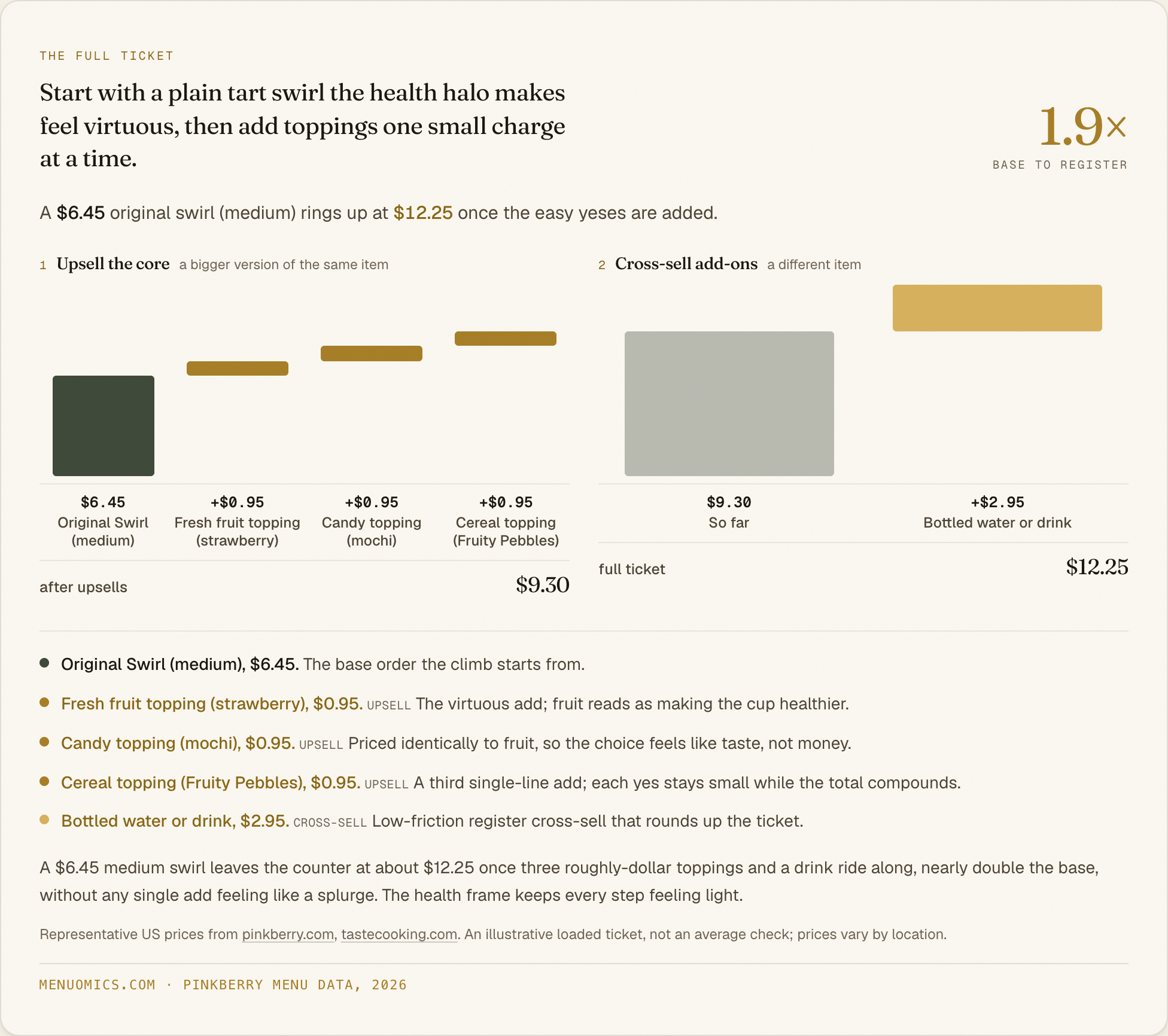
Start with a plain tart swirl the health halo makes feel virtuous, then add toppings one small charge at a time.
A $6.45 original swirl (medium) rings up at $12.25 once the easy yeses are added.
- Original Swirl (medium), $6.45. The base order the climb starts from.
- Fresh fruit topping (strawberry), $0.95. upsell The virtuous add; fruit reads as making the cup healthier.
- Candy topping (mochi), $0.95. upsell Priced identically to fruit, so the choice feels like taste, not money.
- Cereal topping (Fruity Pebbles), $0.95. upsell A third single-line add; each yes stays small while the total compounds.
- Bottled water or drink, $2.95. cross-sell Low-friction register cross-sell that rounds up the ticket.
A $6.45 medium swirl leaves the counter at about $12.25 once three roughly-dollar toppings and a drink ride along, nearly double the base, without any single add feeling like a splurge. The health frame keeps every step feeling light.
Representative US prices from pinkberry.com, tastecooking.com. An illustrative loaded ticket, not an average check; prices vary by location.
Download this chart (PNG) · free to reuse with credit, see reuse terms.
The setup
Pinkberry opened in West Hollywood in 2005 selling something the market had not seen in years: a genuinely tart, nonfat frozen yogurt, served in a spare pink-and-green room with fresh fruit cut on site. The line wrapped the block, the waits ran twenty to thirty minutes, and the city wrote so many parking tickets that the LA Times called it the taste that launched a thousand of them. Fans nicknamed it Crackberry. Paris Hilton, Salma Hayek and others were photographed with a cup, and the photogenic swirl became one of the first food items people posted for status. The pitch underneath all of it was simple and powerful: at roughly 20 calories per ounce, this dessert could pass as health food.
That is the whole trick. Once a tart nonfat base reads as virtuous, the guest has permission to indulge, and the toppings are where the money is. Fresh fruit and candy are listed as separate add-ons rather than folded into one number, so each strawberry-or-mochi decision feels like a small, mostly wholesome yes rather than the step that pushes a cup past ten dollars. The fixed size tiers hide the weight, the rewards app gates the best deals, and the health frame keeps the whole thing feeling light. (Pinkberry does not frame these as behavioral tactics; this is our reading of the observed design.)
What they get right
The behavioral economics already at work.
Tart nonfat yogurt is a permission slip
A tart, nonfat base at roughly 20 calories per ounce lets a dessert masquerade as health food. Chandon and Wansink's health-halo work shows that once a food is coded as healthy, people underestimate its calories and feel licensed to eat more, and to add more. Pinkberry's entire pitch, from the yogurt cultures to the fresh fruit cut on site, exists to earn that 'healthy' code, because a guest who believes the cup is virtuous will happily pile on the toppings that make it anything but.
Original tart framed at ~20 calories per ounce; category sold as guilt-free, Chandon & Wansink, health halo (2007); Taste Cooking, life and death of tart froyo
The toppings are partitioned so every add feels small
Fresh fruit and candy are listed as separate per-item charges rather than folded into the swirl price. Morwitz, Greenleaf and Johnson showed that splitting a total into a base plus small add-ons lowers the perceived total and raises willingness to pay, because people anchor on the headline and discount the extras. At about a dollar apiece, one strawberry topping, one mochi, one drizzle each read as a rounding error, while three of them turn a $6.45 swirl into a cup that reads near eleven dollars.
Toppings listed individually at roughly $0.95 each on top of the base swirl, Morwitz, Greenleaf & Johnson, partitioned pricing (1998)
Crackberry ran on other people wanting it
Pinkberry's rise was pure social proof: twenty-to-thirty-minute lines, roughly a thousand parking tickets, celebrity cups in the tabloids, and a swirl designed to be photographed. The visible queue and the famous fans did the persuading that no menu can. That the crowd itself was the advertisement is the textbook scarcity-and-social-proof pattern, and it is also the brand's fragility: when the lines went away, so did much of the story.
'The taste that launched 1,000 parking tickets'; 20 to 30 minute waits; celebrity fans, Los Angeles Times (2006); LA Weekly; HBS/RCTOM case, Pinkberry to Crackberry
Fixed size tiers hide the weight
Self-serve froyo rivals price by the ounce, which puts a running cost on every gram a guest scoops. Pinkberry's fixed small, medium and large tiers remove that live meter, so the guest never watches the price climb as the cup fills. Setting a fixed size price and then charging separately for toppings keeps the base feeling stable and cheap while the real variability, the toppings, is quietly decoupled from the number the guest committed to.
Fixed size tiers plus per-item topping charges, versus the by-weight self-serve competitors, Taste Cooking, rise of by-weight self-serve froyo (16 Handles); Menuomics menu review, 2026
The app decides what you actually pay
The best prices are not on the board; they are in the pinkcard app. Fifty points earns a $5 reward, every tenth purchase is free, and a birthday cup and surprise offers land only for members. This gates the real discounts behind a download and turns an occasional treat into a tracked, repeat habit, so two guests at the same counter can pay very different effective prices depending on who has the app open.
50 points earns a $5 reward; free yogurt every 10th purchase; app-gated birthday and surprise offers, Pinkberry rewards page (pinkberry.com/rewards); NRN, Pinkberry mobile app and pinkcard launch
What we’d test
The rewrite, with the expected lift and the honest caveat.
Show the loaded-cup total before the last topping, not after
In the app and at the register, keep a live running total visible as toppings are added, so the guest sees the swirl climb from $6.45 toward $11 in real time. Pinkberry currently benefits from the opposite, a base price that feels fixed while the extras hide, but a transparent total builds the trust that keeps froyo guests coming back in a category that has been shrinking on exactly this kind of sticker resentment.
Expect Fewer checkout-surprise complaints and steadier repeat visits, at the cost of a slightly lower average add count.
Caveat A visible meter can suppress impulse toppings; test it as an opt-in 'build your cup' view rather than the default.
Badge one 'fan favorite' build to fight topping overload
The topping wall is large and undifferentiated, which slows the line and pushes undecided guests either to under-order or to freeze. Naming two or three signature combinations (Original with strawberry and mochi, say) and badging them as favorites gives the anxious guest a default and gently anchors the topping count at a profitable two or three rather than one.
Expect Faster lines, higher topping attach among first-timers, fewer plain single-topping cups.
Caveat Over-curating can dampen the customization that regulars enjoy; keep the full wall one tap away.
Cai, Chen & Fang, AER 2009
Sell the health story honestly, in numbers
The halo is doing heavy lifting, but the loaded cup can carry well over 40 grams of sugar once toppings pile on, and the brand once faced a lawsuit over whether the product was even real yogurt. Publishing a clear per-build calorie and sugar figure in the app, alongside the swirl's genuinely low base numbers, keeps the honest health advantage without the backlash risk of an unearned halo.
Expect Durable trust and a defensible health claim, insulating the brand from the 'froyo is just soft-serve' critique that hollowed out the category.
Caveat Explicit sugar counts on the loaded builds may cool topping attach; frame the base swirl's low numbers first.
What diners actually say
Synthesized from public reviews, the reality check that grounds every recommendation.
They praise
- A genuinely distinctive core product: a real tart, nonfat yogurt that created a category rather than copying one.
- The health halo is well-earned at the base, with a swirl around 20 calories per ounce and fruit cut fresh in store.
- Partitioned toppings make customization feel playful and low-stakes, and let the guest author their own cup.
- A clean size ladder and an anchor loaded cup near $11 that makes a plain small swirl feel like restraint.
- A photogenic, minimalist store and swirl that turned customers into free advertising during the craze years.
They criticize
- The health halo is fragile: a loaded cup can top 40 grams of sugar, and a lawsuit once challenged whether it met the legal definition of yogurt.
- Fixed size tiers plus per-topping charges hide how fast the check climbs, so guests routinely pay near double the base swirl.
- The base menu is thin next to by-weight self-serve rivals that offered dozens of flavors and unlimited toppings for one weighed price.
- The brand's persuasion leaned heavily on a craze, and the US footprint has collapsed from a peak near 260 worldwide to about 72 US stores.
- The best pricing is app-gated, so the posted board misstates what an engaged customer actually pays and muddies value trust.
The verdict
Pinkberry is a case study in how far a health halo can carry a dessert. The tart nonfat swirl at roughly 20 calories per ounce gave a generation permission to treat frozen yogurt as health food, and the partitioned topping wall then quietly turned that permission into an eleven-dollar cup, one virtuous-feeling dollar at a time. The behavioral craft in that base-plus-partition design is real and well above the treats-category average, which earns a solid B. What holds it back is not the trick but the exposure: the halo cracked under a real 'is it even yogurt' lawsuit and a rising sugar count, the by-weight self-serve chains out-indulged it, and the footprint has shrunk to a fraction of its peak. The mechanic still works beautifully on the guest standing at the counter; the category around it is the thing that gave way.
Common questions
- Is Pinkberry frozen yogurt actually healthy?
- The base tart swirl is genuinely light at roughly 20 calories per ounce, but a loaded cup can carry well over 40 grams of sugar once toppings pile on. That gap between the virtuous base and the loaded reality is the health halo Pinkberry's whole order is built on.
- How much does a Pinkberry with toppings cost in 2026?
- Representative 2026 US pricing is about $6.45 for a medium plain swirl, with each topping around $0.95, so a loaded large swirl reaches roughly $11. Prices vary by location and run higher in New York and on delivery apps. The per-item toppings are exactly what makes the total climb faster than the base suggests.
- Why is Pinkberry called Crackberry?
- Fans nicknamed the original West Hollywood store Crackberry in 2005 for the obsessive lines, twenty-to-thirty-minute waits, and roughly a thousand parking tickets it generated. That visible crowd was the real advertising, a social-proof engine no menu board could replicate.
- Are Pinkberry toppings charged separately?
- Yes. Fresh fruit and candy toppings are listed as individual add-ons, typically around $0.95 each, on top of the size price rather than bundled in. Splitting the total into a base plus small extras is classic partitioned pricing: each add feels tiny while the check quietly doubles.
- Who owns Pinkberry now?
- Pinkberry is owned by Kahala Brands, which acquired it in December 2015 and is itself a subsidiary of Canada's MTY Food Group. Under that franchisor umbrella the chain has shrunk to about 72 US locations in 2026, which is why the posted menu leans harder on app-gated rewards to keep guests loyal.
- What is the most expensive item at Pinkberry?
- On the standard menu, the priciest single item is the Swirl with Toppings (large), about $11.00 in representative 2026 US pricing (it varies by location; group packs and combo deals can cost more). That top price also does quiet work as the menu's anchor: it is the number that makes everything below it read as reasonable.
- How much is a meal at Pinkberry?
- A meal at Pinkberry starts around $6.45 for the base order and lands near $12.25 once the usual add-ons go on, roughly 1.9x the headline price (representative 2026 US figures; they vary by location). That gap between the price that gets you in and the total you pay is the multiplier this page grades.
Sources (6)
- Pinkberry - Wikipedia (founding, ownership, lawsuit, decline)
- ScrapeHero - Number of Pinkberry locations in the USA (2026)
- Taste Cooking - The Life and Death of Tart Frozen Yogurt
- LA Weekly - The Original West Hollywood Pinkberry Closes After 5 Years
- NRN - Kahala Brands buys Pinkberry (Dec 2015)
- Pinkberry Rewards / pinkcard (official, 2026)
Head to head
More breakdowns
 Olive GardenB+
Never-ending breadsticks read less like generosity than like decoupled pricing: a loss-leader and a recurring scarcity event working in concert.
Read the Olive Garden breakdown → Palmetto SuperfoodsB
A California acai chain whose menu leads with the one promise every acai shop gets accused of breaking: '100% Real Acai, every time.'
Read the Palmetto Superfoods breakdown → SweetgreenB+
The salad chain that names every bowl for its ingredients and farmers, then offers a handful of signature defaults so you don't have to build from scratch.
Read the Sweetgreen breakdown → Chipotle Mexican GrillA-
Chipotle's menu is a build-your-own assembly line with no prices on the rail, so you customize first and total up last, with guac quoted as a tidy little add-on.
Read the Chipotle Mexican Grill breakdown → StarbucksA-
Tall is the small. The names hide the ounces, the app hides the payment, and a pumpkin drink restarts the whole calendar every August. The most studied size menu in the world.
Read the Starbucks breakdown → CAVAB+
CAVA's menu is a build-your-own Mediterranean line that includes three scratch dips and unlimited toppings free, then concentrates the upsell on one flat premium-protein step and resells the dips as paid sides.
Read the CAVA breakdown →Your menu next
Get this for your own menu, free.
Send your menu and we’ll send back the same breakdown, what you get right, what we’d test, and why.
The French Laundry
One prepaid price for a nine-course meal that changes every night, with no a la carte and no dollar signs on the card. The plate has no price because the evening does.
Read it →