Pizza Hut menu, graded
The value relaunch: a fading sit-down brand rebuilds around a flat $7 deal that enforces a two-item minimum, a fixed stuffed-crust upcharge that anchors the premium end, and a solo Melt that opens a daypart a whole pizza never fit
How a $7 flat price hides a two-item minimum, a $3 stuffed-crust upcharge anchors the top, and a solo Melt opens the door a whole pizza closed.
Menu-craft grade
The value relaunch is legible and on-strategy: a $7 Deal Lover's flat price that quietly enforces a two-item minimum, a clean $3 stuffed-crust upcharge that anchors the premium end, and Melts as a genuinely smart solo format that opens a daypart a whole pie never fit. What holds it back is that the craft sits on a shrinking base. Sales fell about 5% in the US in 2025, roughly 250 stores closed in the first half of 2026, and Yum sold the brand (completed September 2026), so the deals read less like confident menu design and more like a brand discounting its way through a decline it has not fixed.
Graded on how well the menu uses behavioral economics, not the food.
Menu and prices verified September 2026
A 3-minute audio read of the analysis
- Type
- Chain
- Where
- Plano, Texas (HQ); founded Wichita, Kansas
- Cuisine
- Pizza, delivery and carryout
- Footprint
- ~6,300 US restaurants (2026); ~19,900 worldwide
- Since
- 1958 (Wichita, Kansas; brothers Dan and Frank Carney)
- Ownership
- LongRange Capital (US and rest of world, closed Sept 1, 2026) and Yum China (mainland China, closed Aug 7, 2026); bought from Yum! Brands for ~$2.7B total
The mechanics, drawn
The same menu, mapped onto an axis, so the behavioral move is something you can see, not just read.
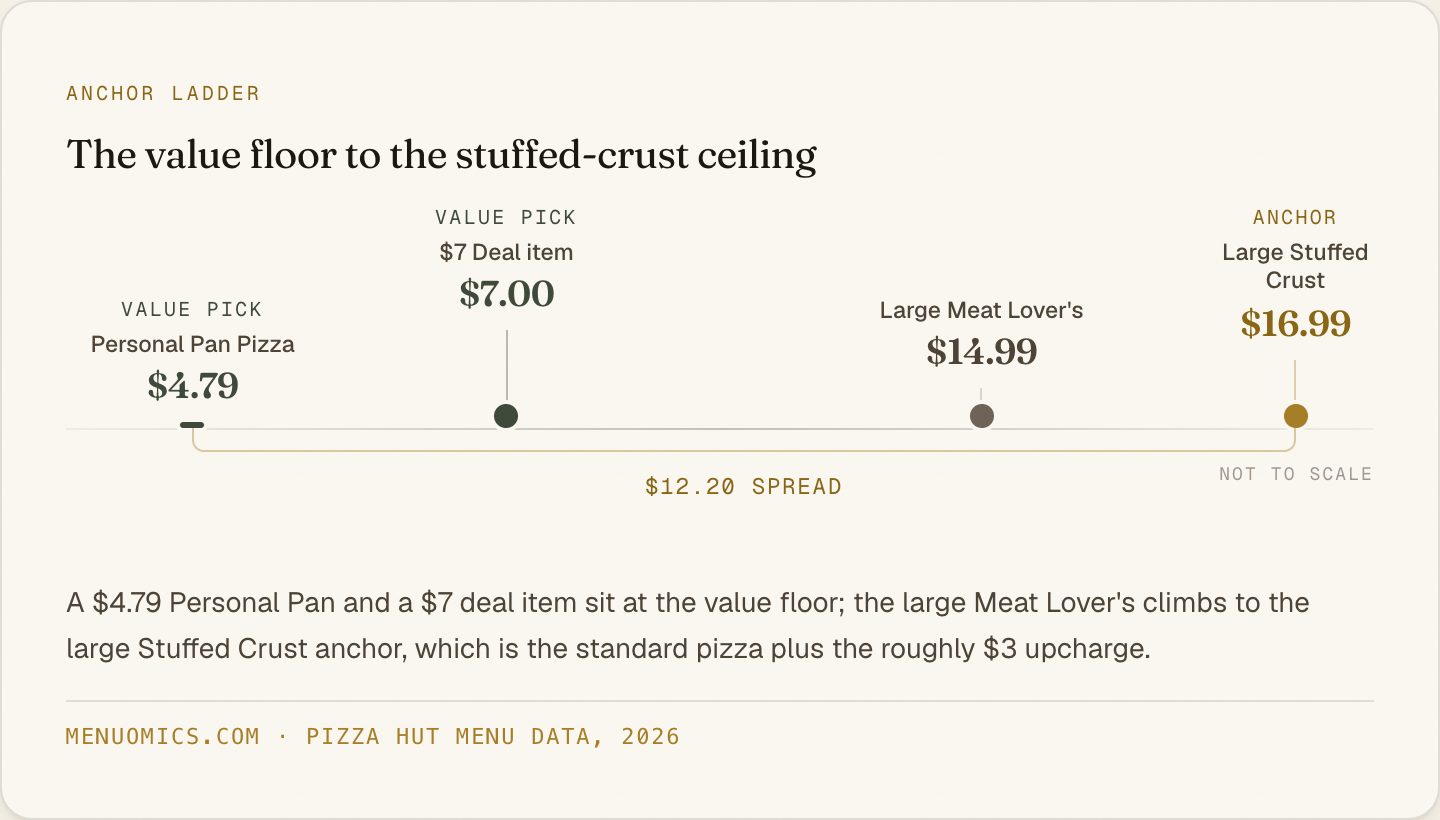
The value floor to the stuffed-crust ceiling
A $4.79 Personal Pan and a $7 deal item sit at the value floor; the large Meat Lover's climbs to the large Stuffed Crust anchor, which is the standard pizza plus the roughly $3 upcharge.
Download this chart (PNG) · free to reuse with credit, see reuse terms.
The full ticket
What it actually rings up to.
The headline price is only the start. The real number is the journey from a base order to the check at the register, one easy yes at a time.
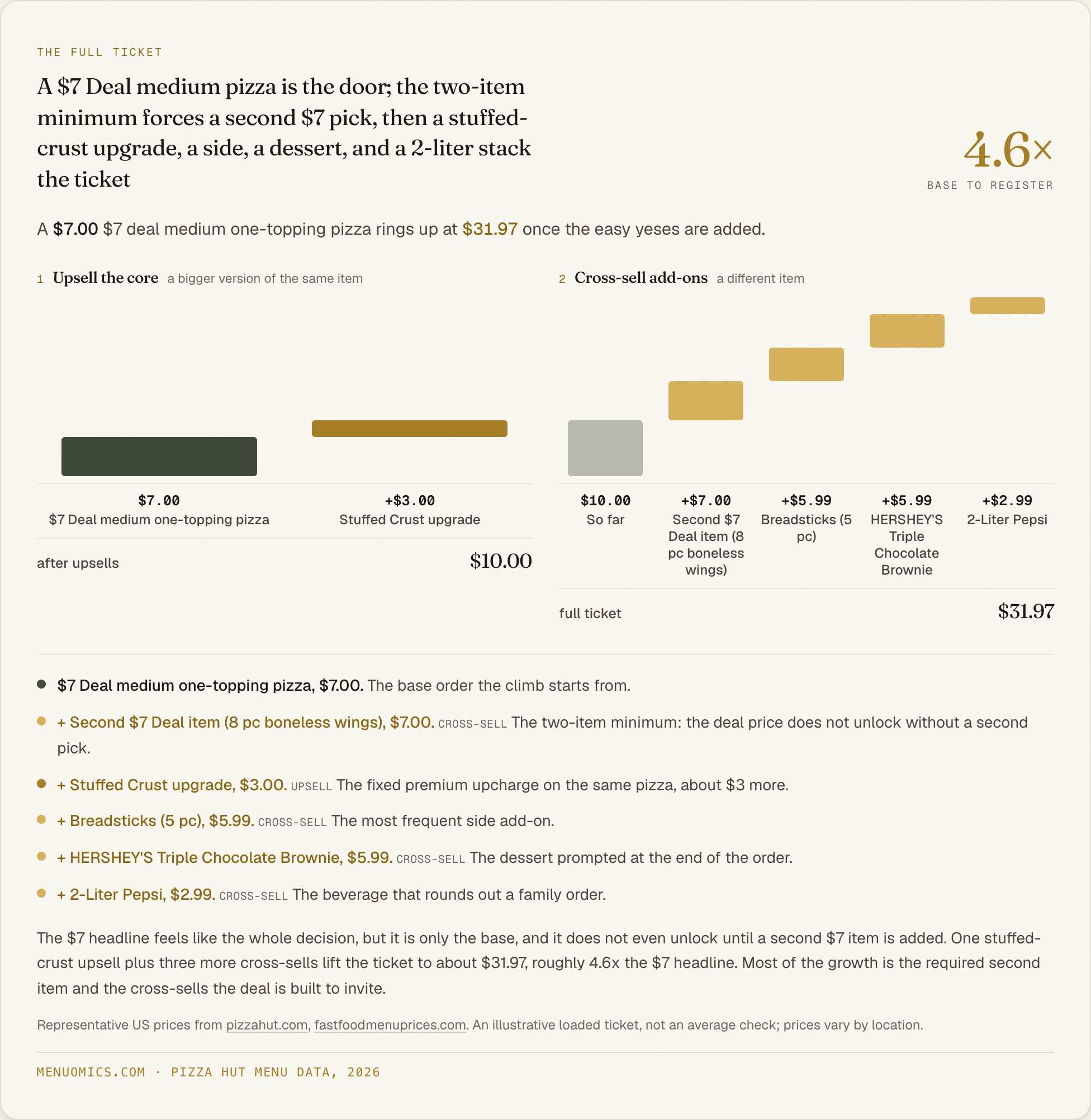
A $7 Deal medium pizza is the door; the two-item minimum forces a second $7 pick, then a stuffed-crust upgrade, a side, a dessert, and a 2-liter stack the ticket
A $7.00 $7 deal medium one-topping pizza rings up at $31.97 once the easy yeses are added.
- $7 Deal medium one-topping pizza, $7.00. The base order the climb starts from.
- + Second $7 Deal item (8 pc boneless wings), $7.00. cross-sell The two-item minimum: the deal price does not unlock without a second pick.
- + Stuffed Crust upgrade, $3.00. upsell The fixed premium upcharge on the same pizza, about $3 more.
- + Breadsticks (5 pc), $5.99. cross-sell The most frequent side add-on.
- + HERSHEY'S Triple Chocolate Brownie, $5.99. cross-sell The dessert prompted at the end of the order.
- + 2-Liter Pepsi, $2.99. cross-sell The beverage that rounds out a family order.
The $7 headline feels like the whole decision, but it is only the base, and it does not even unlock until a second $7 item is added. One stuffed-crust upsell plus three more cross-sells lift the ticket to about $31.97, roughly 4.6x the $7 headline. Most of the growth is the required second item and the cross-sells the deal is built to invite.
Representative US prices from pizzahut.com, fastfoodmenuprices.com. An illustrative loaded ticket, not an average check; prices vary by location.
Download this chart (PNG) · free to reuse with credit, see reuse terms.
The setup
Pizza Hut spent decades as the sit-down pizza brand: the red-roof buildings, the Book It! reading program, the family booth. That heritage is now the thing it is trying to escape. US same-store sales fell about 5% in 2025, roughly 250 underperforming stores closed in the first half of 2026, and in 2026 Yum! Brands sold the whole business for about $2.7 billion, a two-part deal (LongRange Capital outside mainland China, Yum China within it) that closed in August and September. The menu you see in 2026 is a value relaunch: a brand leaning on bundles and a flat headline price to win back a customer who drifted to Domino's and Little Caesars.
The centerpiece is the $7 Deal Lover's menu, roughly 17 items all priced at $7 each, but only when you buy two or more. Above it sits the stuffed-crust upgrade, a fixed roughly $3 upcharge on the pizza Pizza Hut invented in 1995. Below the pizza line sits Melts, a two-slice folded item launched in 2022 and sold explicitly for one person. The read is a value floor, a premium anchor, and a solo format, arranged so almost any order becomes a two-item build. (Pizza Hut does not frame these as behavioral tactics; this is our reading of the observed design.)
What they get right
The behavioral economics already at work.
The flat $7 is really a two-item minimum
The $7 Deal Lover's headline is a single tidy number across about 17 items, but the price only applies when you buy two or more. One Melt at $7 is not the deal; two items is. A single combined value frame ('everything's $7') is easier to accept than itemized prices, and the two-plus condition converts the default order from one item into a self-assembled bundle before any further add-on. The customer builds the combo a set menu would otherwise pre-build.
About 17 items at $7 each, two-item minimum, launched Oct 2023, Pizza Hut $7 Deal Lover's announcement (PR Newswire, Oct 2023)
The stuffed-crust upcharge is a fixed premium anchor
Stuffed crust, the format Pizza Hut invented in 1995, is sold as a roughly $3 upgrade on the same pizza (about $16.99 large versus about $14.99 standard). A small, fixed, memorable upcharge does two jobs: it lifts the ticket on the customers who take it, and it quietly reframes the standard-crust pizza as the restrained, sensible choice. The premium option does not need high take-up to earn its place; it just has to sit there and set the ceiling.
Original Stuffed Crust about $3 over standard crust, Pizza Hut menu; Fast Food Menu Prices, Pizza Hut (2026)
Melts opened the party-of-one daypart
For decades a Pizza Hut order meant a whole pie, which fit a group and shut out the solo diner. Melts, launched October 2022 as two folded slices sold explicitly 'for ME, not WE' at about $6.99, added a format below the pizza price aimed at one person. It is a rare case of menu design opening a genuinely new occasion rather than re-pricing an existing one, and it doubles as a low-commitment $7 Deal pick.
Melts launched Oct 18, 2022 at $6.99, marketed for one person, Pizza Hut Melts launch (PR Newswire / CNN, Oct 2022)
The best prices live behind the app
A growing share of Pizza Hut's real value is app-gated through Hut Rewards, which earns 10 points per $1 and unlocks member-only deals and challenges. Gating the sharpest prices behind a login lets the brand reward frequent, price-sensitive users without cutting the posted price for everyone, but it also means two guests buying the same pizza can pay materially different totals, which muddies the value message the relaunch is trying to send.
Hut Rewards: 10 points per $1, member-only deals; relaunched 2026, Pizza Hut, Hut Rewards (2026); PR Newswire (Apr 2026)
The same pizza carries two prices depending on how you get it
Pizza Hut splits pricing by fulfillment: carryout deals routinely undercut delivery, and delivery layers service and delivery fees on top of a sometimes higher menu price. Presenting carryout as the cheaper path nudges margin-friendly pickup, while the delivery fees sit as separate line items that feel small next to the food total. The effect is a headline price that means less than it looks, because what you pay depends on the channel.
Carryout deals undercut delivery; delivery adds separate fees, Pizza Hut ordering flow; menuNote sampling (2026)
What we’d test
The rewrite, with the expected lift and the honest caveat.
Print the two-item total beside the $7 line
On the deal page, show a common pair and its combined total ('Melt + wings, $14') next to the '$7 each' line, so the two-or-more condition reads as a clear bundle rather than fine print. This integrates the price and pre-empts the 'why is it more than $7' reaction that erodes a value message.
Expect Higher deal take rate with fewer complaints about the minimum.
Caveat A menu-copy change only; it does not alter the deal terms, items, or price.
Name the stuffed-crust upgrade as a plain +$3 step
In the crust step, show the upgrade as an explicit, modest '+ Stuffed Crust $3' on the pizza the customer already chose, rather than re-quoting a higher total. A small visible upcharge keeps working as long as it feels worth it; a silently higher price reads as sneaky and backfires.
Expect Steadier stuffed-crust attach with less sticker surprise.
Caveat A presentation change to how the upcharge is displayed; no change to the price.
Make the solo diner the front door, not an afterthought
Melts opened the party-of-one occasion, but the menu still leads with whole pizzas. Give the single diner a clear lane on the app home (a Melt plus a drink under a named 'for one' set) so the format that widened the audience is the first thing a solo customer sees, rather than buried under the family board.
Expect More solo orders and incremental single-diner visits.
Caveat A layout and defaults change; it does not add items or change prices.
What diners actually say
Synthesized from public reviews, the reality check that grounds every recommendation.
They praise
- The $7 Deal Lover's menu is a legible, well-timed value floor that anyone can reason about in seconds.
- Stuffed crust remains a genuine brand asset and a clean fixed-price premium anchor the brand invented.
- Melts is smart menu design: a solo format that opened a daypart a whole pizza structurally excluded.
- A deep, familiar heritage lineup (Personal Pan, Book It!, the red-roof identity) that still carries real recognition.
- Parity pricing across large specialties keeps the pizza choice about topping preference rather than money.
They criticize
- The value relaunch sits on a shrinking base: US same-store sales fell about 5% in 2025.
- Roughly 250 US stores closed in the first half of 2026, and Yum sold the brand outright in a sale completed September 2026.
- App-gated Hut Rewards deals mean two guests can pay very different prices for the same pizza.
- The carryout-versus-delivery split and delivery fees make the headline price mean less than it looks.
- The brand reads as value-tier now, and the deals can feel like discounting through a decline rather than confident design.
The verdict
Read as menu design, Pizza Hut's 2026 relaunch is competent and on-strategy: a flat $7 deal that quietly enforces a two-item minimum, a fixed roughly $3 stuffed-crust upcharge that anchors the premium end, and Melts as a genuinely clever solo format that opened a daypart a whole pizza never fit. The trouble is what the craft is standing on. Sales fell about 5% in the US in 2025, some 250 stores closed in early 2026, and Yum sold the whole business, so the value menu reads less like a confident play and more like a brand discounting its way through a decline it has not yet reversed. Good bones, real heritage, a value floor that works, all in the service of a turnaround the numbers have not confirmed. That is a C+.
Common questions
- Why is everything at Pizza Hut $7 now?
- The $7 Deal Lover's menu prices about 17 items at $7 each, but only when you buy two or more, so the flat number is really a two-item minimum. That single-price frame makes a whole order easy to reason about, which is the point of a value relaunch aimed at winning back a lapsed brand.
- How does the Pizza Hut $7 Deal Lover's menu work?
- It lists roughly 17 items (medium one-topping pizza, Melts, wings, pasta, sides, dessert, a Pepsi 4-pack) at $7 each when you order two or more, for dine-in, carryout, or delivery. One item alone is not the deal; the flat $7 exists to make you build a two-item order.
- How much extra is stuffed crust at Pizza Hut?
- Original Stuffed Crust runs about $3 more than the same pizza on a standard crust, roughly $16.99 on a large versus about $14.99. That fixed upcharge is a clean premium anchor: a small, memorable number that makes the base pizza read as the thrifty choice.
- What are Pizza Hut Melts?
- Melts are a two-slice folded personal item introduced in October 2022, sold for one person and priced around $6.99 a la carte or as a $7 Deal item. They gave the brand a solo format below the pizza price, pulling in the single diner a whole pie never fit.
- Who owns Pizza Hut in 2026?
- Pizza Hut left Yum! Brands in 2026: Yum China completed its purchase of the mainland-China business on August 7, 2026, and LongRange Capital closed on the US and rest-of-world business on September 1, 2026, about $2.7 billion in total. A value relaunch is what a brand runs when it is trying to prove it is still worth buying, and the buyers just put a price on it.
- What is the most expensive item at Pizza Hut?
- On the standard menu, the priciest single item is the Large Stuffed Crust (specialty), about $16.99 in representative 2026 US pricing (it varies by location; group packs and combo deals can cost more). That top price also does quiet work as the menu's anchor: it is the number that makes everything below it read as reasonable.
- How much is a meal at Pizza Hut?
- A meal at Pizza Hut starts around $7.00 for the base order and lands near $31.97 once the usual add-ons go on, roughly 4.6x the headline price (representative 2026 US figures; they vary by location). That gap between the price that gets you in and the total you pay is the multiplier this page grades.
Sources (8)
- Pizza Hut $7 Deal Lover's menu (official)
- Pizza Hut announces $7 Deal Lover's menu (PR Newswire, Oct 2023)
- Pizza Hut launches Melts, 'not for sharing' (PR Newswire, Oct 2022)
- Yum! Brands agrees to sell Pizza Hut for $2.7B (QSR Magazine, Jun 2026)
- Yum closes Pizza Hut sale to LongRange Capital (Restaurant Dive, Sept 2026)
- Pizza Hut to close 250 stores (Restaurant Dive, 2026)
- Fast Food Menu Prices, Pizza Hut (2026)
- Wikipedia, Pizza Hut
Head to head
More breakdowns
 In-N-Out BurgerA
Three burgers, no seasonal items, and a famous off-menu modifier ('Animal Style') that turns customers into evangelists. Restraint as strategy.
Read the In-N-Out Burger breakdown → Chick-fil-AA
A famously simple chicken sandwich, an easy 'make it a meal' bundle, and free dipping sauces, wrapped in the most-praised service in fast food. The menu stays out of the way so the hospitality can do the selling.
Read the Chick-fil-A breakdown → Chili's Grill & BarA-
A $10.99 bundle dragged Chili's out of a slump and back to the top of casual-dining traffic. Read closely, '3 For Me' is one round number doing the work of three separate decisions.
Read the Chili's Grill & Bar breakdown → Domino'sB+
The $6.99 Mix & Match looks like a low price. Its real design is the words 'two or more': a self-bundle that turns one cheap pizza into a full cart.
Read the Domino's breakdown → Jersey Mike'sB+
Numbered subs in three sizes, a free signature modifier called 'Mike's Way,' and a Giant pitched as the smart-value pick. The size ladder, not the combo, is where the menu does its work.
Read the Jersey Mike's breakdown → Logan's RoadhouseB
A steakhouse that reviewers rank dead last still runs a value menu most casual chains would be proud of. The food is panned; the menu design is not. That gap is the whole point.
Read the Logan's Roadhouse breakdown →Your menu next
Get this for your own menu, free.
Send your menu and we’ll send back the same breakdown, what you get right, what we’d test, and why.
Papa John's
A pizza chain that has sold on 'Better Ingredients' since 1995, then hands you a free garlic dipping sauce and a whole pepperoncini in every box. The premium story and the free ritual do most of the persuading before you taste the pizza.
Read it →