Steak 'n Shake menu, graded
A thin value burger with a premium name, sold beside the milkshake that is literally half the sign.
How a 1934 diner turned a value burger, a clever name, and a milkshake into a three-line ticket climb.
Menu-craft grade
Decades-old linguistic framing ('Steakburger'), a name that pre-sells the highest-margin add-on, and kiosks that quietly lift attach. Held back by aggressive discounting that erodes its own anchors and market-based pricing that hides the menu.
Graded on how well the menu uses behavioral economics, not the food.
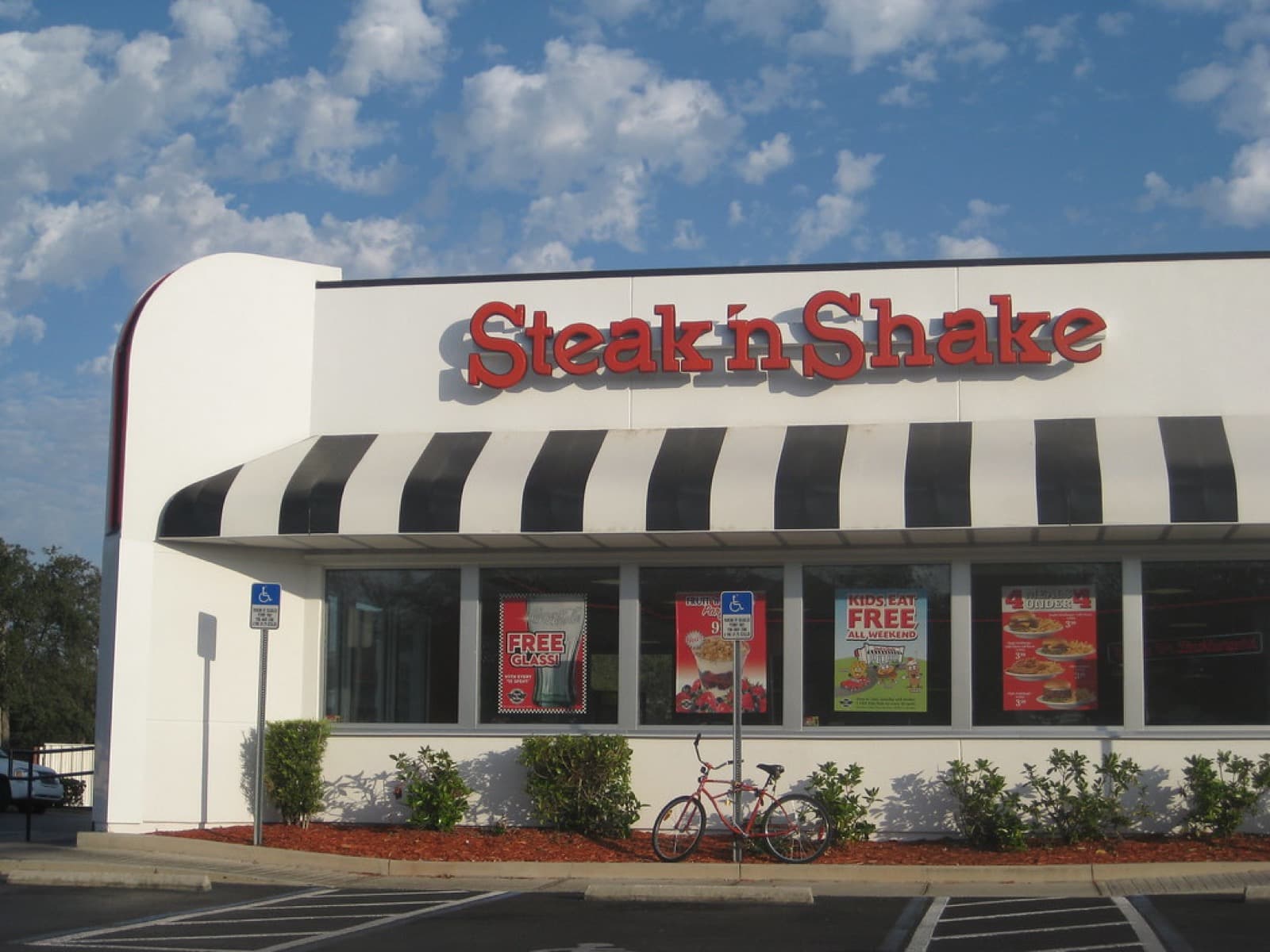
Menu and prices verified September 2026
A 4-minute audio read of the analysis
- Type
- Chain
- Where
- Indianapolis, Indiana (HQ)
- Cuisine
- American diner, burgers and shakes
- Footprint
- About 400 in the US (2026), down from a peak of 628 in 2018
- Since
- 1934, Normal, Illinois (Gus Belt)
- Ownership
- Biglari Holdings (NYSE: BH), since 2008
The mechanics, drawn
The same menu, mapped onto an axis, so the behavioral move is something you can see, not just read.
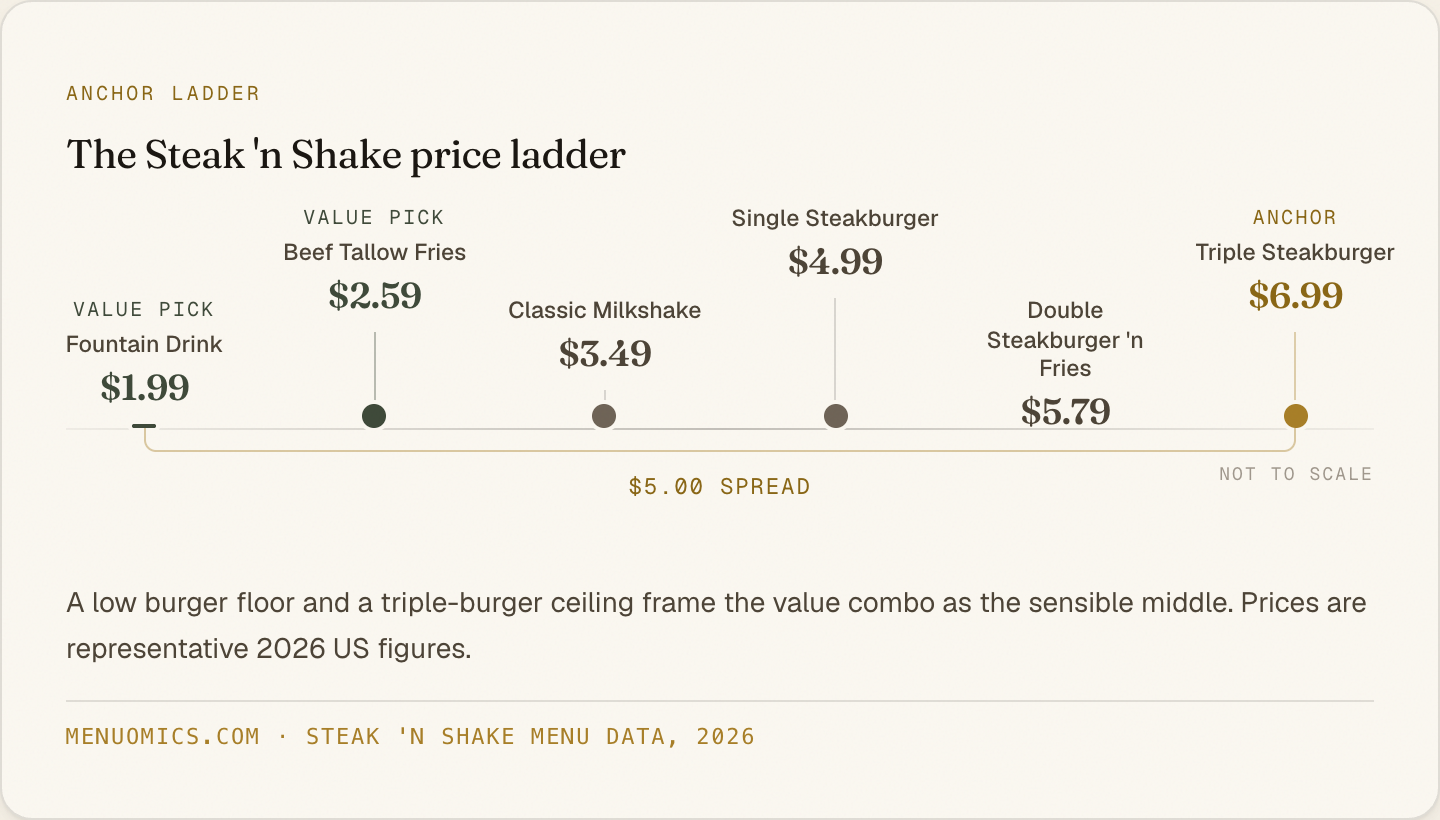
The Steak 'n Shake price ladder
A low burger floor and a triple-burger ceiling frame the value combo as the sensible middle. Prices are representative 2026 US figures.
Download this chart (PNG) · free to reuse with credit, see reuse terms.
The full ticket
What it actually rings up to.
The headline price is only the start. The real number is the journey from a base order to the check at the register, one easy yes at a time.
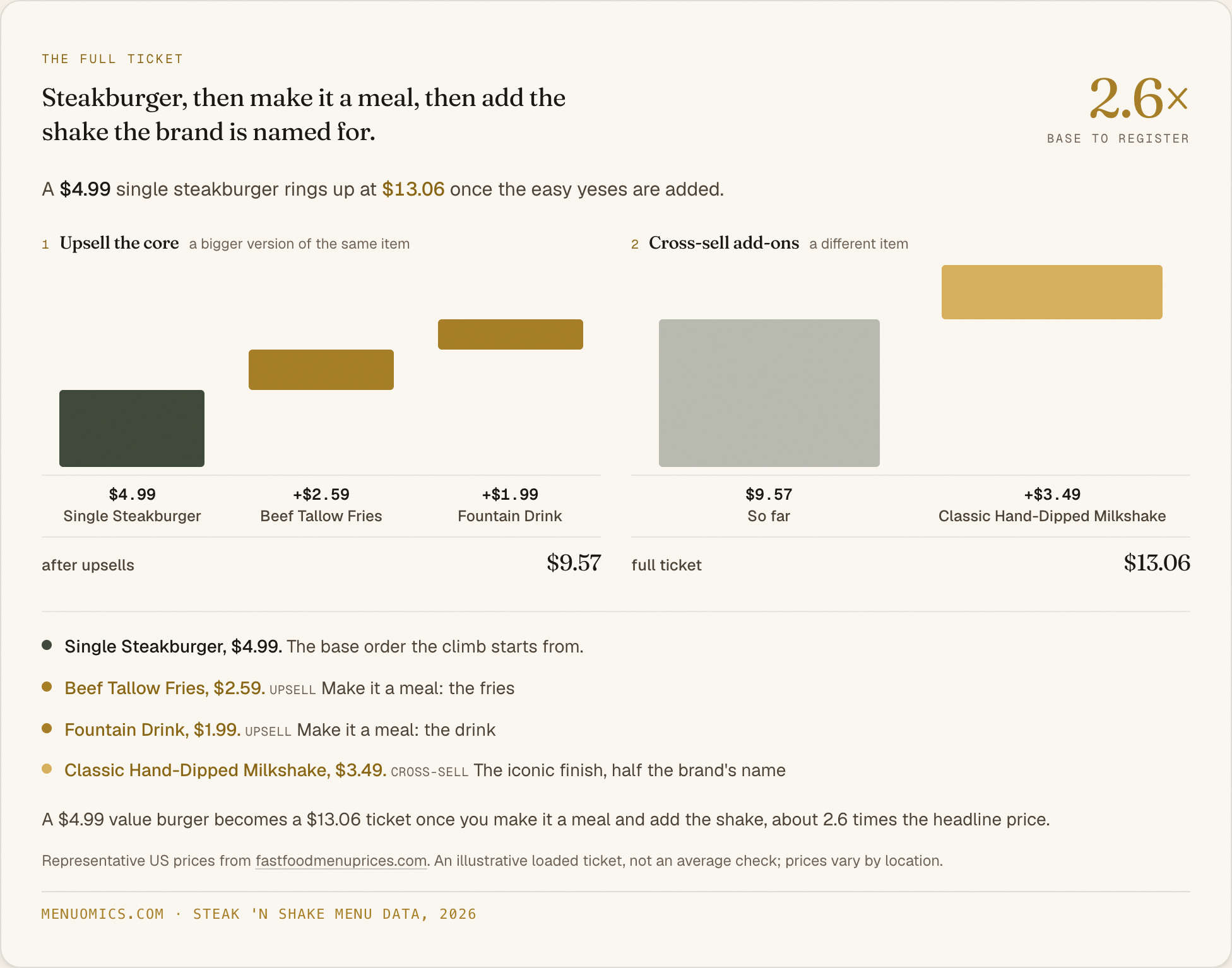
Steakburger, then make it a meal, then add the shake the brand is named for.
A $4.99 single steakburger rings up at $13.06 once the easy yeses are added.
- Single Steakburger, $4.99. The base order the climb starts from.
- Beef Tallow Fries, $2.59. upsell Make it a meal: the fries
- Fountain Drink, $1.99. upsell Make it a meal: the drink
- Classic Hand-Dipped Milkshake, $3.49. cross-sell The iconic finish, half the brand's name
A $4.99 value burger becomes a $13.06 ticket once you make it a meal and add the shake, about 2.6 times the headline price.
Representative US prices from fastfoodmenuprices.com. An illustrative loaded ticket, not an average check; prices vary by location.
Download this chart (PNG) · free to reuse with credit, see reuse terms.
The setup
Steak 'n Shake opened in Normal, Illinois in 1934, and founder Gus Belt built the brand around a piece of theater: he ground steaks into burgers in front of customers under the slogan 'In Sight, It Must Be Right.' That is where the word 'Steakburger' comes from, a premium label bolted onto what is, structurally, a thin, fast-cooking value patty. The chain grew into a full-service diner known as much for hand-dipped shakes as for burgers, peaked near 628 units in 2018, and has since contracted sharply under owner Biglari Holdings, which acquired it in 2008.
The 2021 reinvention is the part worth studying. Steak 'n Shake tore out table service, installed self-order kiosks, and leaned into cheap combo meals, repositioning from sit-down diner to value quick-service. The menu now does the selling that servers used to: a low headline burger price pulls you in, a kiosk asks whether you want to make it a meal, and the milkshake, half of the brand's own name, is teed up as the natural finish. In 2025 the chain switched to beef tallow fries as a quality signal to justify the ticket. (Steak 'n Shake does not frame these as behavioral tactics; this is our reading of the observed design.)
What they get right
The behavioral economics already at work.
'Steakburger' is a 90-year framing trick
A thin, fast-cooking value patty is described with the single most premium word in the meat aisle: steak. The name sets a quality expectation before you taste anything, and it has done so since 1934. Customers order a 'Steakburger,' not a 'thin burger,' and the word alone justifies a price a plain patty could not carry.
Name in use since 1934, Wikipedia: Steak 'n Shake history
A cheap headline burger baits the full ticket
A single Steakburger near $4.99 sets a low reference price that gets people in the door. From there the menu ladders up: double at ~$5.79, triple at ~$6.99, a Frisco Melt at ~$6.49. The high-end items anchor the board so the value combo reads as the reasonable middle, not the floor.
Value meals roughly $4 to $7, fastfoodmenuprices.com, 2026
The milkshake is a cross-sell baked into the logo
Half the brand name is 'Shake.' That makes the highest-margin add-on feel like the expected finish rather than an upsell, and decades of half-price happy-hour shakes have trained the habit. A ~$3.49 classic shake, or a ~$5.29 specialty that costs more than the burger, turns a value order into a dessert-included ticket.
Specialty shakes ~$5.29, above the single burger, steaknshake-menu.us milkshakes, 2026
Kiosks decouple payment and kill social friction
The 2021 switch to self-order kiosks removed the human you would feel awkward adding to your order in front of. A screen prompt to add fries, a drink, or a shake has no social cost to decline and no social cost to accept, and the pain of paying is deferred to the end. That combination reliably lifts attach and average check.
Table service replaced by kiosks in 2021, Fox59 / IBJ, 2021
Beef tallow is a quality signal that defends the price
The 2025 move to 100% beef tallow fries and real butter gives the menu a concrete, repeatable story that answers the 'is this cheap food' objection. It reframes a value chain as a made-with-real-ingredients chain, which supports the whole ticket without raising the headline number.
Switched to 100% beef tallow fries in 2025, QSR Magazine, 2025
What we’d test
The rewrite, with the expected lift and the honest caveat.
Name the shake into the combo tier
Right now the shake is an add-on you opt into. Create an explicitly named 'Meal + Shake' tier on the kiosk so the shake is presented as part of a complete meal, not an extra. Making the shake the framed default rather than an interruption lifts attach without discounting.
Expect Higher shake attach rate on combo orders and a modest lift in average check.
Caveat Do not force it. A pre-checked shake that feels like a trick will erode the trust the brand is rebuilding.
Lead the burger screen with the triple
List the triple Steakburger first on the kiosk burger screen so the ~$6.99 price sets the anchor before the eye reaches the double and single. Presenting the most expensive option first makes the mid-tier double feel like a deliberate, sensible choice rather than a trade-down.
Expect A shift of some single orders up to doubles and a higher burger-line average.
Caveat Keep the value single clearly visible. Hiding it would read as bait-and-switch and hurt the value promise.
Write benefit-led add-on prompts
Replace generic prompts like 'Add a side?' with specific, benefit-led lines that name the item and the small price, for example 'Make it beef tallow fries for ~$2.59.' Concrete wording with a low, explicit number is far easier to say yes to than an abstract category.
Expect Higher click-through on side and shake prompts at the kiosk.
Caveat Limit to one or two prompts. Stacking upsell screens slows the line and annoys repeat guests.
What diners actually say
Synthesized from public reviews, the reality check that grounds every recommendation.
They praise
- The 'Steakburger' name is one of the cleanest examples of durable menu framing in American fast food, working since 1934.
- Value combos in the $4 to $7 band give a genuinely low entry price that pulls traffic without a coupon.
- The milkshake cross-sell is effortless because the product is already half the brand's identity.
- Beef tallow fries and real butter give the value menu a credible quality story instead of just a low price.
- Kiosk ordering keeps the ticket-building logic consistent every time, which servers never could.
They criticize
- Market-based pricing means the same item can swing widely by location, so the menu never sets a stable anchor customers can trust.
- Aggressive discounting and half-price shake promotions repeatedly undercut the very anchors the board tries to build.
- The kiosk experience is functional but visually flat, so the framing lives in words, not in an appetizing menu design.
- The value positioning invites a race to the bottom that can train customers to wait for the next deal.
- A shrinking footprint, from 628 units in 2018 to around 400, means the brand's habit-forming shake ritual reaches fewer people each year.
The verdict
Steak 'n Shake earns a strong grade on menu craft, not on food. The 'Steakburger' name is a 90-year framing win, the milkshake is the rare cross-sell that is pre-sold by the logo, and the kiosk pivot quietly raised attach by stripping out the social friction of upselling. The math is real: a $4.99 burger, a fries-and-drink upgrade, and the iconic shake turn into a ticket more than two and a half times the headline price. What keeps it from an A is discipline. Market-based pricing and relentless discounting keep knocking down the anchors the menu works to build, so the craft is present but not fully trusted.
Common questions
- Is the Double Steakburger 'n Fries a good deal?
- At about $5.79 with fries included, it is one of the strongest value plays in fast food, only 80 cents over the $4.99 single. That tiny step is the design: the near-free upgrade moves nearly everyone up a patty, and the menu recoups it when the kiosk tees up the drink and the hand-dipped shake that is half the brand's name.
- Why is it called a 'Steakburger'?
- Founder Gus Belt ground whole steaks into his patties in view of customers in 1934 under the slogan 'In Sight, It Must Be Right.' The name reframes a thin, fast-cooking value patty as something premium, and it has worked as menu framing for 90 years.
- How does Steak 'n Shake get you to spend more?
- A low headline burger price pulls you in, the kiosk prompts you to make it a meal with fries and a drink, and the milkshake is teed up as the natural finish. A ~$4.99 burger becomes a roughly $13 ticket, about 2.6 times the starting price.
- What is the most expensive item at Steak 'n Shake?
- On the standard menu, the priciest single item is the Triple Steakburger, about $6.99 in representative 2026 US pricing (it varies by location; group packs and combo deals can cost more). That top price also does quiet work as the menu's anchor: it is the number that makes everything below it read as reasonable.
- How much is a meal at Steak 'n Shake?
- A meal at Steak 'n Shake starts around $4.99 for the base order and lands near $13.06 once the usual add-ons go on, roughly 2.6x the headline price (representative 2026 US figures; they vary by location). That gap between the price that gets you in and the total you pay is the multiplier this page grades.
Head to head
More breakdowns
 The Cheesecake FactoryB+
A 21-page, 250-item menu should be a behavioral disaster. It's a roughly $4-billion chain. Here's what all that abundance is quietly doing.
Read the The Cheesecake Factory breakdown → McDonald'sA-
The Extra Value Meal is one of the most-copied ideas in food: fold the whole order into a single number that hurts less than three. Then McValue and the app pile value on top, and the McRib drops in as an event.
Read the McDonald's breakdown → Taco BellA-
A sub-$3 value menu sets the floor, $5/$7/$9 boxes name the deal after its own price, and a never-ending limited-time calendar keeps a reason to come back on the board. Taco Bell sells value loudly, and it works: it gained traffic while rivals shrank.
Read the Taco Bell breakdown → Dunkin'A-
A premium latte anchors the cheap iced coffee as the obvious default, the $6 Meal Deal bundles the breakfast, and Dunkin' Rewards turns the morning run into a streak. The menu craft is textbook; the strain is price creep and an app that increasingly decides the real price.
Read the Dunkin' breakdown → Panda ExpressB+
The whole order comes down to one question, how many entrees. A Bowl is one, a Plate is two, a Bigger Plate is three, and the menu is built so the middle Plate wins. Orange Chicken is the anchor everyone orders, and a quiet $1.50 premium upcharge lifts the check while the headline price stays put.
Read the Panda Express breakdown → Raising Cane'sA-
The chicken-finger chain that built a billion-dollar machine by refusing to sell almost anything else.
Read the Raising Cane's breakdown →Your menu next
Get this for your own menu, free.
Send your menu and we’ll send back the same breakdown, what you get right, what we’d test, and why.
Red Lobster
The seafood chain that gives away warm cheddar biscuits, anchors the menu with a lobster-and-crab Ultimate Feast, and once sold shrimp with no ceiling. We grade the menu craft, not the food.
Read it →