
Subway menu, graded
Subway built an empire on one named-price anchor and a footlong-versus-six-inch frame, then learned that an anchor set too low becomes a ceiling you can never raise and a customer you can never wean off coupons.
A masterclass in anchoring, run in reverse. Subway taught millions what a footlong should cost, then could not undo the lesson.
Menu-craft grade
The bones of the menu are smart: a numbered Series that kills decision paralysis, a footlong that makes the six-inch look small, and charm prices that hug every psychological threshold. But Subway committed the cardinal anchoring sin with the $5 Footlong, fixing its own value perception so low that the number became a prison, gutted franchisee margins, and trained a generation of customers to never order without a coupon. Good instincts, self-inflicted wound.
Graded on how well the menu uses behavioral economics, not the food.
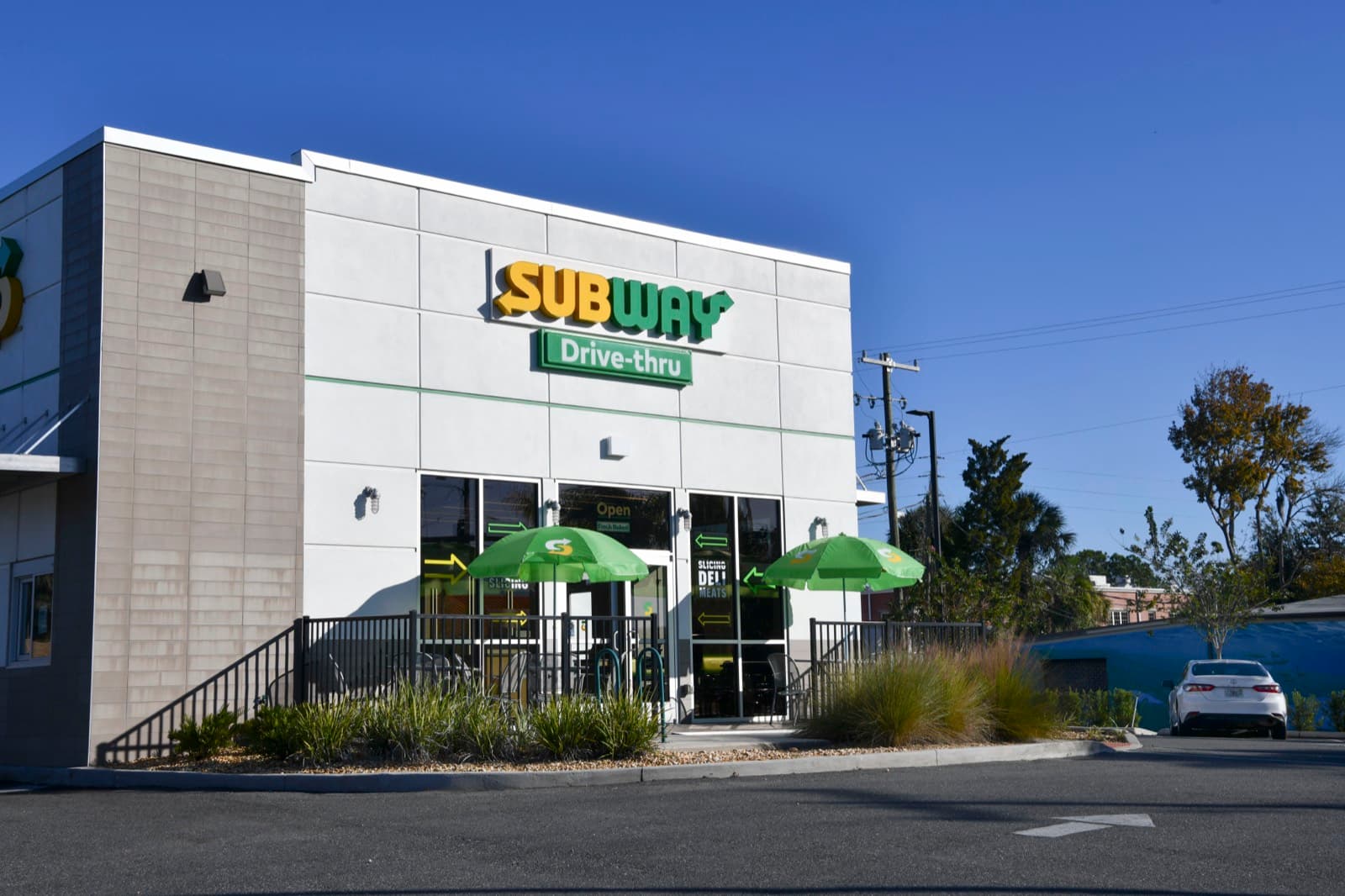
Menu and prices verified September 2026
A 3-minute audio read of the analysis
- Type
- Chain
- Where
- United States
- Cuisine
- Submarine sandwiches, QSR
- Footprint
- ~18,700 US locations (end of 2025), down 10 straight years
- Since
- 1965 (Bridgeport, Connecticut, as Pete's Super Submarines)
- Ownership
- Roark Capital (acquired 2023, roughly $9.6 billion); founded by Fred DeLuca and Peter Buck
The mechanics, drawn
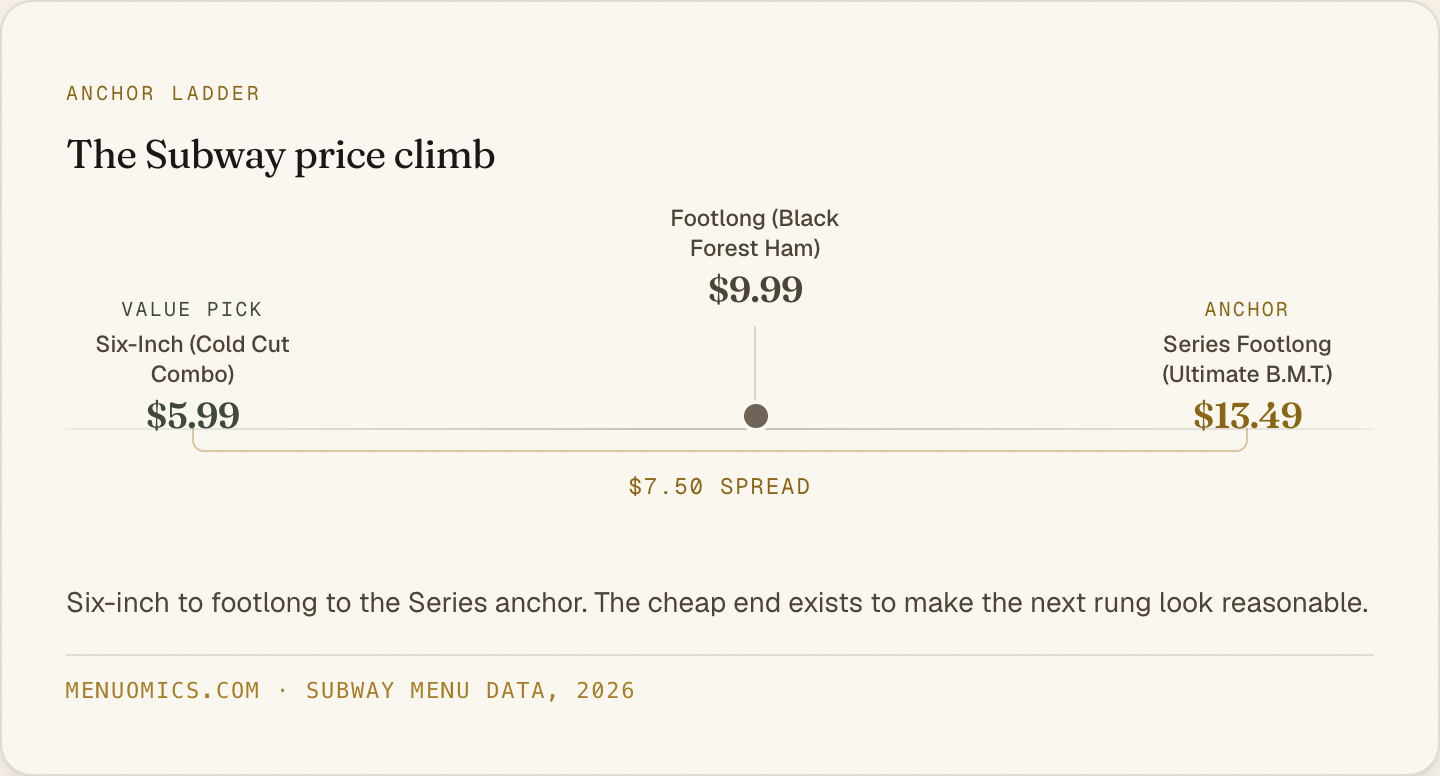
The same menu, mapped onto an axis, so the behavioral move is something you can see, not just read.
The Subway price climb
Six-inch to footlong to the Series anchor. The cheap end exists to make the next rung look reasonable.
Download this chart (PNG) · free to reuse with credit, see reuse terms.
The full ticket
What it actually rings up to.
The headline price is only the start. The real number is the journey from a base order to the check at the register, one easy yes at a time.
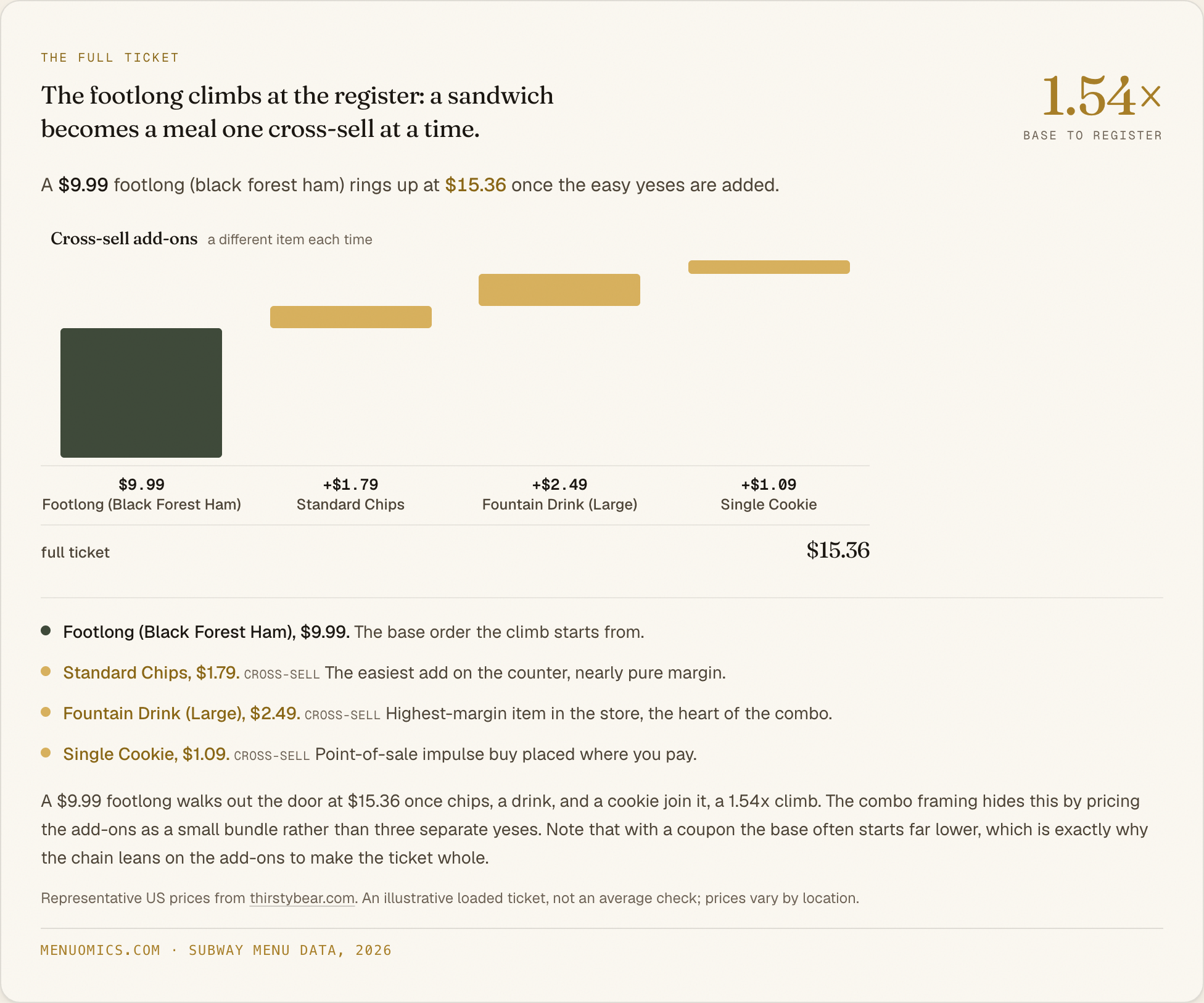
The footlong climbs at the register: a sandwich becomes a meal one cross-sell at a time.
A $9.99 footlong (black forest ham) rings up at $15.36 once the easy yeses are added.
- Footlong (Black Forest Ham), $9.99. The base order the climb starts from.
- Standard Chips, $1.79. cross-sell The easiest add on the counter, nearly pure margin.
- Fountain Drink (Large), $2.49. cross-sell Highest-margin item in the store, the heart of the combo.
- Single Cookie, $1.09. cross-sell Point-of-sale impulse buy placed where you pay.
A $9.99 footlong walks out the door at $15.36 once chips, a drink, and a cookie join it, a 1.54x climb. The combo framing hides this by pricing the add-ons as a small bundle rather than three separate yeses. Note that with a coupon the base often starts far lower, which is exactly why the chain leans on the add-ons to make the ticket whole.
Representative US prices from thirstybear.com. An illustrative loaded ticket, not an average check; prices vary by location.
Download this chart (PNG) · free to reuse with credit, see reuse terms.
The setup
Subway started in 1965 when 17-year-old Fred DeLuca borrowed $1,000 from family friend Peter Buck and opened Pete's Super Submarines in Bridgeport, Connecticut. Renamed Subway in 1972 and franchised aggressively from 1974 on, it grew into the largest restaurant chain in the world by unit count, blanketing strip malls, gas stations, and Walmarts on a low-cost, owner-operator model. That same model is now in retreat at home: Subway has closed stores in the US for ten straight years, slipping below 20,000 domestic units in 2024 for the first time in two decades and ending 2025 near 18,700, its lowest count since 2005. In 2023 the founding families sold the company to private-equity firm Roark Capital for roughly $9.6 billion.
The menu reads like a behavioral-economics syllabus. The footlong exists to make the six-inch feel like a half-measure, a textbook size anchor. The numbered Subway Series collapses an infinite build-your-own decision into a short list of named, pre-spec'd sandwiches, cutting choice friction. Prices cluster just under round numbers, and the 2026 value menu plants a wall of entrees under the $5 threshold. The whole system is engineered to make ordering fast and trading up easy. The catch is that the brand's most famous move, the $5 Footlong, used these same tools to anchor value so low it could never charge what the food cost to make. (Subway does not frame these as behavioral tactics; this is our reading of the observed design.)
What they get right
The behavioral economics already at work.
The named-price anchor that worked too well
The $5 Footlong was the single most effective anchor in fast-food history. By naming the price and the product in one breath, Subway taught the entire country a number, and that number became the mental yardstick every footlong is still measured against. The craft here is real: a round, memorable, repeatable price drove billions in revenue and made Subway synonymous with value during the 2008 recession. The cautionary half is that an anchor cuts both ways. Once $5 was the reference point, every honest price increase felt like a betrayal, which is exactly why we read it as a trap rather than a triumph.
$5 Footlong revenue topped $3.8 billion at its peak, The Hustle, The rise and demise of Subway's $5 footlong
Numbered Series subs that kill decision paralysis
A build-your-own counter is a cognitive tax: bread, protein, cheese, toasting, vegetables, sauces, every step a fresh decision. The Subway Series replaces that with a short list of numbered, pre-spec'd sandwiches you can order by digit. Saying number eighteen is faster and lower-risk than narrating a custom build to a stranger while a line forms behind you. This is genuine choice architecture: it preserves customization for those who want it while giving everyone else a fast default, which speeds the line and nudges customers toward higher-spec signature subs.
Subway Series spans roughly 22 chef-crafted numbered subs, Subway Newsroom, $6.99 Any Footlong release (2024)
Footlong versus six-inch as a built-in upsell
The six-inch is not really a separate product; it is the footlong's foil. Priced at roughly two-thirds the footlong for half the food, it makes the bigger sandwich look like the rational choice, the same trick that sells large popcorn. Most diners never compute the per-inch math; they just see that doubling the sandwich costs far less than double, and they trade up. The size ladder does the persuading without a word of sales copy.
Six-inch ~$5.99 vs footlong ~$9.99 on the same sub, ThirstyBear, Subway Menu With Prices (2026)
Charm pricing pinned to every threshold
Almost nothing on the board lands on a round number. Footlongs sit at $9.99 and $11.99, cookies at $1.09, and the 2026 value menu deliberately parks subs at $3.99 and $4.99 to stay under the $4 and $5 walls. These are not accidents; they are left-digit pricing, where $9.99 reads as nine-something rather than ten. Stacked across a menu this large, the cumulative effect is a board that always feels a notch cheaper than it is.
2026 value menu: 15 entrees priced under $5, Subway Newsroom, First-Ever Value Menu (Apr 2026)
Combos that hide the real ticket climb
The meal deal frames the chips and drink as a small add-on, about $2 over the sub, rather than as their full standalone prices. Partitioning the upsell this way makes the jump feel trivial even though it can lift the ticket by half. The bundle also quietly captures the two highest-margin items in the store, the fountain drink and the snack, in a single yes. It is the most profitable sentence an employee can say, and the menu is built to make saying it natural.
Meal deal adds chips/cookies plus a 20 oz drink for about $2, Subway Newsroom, First-Ever Value Menu (Apr 2026)
What we’d test
The rewrite, with the expected lift and the honest caveat.
Stop selling value as a code to unlock
Subway's value lives behind app codes and limited windows, which trains customers to never order at full price and to feel cheated when a deal lapses. Present the value menu as a permanent, printed part of the board with its own clear section, framed as the everyday price rather than a temporary unlock. The goal is to reset the reference point upward gently, so a fair price stops reading as a penalty.
Expect Less coupon conditioning over time and a higher share of full-margin orders as the everyday price becomes the new normal.
Caveat This is a copy and presentation change only, not a change to recipes, portions, or the underlying deals offered.
Give the Series a visible price ladder
The numbered Series is the best thing on the menu, but its prices are buried and inconsistent across markets. Lay the numbered subs out as an explicit ladder, classic six-inch at the bottom, footlong in the middle, premium Series at the top, with the most expensive sub shown first so it anchors the rest. Make the climb legible and the mid-tier signature becomes the comfortable compromise most people pick.
Expect More trade-ups from base footlongs to higher-spec Series subs and a higher average sub price.
Caveat This is a menu ordering and layout change only; no item, price, or portion is altered.
Name the premium footlong as the hero
Subway leans hard on its cheapest items, which keeps the brand cheap in the customer's mind. Put the priciest footlong, the Series anchor near $13.49, in the visual hero slot with the largest treatment. It does not need to sell in volume; its job is to make the $9.99 footlong feel like the sensible middle and pull the whole perceived range upward.
Expect A higher anchor reference and a modest lift in mid-tier footlong selection.
Caveat This is a layout and wording change only; the premium item already exists and its price is unchanged.
What diners actually say
Synthesized from public reviews, the reality check that grounds every recommendation.
They praise
- The numbered Subway Series is a clean piece of choice architecture: order by digit, skip the decision tax of a build-your-own line.
- Footlong-versus-six-inch is a self-running upsell; the size ladder does the persuading with zero sales copy.
- Charm pricing is disciplined and everywhere, with the 2026 value menu deliberately tucked under the $5 wall.
- The combo bundles the two highest-margin items, drink and snack, behind a single low-friction yes.
- The $5 Footlong, whatever it cost the company, remains one of the most successful price anchors any restaurant has ever landed.
They criticize
- The $5 anchor became a ceiling: it fixed value perception so low the brand could never raise prices without feeling like a betrayal.
- Coupon and BOGO dependence has trained regulars to never pay full price, hollowing out margins and the meaning of the listed numbers.
- Franchisee economics buckled under the deal; roughly three-quarters of franchisees opposed the promotion before it was finally dropped around 2018.
- Ten straight years of US closures, below 20,000 units in 2024, signal that cheap traffic did not translate into durable store-level profit.
- The menu's value-first framing keeps the brand stuck in a discount identity that the higher-spec Series subs struggle to escape.
The verdict
Subway is the best argument in fast food that craft and outcome can diverge. The menu is genuinely well built: a numbered Series that erases decision friction, a footlong that makes everything smaller look like a compromise, charm prices that hug every threshold, and combos that quietly capture the highest-margin items. Yet the brand's defining move, the $5 Footlong, weaponized those same tools against itself, anchoring value so low that the number became a cage, enraging franchisees and conditioning customers to wait for a deal that the company could no longer afford to give. The result is a chain that knows exactly how to design a menu and spent a decade proving that the wrong anchor, set once, can cost you years of closures to undo. Smart hands, self-inflicted wound. That is a C+.
Common questions
- Why did Subway drop the $5 Footlong?
- Launched nationally in 2008, the $5 Footlong was a hit during the recession, but as food, labor, and rent costs rose it became unprofitable for many franchisees. Around three-quarters of franchisees opposed it in surveys, and Subway phased it out around 2018. The deeper problem was the anchor itself: customers had been taught that a footlong costs $5, so any increase felt like a betrayal.
- How much is a footlong at Subway in 2026?
- Representative 2026 US prices run from roughly $9.99 for an everyday footlong like Black Forest Ham up to about $13.49 for a loaded Subway Series sub such as the Ultimate B.M.T. Prices are set by individual franchisees and vary widely by location, and most regulars pay less by using app coupons or the value menu.
- Does Subway have a value menu?
- Yes. In April 2026 Subway launched its first-ever value menu with 15 entrees under $5, including Deli Faves six-inch subs and Protein Pockets at about $3.99 and a rotating Sub of the Day near $4.99, plus a meal deal that adds chips or cookies and a drink for roughly $2 more.
- What is the most expensive item at Subway?
- On the standard menu, the priciest single item is the Subway Series Footlong, The Ultimate B.M.T. (#18), about $13.49 in representative 2026 US pricing (it varies by location; group packs and combo deals can cost more). That top price also does quiet work as the menu's anchor: it is the number that makes everything below it read as reasonable.
- How much is a meal at Subway?
- A meal at Subway starts around $9.99 for the base order and lands near $15.36 once the usual add-ons go on, roughly 1.54x the headline price (representative 2026 US figures; they vary by location). That gap between the price that gets you in and the total you pay is the multiplier this page grades.
Head to head
More breakdowns
 Olive GardenB+
Never-ending breadsticks read less like generosity than like decoupled pricing: a loss-leader and a recurring scarcity event working in concert.
Read the Olive Garden breakdown → Palmetto SuperfoodsB
A California acai chain whose menu leads with the one promise every acai shop gets accused of breaking: '100% Real Acai, every time.'
Read the Palmetto Superfoods breakdown → SweetgreenB+
The salad chain that names every bowl for its ingredients and farmers, then offers a handful of signature defaults so you don't have to build from scratch.
Read the Sweetgreen breakdown → Chipotle Mexican GrillA-
Chipotle's menu is a build-your-own assembly line with no prices on the rail, so you customize first and total up last, with guac quoted as a tidy little add-on.
Read the Chipotle Mexican Grill breakdown → StarbucksA-
Tall is the small. The names hide the ounces, the app hides the payment, and a pumpkin drink restarts the whole calendar every August. The most studied size menu in the world.
Read the Starbucks breakdown → CAVAB+
CAVA's menu is a build-your-own Mediterranean line that includes three scratch dips and unlimited toppings free, then concentrates the upsell on one flat premium-protein step and resells the dips as paid sides.
Read the CAVA breakdown →Your menu next
Get this for your own menu, free.
Send your menu and we’ll send back the same breakdown, what you get right, what we’d test, and why.
Panda Express
The whole order comes down to one question, how many entrees. A Bowl is one, a Plate is two, a Bigger Plate is three, and the menu is built so the middle Plate wins. Orange Chicken is the anchor everyone orders, and a quiet $1.50 premium upcharge lifts the check while the headline price stays put.
Read it →