
Crumbl menu, graded
Crumbl turns the menu itself into the product: six permanent classics anchor the board while four flavors rotate out every Sunday night, so the lineup is always expiring, the pink box is engineered to be filmed, and a box ladder from a single ~$5 cookie up to a twelve-count party box turns a weekly ritual of manufactured scarcity into a shareable, ever-larger ticket.
How a Sunday-night flavor drop, a filmable pink box, and a single-cookie-to-twelve-pack ladder turn a ~$4.99 cookie into a weekly ritual.
Menu-craft grade
As a piece of demand engineering this is one of the sharpest in the catalog. The weekly four-flavor rotation is a genuine variable-reward loop with a built-in expiry date, the millennial-pink box is a deliberately filmable object that turned customers into an unpaid marketing department (155 million #crumbl views, closed Sundays that build a Monday drop), and the box ladder scales a single cookie into a party order. It loses the plus for self-inflicted value erosion: the single cookie has climbed from about $3 in 2021 to roughly $4.99, average unit volume fell about 16% in 2025, and the ~720-calorie cookie is labeled at a quarter-cookie serving size that hides the real number.
Graded on how well the menu uses behavioral economics, not the food.
Menu and prices verified September 2026
A 3-minute audio read of the analysis
- Type
- Chain
- Where
- Lindon, Utah (headquarters)
- Cuisine
- Rotating gourmet cookies and desserts
- Footprint
- ~1,101 US locations (2026), plus ~25 in Canada
- Since
- 2017 (Logan, Utah; cousins Jason McGowan and Sawyer Hemsley)
- Ownership
- Privately held; franchised. In May 2025 sold a stake to TSG Consumer Partners
The mechanics, drawn
The same menu, mapped onto an axis, so the behavioral move is something you can see, not just read.
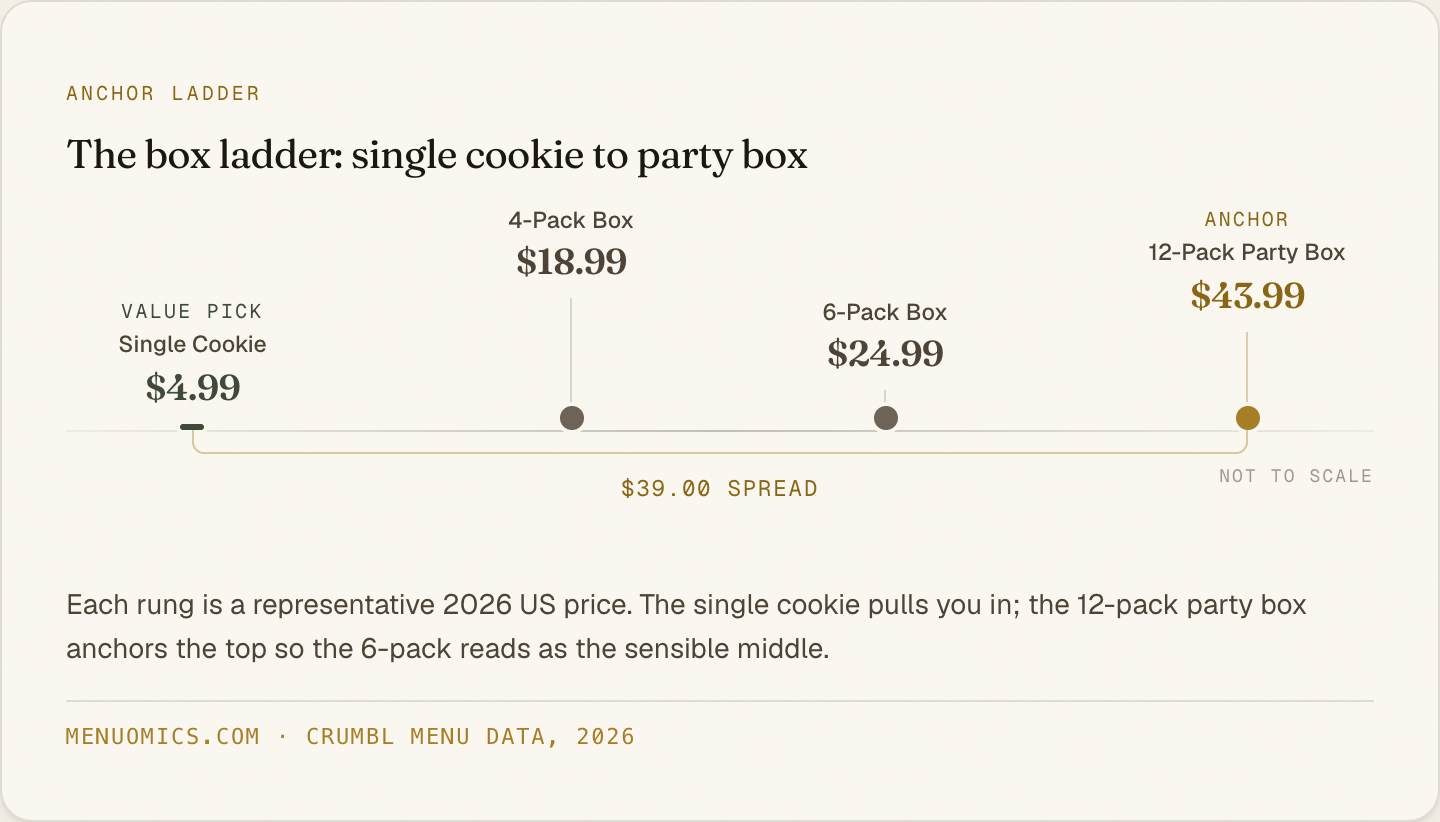
The box ladder: single cookie to party box
Each rung is a representative 2026 US price. The single cookie pulls you in; the 12-pack party box anchors the top so the 6-pack reads as the sensible middle.
Download this chart (PNG) · free to reuse with credit, see reuse terms.
The full ticket
What it actually rings up to.
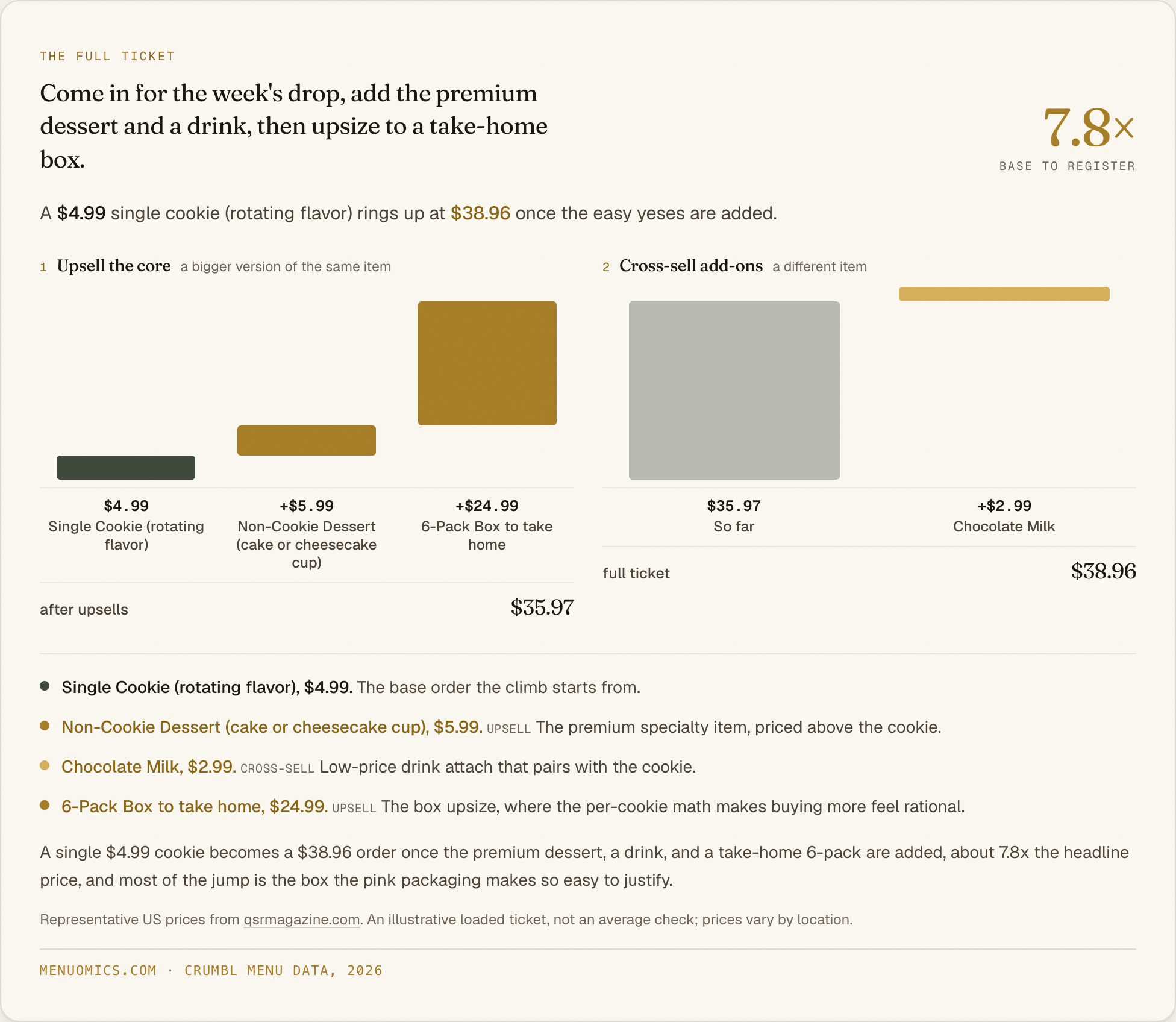
The headline price is only the start. The real number is the journey from a base order to the check at the register, one easy yes at a time.
Come in for the week's drop, add the premium dessert and a drink, then upsize to a take-home box.
A $4.99 single cookie (rotating flavor) rings up at $38.96 once the easy yeses are added.
- Single Cookie (rotating flavor), $4.99. The base order the climb starts from.
- Non-Cookie Dessert (cake or cheesecake cup), $5.99. upsell The premium specialty item, priced above the cookie.
- Chocolate Milk, $2.99. cross-sell Low-price drink attach that pairs with the cookie.
- 6-Pack Box to take home, $24.99. upsell The box upsize, where the per-cookie math makes buying more feel rational.
A single $4.99 cookie becomes a $38.96 order once the premium dessert, a drink, and a take-home 6-pack are added, about 7.8x the headline price, and most of the jump is the box the pink packaging makes so easy to justify.
Representative US prices from qsrmagazine.com. An illustrative loaded ticket, not an average check; prices vary by location.
Download this chart (PNG) · free to reuse with credit, see reuse terms.
The setup
Crumbl opened in 2017 in Logan, Utah, started by cousins Jason McGowan and Sawyer Hemsley, and grew to more than 1,100 US locations by 2026 on the back of one idea: do not sell a cookie, sell a menu that keeps changing. The board holds six permanent classics (Milk Chocolate Chip, Pink Sugar, Snickerdoodle, Chocolate Crumb with Oreo, Brownie Batter, and Celebration Cake) but the headline is the four flavors that rotate out every single week. The new lineup drops Sunday around 8pm on the app and social channels, the stores themselves stay closed every Sunday, and by Monday morning there is a fresh set of cookies that will be gone in seven days. The cookie is roughly six ounces and about five dollars; the thing people actually line up for is the reveal.
Read as menu craft, Crumbl is a machine for manufacturing anticipation. The weekly rotation gives every visit a deadline and every flavor an expiry date, which is scarcity you can taste. The oversized cookie arrives in a millennial-pink box that Crumbl designed to look like a flower box and to sit perfectly in a phone frame, so customers film the unboxing for free and the brand almost never pays an influencer. Above the single cookie sits a box ladder, four, six, and twelve counts, that scales a solo treat into a shareable event, and non-cookie desserts and drinks widen the ticket further. (Crumbl does not frame these as behavioral tactics; this is our reading of the observed design.)
What they get right
The behavioral economics already at work.
The four-flavor Sunday drop is a variable-reward loop with an expiry date
Six flavors are permanent, but four rotate out every week and the new set is revealed Sunday around 8pm, with stores closed all Sunday so the drop lands fresh on Monday. Every flavor therefore has a seven-day life span, which turns a cookie you could get any time into a now-or-never decision, the Worchel cookie-jar effect run on a weekly clock. The unpredictability of what returns and what is new is the same variable-reward mechanic that makes feeds addictive: you check every week because you cannot be sure what you will get.
6 permanent classics plus 4 flavors rotating weekly; reveal Sunday ~8pm, stores closed Sundays, Crumbl; QSR Magazine; Worchel, Lee & Adewole (1975)
The pink box is a filmable object, so customers are the ad budget
Crumbl designed the packaging to look like a flower box and to sit cleanly in a phone frame, and the company has said on the record that it does not pay for influencer collaborations. Instead thousands of amateurs post unboxings and taste-test spoilers every week, which is social proof at a scale no menu board can buy. The hashtag #crumbl has drawn about 155 million views on TikTok, and the brand carries millions of followers, so the persuasion happens on other people's phones before a customer ever walks in.
~155M #crumbl views on TikTok; brand says it does not pay for influencer collaborations, Modern Retail (2021); House of Marketers; Cai, Chen & Fang, AER 2009
The box ladder scales a solo treat into a party order
A single cookie is about $4.99, but the board pushes past it to a 4-pack at roughly $18.99, a 6-pack at about $24.99, and a 12-pack party box near $43.99. The big box does two jobs: it anchors the customer on a larger quantity than a solo cookie, and its size makes the 6-pack read as the reasonable middle. Because the box is also the most photogenic version of the product, buying more is quietly reframed as buying a better piece of content.
Single ~$4.99 up to a 12-pack near $43.99, roughly $49 in higher-cost markets, Crumbl franchise pricing surveys, 2026
A cookie labeled by the quarter hides how big it really is
Crumbl's oversized cookie carries a genuinely large calorie load, with the Milk Chocolate Chip cookie totaling about 720 calories and a full day's saturated fat, and the classic Pink Sugar cookie reaching roughly 760 calories. The menu blunts that number by listing nutrition at a quarter-cookie serving, so the board shows a figure around 180 calories for something almost nobody eats in four sittings. Framing the portion small makes the indulgence feel smaller than it is, which lowers the resistance to saying yes.
Milk Chocolate Chip ~720 cal (listed as 180 per serving, 4 servings per cookie); Pink Sugar ~760 cal, Center for Science in the Public Interest (2023)
The app owns the reveal, so the habit lives on your phone
The Sunday flavor reveal, ordering, and Crumbl rewards all run through the mobile app, and popular flavors sell out there first. Putting the weekly drop behind an app you already have open builds a recurring check-in habit and abstracts the payment away from cash, so ordering three cookies you did not plan on is one tap rather than a counter decision. The weekly reveal is the reason to open the app; the frictionless checkout is what turns that visit into a purchase.
Weekly reveal, ordering, and rewards are app-first; popular flavors sell out in-app first, Crumbl app; Prelec & Simester, pay more with cards (2001)
What we’d test
The rewrite, with the expected lift and the honest caveat.
Show the per-cookie math on each box
The 4-, 6-, and 12-packs are priced as round box totals, leaving the customer to guess whether the bigger box is a better deal. Printing the per-cookie price beside each box makes the quantity discount legible in one glance and lets the party-box anchor pull orders upward honestly.
Expect More single-cookie buyers trading up to a box once the per-cookie saving is visible.
Caveat If the per-cookie math reveals the discount is thin, transparency can backfire and make the box look like a worse deal.
Put the whole-cookie calorie count on the board
Listing nutrition at a quarter-cookie serving understates a roughly 720-calorie cookie by a factor of four. Showing the true whole-cookie number treats the customer as an adult and, counterintuitively, can build the kind of trust that a viral brand living on customer goodwill depends on.
Expect Higher perceived honesty and less backlash risk, with little effect on impulse purchases the hype already drives.
Caveat A large number on the board can dent sales among calorie-conscious guests; some markets already require it.
Frame the rotation's end date, not just its start
The Sunday reveal is loud, but the disappearance is silent. Adding a plain 'gone Saturday night' line to each rotating flavor in the app names the deadline that is already driving the visit and sharpens the now-or-never pull without inventing any false scarcity.
Expect More purchases of rotating flavors earlier in the week as the deadline becomes explicit.
Caveat Overusing countdown language on a weekly cadence can train regulars to tune it out; keep it to a single quiet line.
What diners actually say
Synthesized from public reviews, the reality check that grounds every recommendation.
They praise
- The weekly four-flavor rotation is a genuine scarcity engine: every flavor has a deadline, so the menu itself is the reason to come back.
- The pink box is a masterclass in designed-for-social packaging, turning ordinary customers into an unpaid, self-renewing marketing department.
- A clean box ladder from a single cookie to a twelve-count party box scales a solo impulse into a shareable event with an obvious middle.
- Six permanent classics give the board a stable spine, so the rotating four can create urgency without ever leaving a first-timer with nothing familiar.
- The app-first model makes the Sunday reveal a recurring ritual and folds ordering, rewards, and the flavor drop into one low-friction habit.
They criticize
- Steady price creep: a single cookie has climbed from about $3 in 2021 to roughly $4.99, near a 66% rise in a few years.
- Nutrition is labeled at a quarter-cookie serving, obscuring a roughly 720-calorie cookie that carries a full day of saturated fat.
- Average unit volume fell about 16% in 2025 to roughly $1.14 million after peaking near $1.84 million in 2022, and median franchisee net profit dropped 32% in 2024.
- Quiet upcharges on non-cookie desserts and some premium specials mean the posted cookie price is not always what the ticket becomes.
- The whole model leans on novelty churn, so a slow flavor week or app outage removes the one thing keeping the visit habitual.
The verdict
As demand engineering, Crumbl is one of the most sophisticated brands in this catalog. Where Cinnabon sells the smell and Baskin-Robbins sells the count, Crumbl sells the calendar: a weekly four-flavor rotation that gives every cookie an expiry date, a pink box built to be filmed so customers do the advertising, and a box ladder that turns one ~$5 cookie into a party order. The craft is an easy A. What holds it to an A- is discipline, not design. The single cookie has crept from about $3 to nearly $5, the calorie math is hidden behind a quarter-cookie serving size, and 2025 average unit volumes fell sharply, which shows how fragile a business built on weekly novelty becomes when the novelty stops being enough. The machine is brilliant; the numbers it now carries are the thing to watch.
Common questions
- Why does Crumbl change its cookies every week?
- Six flavors are permanent, but four rotate out every week, revealed each Sunday around 8pm. The seven-day life span gives every flavor a deadline, turning a normal cookie into a now-or-never buy and a reason to come back weekly.
- How much does a Crumbl cookie cost in 2026?
- A single cookie runs about $4.99, a 4-pack around $18.99, a 6-pack about $24.99, and a 12-pack near $43.99, with higher prices in markets like California. Prices are set by franchisees and vary by location, and the box ladder is built to grow one cookie into a party order.
- How many calories are in a Crumbl cookie?
- Most Crumbl cookies run about 700 to 800 calories; the Milk Chocolate Chip is roughly 720 and the Pink Sugar about 760. Crumbl lists nutrition at a quarter-cookie serving, which makes the board number look far smaller than the real cookie.
- Why is the Crumbl pink box such a big deal?
- The box was designed to look like a flower box and to fit a phone frame, so customers film unboxings for free. Crumbl says it does not pay for influencer collaborations, so the filmable box is the marketing engine, with #crumbl drawing about 155 million TikTok views.
- Who owns Crumbl and how many locations are there?
- Crumbl is privately held and franchised, founded in 2017 by cousins Jason McGowan and Sawyer Hemsley, with about 1,101 US locations in 2026 after selling a stake to TSG Consumer Partners in 2025. Franchising is why the same cookie can cost noticeably more in one market than another.
- What is the most expensive item at Crumbl?
- On the standard menu, the priciest single item is the 12-Pack Party Box, about $43.99 in representative 2026 US pricing (it varies by location; group packs and combo deals can cost more). Formats like that are priced to move the decision to per-unit math: the big number buys a lower cost per piece, and that falling per-piece price is where the persuasion happens.
- How much is a meal at Crumbl?
- A meal at Crumbl starts around $4.99 for the base order and lands near $38.96 once the usual add-ons go on, roughly 7.8x the headline price (representative 2026 US figures; they vary by location). That gap between the price that gets you in and the total you pay is the multiplier this page grades.
Sources (6)
- Crumbl Cookies - Wikipedia (founding, ownership, rotation)
- QSR Magazine: Crumbl's sales dipped in 2025 as footprint grows
- ScrapeHero: Number of Crumbl Cookies locations in the USA (2026)
- Modern Retail: How Crumbl Cookies took over TikTok
- Center for Science in the Public Interest: How many calories are in a Crumbl cookie?
- Food Republic: Why does Crumbl sometimes upcharge its desserts?
Head to head
More breakdowns
 In-N-Out BurgerA
Three burgers, no seasonal items, and a famous off-menu modifier ('Animal Style') that turns customers into evangelists. Restraint as strategy.
Read the In-N-Out Burger breakdown → Chick-fil-AA
A famously simple chicken sandwich, an easy 'make it a meal' bundle, and free dipping sauces, wrapped in the most-praised service in fast food. The menu stays out of the way so the hospitality can do the selling.
Read the Chick-fil-A breakdown → Chili's Grill & BarA-
A $10.99 bundle dragged Chili's out of a slump and back to the top of casual-dining traffic. Read closely, '3 For Me' is one round number doing the work of three separate decisions.
Read the Chili's Grill & Bar breakdown → Domino'sB+
The $6.99 Mix & Match looks like a low price. Its real design is the words 'two or more': a self-bundle that turns one cheap pizza into a full cart.
Read the Domino's breakdown → Jersey Mike'sB+
Numbered subs in three sizes, a free signature modifier called 'Mike's Way,' and a Giant pitched as the smart-value pick. The size ladder, not the combo, is where the menu does its work.
Read the Jersey Mike's breakdown → Logan's RoadhouseB
A steakhouse that reviewers rank dead last still runs a value menu most casual chains would be proud of. The food is panned; the menu design is not. That gap is the whole point.
Read the Logan's Roadhouse breakdown →Your menu next
Get this for your own menu, free.
Send your menu and we’ll send back the same breakdown, what you get right, what we’d test, and why.
Pinkberry
The chain that started the tart-froyo craze sells a nonfat swirl as guilt-free dessert, then lets the toppings quietly do the work of doubling your check.
Read it →