Pizzeria Delfina menu, graded
Sell curation and provenance at a premium: a short board and a high price are the quality signal, not a cost to explain away.
Pizzeria Delfina runs the independent inverse of the pizza chains: a short menu and a high price ARE the positioning, sold on provenance and the fine-dining sibling next door.
Menu-craft grade
A short, confident pizza board priced high on purpose, where provenance cues and the fine-dining sibling next door do the justifying. The curation and the premium ARE the positioning. A menu that varies by location and leans on knowledge the diner has to bring keeps it just short of an A.
Graded on how well the menu uses behavioral economics, not the food.
Menu and prices verified September 2026
A 3-minute audio read of the analysis
- Type
- Independent
- Where
- San Francisco, California
- Cuisine
- California-Italian pizzeria, Neapolitan-inspired
- Footprint
- 4 locations
- Since
- 2005
- Ownership
- Delfina Restaurant Group (chef Craig Stoll and Annie Stoll)
The mechanics, drawn
The same menu, mapped onto an axis, so the behavioral move is something you can see, not just read.
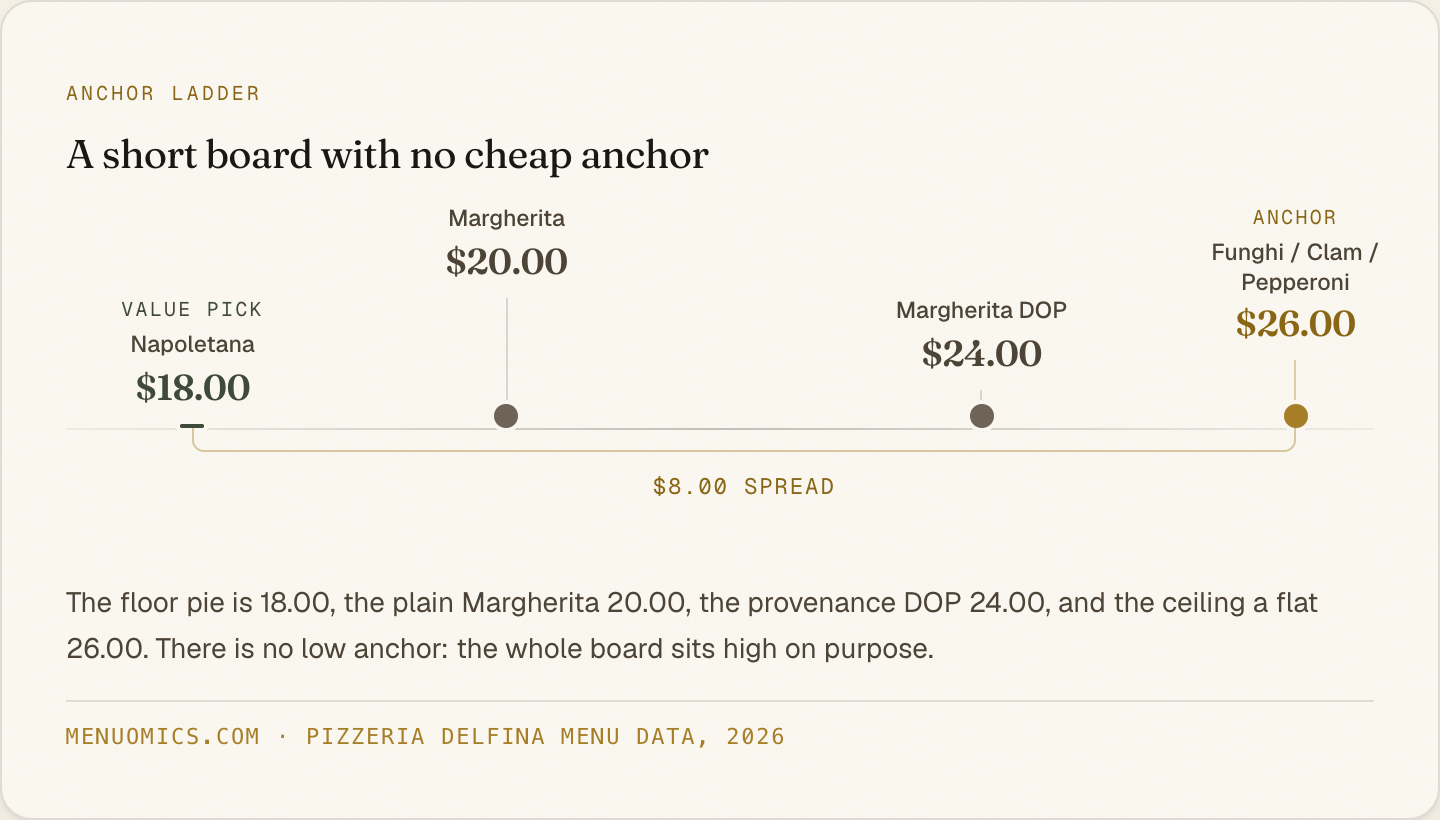
A short board with no cheap anchor
The floor pie is 18.00, the plain Margherita 20.00, the provenance DOP 24.00, and the ceiling a flat 26.00. There is no low anchor: the whole board sits high on purpose.
Download this chart (PNG) · free to reuse with credit, see reuse terms.
The full ticket
What it actually rings up to.
The headline price is only the start. The real number is the journey from a base order to the check at the register, one easy yes at a time.
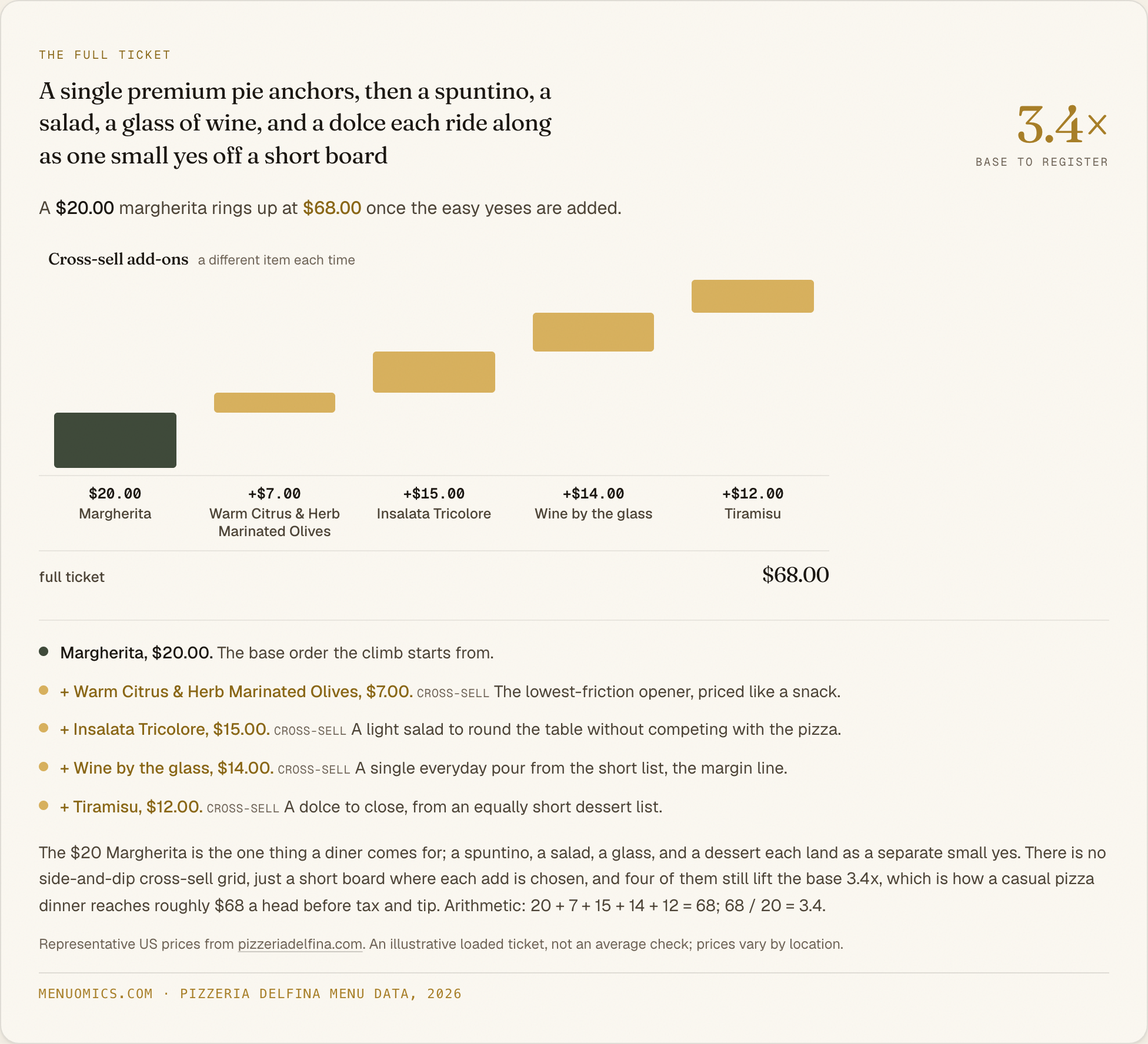
A single premium pie anchors, then a spuntino, a salad, a glass of wine, and a dolce each ride along as one small yes off a short board
A $20.00 margherita rings up at $68.00 once the easy yeses are added.
- Margherita, $20.00. The base order the climb starts from.
- + Warm Citrus & Herb Marinated Olives, $7.00. cross-sell The lowest-friction opener, priced like a snack.
- + Insalata Tricolore, $15.00. cross-sell A light salad to round the table without competing with the pizza.
- + Wine by the glass, $14.00. cross-sell A single everyday pour from the short list, the margin line.
- + Tiramisu, $12.00. cross-sell A dolce to close, from an equally short dessert list.
The $20 Margherita is the one thing a diner comes for; a spuntino, a salad, a glass, and a dessert each land as a separate small yes. There is no side-and-dip cross-sell grid, just a short board where each add is chosen, and four of them still lift the base 3.4x, which is how a casual pizza dinner reaches roughly $68 a head before tax and tip. Arithmetic: 20 + 7 + 15 + 14 + 12 = 68; 68 / 20 = 3.4.
Representative US prices from pizzeriadelfina.com. An illustrative loaded ticket, not an average check; prices vary by location.
Download this chart (PNG) · free to reuse with credit, see reuse terms.
The setup
Craig and Annie Stoll opened the first Pizzeria Delfina in 2005 in a 600-square-foot Mission storefront next to their James Beard Award-winning restaurant Delfina, which they had opened in 1998. The pizzeria became a San Francisco food-scene fixture and grew into the Delfina Restaurant Group, with four Bay Area locations as of 2026: the Mission (18th Street), Pacific Heights (California Street), Burlingame, and downtown Palo Alto (Emerson Street). The food is California-Italian and Neapolitan-inspired, a distinctly California thin-crust pie, sold off a short board of red and white pizzas alongside spuntini, seasonal antipasti, salads, a tight Italian wine list, and a few dolci. A retail frozen line extends the brand into premium grocers and ships nationwide on Goldbelly.
The behavioral interest is that everything here works in the opposite direction from a delivery chain. Where Domino's or Papa John's engineer a low anchor price and a cross-sell multiplier of sides and dips, Pizzeria Delfina keeps the board short, prices the pizzas high, and lets provenance and reputation carry the premium. A confident nine-or-ten-pizza list reads as quality rather than lack, ingredient and DOP cues justify a $24 pie, and the fine-dining Delfina next door lends its halo to the whole operation. The frozen box at the grocer then borrows that same restaurant credibility on the shelf. (Pizzeria Delfina does not frame these as behavioral tactics; this is our reading of the observed design.)
What they get right
The behavioral economics already at work.
The short board is the confidence signal
The pizza list is deliberately short, roughly nine or ten pies, where a chain menu sprawls into sizes, crusts, and build-your-own grids. A tight, curated board lowers the cost of deciding and, more to the point here, reads as conviction: a kitchen that offers few things is understood to have chosen them. Fewer options can raise satisfaction and confidence in the pick, which is the inverse bet from a chain's endless menu.
~9 to 10 pizzas, split Red and White, Iyengar and Lepper, 2000 (choice overload)
Provenance justifies the premium
The menu leans on origin and ingredient cues, most explicitly the separately listed Margherita DOP that charges $24 for the same shape of pie as the $20 Margherita, purely on the pedigree of protected-origin tomatoes and cheese. Documented accounts of the kitchen point to Italian 00 flour of the Caputo type and long fermentation. Named, sourced ingredients raise appeal and willingness to pay, and here they are what makes a $24 pizza read as craft rather than markup.
Wansink, Painter and van Ittersum, 2001 (descriptive labels)
The fine-dining sibling casts a halo
The original pizzeria sits directly next to Delfina, the Stolls' James Beard Award-winning restaurant. That adjacency, and the shared name, transfers the fine-dining room's authority onto a casual pizza board. A diner who knows Delfina reads the pizzeria's prices through that lens, so the premium feels earned by association before a single pie arrives.
Delfina Restaurant Group; James Beard Award-winning Delfina next door
Price-quality signaling done on purpose
There is no low anchor and no charm pricing: the floor pie is $18 and the ceiling is a flat $26, written in whole dollars. A pizza that costs noticeably more than a chain's is understood as a different category of thing, and the confident round numbers reinforce it. The high price is doing work the descriptions do not have to, telling the diner this is craft before they taste it.
Pizzas $18 to $26, whole-dollar pricing, no .99 endings, Pizzeria Delfina menu (Pacific Heights), as sampled 2026
The frozen line borrows the restaurant's credibility
The retail frozen pies sell at premium grocers and on Goldbelly for roughly $18 to $26, within a dollar or two of the restaurant pizzas, and carry the same names and reported build (00 flour, long ferment). Pricing the box near the restaurant pie, rather than at the mass-frozen shelf price, signals that it is the restaurant's pizza and not a licensed knockoff, which is how the extension protects the parent brand's premium.
Frozen pies ~$18 to $26; sold at Bi-Rite, Berkeley Bowl, Good Eggs, Goldbelly, Pizzeria Delfina PD on the GO retail page, 2026
What we’d test
The rewrite, with the expected lift and the honest caveat.
Say why the DOP pie costs more, in one clause
The board lists Margherita at $20 and Margherita DOP at $24 but leaves the diner to know what DOP means. One short clause naming the protected-origin tomatoes and cheese on that single line would let the upgrade justify itself for the table that does not already know. This changes menu wording only.
Expect A higher share of diners choose the DOP knowingly, since the reason for the extra $4 is on the page rather than assumed.
Caveat Menu copy only, one clause; this room earns authority through restraint, so keep it short of sales language.
Mark one or two glasses as the pizza pairing
The wine list is short and Italian-leaning and the glass is the margin. A quiet by-the-glass suggestion on a couple of the signature pies, the everyday red with the Salsiccia, a crisp white with the Clam, turns the glass from an afterthought into part of the order without adding items.
Expect More glasses attached per table, the highest-margin line, with no change to the food.
Caveat Menu wording and layout only; one pairing cue per pie, keeping the short list intact.
Tie the frozen box back to the room on the label
The grocery pie competes on a shelf full of mass brands. A short line on the retail packaging noting the same 00 flour, the long ferment, and the restaurant it comes from would carry the room's credibility to the point of sale. This tests packaging copy, not the pizza or its price.
Expect The premium price reads as justified at the freezer case, where the shopper cannot taste the difference first.
Caveat Packaging copy only; it does not change the frozen recipe, the ingredients, or the retail price.
What diners actually say
Synthesized from public reviews, the reality check that grounds every recommendation.
They praise
- The pizzas are routinely called among the best in San Francisco
- A thin, blistered California take on the Neapolitan pie, distinctive rather than derivative
- The short, seasonal antipasti and salads are fresh and well chosen
- A tight, thoughtful Italian wine list that fits the food
- The frozen retail line earns real critical praise, a rare feat for a restaurant extension
They criticize
- Pricey for pizza, with pies pushing $26 before drinks
- The board and prices vary confusingly between locations
- The Mission location leans takeout and delivery, so the room experience differs by site
- Small pies and a short menu can feel slight for the check once a table shares
- The provenance premium rewards diners who already know what DOP and Caputo mean
The verdict
Pizzeria Delfina is the clean independent counterexample to the pizza chains in this catalog: no low anchor, no cross-sell multiplier, just a short board of ingredient-led pies at a confident $18 to $26. The curation is the pitch, the provenance cues and the DOP upgrade justify the premium, and the James Beard sibling next door lends the whole thing a halo the price then trades on. The design travels to the freezer case, where a near-restaurant price tells the shopper the box is the real pizza. The honest catch is that the premium leans on knowledge the diner has to bring, and the shifting per-location board blurs an otherwise sharp story.
Common questions
- How much is a pizza at Pizzeria Delfina?
- Pizzas run roughly $18 to $26 (2026), from the $18 Napoletana up to the $26 Funghi, Clam, and Pepperoni pies, with the provenance-named Margherita DOP at $24 (Pacific Heights, prices vary by location). The board is deliberately short and the numbers sit high on purpose, so the price reads as a signal of craft rather than a thing to negotiate.
- Can you buy Pizzeria Delfina frozen pizza?
- Yes. The frozen line sells at Bay Area grocers like Bi-Rite, Berkeley Bowl, and Good Eggs, roughly $18 to $26 a pie (2026), and ships nationwide on Goldbelly. Selling the frozen pie at a near-restaurant price lets the grocery box borrow the room's credibility instead of competing on the low shelf price the mass frozen brands live on.
- Who owns Pizzeria Delfina?
- It is owned by Craig and Annie Stoll's Delfina Restaurant Group, whose James Beard Award-winning Delfina sits next door to the original Mission pizzeria. That sibling fine-dining room casts a halo over the pizzeria, so a $24 pizza inherits the reputation of the restaurant it grew out of.
- Is Pizzeria Delfina worth the price?
- For a table that reads a short, ingredient-led board as a quality signal, the pizzas are widely called among the best in the city, and provenance cues like Caputo-style 00 flour and DOP tomatoes justify the premium in the diner's head. The whole design asks you to trust a curated few pies at a confident price, which is the opposite of the low-anchor, add-on-heavy playbook the delivery chains run.
Sources (7)
- Pizzeria Delfina official site (locations, menus)
- Pizzeria Delfina Pacific Heights menu (as sampled 2026)
- Pizzeria Delfina 'PD on the GO' frozen retail (grocers, Goldbelly)
- The Almanac: Craig and Annie Stoll on Pizzeria Delfina (2024)
- Pizzeria Delfina on Goldbelly (nationwide frozen shipping)
- Choice overload (jam study), Iyengar & Lepper, 2000
- Descriptive labels +27% sales, Wansink, Painter & van Ittersum, 2001
Head to head
More breakdowns
 Zuni CafeA-
A 75.00 chicken that takes about 75 minutes, and the menu says so. A practical warning that also happens to reduce uncertainty, printed in the margin.
Read the Zuni Cafe breakdown →A 1988 supper club hidden down a Gold Street alley, where live jazz, $18 martinis and tableside theater are the product and the food only has to clear the bar the room has raised.
Read the Bix breakdown →An elegant, romantic neighborhood bistro in Lower Pacific Heights serving modern French cooking with a Californian accent, from chef JP Carmona and the B Patisserie team.
Read the Routier breakdown →The James Beard 'America's Classic' that builds its whole reputation on what it leaves out: no rice, six meats, one price, off-menu dorado.
Read the La Taqueria breakdown →A Tenderloin Creole institution where one cheap, famous beignet gets bundled into a four-way Flight that quietly triples the check.
Read the Brenda's French Soul Food breakdown → NopaA
NopaAA 2006 Divisadero gathering place whose daily wood-fired menu prints prices as plain numbers, no dollar signs, no cents, anchored by a 49 brisket.
Read the Nopa breakdown →Your menu next
Get this for your own menu, free.
Send your menu and we’ll send back the same breakdown, what you get right, what we’d test, and why.
Flour + Water Pizzeria
The North Beach pizza spinoff of the acclaimed Flour + Water pasta flagship, where a ten-pie menu at $18 to $23, a glass dough room, and a curated natural-wine list sell craft and pedigree at a premium.
Read it →