Jamba menu, graded
Jamba sells the feeling of a healthy decision, then monetizes it with a three-rung size ladder whose top step costs about fifty cents, paid boosts and $4 wellness shots layered on top of the cup price, and $11-plus acai bowls parked above everything so a $9.49 large smoothie reads like moderation.
How a $7.99 small becomes a $25 order: a 50-cent step to the large cup, a $4.29 ginger shot at the register, and an acai bowl anchoring the top of the board.
Menu-craft grade
The core architecture is genuinely good: a clean 16/22/28 oz ladder with a shrinking top step that makes the large feel like the smart buy, boosts and shots as textbook partitioned add-ons, and acai bowls as a price ceiling that flatters the smoothie board. It loses the A range because the machine runs on a health halo the nutrition numbers do not support (CSPI counted 21 teaspoons of added sugar in one large smoothie, and the 'whole fruit' framing drew a 2018 class action), and because pricing is opaque, with no posted national list and aggregators disagreeing by more than a dollar on the same cup.
Graded on how well the menu uses behavioral economics, not the food.
Menu and prices verified September 2026
A 4-minute audio read of the analysis
- Type
- Chain
- Where
- Atlanta, Georgia (headquarters, GoTo Foods)
- Cuisine
- Smoothies, acai bowls, and juices
- Footprint
- ~710 US locations; ~850 systemwide with international (2026)
- Since
- 1990 (San Luis Obispo, California, as Juice Club; renamed Jamba Juice in 1995)
- Ownership
- GoTo Foods (formerly Focus Brands), an affiliate of Roark Capital; acquired for about $200 million in 2018
The mechanics, drawn
The same menu, mapped onto an axis, so the behavioral move is something you can see, not just read.
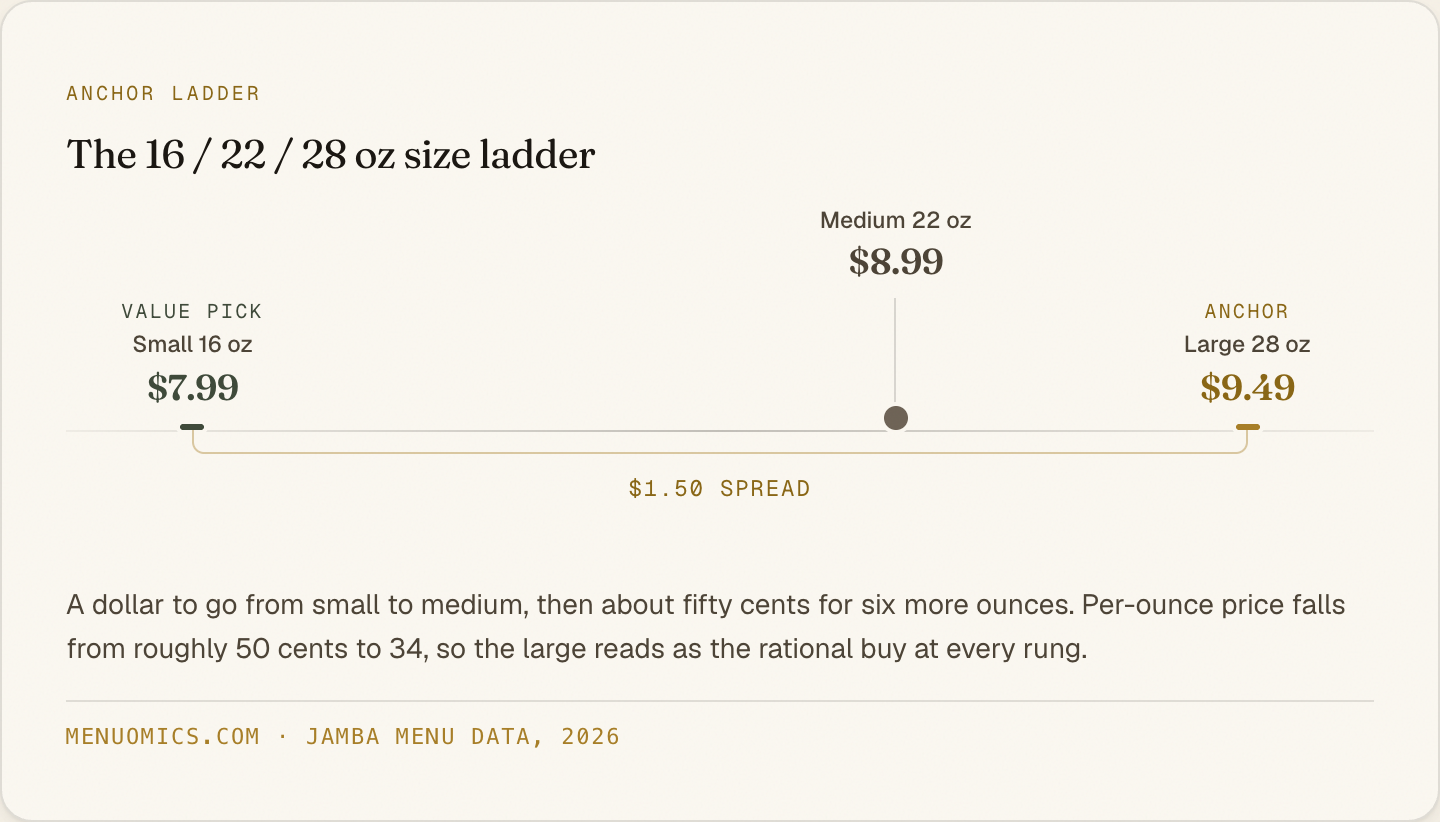
The 16 / 22 / 28 oz size ladder
A dollar to go from small to medium, then about fifty cents for six more ounces. Per-ounce price falls from roughly 50 cents to 34, so the large reads as the rational buy at every rung.
Download this chart (PNG) · free to reuse with credit, see reuse terms.
The full ticket
What it actually rings up to.
The headline price is only the start. The real number is the journey from a base order to the check at the register, one easy yes at a time.
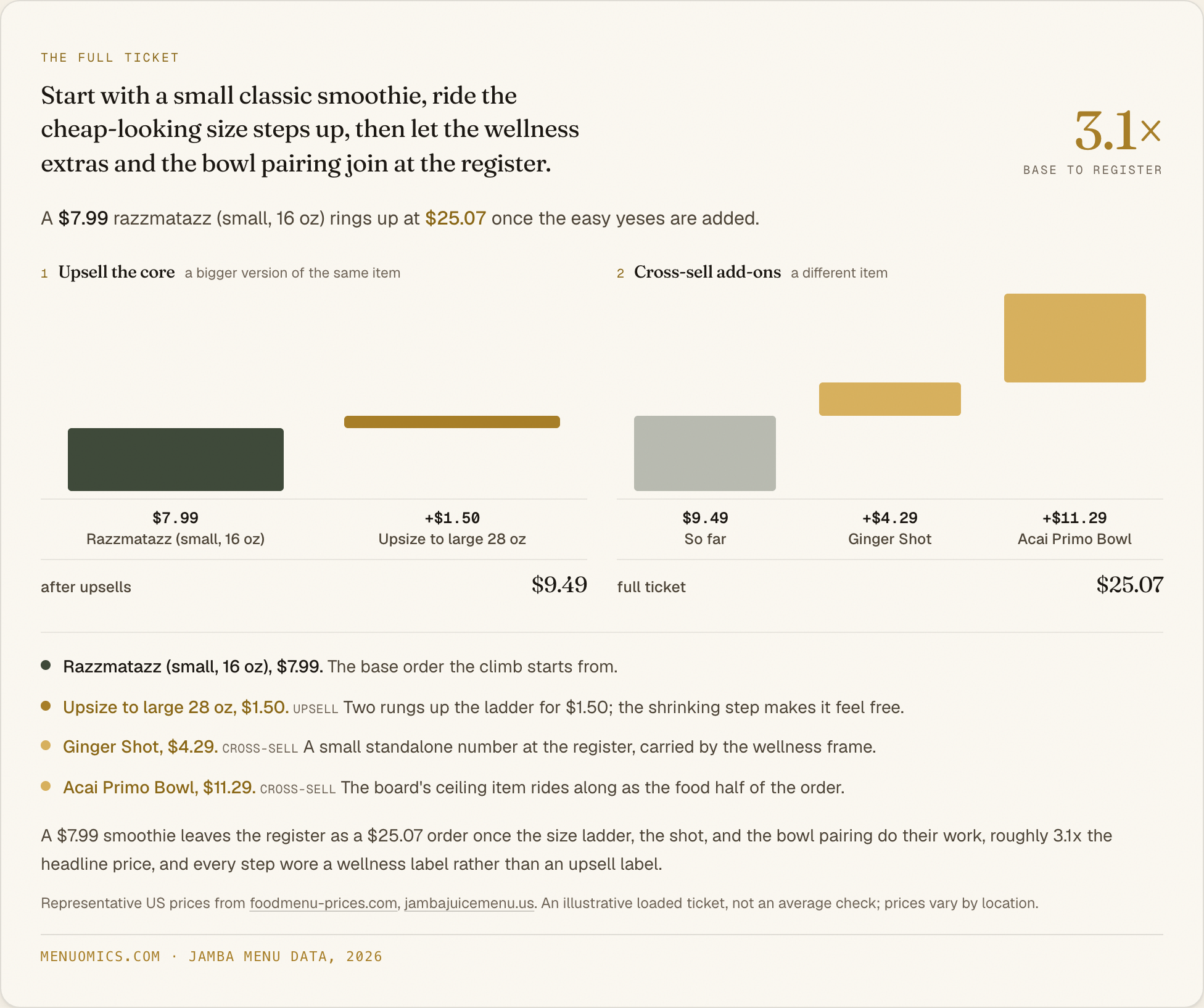
Start with a small classic smoothie, ride the cheap-looking size steps up, then let the wellness extras and the bowl pairing join at the register.
A $7.99 razzmatazz (small, 16 oz) rings up at $25.07 once the easy yeses are added.
- Razzmatazz (small, 16 oz), $7.99. The base order the climb starts from.
- Upsize to large 28 oz, $1.50. upsell Two rungs up the ladder for $1.50; the shrinking step makes it feel free.
- Ginger Shot, $4.29. cross-sell A small standalone number at the register, carried by the wellness frame.
- Acai Primo Bowl, $11.29. cross-sell The board's ceiling item rides along as the food half of the order.
A $7.99 smoothie leaves the register as a $25.07 order once the size ladder, the shot, and the bowl pairing do their work, roughly 3.1x the headline price, and every step wore a wellness label rather than an upsell label.
Representative US prices from foodmenu-prices.com, jambajuicemenu.us. An illustrative loaded ticket, not an average check; prices vary by location.
Download this chart (PNG) · free to reuse with credit, see reuse terms.
The setup
Jamba started in 1990 as Juice Club, a single shop in San Luis Obispo founded by Kirk Perron, and grew into Jamba Juice, the chain that made the blended smoothie a mainstream American purchase. In 2018 Focus Brands (now GoTo Foods, an affiliate of private equity firm Roark Capital) bought the roughly 850-store chain for about $200 million, and within a year the new owner did something unusual: it deleted half the brand name. 'Juice' had become a liability word, with US juice purchases falling by roughly 530 million gallons in the five years after 2012 as consumers soured on liquid sugar, so Jamba Juice became simply Jamba, tagline 'Smoothies. Juices. Bowls.'
The menu that survived the rebrand is a quiet upsell machine wearing wellness colors. Smoothies come in three cup sizes (16, 22, and 28 ounces) with price steps that shrink as the cup grows, so the large always looks like the rational buy. Boosts and wellness shots sit beside the register as small separate numbers. Acai bowls, introduced as the post-rebrand flagship, price above every smoothie and pull the whole board upward. San Francisco independents like Judahlicious and Palmetto Superfoods run the same health-halo pricing on a chalkboard; Jamba runs it at industrial scale, standardized across hundreds of franchises and wired into a points app. (Jamba does not frame these as behavioral tactics; this is our reading of the observed design.)
What they get right
The behavioral economics already at work.
Three cups, one shrinking step
Classic smoothies run about $7.99 for 16 ounces, $8.99 for 22, and $9.49 for 28. The first step up costs a dollar; the second costs about fifty cents for six more ounces, so per-ounce price falls from roughly 50 cents to 34 as you climb. Simonson and Tversky showed that people avoid extremes and gravitate to middles, but Jamba's ladder goes further: it makes the top rung the arithmetic bargain, so both the compromise chooser and the value optimizer end up buying more blended fruit than they walked in wanting.
Classic line ~$7.99 / $8.99 / $9.49 for 16 / 22 / 28 oz; the final step is about 50 cents, foodmenu-prices.com Jamba menu (2026)
The halo prices the cup
A 22-ounce blended fruit drink at nine dollars only makes sense if it is filed under wellness rather than dessert, and everything about the board (greens imagery, 'whole fruit' language, boost menus) does that filing. Research by Provencher, Polivy and Herman found people eat substantially more of a food when it is framed as healthy, and the same licensing logic loosens wallets. The numbers underneath are dessert numbers: CSPI counted about 21 teaspoons of added sugar in a large La Vida Mocha, comparing it to a McDonald's vanilla cone plus a large Coke.
Large La Vida Mocha: ~530 calories and about 21 teaspoons of added sugar, CSPI, Smoothie Shakedown
Boosts and shots split the price into pieces
The cup price is only the opening bid. A basic vitamin or energy boost is often free with a smoothie, which normalizes the add-on step; whey and plant protein scoops then cost roughly $2 to $3, and ginger or turmeric shots sit at the register around $4.29. Each is quoted as a small standalone number against a nine-dollar base, and partitioned-pricing research shows separated surcharges register as smaller than the same total shown as one figure. The free first boost is the cleverest part: it teaches the gesture before charging for it.
Wellness shots ~$4.29; protein boost add-ons typically $2 to $3 on top of the smoothie price, 2026 menu aggregators; Jamba menu
Deleting 'juice' was menu engineering at brand scale
By 2019 the word 'juice' meant liquid sugar to enough consumers that US juice purchases had fallen by roughly 530 million gallons in five years. Jamba's response was not to reformulate but to rename: Jamba Juice became Jamba, the tagline became 'Smoothies. Juices. Bowls.', and stores were remodeled in calmer, lighter tones. The recipes stayed sweet, but the category the customer files the purchase under changed, and with it the reference price. A juice is a $4 supermarket item; a 'smoothie, juice and bowl' brand can charge $9 to $11 without the comparison ever being triggered.
US juice purchases fell ~530 million gallons in the five years after 2012 (~4 billion gallons), CNN Business (2019)
Bowls raise the ceiling
The acai bowls added around the rebrand price at about $11.29 and run to $13.99 in some markets, comfortably above every smoothie on the board. Whatever the bowls sell on their own, their structural job is anchoring: with an $11-to-$14 item visible at the top, the $9.49 large smoothie stops being the expensive option and becomes the sensible middle of the whole menu. The spoon-and-toppings format also gives the premium a physical justification that a bigger cup of the same blend never could.
Acai bowls ~$11.29, up to ~$13.99 in some markets, versus ~$9.49 for the top smoothie, foodmenu-prices.com; jambajuicemenu.us (2026)
What we’d test
The rewrite, with the expected lift and the honest caveat.
Badge the 22-ounce as the crowd's choice
In the app and on kiosk screens, pre-select the medium and give it a single quiet 'most ordered' tag. Popularity labels have been shown to lift the tagged item's sales by 13 to 20 percent, and a default size removes one decision from an order flow that already asks the guest to pick a line, a flavor, and a boost.
Expect A higher medium and large mix without touching prices.
Caveat For a wellness brand, visibly defaulting people into more ounces of sugar is a reputational trade; keep the badge on the medium, not the large.
Cai, Chen & Fang, AER 2009
Make the free boost the first tap, the paid one the second
At mobile checkout, surface one prompt: 'Pick your free boost.' Once the guest has engaged with the boost concept at zero cost, offer the protein upgrade as a one-tap swap. The free step normalizes the add-on gesture, and the paid conversion happens inside a frame the guest already accepted.
Expect Higher paid-boost attach rate than a cold upsell prompt.
Caveat One prompt only; stacking wellness upsells at checkout reads as nagging and invites cart abandonment.
Whisper the prices
Jamba's boards still carry dollar signs and charm endings, which is value-menu typography on a wellness brand. The Cornell study found that simply removing the currency symbol lifted spend by about 8 percent per person; a brand whose whole premise is that this is self-care, not fast food, should let the numbers recede.
Expect Roughly 8% higher average check per the Cornell result, with a more premium read.
Caveat Charm .99 endings undercut the whisper; this works best if the endings are rounded at the same time.
Yang, Kimes & Sessarego, Cornell 2009
What diners actually say
Synthesized from public reviews, the reality check that grounds every recommendation.
They praise
- Full nutrition transparency: Jamba publishes a complete nutrition guide covering calories, sugar, and allergens for every item and size, more than most of the category volunteers.
- The three-size ladder is clean and legible; sizes are honest ounces (16/22/28), not invented vocabulary, and comparing them takes seconds.
- The 2019 rebrand was honest category housekeeping: the company renamed itself after what it actually sells instead of defending a fading word.
- Genuinely lighter options exist and are findable, from Purely Carrot juice to whole-food bowls and plain oatmeal, as Healthline's review credits.
- Rewards math is simple and generous at the entry: 10 points per dollar, redemptions from 250 points, and a birthday smoothie for anyone who spent just $10 in the prior year.
They criticize
- The halo does not survive the label: CSPI counted about 21 teaspoons of added sugar in a large La Vida Mocha, likening it to a McDonald's cone plus a large Coke.
- A 2018 class action (filed with CSPI) alleged the 'whole fruit and vegetable' marketing masked smoothies built on cheap pear and white grape juice concentrates and sherbets.
- Juice-bar prices with no posted consistency: there is no national price list, and the same cup can differ by more than a dollar between markets and aggregators.
- The 50-cent step to the large is engineered upsizing of liquid calories, which sits awkwardly under a brand voice about eating better.
- Bowls drifting toward $14 in some markets stretch the everyday-wellness-habit story thin for what is fruit, granola, and a spoon.
The verdict
As menu craft, Jamba is the most disciplined version of the smoothie-shop playbook. The size ladder with its shrinking top step is a genuinely elegant piece of pricing, the free-then-paid boost architecture is partitioned pricing done with a light touch, and parking $11-to-$14 bowls above the smoothie board is anchoring by the book. Where the SF independents improvise this halo economy shop by shop, Jamba has standardized it across a roughly 850-shop system and bolted a points app to it. The problem is the fuel the machine runs on. The premium is justified almost entirely by a health frame that the chain's own nutrition tables undercut, and that gap has already produced a lawsuit and years of documented criticism. Great ladder, soft foundations: B+.
Common questions
- How much does a Jamba smoothie cost in 2026?
- Representative US prices run about $7.99 for a 16 oz small, $8.99 for a 22 oz medium, and $9.49 for a 28 oz large in the classic line, with plant-based and protein blends reaching $9.29 to $10.49. Bowls run about $11.29 to $13.99. Franchisees set their own prices, so figures vary by market.
- Why did Jamba Juice change its name to Jamba?
- In 2019, after Focus Brands (now GoTo Foods) bought the chain for about $200 million, Jamba Juice dropped 'juice' from its name. Juice had picked up a sugar-heavy reputation, US juice purchases were falling, and the menu had expanded to smoothies, bowls, and bites, so the brand renamed around the tagline 'Smoothies. Juices. Bowls.'
- Are Jamba smoothies actually healthy?
- Some are, many are not. Healthline notes genuinely nutritious whole-food options, but the Chunky Strawberry bowl carries about 600 calories and 46 g of sugar, and CSPI counted about 21 teaspoons of added sugar in one large smoothie. Whole-fruit blends without sherbet or juice concentrate bases are the safer picks.
- What sizes do Jamba smoothies come in?
- Three sizes: small (16 oz), medium (22 oz), and large (28 oz). The price steps shrink as the cup grows, roughly a dollar from small to medium and only about fifty cents from medium to large, which is why the large so often feels like the smart buy.
- What is the most expensive item at Jamba?
- On the standard menu, the priciest single item is the Acai Primo Bowl, about $11.29 in representative 2026 US pricing (it varies by location; group packs and combo deals can cost more). That top price also does quiet work as the menu's anchor: it is the number that makes everything below it read as reasonable.
- How much is a meal at Jamba?
- A meal at Jamba starts around $7.99 for the base order and lands near $25.07 once the usual add-ons go on, roughly 3.1x the headline price (representative 2026 US figures; they vary by location). That gap between the price that gets you in and the total you pay is the multiplier this page grades.
Sources (8)
- Jamba official menu
- Jamba Rewards (official)
- Jamba menu prices, foodmenu-prices.com (2026)
- Jamba Juice menu with prices, jambajuicemenu.us (2026)
- CNN Business: Jamba Juice is dropping 'juice' from its name (2019)
- CSPI: Smoothie Shakedown, drinkable fruit or fruity sugar drink?
- PR Newswire: Jamba Juice facing lawsuit over 'whole fruit and vegetable' smoothies (2018)
- Wikipedia: Jamba Juice (founding, ownership, store count)
Head to head
More breakdowns
 Olive GardenB+
Never-ending breadsticks read less like generosity than like decoupled pricing: a loss-leader and a recurring scarcity event working in concert.
Read the Olive Garden breakdown → Palmetto SuperfoodsB
A California acai chain whose menu leads with the one promise every acai shop gets accused of breaking: '100% Real Acai, every time.'
Read the Palmetto Superfoods breakdown → SweetgreenB+
The salad chain that names every bowl for its ingredients and farmers, then offers a handful of signature defaults so you don't have to build from scratch.
Read the Sweetgreen breakdown → Chipotle Mexican GrillA-
Chipotle's menu is a build-your-own assembly line with no prices on the rail, so you customize first and total up last, with guac quoted as a tidy little add-on.
Read the Chipotle Mexican Grill breakdown → StarbucksA-
Tall is the small. The names hide the ounces, the app hides the payment, and a pumpkin drink restarts the whole calendar every August. The most studied size menu in the world.
Read the Starbucks breakdown → CAVAB+
CAVA's menu is a build-your-own Mediterranean line that includes three scratch dips and unlimited toppings free, then concentrates the upsell on one flat premium-protein step and resells the dips as paid sides.
Read the CAVA breakdown →Your menu next
Get this for your own menu, free.
Send your menu and we’ll send back the same breakdown, what you get right, what we’d test, and why.
Carvel
America's original soft-serve chain runs two menus at once: a walk-up board priced for a weekly habit, and a nostalgia-powered cake case where a 1977 whale sells for eleven times a large cone.
Read it →